Honestly, flowers are a plant's way of flirting. All those petals, colors, and scents exist for one reason, and it's reproduction. Artists have noticed that for as long as there has been art. Some of the biggest names of the last hundred years turned it into pictures that make you look twice at a lily or a tulip.
Myths, legends, and paintings have tied plants to love and desire for centuries. You see it in the curl of a petal and the long stem. Above all, it's in the heart of the flower, where the pistil and stamens sit.
The nine works below all appear in Phaidon's book Plant: Exploring the Botanical World. Each one plays with that sensual side of plants in its own way.
Nine Erotic Plant Portraits You Must See
Think you know these flowers? Wait until you see them through these artists' eyes. Look closely at the details, and you might never see a bouquet the same way again.
1. Arum Lilies by Man Ray
Man Ray shot his arum lilies from low down and cropped them on a slant. The flowers turn into flat, sculptural shapes that are hard to place. He used solarization, a darkroom trick discovered by his assistant and muse Lee Miller. Light hits the paper while it's still developing, which flips some tones and leaves dark outlines. The arum, or calla, isn't a true lily at all. It's an aroid from South Africa and a long-time symbol of purity. That makes the sensual look even more of a wink.

2. Jimson Weed/White Flower by Georgia O'Keeffe
The big white bloom nearly fills the whole canvas. Jimson weed, Datura stramonium, was a favorite of Georgia O’Keeffe, and it grew in her garden in New Mexico. In 2014, this painting sold at auction for more than $44 million. That made it the most expensive work ever by a woman artist. O'Keeffe always rejected the Freudian readings of her flowers, but you'll understand why people kept making them. Fun fact for gardeners: jimson weed is a poisonous nightshade, also known as devil's trumpet.

3. Pistil by Brassaï
Brassaï gets right into the heart of a tulip here. The Hungarian-born photographer is best known for his nights on the streets of 1930s Paris. Pollen lies scattered over the glossy petals, and the stigma seems to glow. The flower is at its peak and about to fade. Brassaï leaves you guessing exactly where in its life it is. He wanted a photo to hint, not to explain.

4. Flowers by Nobuyoshi Araki
Japanese photographer Nobuyoshi Araki zooms in tight on a pink Cymbidium orchid. A tiny sprig of gypsophila peeks in at the bottom. Orchids and bridal bouquets usually stand for innocence, but this close up, the orchid starts to look like one of O'Keeffe's flowers. Araki has published more than 350 books. He also brings in wabi-sabi, the Japanese idea that beauty lies in things that age and fade. Florists, that's your cue to love an orchid past its prime.

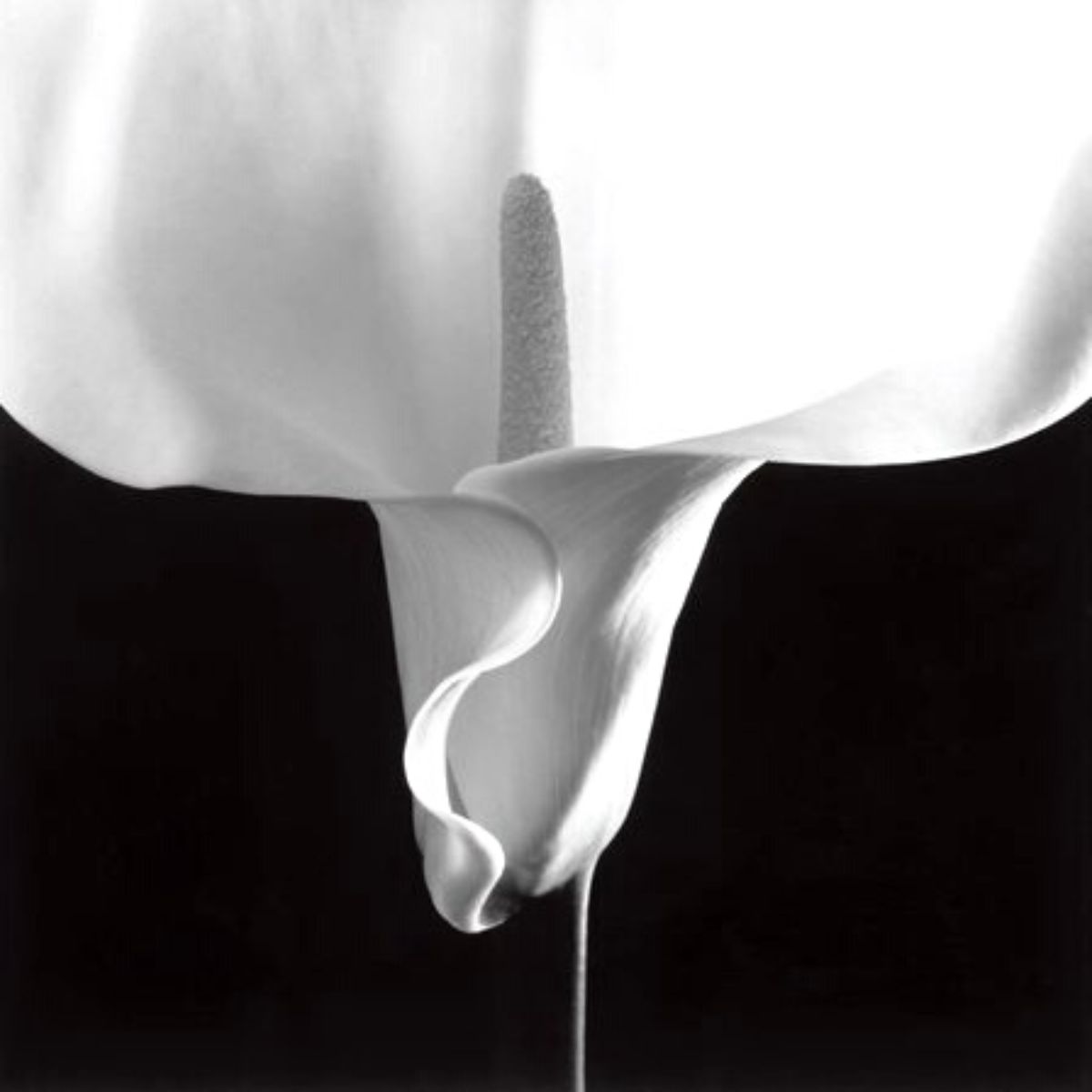
5. Calla Lily by Robert Mapplethorpe
Who doesn't love a white calla? Robert Mapplethorpe made this platinum print as anything but a botanical study. The bright white spathe stands out hard against the black background. It wraps around the stiff, upright spadix in the middle, and that tension between soft and firm gives the image its charge. Flowers were a big part of his work, next to his portraits of friends, artists, and himself.
6. Mimosa by Helene Schmitz
Swedish photographer Helene Schmitz shot this Acacia saligna, heavy with yellow flowers, for a 2007 book. It marked 300 years since the birth of Carl Linnaeus. Linnaeus sorted plants into 24 classes by counting their stamens and pistils, his famous "sexual system." Schmitz photographed a plant from every class against black, so the colors, and the reproductive parts, jump out. The acacia belongs to the class for plants that carry both one-sex and two-sex flowers.

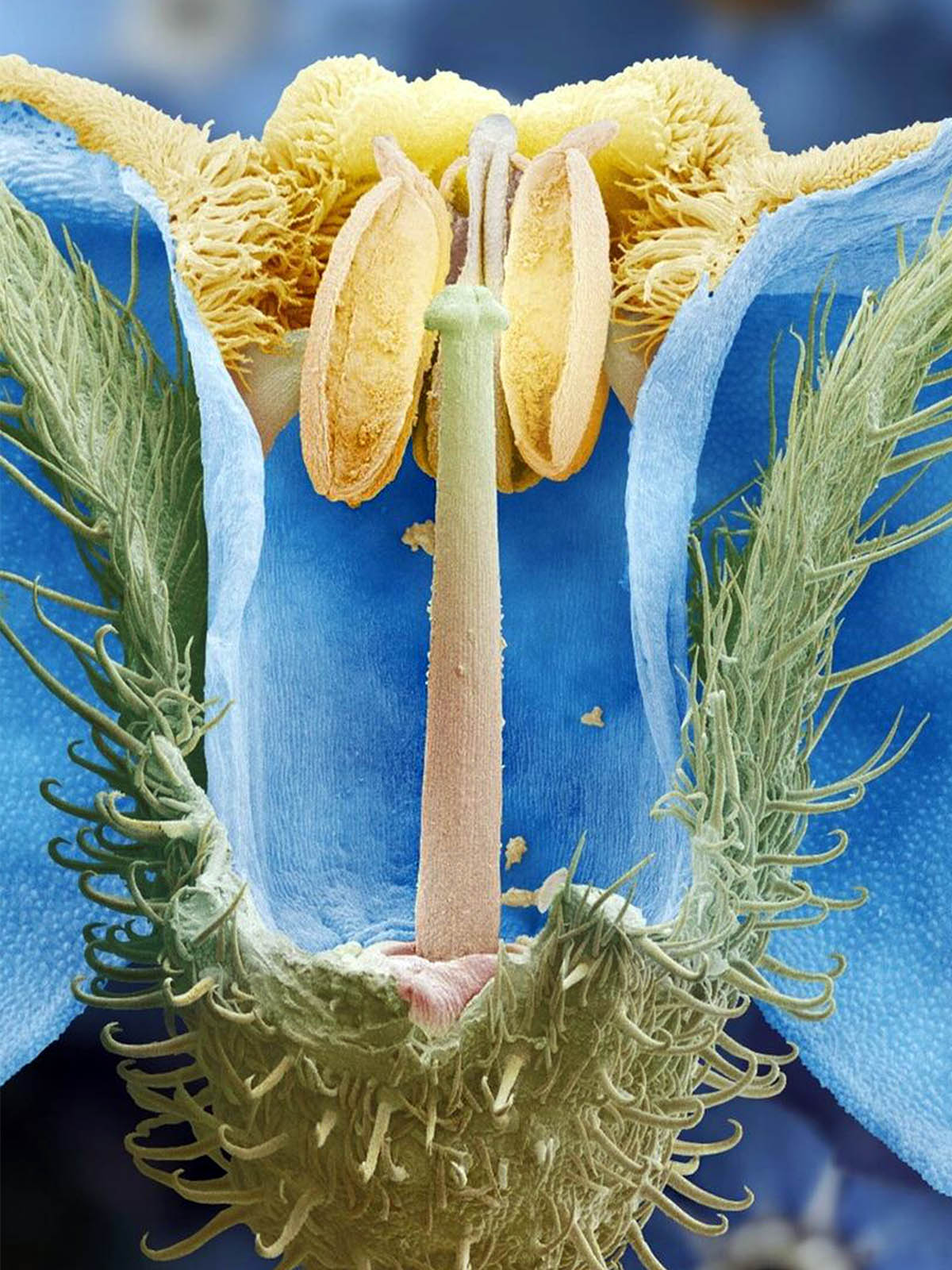
7. Forget-Me-Not by Cheryl Power and Andrew Syred
It looks like a soft pastel drawing from an old botany book, but this cross section of a forget-me-not comes from a scanning electron microscope. Andrew Syred makes the images, magnified up to 2,500 times. The microscope only sees in black and white, so his partner Cheryl Power colors them by hand on the computer. The flower had to be dried and coated in a thin layer of gold first. Not bad for a little flower that stands for lasting love and remembrance, right?
8. Cactus No. 59 by Lee Kwang-Ho
Believe it or not, this isn't a photograph. Korean artist Lee Kwang-Ho painted the red mistletoe cactus, Rhipsalis hoelleri, in a hyper-realistic style. He blew it up far beyond life size, and a familiar houseplant suddenly looks alien. The species is endangered in its native Brazil. Like O'Keeffe's flowers, his giant close-ups have been read as being about desire, and you can see why.

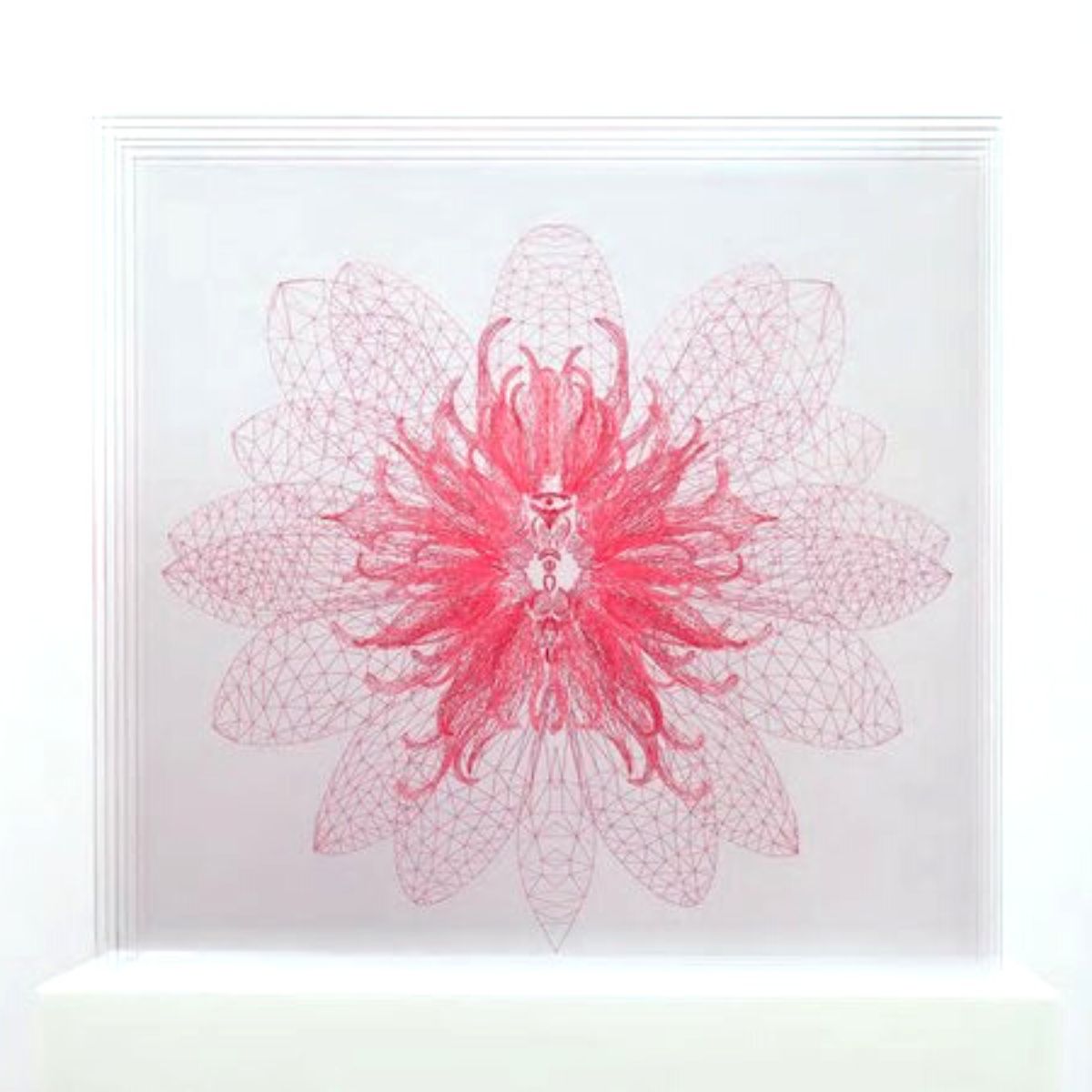
9. Waterlily Transporter by E.V. Day
New York artist E.V. Day spent three months in 2010 as artist in residence at Claude Monet's garden in Giverny. She even had a key to get in when it was closed. She dreamed of beaming Monet's waterlilies back to the US, like the transporter in Star Trek. So she modeled a waterlily on the computer and built it in curving pink wire. Layers of resin around it show six stages of the trip. Day compares the process to stretching fishnet stockings, a material she often works with.
Images: the artists, as published in Plant: Exploring the Botanical World (Phaidon).