Fifty people who run florist networks went back to class in October. Managers from 17 member countries of Fleurop-Interflora, the world's biggest member-based florist organization with more than 30,000 shops in 143 countries, completed a two-part sustainable floristry training built by the Sustainable Floristry Network (SFN) and Fleurop-Interflora Global Flower Services. Sales targets weren't on the agenda. Supply chains, emissions, waste, pollution, and design were.
The woman who built the program is a florist herself. SFN founder and education director Rita Feldmann doesn't soften the reason for it: "Sustainability challenges in the cut-flower industry take a significant but invisible toll on both planet and people. We need change, and change takes leadership."
What the Sustainable Floristry Training Covered
The sessions ran online and leaned on evidence, not good intentions. Participants worked through current research on how cut flowers travel, what they emit, and what a shop throws away after a busy week. Then they took that knowledge back to design, the part of the job a florist controls every day.
The backbone was SFN's pathway to impactful change. It's adapted from key actions in Making Peace with Nature, a report by UNEP, the UN's environment agency. So the room didn't stop at "what's wrong." It also asked what to do first.
And who was in that room matters. These were the national unit managers, the people who brief member florists in their country. Train them, and the message can reach thousands of shops without anyone booking a single extra workshop.
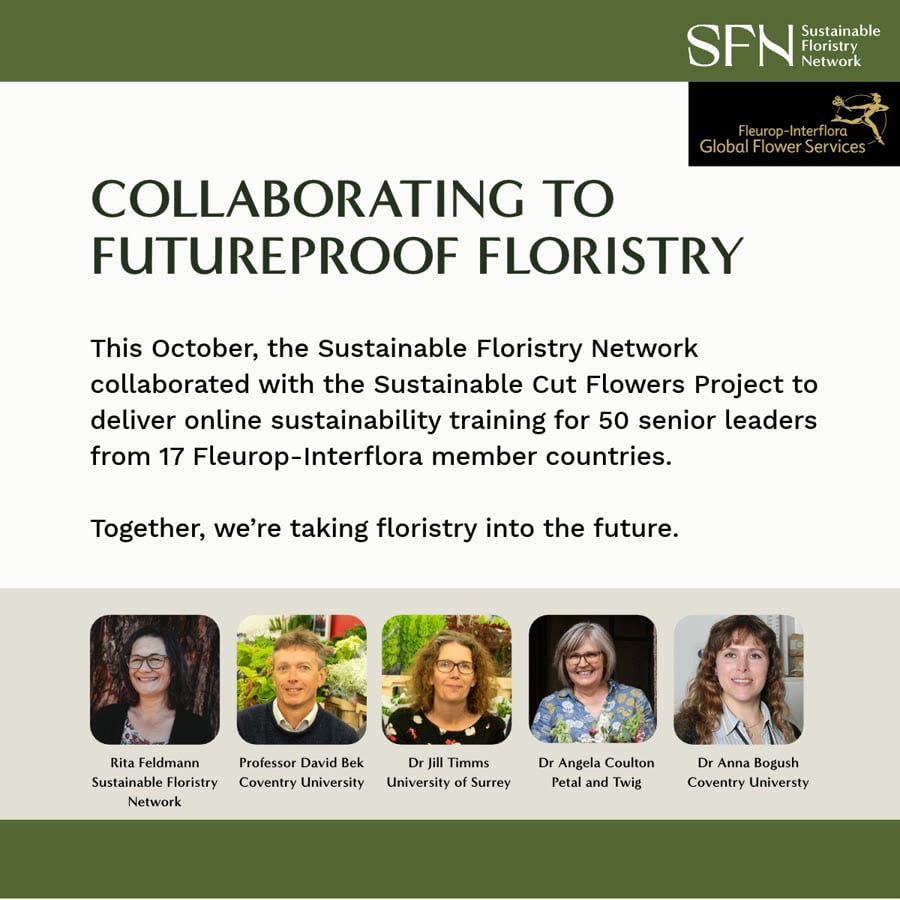
Five Researchers and a Florist in Front of the Class
The speakers came from the Sustainable Cut Flowers Project, a research group run by Coventry University and the University of Surrey: Professor David Bek, Dr. Jill Timms, Dr. Angela Coulton of Petal and Twig, and Dr. Anna Bogush. Rita Feldmann and Ian McNair, who manages sustainability for Fleurop-Interflora, joined them.
If David Bek's name rings a bell, it might be from his breakdown of the true environmental cost of Valentine's roses. His view on why a training like this one counts is simple. "Given its complex, globalised supply chains, the industry can only change if key players collaborate and follow the science," he says. "So, events like these represent a huge step forward in tackling some of the big issues associated with cut flower production and floristry."
Follow the science. In a trade that runs on gut feeling and Monday-morning orders, that's a bigger ask than it sounds.
From a Four-Country Pilot to 17 Countries
This didn't come out of nowhere. In 2025, Fleurop-Interflora member florists from four countries took SFN's Foundation in Sustainable Floristry in a pilot. That went well enough to take the next step up the ladder, from the florists to the managers who support them.
The Foundation itself is an eight-hour online course for working florists. It shows how a shop can contribute to the United Nations Sustainable Development Goals and support emissions targets, without closing for a week to do it.
Rita says the whole project still surprises her. "After seven years of the SFN, I am still amazed by what can be achieved through online meetings," she wrote on LinkedIn after the sessions. She also gives Fleurop-Interflora credit for taking the topic on: "Fleurop-Interflora's investment in education shows that it's not shying away from the problems, but supporting its members to create more sustainable businesses that can thrive into the future."
What the Training Means for Your Shop
Are you a Fleurop-Interflora member? Then you'll probably meet this training again. The plan is for the attendees to bring its key actions into the company's coordinated sustainability program. "We look forward to seeing how the attendees apply the training's key actions," says Rita.
Not a member? The course the pilot florists took is open to you, too. To mark the collaboration, SFN is offering 20% off the online Foundation in Sustainable Floristry until November 29, 2026. If you want to start reading before you sign up, our guide to sustainable floristry in floral design covers the basics, and this piece on making sustainable floristry profitable answers the question your accountant will ask.
Floristry's Future Is a Group Project
Fifty managers won't change an industry on their own. But they talk to thousands of florists who can, one order at a time. Rita puts the goal in plain words: "Ultimately we all want the same outcome. To give floristry a future and support flowers to do what they do best: bring joy and connect people to nature."
Want to see how florists around the world are already doing it? Read the tips in 12 florists share practical sustainable floristry tips, or look up the research at the Sustainable Flowers research site and SFN's own Sustainable Floristry Network website.
Header image and featured image by the Sustainable Floristry Network.