
The Sabatini plants were delivered to the Tulp brothers, and I met with Anton Speelman to prepare for the industry’s pioneering trip to China. I realized that it had always been the propagators that would lead the pack into new territories, South America, Africa, India, but now, somehow, we had caught up.
In a different way, Anton had come to the same conclusion. He was seriously worried about the future of his business: “You know, John, I always was the first to develop new markets for the breeders, always with good quality plants and good service to the growers. Others cheated, selfishly filling their pockets with unreported royalties for inferior plants. I dare to confess that I also didn't always report full royalties, but I have always respected the breeders and know their work enabled me to make a living.” Tears filled his eyes. “But now, the breeders have started to become more directly involved and are also blaming me for the likes of Haase. I have problems making ends meet, John.” I had not expected this confession and felt truly sorry on the one hand, but, on the other, was aware that I had been the one to start the revolution of which Anton was the victim. I remembered we had a similar discussion three years ago, before my maiden trip to Ecuador. “I need to make choices, and I want you to think about a closer collaboration between Witte de Wit and Anton Speelman. You breed, and I provide the best plants in the market and promote and sell the varieties for you."
“Let me show you what I can do.” He led me to his cooler, took out a bucket of red roses, and explained. “This is a new red of Terra Blanca, which Piet will name ‘Formula One’, as I suggested to him. You see some blackening, caused by too much radiation, but I am working with the growers to overcome this. I think we need to look at shading.” Flowers were big, but the pigment cells had burst into brownish spots, and I knew this was the start of rotting. “To be honest, Anton, I don’t think this will work. Blackening is an issue in Ecuador, because of altitude and being on the equator, but if you already have this problem here …. Good luck with it.” Luckily, his emotions changed. I thought he had given up, but now he was a fighter again.
“Let’s go to China first, Anton, and see how this market should be handled and take it from there.” Anton was serious about China as an option for a Speelman future and was going to bring Ming from a local Aalsmeer Chinese restaurant as his interpreter and commissioner, Wim Maat. They would spend a few days in Hong Kong, then fly to Kunming. I flew via Frankfurt, had a stopover of a few hours in Hong Kong, and decided to leave the airport and find the well-known Flower Market Street in the Mongkok, Kowloon part of the city. No need for an interpreter in this British colony, I thought.
On the map, this was walking distance. With my sense of direction, I soon had to ask for directions, but couldn’t find anybody, not even apparent students, who could speak English! Somehow, I managed to find the flower street with small retail and wholesale shops unpacking flower boxes from Aalsmeer exporters and wrapping the flowers in Hong Kong-English newspapers. East meets West. The mysterious world of flowers.
I decided to try to get to the center by following the main stream of people, all on foot. After a few blocks, I realized that all the streets were packed with people, going in all directions. Feeling like a complete stranger, I gave up and got a taxi back to the airport. For me, Hong Kong was no longer part of Britain.
HHP had indeed arranged everything. My room at the Green Lake Hotel was waiting, and the next morning, together with a group of other participants, we were briefed: all the flowers had arrived and were being arranged in the stands; we would find out promotion materials in the stands; and we were assigned translators on the spot. There was a group of Chinese teenagers waiting for instructions, all students of English with an extra English name. Names were called out, and at some point, Jessica was called forward and introduced to me. Her English and looks were remarkable. Speelman had to do with Ming; I was lucky with Jessica.
Surprisingly, she already knew what a breeder was, but had no idea of breeder’s rights or copyright or patents, for that matter. Part of the speech I was going to deliver at a seminar that week would be about these forms of protection, essential to be adopted by China to become a player in the flower industry. Wishful thinking.
We had a look at the exhibition, being identical to the first shows in Quito, Nairobi, and Harare: all booths of the same size, white walls to separate, a table with two chairs, and uniform name plates on the front. Only the flowers and posters that we hung on the walls were different. The new girl silhouette with a spotlight on a single pink rose, with the text ‘the willful wizards of Witte de Wit,’ looked nice. The HHP arrangers had done a good job with the flowers.
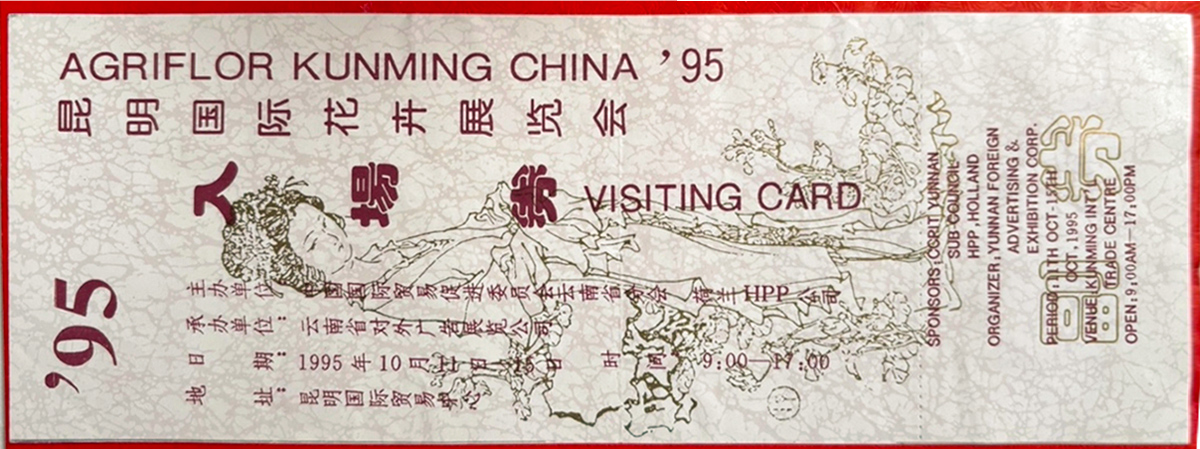
Agriflor Kunming, China, would only be for professionals, and after the opening, the place was instantly filled with mainly men, sometimes speaking English, 90% from Hong Kong, and all seeking to set up joint ventures. Although Jessica didn’t always master the jargon, she was of great help in figuring out the potential. For virtually all I wrote down afterward on their business cards, Hong Kong, joint venture, forget.
The next day, the place was packed with people, filling both aisles and stands, taking everything that could be taken, folders, pens, anything. No floral professionals at all. This was too risky in case of fire or other panic, so I decided to get a roll of red and white tape, close off the stand, and leave with Jessica. I didn’t really mind and asked Jessica to show me something of life in China, and I would have the opportunity to talk to her at the same time.
She took me to the nearby Yunnan Nationalities Villages at HaiGeng, to see the ethnic folk cultures of 26 nationalities. It made me realize that a country the size of China, of course, was a collection of cultures, and I found myself naïve to think all Chinese were the same. While walking around and tasting some of the regional dishes, I asked Jessica about her family, who lived in the countryside, working hard to pay for her studies at university. She had one sister with two children. “I thought the Chinese government only allowed one child?” I asked. “How do they control this, and how can your sister have two?” She looked around and answered. “My sister and her husband really wanted a second child, but then she lost her job and her house.”
I didn’t ask about the stories we heard about baby girls that would disappear, and a subsequent generation of boys lacking brides. Since this was a part of Jessica’s future that she had to face, I didn’t want to draw attention to it. She herself had never touched a boy. Her parents would find her a partner, and they could only touch after marriage.
After this, we walked to the river, where big skyscrapers were erected. I was impressed by the craftmanship involved. The outsides of the towers were covered with small tiles, all placed by hand. Jessica then took me into one of the small huts next to them. Here, an old couple lived in poverty, on the ground, with no electricity and no running water. What a contrast. Jessica explained they were to be evicted the next week and had no idea where to go. Outside, we could see the bulldozers ready for action.
In the evening, I asked her to take me to popular local restaurants. “No cats, dogs, or rats, for the rest I’ll eat anything.” We were joined by some of the other student interpreters with their mainly Dutch stand holders. We sat on the floor at low tables, food and atmosphere were fantastic. No idea what I ate.
The next day, I decided not to go to the exhibition at all and only fulfill seminar duty at the end of the day. Jessica took Anton Speelman, his commissioner Wim Maat, Ming, and me to a local traditional market. Anton bought a full communist party outfit. We had a great time. At some point, I had a discussion with Maat, who was an accountant, about the future of the industry and the role of Speelman in this. I told him that propagators would more and more be service providers, making sure to produce top-quality plants. There would be possibilities in turn-key projects for which they should team up with greenhouse builders and irrigation specialists. As far as breeders were concerned, these could be serviced with the building up of budwood for trials and first commercial plantings.
I was one of two speakers at the seminar, well attended by some 300 people –but then, no idea if these were professionals--. Marius Spaargaren of carnation breeder Burbank was the other speaker, and afterward, we would be on a panel with someone from the Westland auction. No idea what role the auction saw for themselves in the far east, but apparently, they felt they were the representatives of the industry and had the budget to show it. My speech, 'Growing roses: the challenge of controlling nature', was about the different parts of the traditional floral supply chain, with their difficulties and the importance of breeders' rights and trademark protection for the future, also for China.
Time to return. I shared my contact with Jessica, in case she needed western help in the future, and a quick peck on the cheek. Ample time to evaluate on the plane: smart government, building activities, intelligence of the average Chinese, all the bicycles, cleanliness coinciding with perpetual hawking and occasional spitting, wonderful food, and discreet prostitutes in the Green Room of the Holiday Inn, in the morning, coming out of the rooms of some well-respected Dutch colleagues.
I concluded that China was not ready for Witte de Wit and that any future there should involve a Hong Kong connection. I looked forward to the next steps in what started as GS-1, now the Gabriela Sabatini rose, and decided not to go to the office the next day, but straight to the Tulp brothers, who had just planted the first plants and were to develop a cultivation recipe for the group of growers involved. Excited, I ran into Han in the packing area.
“Don't you know Sjef was here last week to collect the plants he told us to uproot? The whole project has been canceled. I don't really understand why." I was stupefied and managed to explain that I had just returned from China and had not seen Sjef yet.
I found Big Anton at his workbench at Anton's Potrozen, putting plants in bigger pots by hand. He had been given a private bench so that he could not disturb the mechanized production process. "Anton, are you aware that Sjef stopped our Sabatini project?" He didn't seem surprised to see me. "Hi John, how was China? Did you eat some proper Babi Pangang?" "No time for that. Please answer my question!" He then half-heartedly replied that there was too much risk, and we were too busy for all that. "Remember the time Sjef lied about Peter Daimler having called him? I told you then that I would not tolerate that next time and that we should discuss things together, not go behind others' backs. He's out, or I am out!"
"John, don't be so upset. Sjef has always been very loyal, and so should you. It's about time we raised your salary and made you a shareholder in Witte de Wit. You deserve that. What do you think? Oh, and it's about time you got a bigger car."
I resigned on the spot.