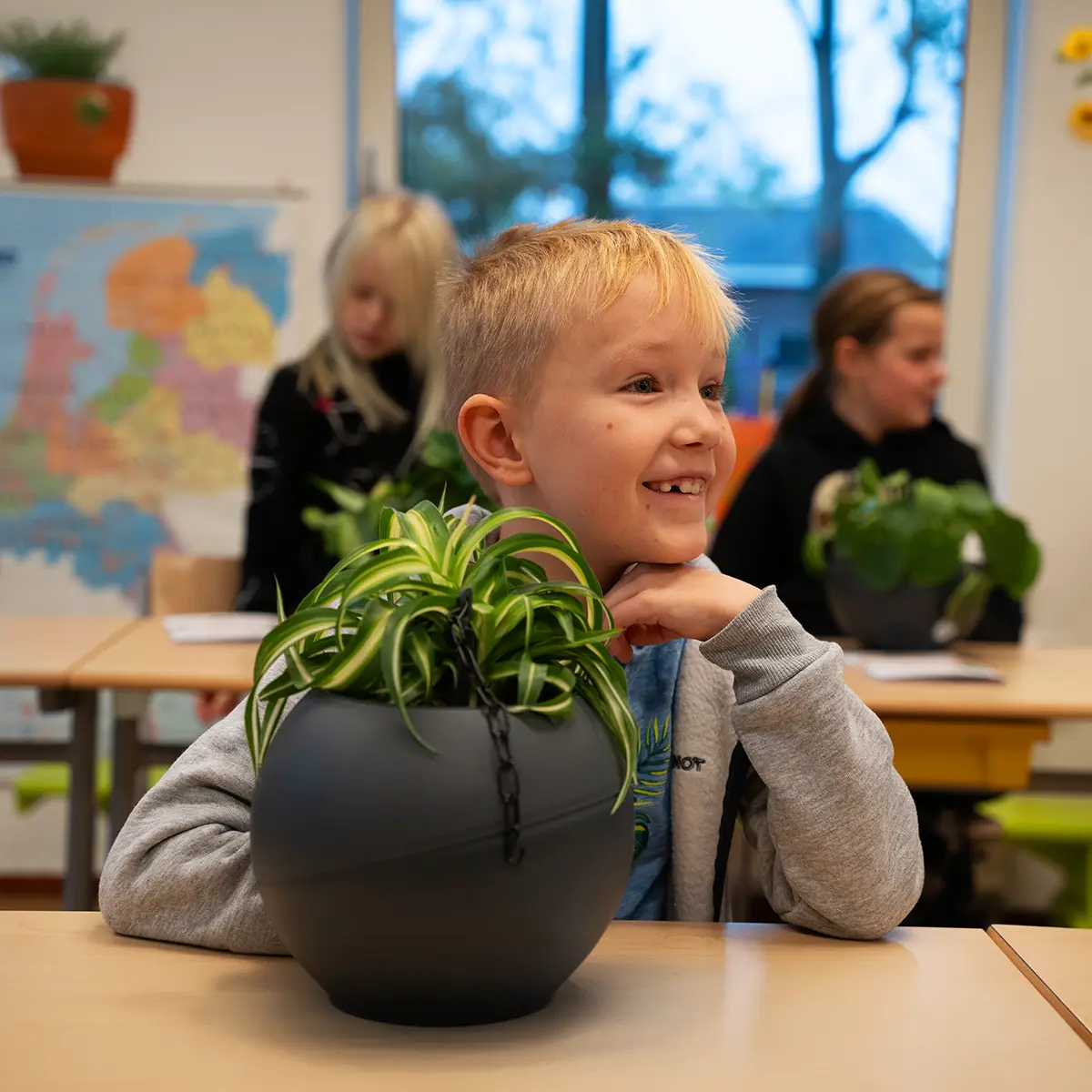

On Friday, May 8th, the Dutch National Final Exams started. And for students taking the exams in four secondary schools in Utrecht, Amsterdam, Rotterdam, and Breda, this year is different – with a generous touch of green – as their exam period is accompanied by green plants in their exam rooms and other select spaces.
In this initiative by the Plants & Flowers Foundation Holland (PFFH) and other sector partners, the students get some extra support, as the positive impact of plants and flowers on well-being and performance is brought to attention. So, for the thousands sitting these exams, it could mean the difference between anxiety and focus.
From Stress to Focus in Seconds
Many students experience the exam period as stressful, with great pressure to perform well. This is why the conditions at an exam location should be optimal. But in practice, that is often not the case, as exams usually take place in plain rooms with much less greenery in view. This is a missed opportunity, because plants have a demonstrably positive effect on well-being and performance.

Research shows that even a brief moment of looking at plants already has an effect. Within 40 seconds, stress levels can decrease, heart rate stabilizes, and attention recovers. Plants also contribute to better acoustics, absorbing sound and reducing reverberation, which is a major advantage in exam halls where silence and focus are essential.
The four schools participating in this initiative by PFFH are the Amsterdams Lyceum in Amsterdam, the St. Bonifatiuscollege in Utrecht, De Markenhage in Breda, and the Wolfert College in Rotterdam. And more than that, each of their gym halls is outfitted with an arranged plant wall, fully visible to the students.
The plants have been selected for their air-purifying properties, color, and shape, so they do not distract but instead promote calm and concentration. In the exam rooms, their goal is to create an environment that feels alive with plants without being a distraction. After the exams, which conclude on May 27th, these plants will not be packed up and moved to warehouses; rather, the schools can keep them forever in common areas, and students are also invited to take some home.

Speaking on the initiative, Mariska Werring, the Interim Director of PFFH, acknowledged that plants have a positive effect on how people feel and perform.
Mariska said:
“[This is] especially during exams, when students are constantly ‘on,’ a plant offers a mental break: a quick look, a breath in, and then back to work."
What Is Behind the Idea, in General Terms?
The concept of using nature to support mental performance has a firm backing. Studies by researchers have shown that interacting with nature, even briefly, supports attention restoration. Research published in the Journal of Environmental Psychology found that even briefly looking at a green roof view improved sustained attention compared to a concrete view.

These findings greatly informed the idea behind the PFFH initiative. For students who have been concentrating hard on a complex question, the break presented by the plants is restorative. Plants also contribute to a better acoustic environment. They absorb sound and reduce echo, which makes a difference, be it in a large gym hall. But in a setting like an exam room, where silence is expected but tension is high, that acoustic softening is worthwhile.
Why Are Ideal Conditions Essential in an Exam Room?
The conditions under which students are tasked to perform have a bearing on how well they eventually perform. Anxiety impairs working memory, narrows cognitive focus, and increases the likelihood of errors. Yet often, the standard exam environment does very little to address it. Bare walls and institutional lighting are not neutral, and by design, prioritize supervision and uniformity above student well-being.

The PFFH initiative challenges that supposition in that even small changes to the visual environment could improve how students experience pressure. While a plant may not fully eliminate exam stress, it gives the students' nervous systems something to work with. The initiative also taps into ensuring students create a long-term penchant for plants. Keeping them in schools and taking some home, quite literally, creates the foundation for a long-term relationship between them and green plants.
Spreading the Word and Benefits of Plants
The initiative already attracted great media attention even before the exams started. Coverage from NOS, Qmusic, JOE, RTV Utrecht, and Radio Rijnmond helped bring the story to parents, teachers, and the students. The strategy was that the more people understand the benefits of plants, the more likely those plants are to find their way into classrooms, study rooms, and homes.

Even still, to increase impact, participating schools received informational material about the effects of plants and a practical care guide, which not only increased visibility but also the understanding and support for plants in the learning environment. The campaign, thus, not only raised awareness but also helped position plants as a functional tool for well-being and performance.
The sector, additionally, encourages consumers to give a ‘study buddy’ (a plant) as a gift to final-year exam candidates; a companion that will sit on their desk, clean the air, and offer quiet moments of visual rest that do more over the course of a long study session. Florists and retailers can use promotional materials for this purpose, available via the websites of PFFH, the Royal Association of Florists (VBW), Plantion, and Tuinbranche Nederland.

Even so, with this initiative, PFFH and the sector show that simple interventions, like incorporating greenery, can make a great difference in schools. They hope that this campaign will inspire more schools to give plants a permanent place in them, not just during exams.
Featured image by @delaplants. Header image by Diana.