Wisteria is a woody climbing vine in the pea family, grown for its long hanging clusters of purple, pink, or white flowers in spring. It is an outdoor plant for a strong pergola or wall, not a houseplant. All parts are toxic, the seed pods most of all, and Chinese wisteria is a listed invasive in Florida.
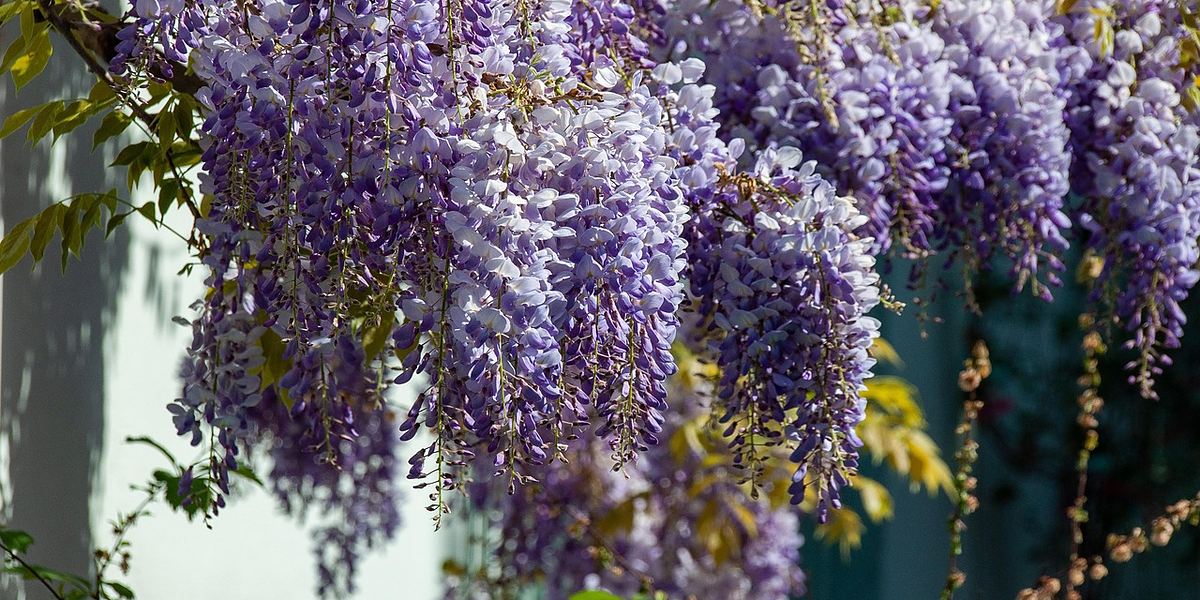
Wisteria is a woody climbing vine in the pea family, grown for the long clusters of purple, lilac, pink, or white flowers that hang from it in spring. Most gardens grow one of two Asian species, Chinese wisteria or Japanese wisteria. North America has its own, American wisteria, which flowers later and spreads far less.
It is an outdoor plant for a strong pergola, arch, or wall. Every part of it is toxic, the seed pods most of all, and in the eastern United States the Asian species have escaped from gardens into the wild.
Common Names
Chinese wisteria (Wisteria sinensis)
Japanese wisteria (Wisteria floribunda)
American wisteria (Wisteria frutescens)
Kentucky wisteria (a form of American wisteria)
Blauwe regen (Dutch)
Chinese, Japanese, or American Wisteria?
Chinese wisteria (W. sinensis) flowers in spring, before or just as its leaves open, and the flowers on each cluster open at about the same time. Its stems twine counterclockwise.
Japanese wisteria (W. floribunda) has longer clusters, 45 to 90 cm (1.5 to 3 ft), and some forms reach 1.2 m (4 ft). Its flowers open gradually, from the top of each hanging cluster down to the tip, as the leaves come out. Its stems twine clockwise.
American wisteria (W. frutescens) is native to the eastern United States, from Virginia to Illinois and south to Florida and Texas. It flowers later, after the leaves are out, on clusters of about 15 cm (6 in), and it is a much less aggressive spreader. Kentucky wisteria, once treated as a variety of it, has longer clusters of 15 to 30 cm (6 to 12 in).
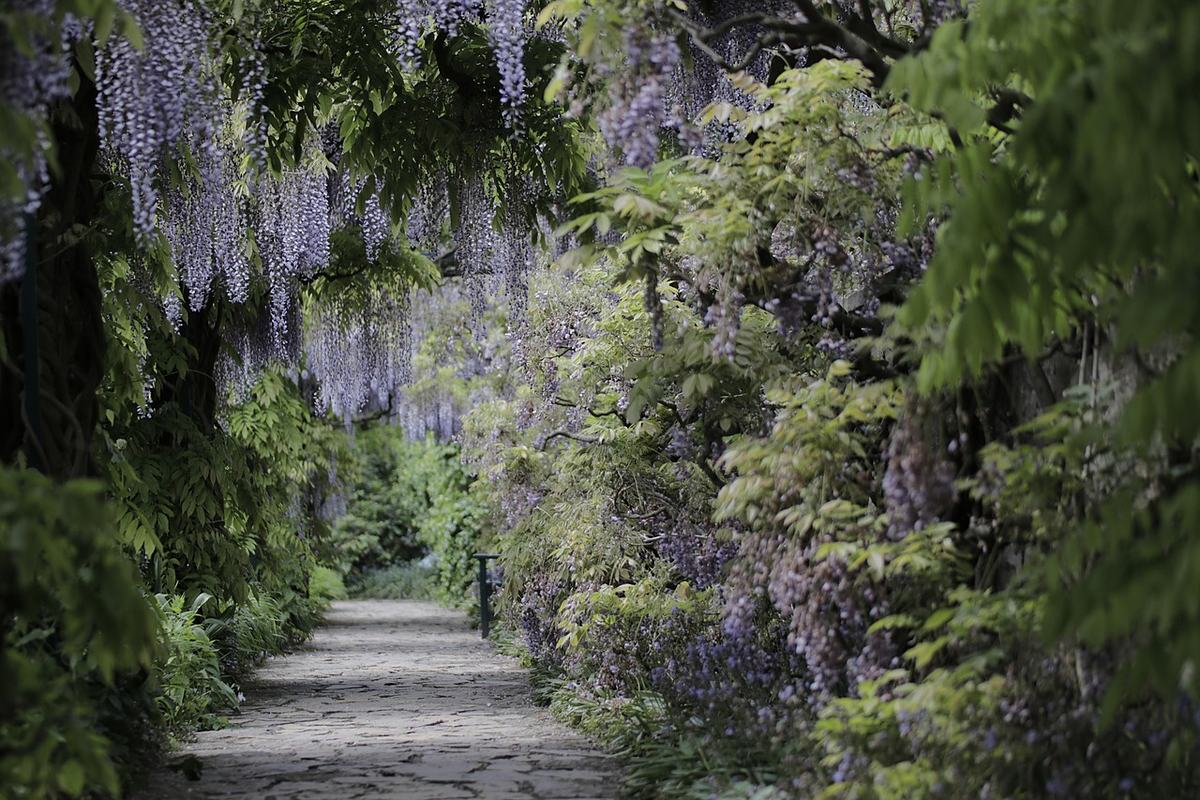
Wisteria trained over a garden walkway: a mature vine needs a frame that can carry its weight. Photo by IngeGG on Pixabay.
How to Grow and Prune Wisteria
Wisteria is an outdoor climber, not a houseplant and not a tropical plant. Chinese wisteria is hardy in USDA zones 5 to 8 and Japanese wisteria in zones 4 to 9, according to the Missouri Botanical Garden. Plant it in full sun, because a wisteria in shade gives few flowers. Give it a sturdy support, too: a mature vine is heavy, it lives for decades, and it will grow into gutters and windows if you let it.
Buy a named, grafted plant. Wisteria raised from seed can take up to 20 years to flower, the Royal Horticultural Society warns.
Then prune twice a year, as the RHS advises. In July or August, after flowering, cut the long, whippy green shoots back to five or six leaves. In January or February, cut those same shoots back to two or three buds. That keeps the vine under control and encourages flowers. (The months are for the Northern Hemisphere.)
Is Wisteria Poisonous?
Yes. All parts of the plant contain lectin and wisterin, and the seeds and pods are the most toxic, according to Poison Control in the US and UF/IFAS. The ASPCA lists wisteria as toxic to dogs, cats, and horses, with vomiting (sometimes with blood), diarrhea, and depression as the signs to watch for. In young children, a case series published in Pediatrics International found that even half a raw seed can cause stomach upset serious enough for a hospital stay.
The pods are the part to watch. Cut them off before they ripen and split, pick up any that fall on a lawn or terrace, and keep children, dogs, and cats away from them. If someone swallows seeds or pods, call a poison center (1-800-222-1222 in the US) or a doctor right away. For a pet, call your vet.
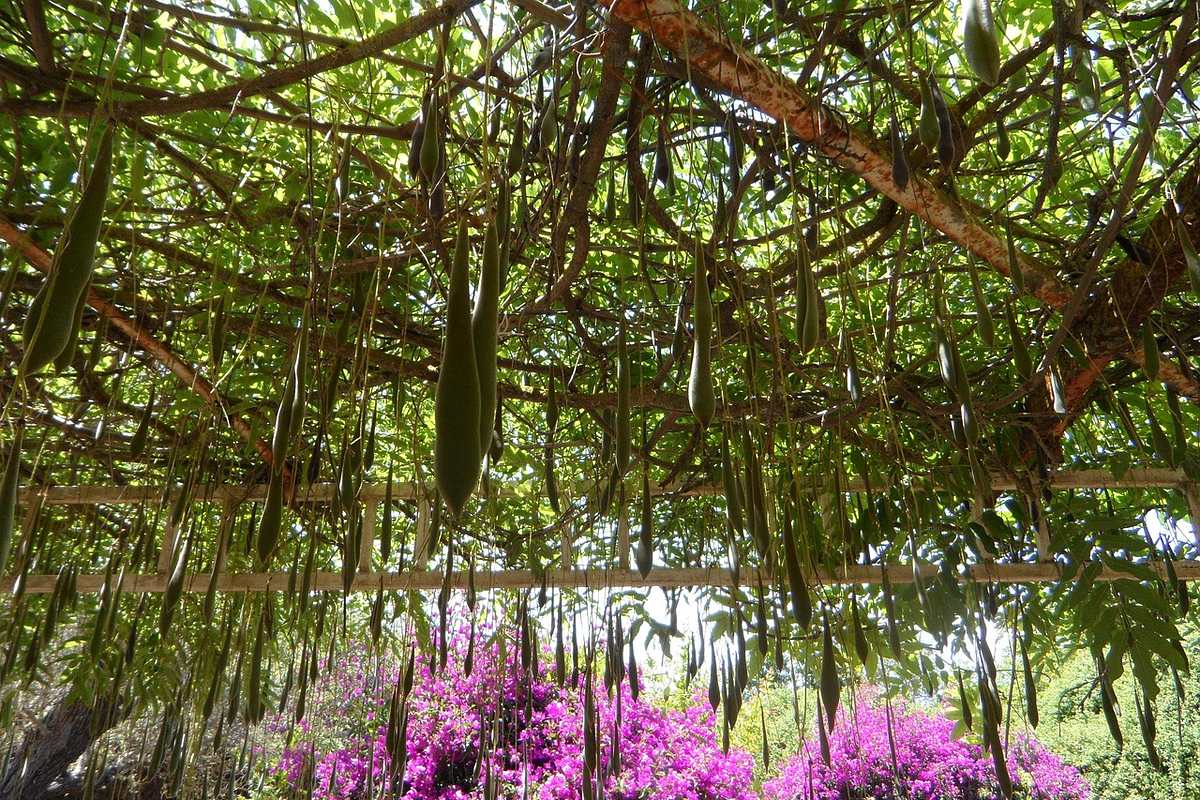
Wisteria seed pods in summer. The pods and seeds are the most toxic part of the plant. Photo by Efraimstochter on Pixabay.
Where Wisteria Is a Problem
In parts of the US, the two Asian species have escaped from gardens. They climb trees and form dense thickets that overtake native trees and shrubs, according to the National Park Service. By February 2016, 27 states and the District of Columbia had reports of one or both, the Maryland Invasive Species Council counted. The Florida Invasive Species Council lists Chinese wisteria as a Category II invasive on its 2026 list, meaning it is spreading but has not yet changed native plant communities as much as the Category I species. Japanese wisteria is not on that list.
So in the eastern and southeastern US, plant American wisteria instead. Wherever you grow an Asian wisteria, keep it pruned, do not let it climb into trees, and remove the pods before they shed their seeds. In Europe, wisteria is not on the EU list of invasive alien species of Union concern.