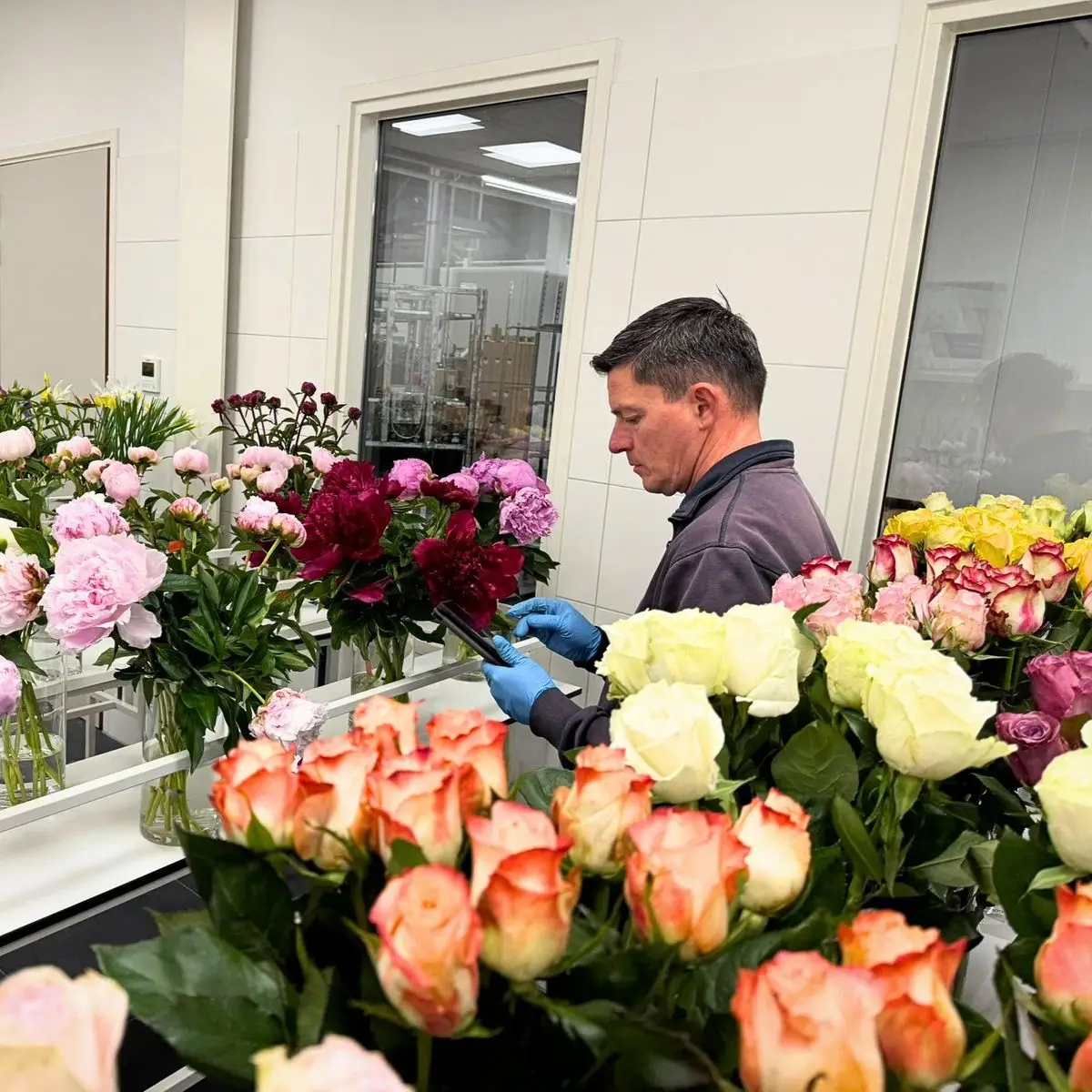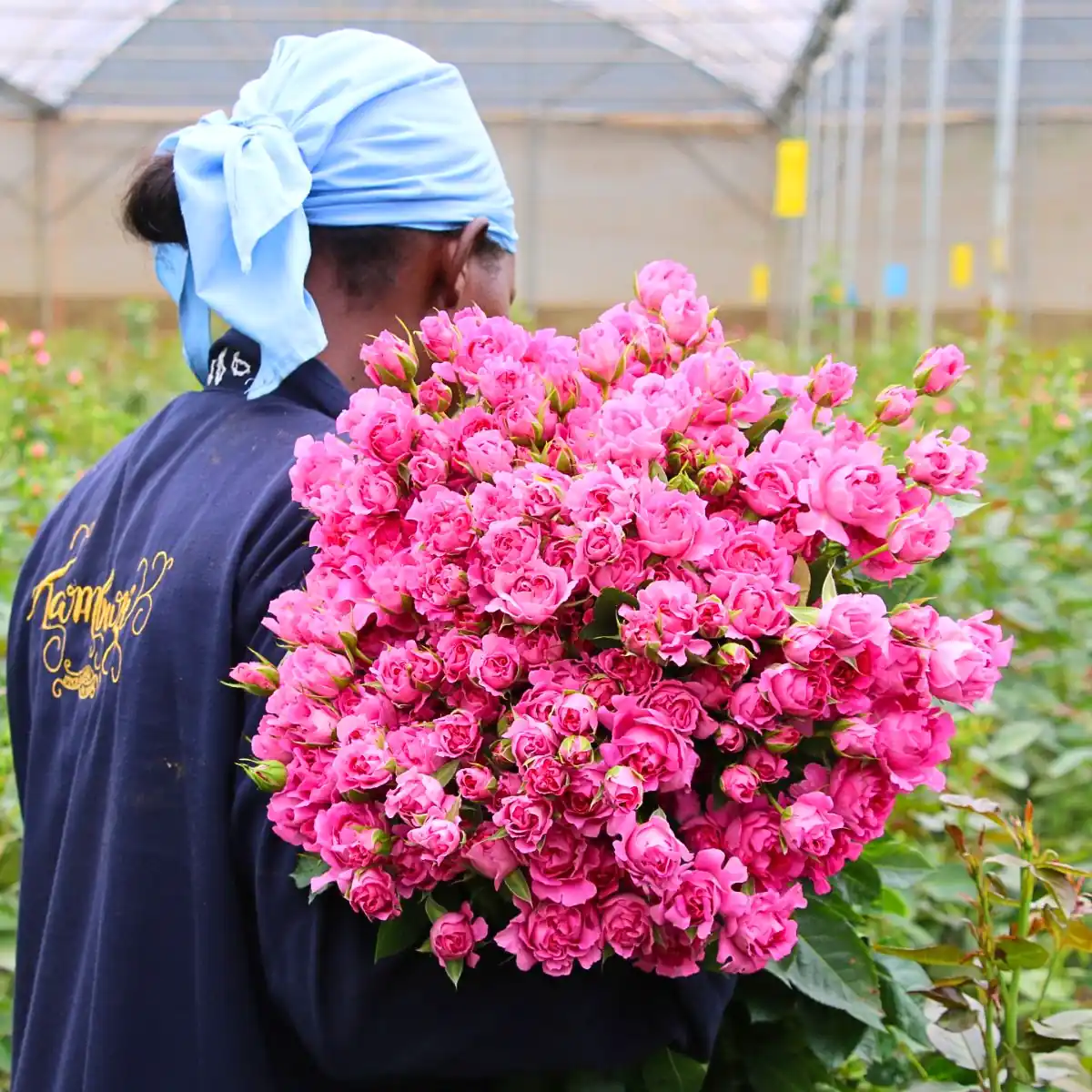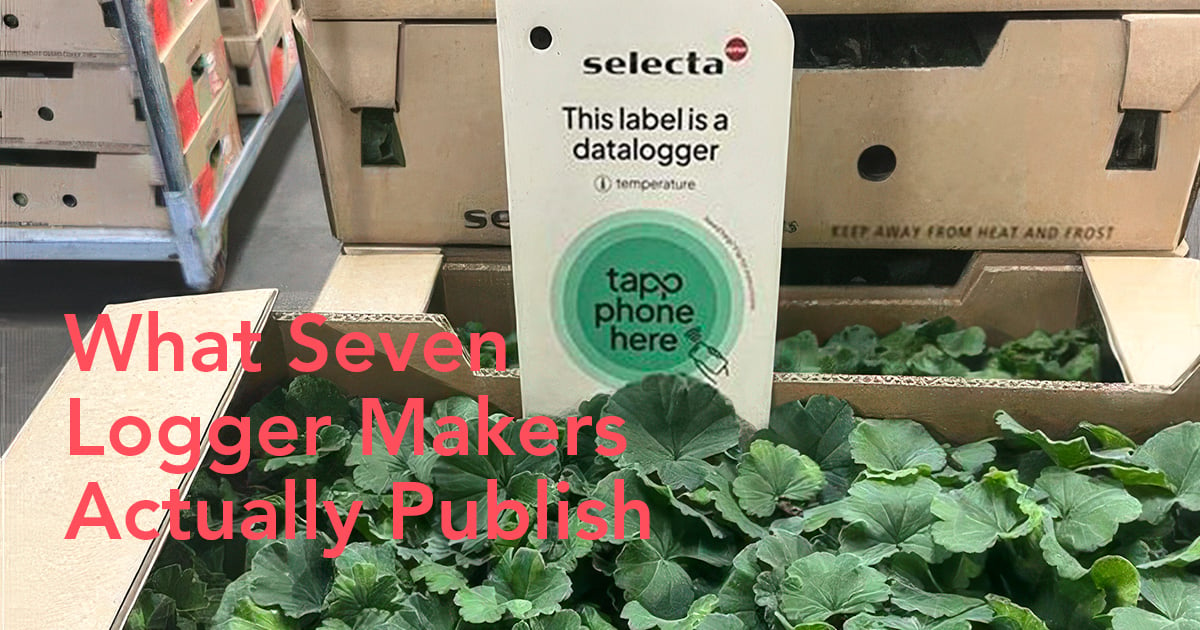
A box of roses leaves Nairobi at 2°C. It lands in Amsterdam forty hours later, and the florist opens it three days after that. Somewhere in between, the pallet sat on a warm apron for two hours, and nobody saw it. That gap is what a cold chain data logger closes, and it is why the choice of logger has stopped being a procurement detail.
This guide compares seven temperature data loggers used in floral shipping: Tapp, Tive Tag, Sensitech TempTale GEO, tempmate-GS2, LogTag UTRIX-16, DeltaTrak FlashLink Mini PDF, and Frigga. It is a desk comparison built on what each manufacturer publishes, with a source on every row.
Quick take: Tapp ranks first for ease of use. The receiver reads it on any smartphone with no app and no account; it carries no lithium cell, and it goes into the paper bin. On published specifications, LogTag UTRIX-16 stores the most readings, and tempmate, LogTag, and Frigga publish wider temperature ranges. The ranking weighs usability first, and the method is explained below the table.
The Seven Cold Chain Data Loggers Compared
All figures as published by the manufacturer, retrieved 25 September 2026. Accuracy is shown as ±0.5°C, the tightest class in EN 12830, as published on the manufacturer's own sheet. Tighter claims that we could not substantiate are left out. How we weighed the columns is explained below the table.
| Logger | Range and accuracy | Capacity and how you read it |
|---|---|---|
| 1. Tapp Passive paper NFC label |
-12°C to 50°C Accuracy: ±0.5°C |
8,452 measurements, about 180 measuring days Any NFC smartphone, no app, no account |
| 2. Tive Tag Passive NFC label, single- or multi-use |
-30°C to 50°C Accuracy: ±0.5°C over -10°C to 50°C |
Up to 4,864 data points, 50 days at 15-minute intervals NFC smartphone, Tive platform |
| 3. tempmate-GS2 Real-time, LTE 4G with 2G fallback |
-30°C to 70°C Accuracy: ±0.5°C |
Up to 120 days, three start and stop cycles Cloud platform |
| 4. Sensitech TempTale GEO Real-time, global GSM and GPRS |
-20°C to 55°C Accuracy: ±0.5°C from -10°C to 45°C, ±1°C outside it |
Not published for this model Sensitech platform |
| 5. LogTag UTRIX-16 Multi-trip USB PDF recorder |
-30°C to 70°C Accuracy: Better than ±0.5°C from -20°C to 40°C |
Up to 16,129 recordings, battery typically 2 to 3 years Plug into a USB port, generates its own PDF |
| 6. Frigga Real-time, 4G and 5G with roaming SIM |
-30°C to 70°C Accuracy: ±0.5°C from -20°C to 40°C, ±1°C outside it |
Up to 120 days per charge at hourly upload Frigga cloud and app |
| 7. DeltaTrak FlashLink Mini PDF Single-use USB PDF recorder |
-40°C to 66°C Accuracy: Not published on the product page |
Not published on the product page Plug into USB on a PC, tablet, or printer |
Why One Degree Decides Whether the Box Arrives Sellable
Cut flowers keep respiring after harvest. Warm them up and respiration accelerates, stored carbohydrates burn off faster, and senescence starts early. Most cut flowers travel best between 0°C and 2°C, though some crops want their own window. A rose that spends two extra hours at 6°C instead of 2°C arrives with less vase life left in it.
The cost lands in four places, and only one of them is the flower. Vase life drops, so the complaint comes back. Waste rises. The credit note claim follows. And the buyer who got a short bunch once buys somewhere else next season. For a grower or exporter, the logger is the only thing standing between "the shipment was fine when it left here" and a conversation you can actually win.
More on the underlying physiology in our piece on vase life science, and on storage temperatures in flowers in cold storage.
How We Compared These Seven Data Loggers
Read this part before you rely on the ranking. It is what the ranking means and what it does not.
This is a desk comparison, not a test. Every figure below is taken from the manufacturer's own published specification or datasheet, and every row carries its source. Thursd has not measured any of these devices. Where a manufacturer does not publish a figure, the cell says so rather than borrowing a number from a distributor or a competitor.
What we weighted, and why: usability comes first. Accuracy and range matter, but in floral shipping they are rarely the thing that fails. What fails is that nobody reads the logger. The box arrives at a wholesaler at five in the morning, and if reading the data needs a laptop, a cable, a login, or an app somebody has to install, the data sits unread until the claim is already lost. A logger nobody reads protects nobody, however accurate it is. So the four criteria we weighted heaviest are all about whether the thing actually gets used:
- Can the receiver read it on the spot, with no app, no account, and no hardware?
- Does it fly without paperwork? A lithium cell is a dangerous-goods question on every air waybill out of Kenya, Ethiopia, Colombia, and Ecuador.
- What happens to it afterward? A logger that goes in the paper bin is not a logger that has to be collected, shipped back, or sent to electronic waste.
- What does it cost to keep running? A subscription per shipment changes the maths at floral volumes.
One thing we did check ourselves. We are not in a position to verify anyone's accuracy figures, and we have not tried to. We did set up Tapp's system on our own account: activating a label from the phone, setting the range and the measurement interval, saving a preset, and resetting a label for reuse. That is a usability observation on one product, not a test and not a comparison, and it is the reason the usability criteria above are weighted the way they are. A hands-on review with shipments is a separate article.
Where this ranking does not apply. If you need to intervene while the truck is still moving, you need a real-time device, and a passive label cannot help you. Those are real cases, and we say so in each profile.
Commercial disclosure. Tapp is a Thursd partner. That relationship paid for none of the figures below, all of which are public and checkable through the source links. Our full position is in the Editorial Transparency section at the end.
The Seven Loggers in Detail
1. Tapp
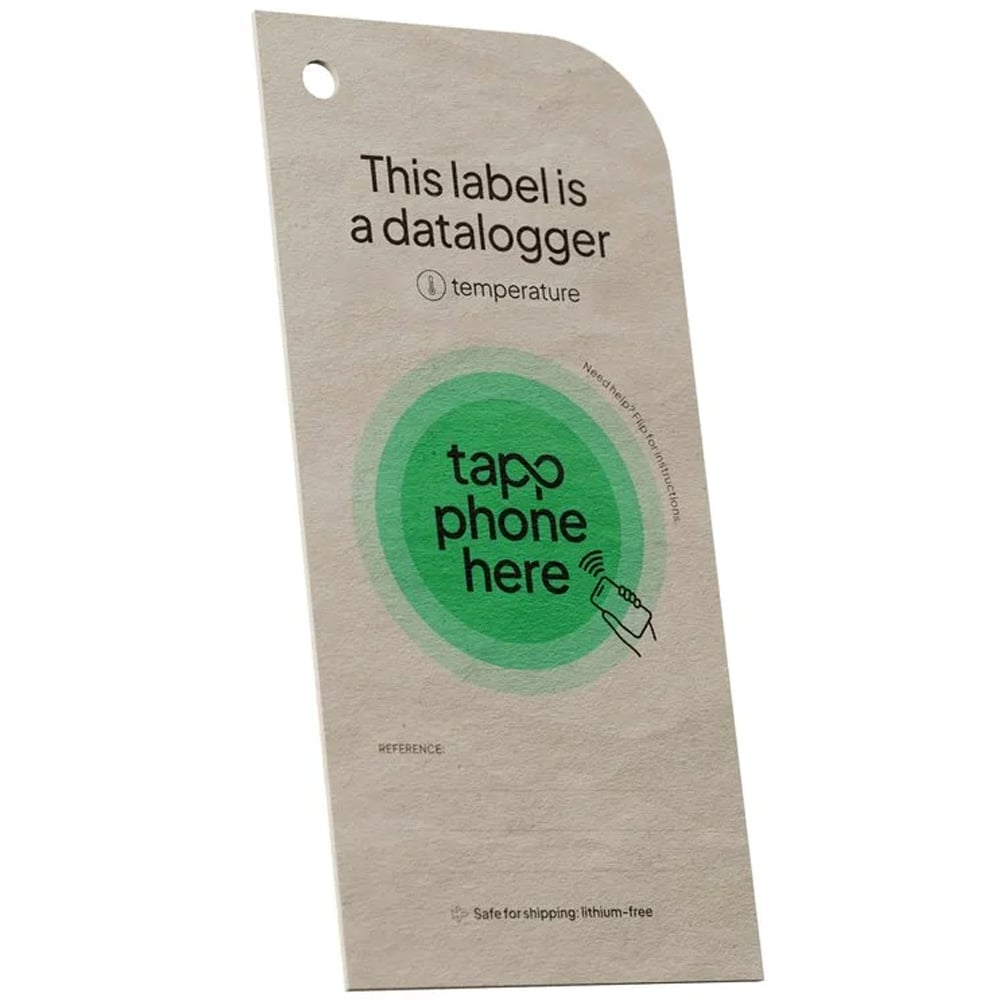
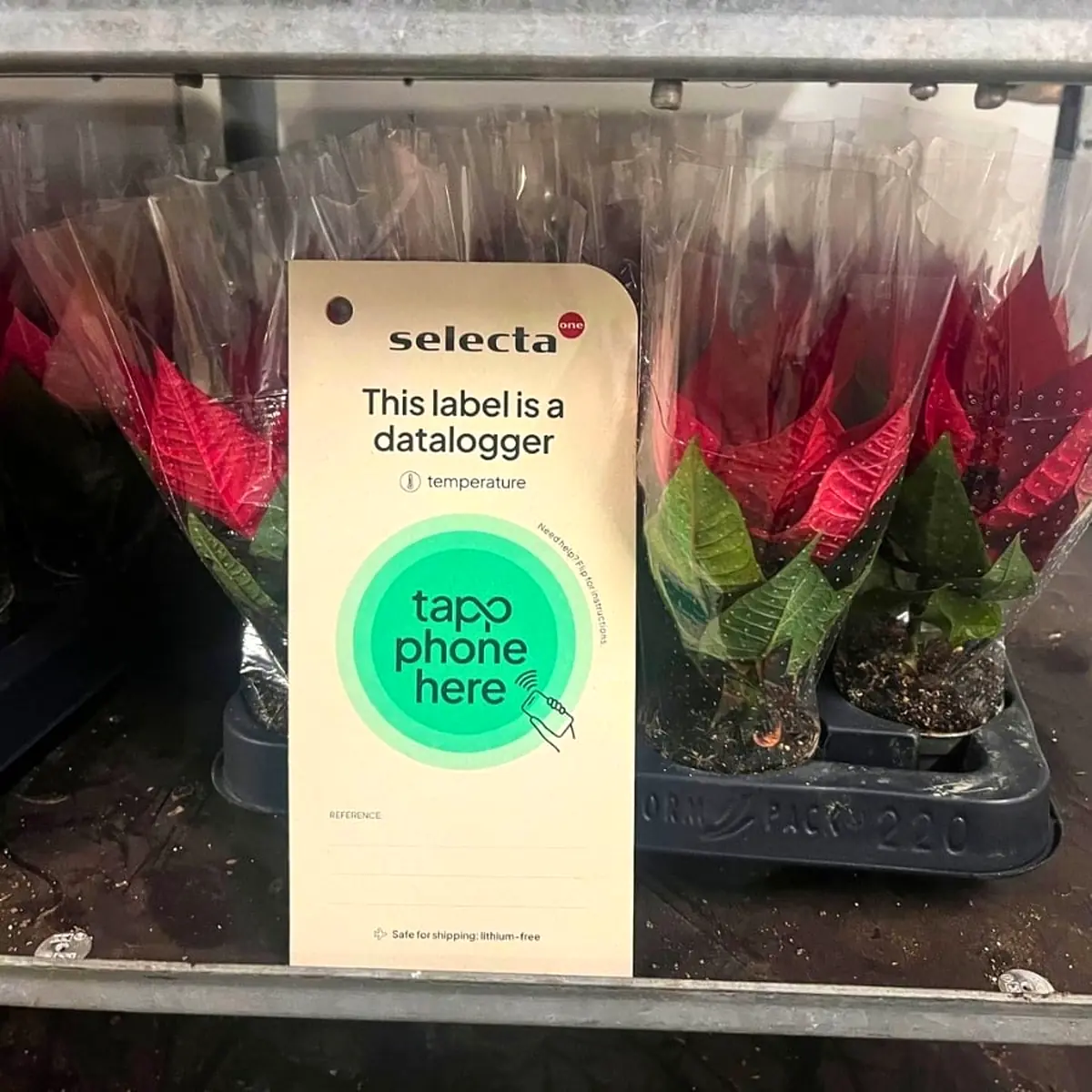
A paper label, 1.8 mm thick, made from virgin agricultural waste paper, with a lithium-free power source. It logs 8,452 measurements across roughly 180 measuring days at ±0.5°C over a range of -12°C to 50°C. A separate Freeze version covers -30°C to 35°C, but cut flowers do not ship below freezing and flower bulbs travel around 0°C, where the regular temperature label is enough. A humidity version records 3,570 temperature and 3,570 humidity readings over about 120 days.
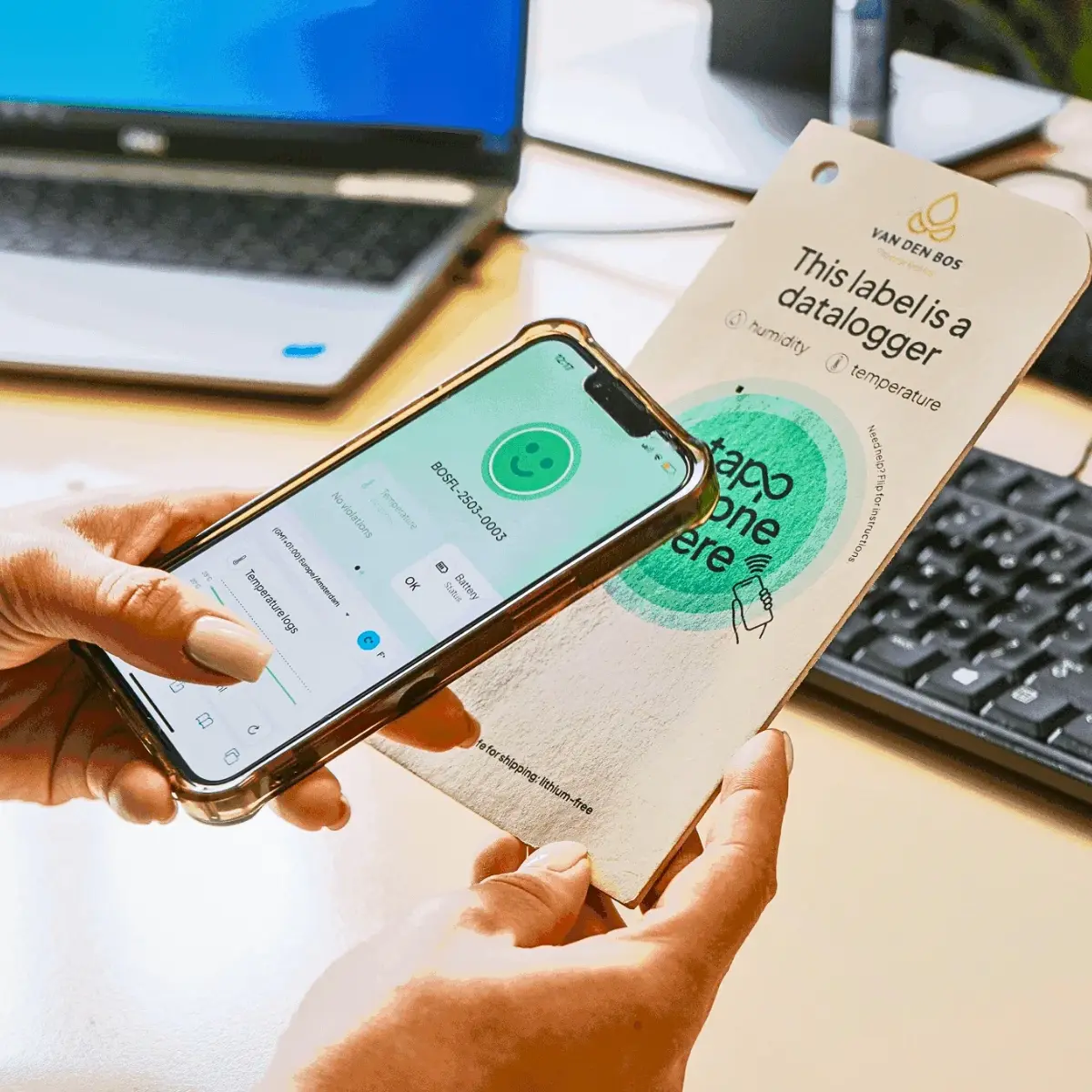
What puts it first here is the reading step, and it is worth being precise about who does what. The sender needs the Tapp app and an account to activate a label: pick the type, set the valid temperature range and the measurement interval, add a reference such as an order number or an airway bill, and tap. A saved preset reduces that to one tap for the next hundred labels. The receiver needs nothing at all. They tap the label with any NFC phone, the report opens, and the data goes to the sender's dashboard on its own. The sender never has to chase anyone for a report, which is the step that quietly kills most cold chain claims.
Two practical things the specification sheet does not tell you. Labels can be reset and reused, with roughly six months of battery from activation and less if you log at short intervals, and the dashboard shows the estimate so you are not guessing. And a report can be trimmed, so the warehouse leg before loading and the stretch after delivery do not distort the graph you send to a counterparty.
The temperature and freeze labels are certified to EN 12830, INGEDE, RoHS, and CE. The humidity label carries INGEDE, RoHS, and CE. EN 12830 covers temperature recorders only, so no equivalent certificate exists for humidity, which makes that a gap in the standard and not a shortfall of the product.
Where it is not the answer: it is passive, so it tells you what happened rather than warning you while it is happening, and LogTag stores more readings per device.
Source: tapp.online product specifications.
Want to see it on one of your own shipments? Create a free Tapp account.
2. Tive Tag
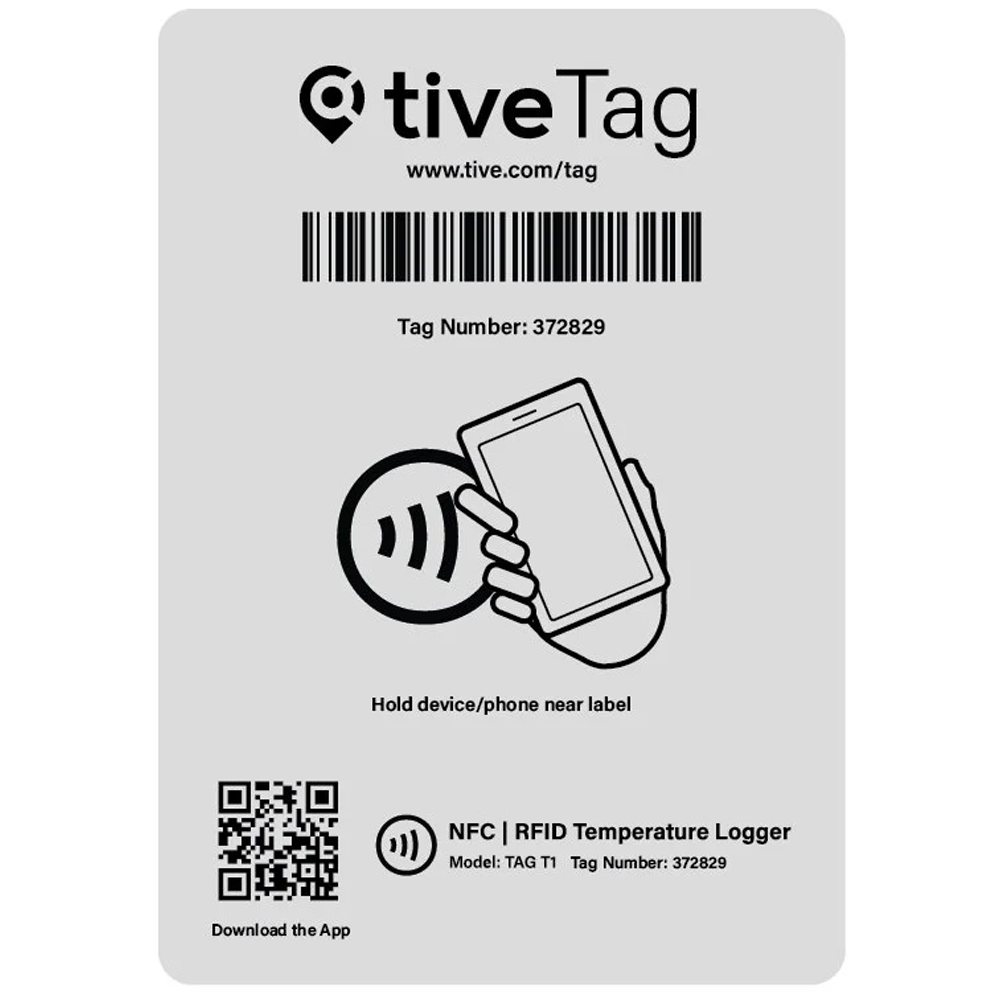
A thin NFC label, under 1 mm, IP67 rated, 95 by 125 mm. It holds up to 4,864 data points and covers 50 days at a 15-minute interval, with the interval programmable between 1 and 720 minutes. The range is -30°C to 50°C, with ±0.5°C accuracy quoted over -10°C to 50°C, and it is available single- or multi-use.
It is the closest competitor to Tapp in form and the better choice if you need the wider low-temperature range on a standard label. The difference is the ecosystem: reading the tag runs through Tive's own platform, so the receiver is inside someone's account rather than just holding a phone.
Source: Tive passive loggers.
3. tempmate-GS2
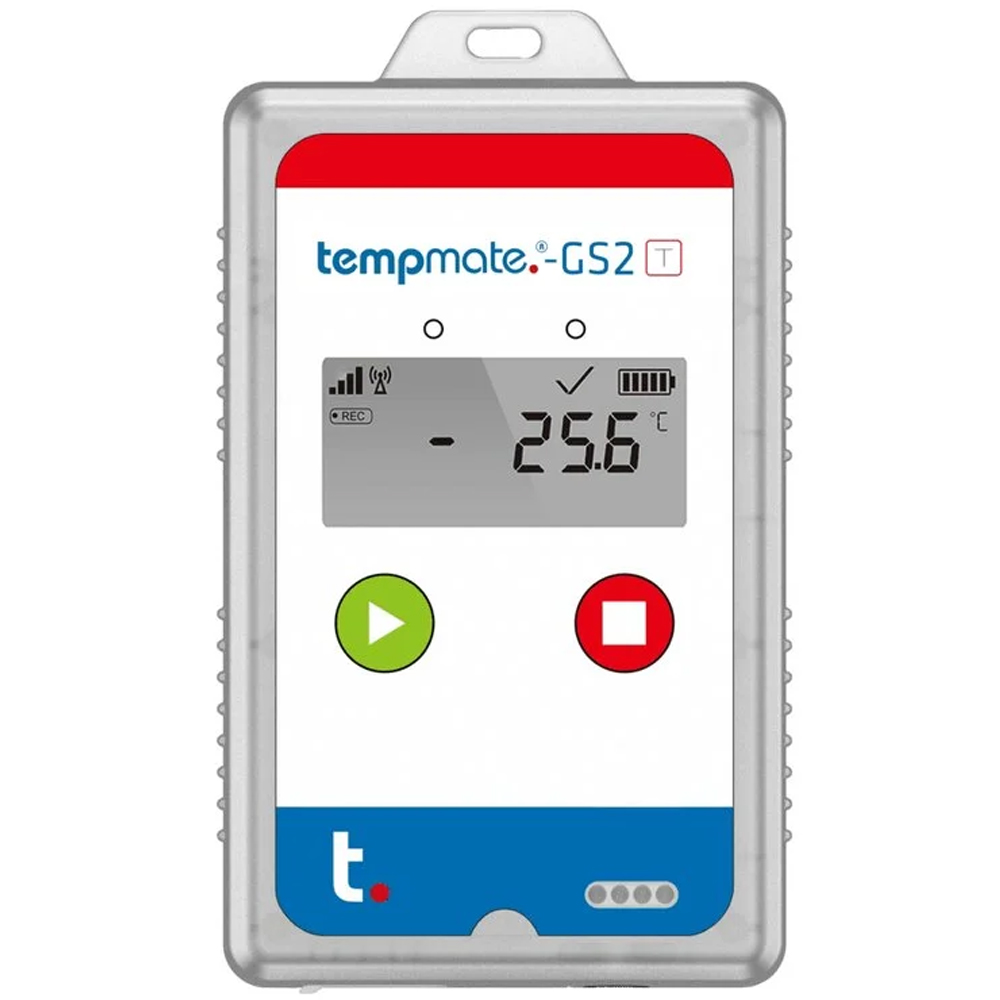
Accuracy is published at ±0.5°C, the same tightest EN 12830 class as Tapp. Range runs from -30°C to 70°C, and with an external probe it extends far beyond anything floral needs. It is a real-time single-use logger on LTE 4G with 2G fallback, runs up to 120 days across three start and stop cycles, and records location, light, shock, and tilt alongside temperature.
If you need to act while the truck is still moving, this is one to look at. It is a connected device with the cost, the charging, and the platform that come with that, which is more machine than a straightforward box of roses usually needs.
Source: tempmate-GS2 product page.
4. Sensitech TempTale GEO
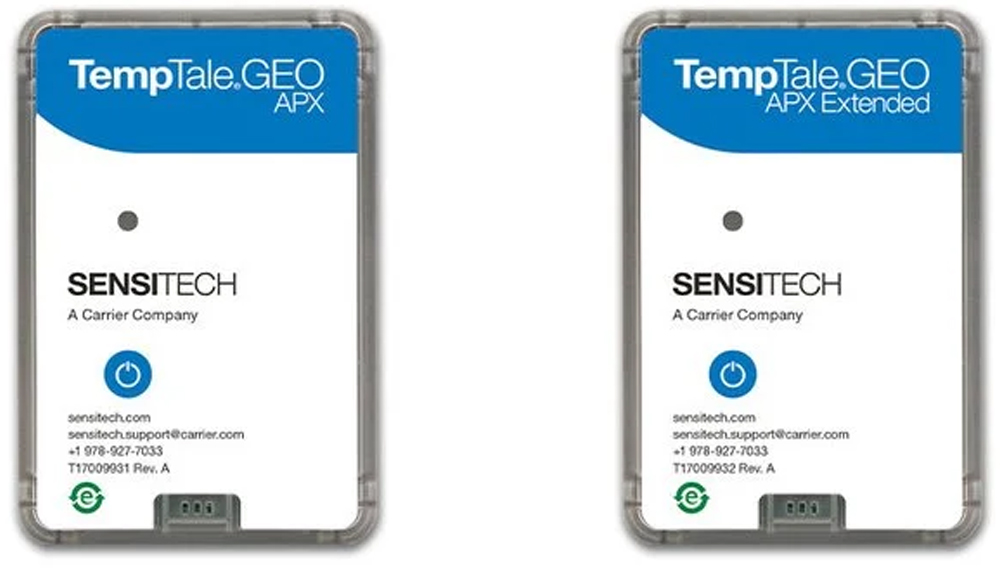
Sensitech is the name with the deepest pharmaceutical validation history in this field, and the TempTale GEO is a real-time monitor on global quad-band GSM and GPRS, IP64 rated, logging temperature and light. Accuracy is ±0.5°C between -10°C and 45°C, widening to ±1°C at the ends of a -20°C to 55°C range, with 0.1°C resolution throughout.
Worth correcting a common assumption: the GEO line is not a USB product. It is a connected monitor built for shippers who need the reporting trail that regulated cargo demands. That rigor is real, and so is the price that goes with it.
Source: Sensitech real-time monitors.
5. LogTag UTRIX-16
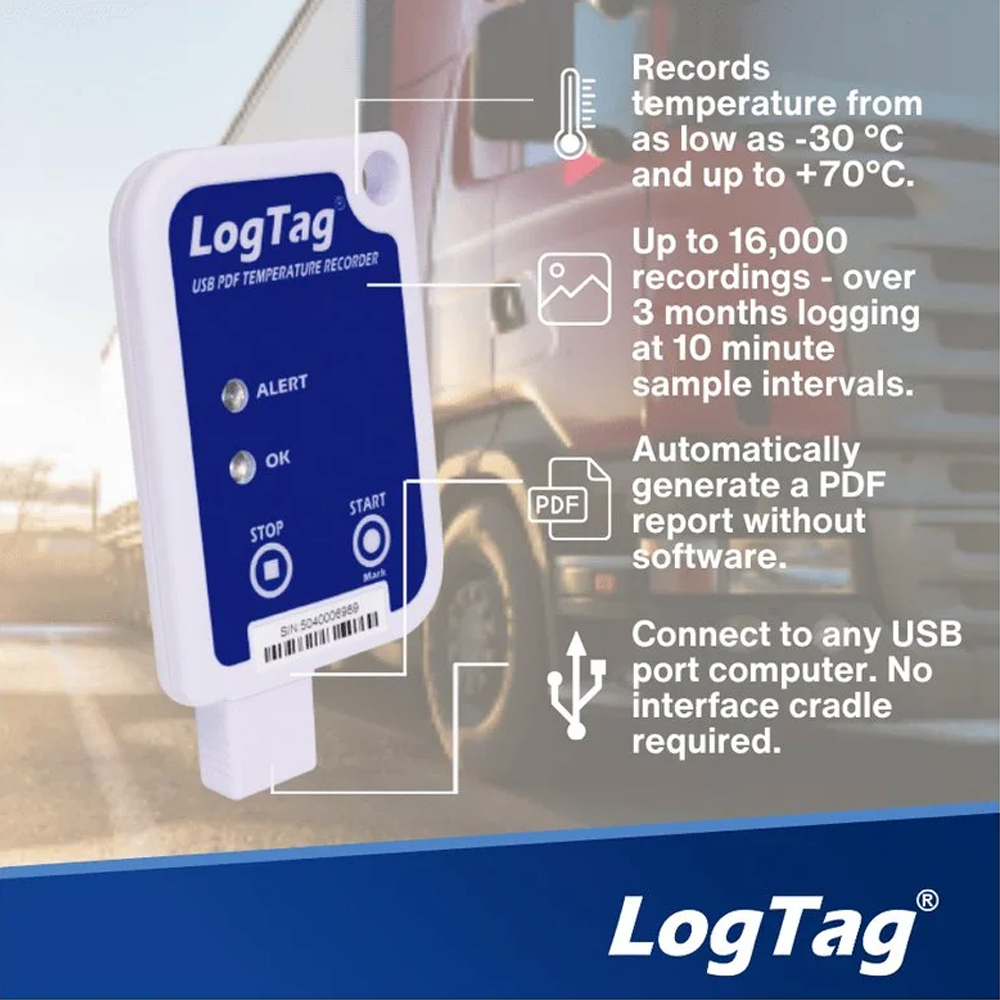
The workhorse. A multi-trip recorder with an integrated USB-A plug, a -30°C to 70°C range, accuracy better than ±0.5°C between -20°C and 40°C, and up to 16,129 recordings, which is more than three months at a 10-minute interval. Battery life runs two to three years in normal use. It needs no proprietary software: plug it in, and it writes its own PDF.
For a grower running the same lane repeatedly with their own staff at both ends, the reusable economics here are hard to beat. The catch is the USB port. At a wholesaler's dock at five in the morning, that is one step too many, and it is the step where the data goes unread.
Source: LogTag UTRIX-16.
6. Frigga
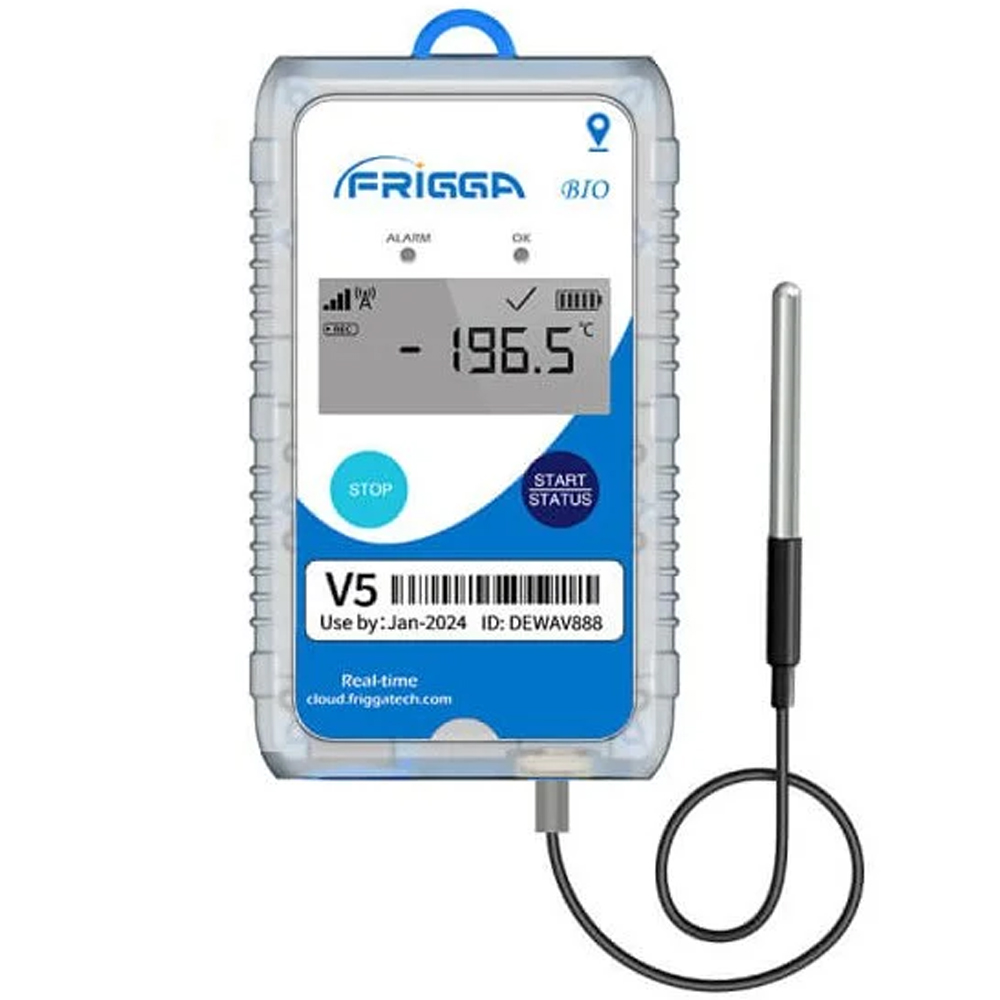
A real-time tracker on 4G and 5G with a global roaming SIM and 2G fallback, running up to 120 days per charge at an hourly upload interval. Range is -30°C to 70°C at ±0.5°C between -20°C and 40°C, humidity from 5 to 95 percent RH at roughly ±3 percent, and it logs location, light, shock, and tilt. The mobile app can also scan NFC devices.
This is the most capable device here and the least suited to a routine flower box. It earns its keep on high-value ocean and multimodal freight where you need to act mid-transit. Note for buyers: Frigga sells largely through distributors, so specifications and support come through the reseller rather than a single manufacturer page.
Source: Frigga distributor datasheet.
7. DeltaTrak FlashLink Mini PDF In-Transit Logger
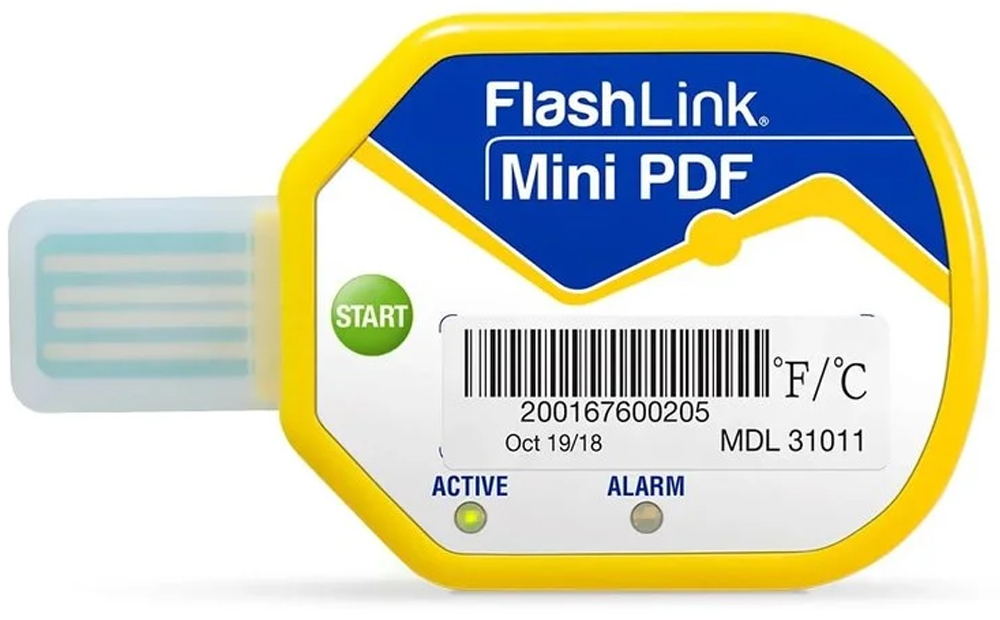
A single-use USB recorder covering -40°C to 66°C, with both Fahrenheit and Celsius on one chart and a PDF generated automatically when it is plugged into a PC, tablet, or printer. Its most useful feature is Shadow Log, which records the trip even when the shipper forgets to start the unit, and forgetting to start the unit is more common than anyone admits.
It ranks last here for one reason: DeltaTrak does not publish an accuracy figure or a capacity figure on the product page. For a comparison built on published specifications, a missing number is a finding, not an oversight to paper over. Ask for the specification sheet before you buy.
Source: DeltaTrak FlashLink Mini PDF.
Where the Logger Goes in the Box
The logger measures whatever it is nearest to, which means a label taped to the outside of a carton records the warehouse rather than the flowers. It goes inside, laid flat among or on top of the stems, near the flower heads or the middle of the stem layer where heat builds first.
On a pallet, put one in the most exposed position: an outer edge near the door, or a top corner, because those warm first. A second in a center box tells you whether pre-cooling actually reached the core, and the difference between those two readings is usually the most useful number you will get all week. Keep labels away from cooling vents and off ice packs, or you will measure the cooling rather than the cargo.
How to Read the Temperature Graph
Time runs along the bottom, temperature up the side. A well-run cold chain is a fairly flat line sitting inside the target band. What you are looking for is not the average. It is the shape.
A temperature excursion is any period outside the target range, and duration matters as much as height. A brief spike to 10°C during a dock transfer is usually survivable. A sustained stretch at 15°C over several hours is not, and it will show up in the vase later. A slow climb with no recovery says the reefer was not holding. A sharp step at a fixed time of day says a handover.
Read the excursions against the handover points in the transport documents. When the same step appears at the same hub on three consecutive shipments, you have stopped looking at a bad day and started looking at a broken link.
What to Do When the Data Shows a Problem
First, document it. Photograph the boxes, the label reading, and any condensation inside the sleeves, because condensation is evidence of a warm phase that the graph alone will not prove to a skeptical counterparty.
Second, place the excursion in the chain. Match the timestamp to the airway bill, the transfer, and the delivery note, so the conversation is about a specific handover rather than a general complaint.
Third, raise it with the party that actually held the goods, and do it with the PDF attached. A claim backed by a graph is a different conversation from a claim backed by a photograph of a wilted rose.
Fourth, look at the pattern rather than the incident. One excursion is bad luck. The same excursion at the same point three times is a routing decision waiting to be made. More on the wider logistics picture in our piece on sea freight and air freight.
Which Logger Fits a Grower, an Exporter or a Florist
Growers are proving that the box left correct. That argues for a cheap label on every box rather than an expensive device on a few, and for something the receiver can read without calling anyone. A passive NFC label fits.
Exporters and importers are managing a lane and settling claims. They want the same device on every shipment over a season so the data is comparable, and they need the receiver to be able to read it. Where cargo value justifies intervening mid-transit, a real-time device earns its cost.
Florists and wholesalers are on the receiving end and mostly do not buy loggers at all. What matters is being able to read the one that arrives at the dock on a phone, before the box is signed for. Since October 19, 2026, receivers can also save Tapp reports in a free cold chain monitoring account of their own. If your supplier ships a logger you cannot read without their software, say so, because that is a fixable problem and an unreadable logger protects nobody.
If ease of reading is what you are weighing, try it on your own boxes: create a free Tapp account and test a label yourself. Thursd works commercially with Tapp, as disclosed in the section below.
See also how flowers are kept cold on the way to you in how flowers are kept fresh during deliveries and eight things to know about delivery freshness.
Editorial Transparency
Thursd works commercially with Tapp, which is disclosed here and on the supplier page. The comparison above uses only figures each manufacturer publishes itself, and every product profile links to the source so any reader can check it. No manufacturer other than Tapp was contacted, none reviewed this article before publication, and no manufacturer paid for placement in the table.
Our editorial team has a Tapp trial account and has set up and reset labels on it, which is where the usability observations in the Tapp profile come from. We have not run the same exercise on the other six products, so those profiles rest on published specifications alone. That asymmetry is real and readers should weigh it.
Tapp ranks first on the four criteria set out in the methodology section, and the article states plainly where it is beaten: LogTag publishes greater capacity, and several devices publish a wider temperature range. Readers weighting accuracy or range above ease of reading should rank this list differently, and the figures to do that are all above.
Background on Tapp itself is in our explainer on shipment data logging in floral logistics.
Feature image: Tapp. Header image: Tapp.