A Christmas table tells guests they were expected. That is the quiet work of Christmas floral arrangements: not to fill a room, but to make it feel ready for the people who are about to walk into it. A low Christmas centerpiece of fir and red roses says it at the dinner table. A wreath says it at the front door, before anyone has even knocked.
This guide is written for two readers at once. One is decorating a home and wants Christmas flower arrangements that look generous without taking every evening of December. The other is a florist who will make dozens of them during the holiday season, for clients who often have red in mind before they walk in. Both need the same foundation, so the guide moves from the dining table to the mantel and the door, then to the Christmas flowers and greens that work in December and how to keep them fresh until the new year. If you are still choosing your flowers, start with the most popular Christmas plants and flowers.
What Makes a Christmas Floral Arrangement Work?
Some may ask: why do some Christmas flower arrangements look rich, while others look like a few red flowers pushed into a bowl? The answer is structure. A good arrangement is built in layers. Evergreens come first and form the backbone, because they give shape, scent, and a green base that lasts for weeks. Focal flowers come next, a handful of larger flowers that carry the color, such as Amaryllis, roses, Calla, or Anemone. Texture comes last, from red berries, pine cones, seed heads, and a few silver leaves, and it is this layer that makes an arrangement read as Christmas rather than as any other season.

Color is where most choices are made. The classic Christmas palette of red, green, and gold has not lost its place, and it rarely fails in warm winter light. A white Christmas look works just as well, built from white Amaryllis, white roses, and frosted or silver foliage such as Eucalyptus. Modern palettes go further and pair white with silver and icy blue, which suits lighter interiors and a calmer kind of holiday decor. A red and white candy cane theme sits somewhere in between, playful and still clearly festive. Non-floral elements such as baubles, ribbon, and candles add depth to any of these palettes, as long as the flowers stay the main subject.

Height and texture finish the work. Varied heights give the eye a path through the design, so a tall stem of Amaryllis or a branch of Ilex beside low clusters of roses reads better than flowers cut to one length. Likewise, a matte green next to a glossy ribbon, or a velvet bow next to rough bark, creates the contrast that photographs well and holds attention across the space.

Photo: @masterflorists
Christmas Centerpieces for the Dining Table
A centerpiece is not a separate decoration, but part of the table setting. It should therefore complement the table runner, the plates, and the place settings rather than compete with them. Before choosing a single flower, measure the table, count the guests, and decide where the food will stand. Christmas centerpieces that look wonderful on their own often fail once the dishes arrive. A traditional style of fir and red roses and a more natural style of moss, twigs, and white flowers both follow this rule.
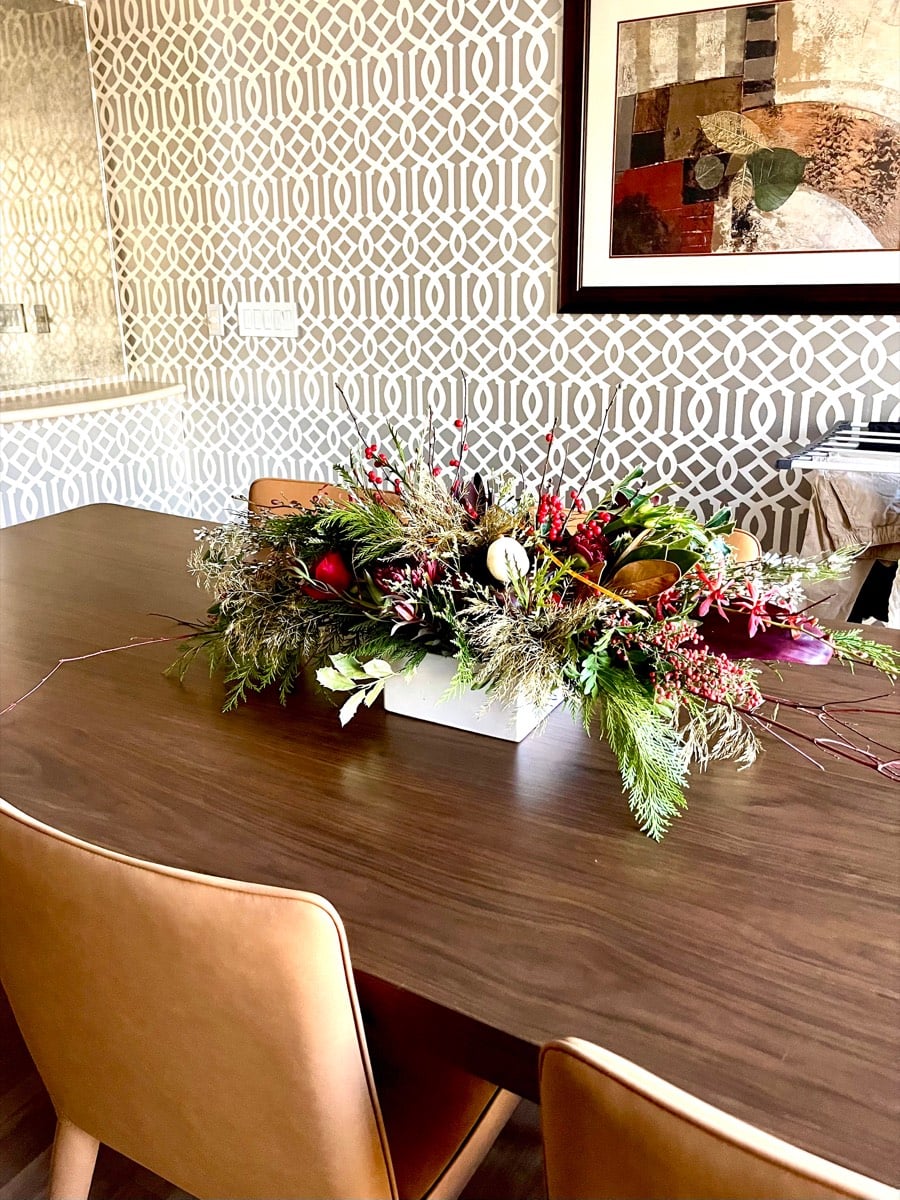
The most practical Christmas centerpiece for a dinner table is low and long: a runner of fresh Christmas greens down the middle, with flowers and candles set into it at intervals. Guests should be able to see each other across the table, so keep the design below eye level when seated. A runner also scales easily. For a table of six, one length of greens with three clusters of roses and red berries is enough; for a long farmhouse table at a family gathering, repeat the same cluster rather than inventing a new one every half meter. Repetition looks deliberate, and it leaves the rest of the table free for the food.
Arthur Williams (IMF, AIFD, EMC), who runs Babylon Floral Design in Denver, Colorado, builds his Christmas centerpieces in two shapes. "We do a lot of low and lush styles in clear glass with a leaf wrap and interior branch armature," he says. The second is long and low, made in renewal foam "to get more of a stretched out and sculptural design (plus it's easy to add candles)." Timing is the other half of the work. He makes most centerpieces about a week before the dinner, and when a customer asks for more delicate flowers, he times the piece for three days ahead.
In Hungary, the food leaves even less room for flowers. "The Christmas table in Hungary isn't really about elaborate decorations, it's all about the abundance of food!" says Krisztián Kövér, a master florist for more than thirty years and the founder of Botanic Art in Pomáz. Next to the Christmas tree and the Advent wreath, he says, "an average Hungarian family might add, at most, one centerpiece to the dining table." That one piece has a modest job: "The decoration doesn't need to compete with the food or the conversation; its role is simply to enhance the atmosphere." So he keeps a centerpiece neither so tall nor so wide that it gets in the way of the conversation or the serving dishes.

Candle Centerpieces and Candle Holders
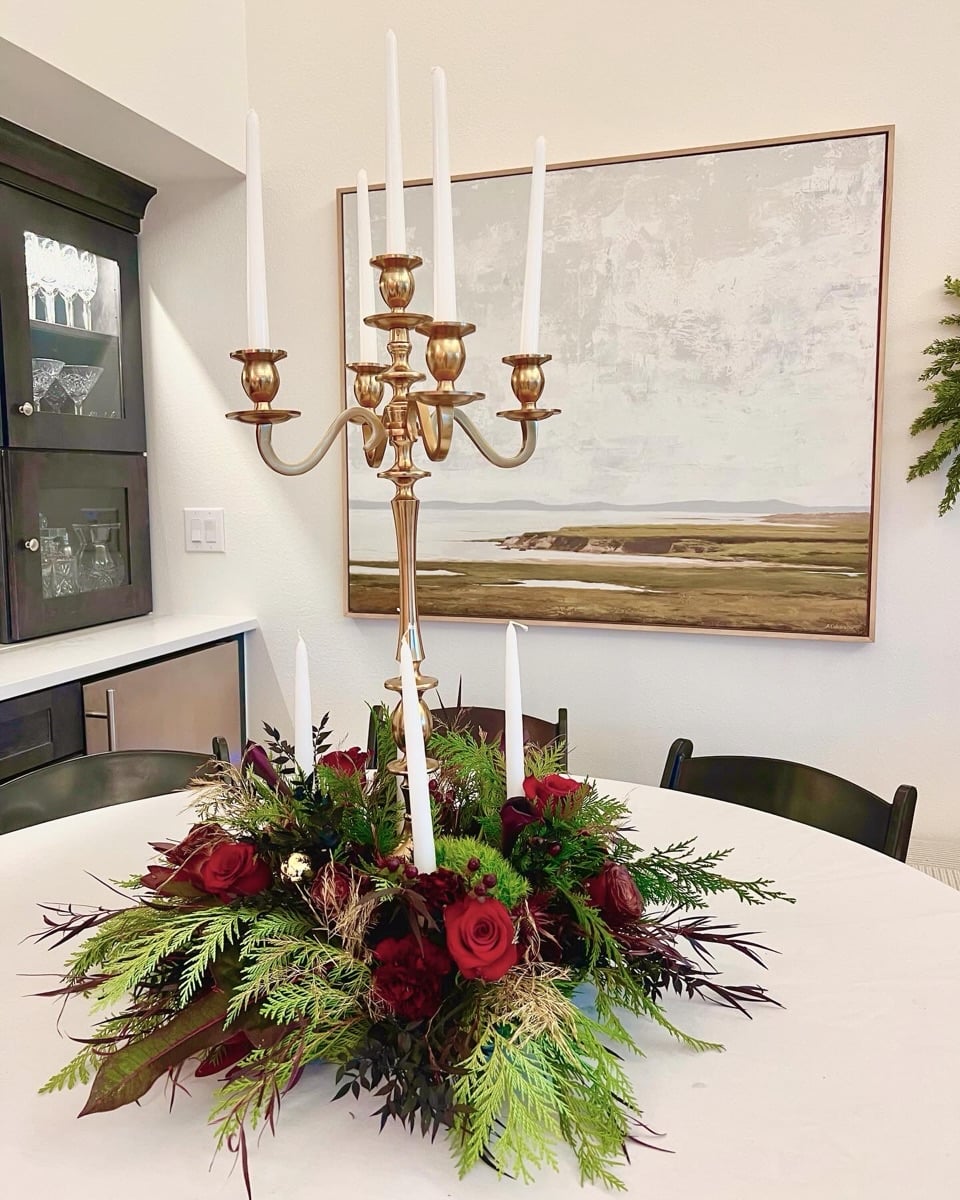
Candles and Christmas greens have shared the holiday table for a long time. Pine cones, ribbons, and short stems of fir around a group of candle holders give the classic look, while glass hurricanes around the flames keep the flowers away from the heat. Safety, of course, is not a detail here. Cut greens dry out in a heated home, and University of Illinois Extension warns that greens that have turned dry and brittle become a fire hazard near heat. Never leave a candle burning unattended in an arrangement of greens, and replace any branches that snap instead of bend.

Small Arrangements for the Coffee Table and Side Tables
Not every surface needs a statement. A coffee table, a side table, or a windowsill is better served by small arrangements: a few stems in a clear glass vase, three bud vases in a row, or a low bowl of moss with one Amaryllis rising out of it. A clear glass vase filled with white flowers, silver twigs, and a few frosted cones gives a snow globe effect that brings a little holiday cheer to a quiet corner. In a wide glass vase, a grid of clear tape across the opening, or a few crossed stems of greenery, holds the flowers upright without any foam, and a single rose in a narrow glass vase needs no support at all. These small tabletop pieces are also the easiest Christmas flowers to give to friends and loved ones, because a host gift that needs no extra table is always welcome.

Photo: @addictedtochina
Mantel and Staircase Garlands
The mantel is a second focal point in many living rooms at Christmas, and it rewards greens more than flowers. A garland of fir, cedar, or pine laid along the shelf, with a few clusters of berries and dried orange slices, will look generous for weeks with very little care. The beauty of a garland is that it asks for so little. Flowers can join it, though they need water, so place them in small vessels hidden behind the greens or in individual water tubes.

Water tubes are the florist's answer to this problem. Violeta Veikniene, a florist who designed a Christmas piece around Thursd's trend color for 2026, put it plainly in her Crimson Nocturne design: "Each flower is placed in a water tube, allowing it to stay hydrated and fresh for days." The same tubes, she noted, let the flowers be replaced or refreshed without disturbing the structure of the design, which matters on a mantel that has to look its best from early December to New Year's Day.
Krisztián Kövér of Botanic Art builds a mantel piece around its frame first. "For mantelpiece arrangements, I choose plant materials that give the design shape and structure," he says. Heating and dry air shorten the life of fresh flowers up there, and so does a lack of water, which is why "it's best to place the arrangement as far from the heat source as possible and make sure the flowers have an adequate water supply."
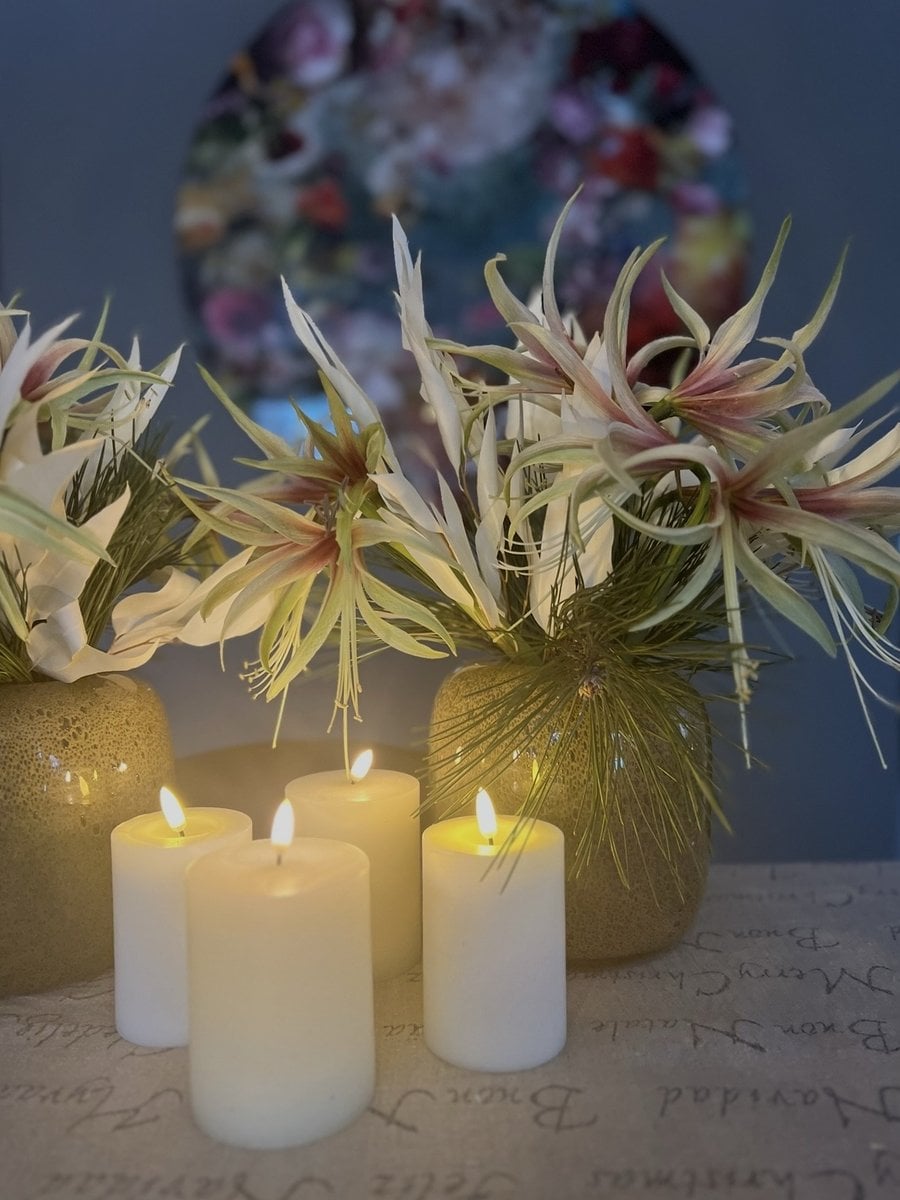
A staircase banister takes a garland in the same way, tied at intervals with ribbon or velvet. Keep it out of direct sun and away from radiators, and mist the greens now and then. Continental Floral Greens, which grows and harvests Christmas greens in Washington State, has shared its own tips for holiday garlands and wreaths.
Not every climate allows it, though. In dry, heated Denver, Arthur Williams of Babylon Floral Design has largely left fresh garlands and wreaths behind. "We are so dry that they just become crispy within a week even with an anti-transpirant," he says. "I just can't send out something that I know will be disappointing." Where the air is that dry, a design that stands in water is the safer choice for the mantel.

Wreaths and Wall Pieces for the Front Door
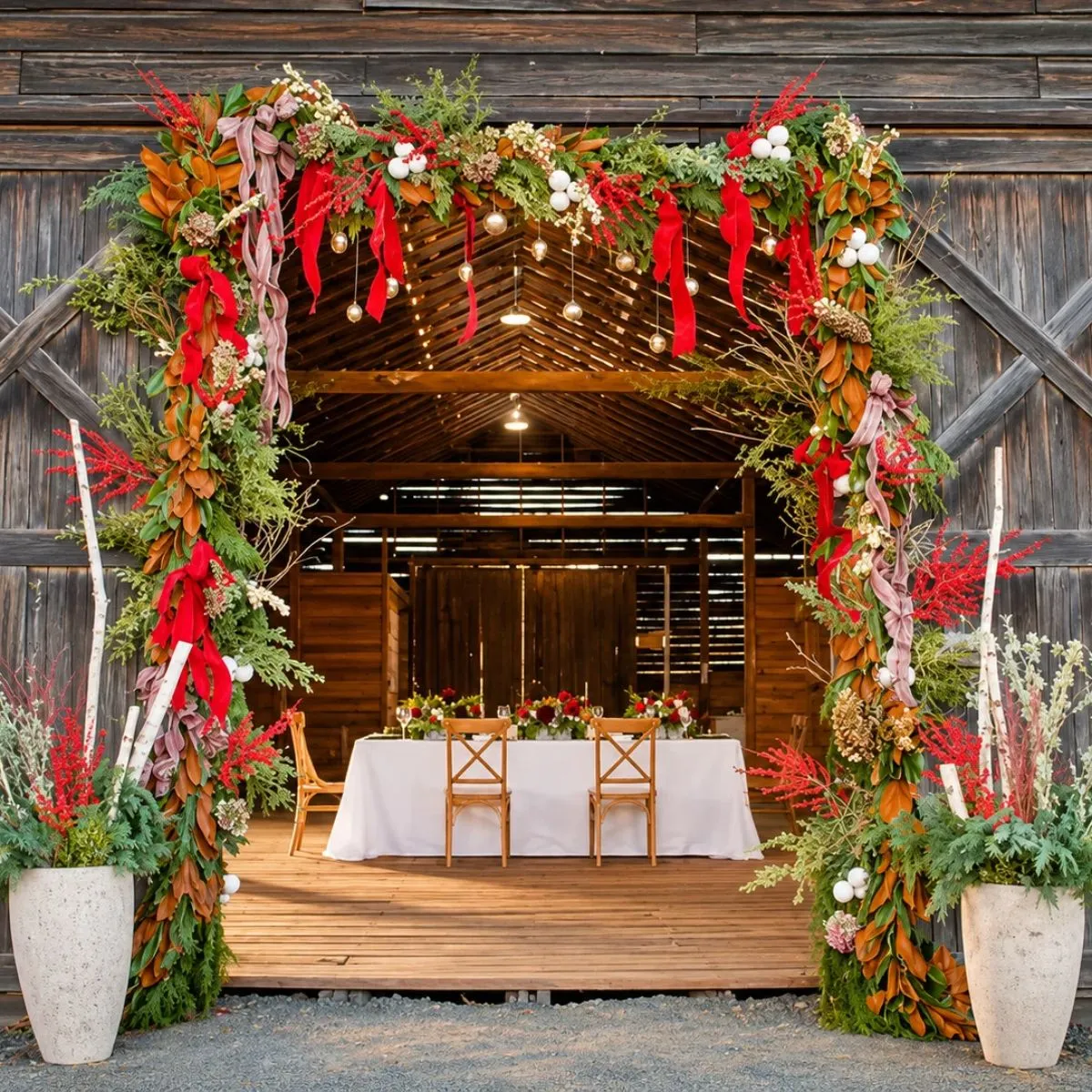
A wreath on the front door is the first Christmas arrangement anyone sees, and outdoors it has an advantage that no indoor piece has: cold air. Greens left outdoors stay fresh all season, according to University of Illinois Extension, which is why a door wreath hung after Thanksgiving can still look right in the first week of January, through the coldest weeks of winter.

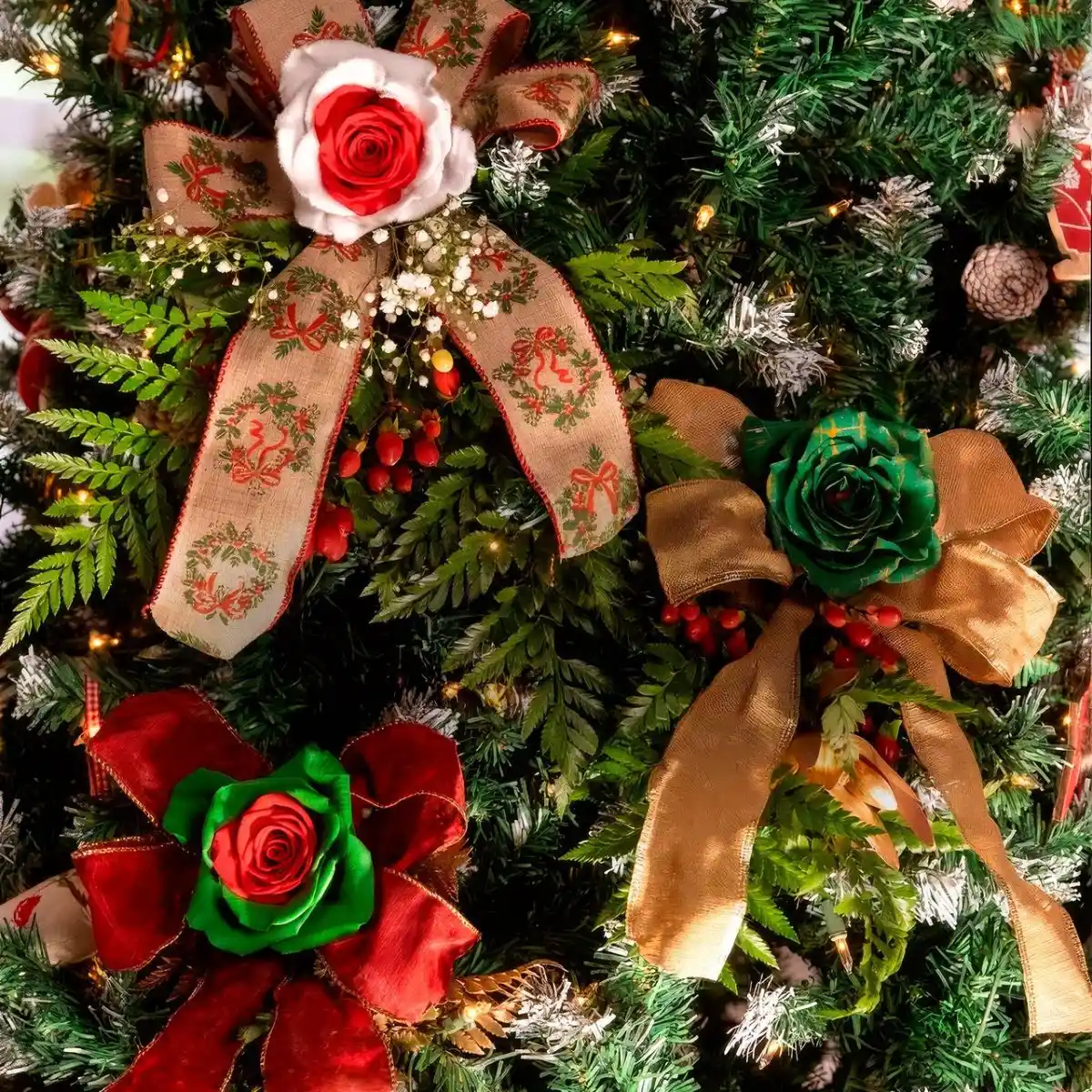
Wreaths follow the same layers as any arrangement: a ring of greens, a focal group of flowers or fruit, and texture. Dried orange slices, rosehips, and a velvet bow suit a classic door, while Eucalyptus and lavender give a softer, gray-green look. For dozens of ideas, see the guide to Christmas wreath ideas, and for the four-candle wreath that belongs on the table rather than the door, read about the advent wreath and its candles.
Wall pieces work in the same way. A swag of fir tied with ribbon, a kissing ball of boxwood, or a bunch of mistletoe hung in a doorway brings Christmas decor to places where a vase would never fit. The custom behind that last one is told in the legend of the kissing plant. Hang mistletoe high, though; the reason follows in the care section below.
Which Flowers and Greens Work in December?
December is a quieter month in the flower fields, yet it is far from empty. Holiday flowers in December come from greenhouses in Europe and from farms in Kenya, Colombia, and Ecuador, so the choice is wider than many people expect. The Christmas flowers that work best are the ones that cope with a warm living room, and the Christmas greens that work best are the ones that keep their needles. Here is how they divide.
Focal Flowers
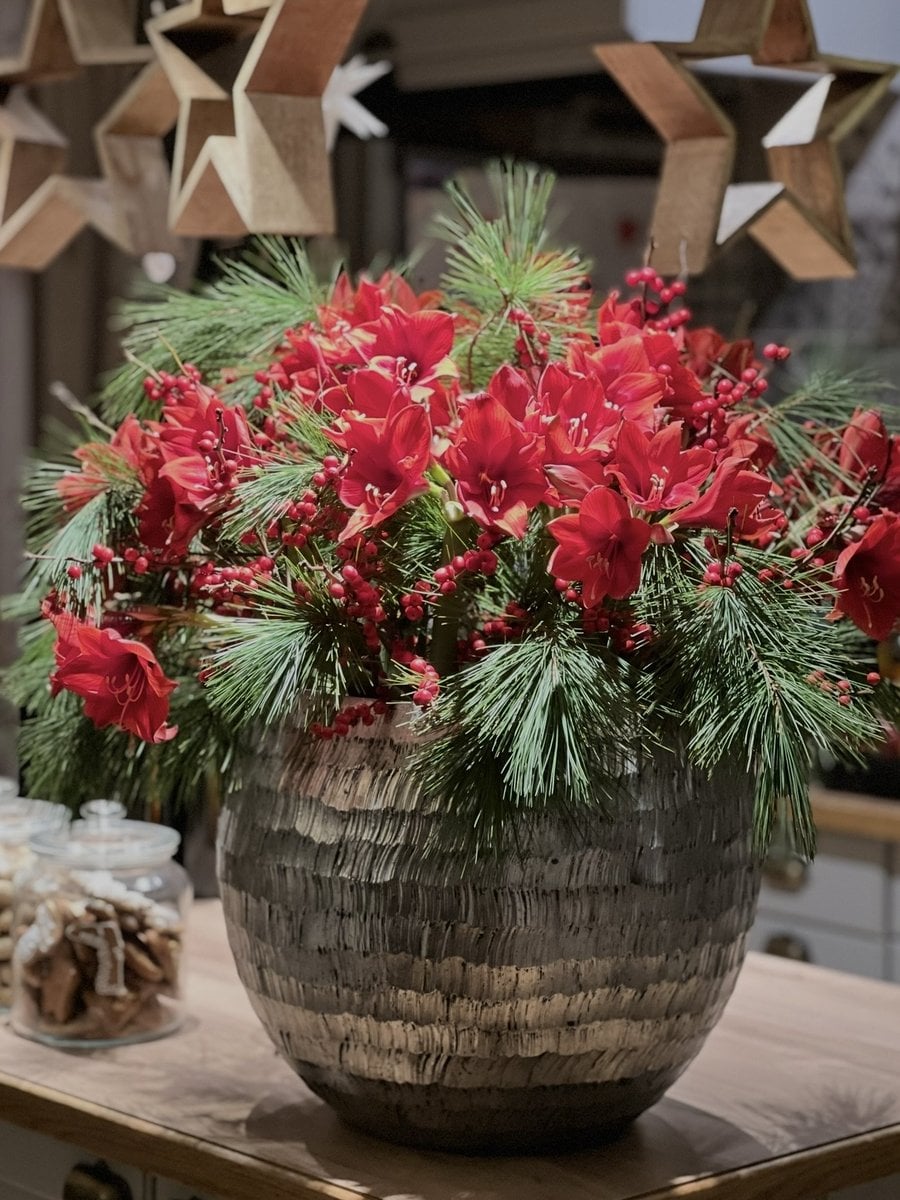
Amaryllis is the most dramatic of the focal flowers, with large trumpet-shaped flowers on tall, hollow stems. A red cultivar such as Amaryllis Ferrari, with its large, velvety, rich red flowers, can carry a centerpiece on its own; the guide to the Christmas Amaryllis tells its full story. Roses come next. Red roses carry the festive mood, while white roses suggest the stillness of winter, and Thursd has picked out the most beautiful red roses for Christmas as well as the best white roses for Christmas.
Beyond those two, Calla lilies give clean lines in red or white, as Calla lilies for Christmas shows. Anemone brings a dark eye that works with both red and white, which Anemone Mistral Panda demonstrates well, and Ranunculus such as Ranunculus Aazur White adds soft, layered petals to a white design. Alstroemeria comes in Christmas reds and whites too, as in these red and white Alstroemeria. Orchids, from Phalaenopsis to Cymbidium, suit a more modern table. Lilies are popular holiday flowers too, and their scent fills a house, but they belong only in homes without cats, as explained in the care section. Finally, the Helleborus, known as the Christmas rose, is a winter flower in its own right; Helleborus Niger does not belong to the rose family at all, and the page on the Christmas rose explains how it earned the name.
The orchid and Amaryllis design below comes from Lacy Bird, the floristry studio Thursd profiled in 2022, and it shows how well white orchids and red Amaryllis carry each other.

Photo: @lacybird_uae
Christmas Greens and Branches
The quality of the greens decides how long an arrangement lasts. Among needled evergreens, white pine, junipers, yew, cedars, firs, and spruce hold up well when cut, and among broadleaf greens, holly, Magnolia, and boxwood do the same, according to horticulture educator Candice Miller of University of Illinois Extension. Nobilis, the noble fir, is one of the best-known Christmas greens in the trade and is sold as branches, wreaths, and trees, as Thursd explained in its piece on Danish Nobilis. Boxwood gives a fine, dense texture for small pieces, and Eucalyptus adds silver and scent.
Florists in dry climates choose their greens with the same care. At Babylon Floral Design, Arthur Williams works mostly with cedar, Eucalyptus, Magnolia, pepperberry, and Leucadendron. The choice is practical as much as visual: "Less issues with sticky and black fingers and allergies," he says. His shop also sprays an anti-transpirant on everything that leaves the shop, all year round.
For a full overview, read about the best types of Christmas greenery and the different types of fir trees. Growers and traders publish their own Christmas greens every season, such as the Christmas greens of Adomex, and the scent of those evergreens does more for a home than most people expect, as this piece on holiday scents explains.


Red Berries, Cones, and Texture
Berries are what make an arrangement say December. Ilex, the holly whose bare winter stems are covered in red berries, is the classic, and it rewards a little care, as these Ilex care tips explain. Hypericum adds smaller berries in red and dark red, as on Hypericum Coco Diablo, while white waxflower such as Waxflower Blizzard looks like fresh snow in a white design, and small white Gypsophila does the same in a softer way, as Gypsophila Polar Bear shows. Pine cones, lotus pods, cinnamon sticks, and dried orange slices add texture and a little scent, and they last as long as the greens around them.

Christmas Plants in an Arrangement
Potted plants can join a Christmas arrangement too, and they often outlast the cut flowers. A Poinsettia, which comes in white, pink, and marbled forms as well as the classic red, gives instant color when its small pot is set into a bed of greens; to keep it healthy, follow the Poinsettia care guide. As a cut flower it is a different story: Arthur Williams of Babylon Floral Design avoids cut Poinsettias in his Denver shop altogether. An Amaryllis bulb planted in moss, a Helleborus in a low bowl, or a row of potted Cyclamen can stand in for cut flowers on a windowsill, and pot Chrysanthemums have their own Christmas role, as these Christmas table ideas with pot Chrysanthemums show. The Christmas cactus, meanwhile, flowers on its own schedule; the Christmas cactus care guide explains how to time it. A potted Poinsettia or Amaryllis also makes an easy Christmas gift, since it keeps flowering long after the cut flowers of the holiday season are gone.

Photo: @flowers_by_nicole
How to Make Christmas Flower Arrangements Last
Most Christmas flower arrangements fail for the same reason: heat. A heated living room is a harsh place for cut flowers and greens. In essence, the care that keeps them fresh is simple, if a little unglamorous.
Condition the greens first. University of Illinois Extension advises soaking cut greens overnight to rehydrate them before bringing them indoors, and testing them by bending the needles: fresh needles flex and do not break. Avoid greens that are already shedding or have brown, dry tips, because no care will bring back their quality.
Recut every stem. Cut flower stems at a sharp angle with a clean knife or pruner, ideally under water, and place them straight into fresh water with flower food. Remove every leaf that would sit below the water line.
Choose the spot with care. Keep arrangements out of direct sunlight and never near space heaters, heating vents, or sunny windows, as the same Illinois Extension guidance puts it. A fireplace that is in use is no place for fresh flowers either.
Mist the greens and top up the water. Spritzing greens regularly keeps them hydrated. An antitranspirant spray seals in moisture too, but Illinois Extension advises against it on juniper berries, cedar, and blue spruce, because it can damage their waxy coating. Check the water every day, since a vase or tray that runs dry is the quickest way to lose an arrangement.
Plan for a refresh. Greens can last for weeks, and most cut flowers will not. Build the arrangement so that the flowers sit in water tubes or small vessels, and swap them halfway through the Christmas season. The greens stay, and the design looks new again.
Floral foam deserves a word of its own. It holds water and stems well, which is why florists have used it for decades, but it is a plastic. Researchers at RMIT University in Melbourne reported in 2019 that floral foam breaks into microplastics and that all the aquatic animals they tested ingested the particles. Many designers now work without it. Deborah Provenziani described her natural Christmas designs on Thursd as following one rule: "no plastic, wire, or foam for most of my arrangements." Others use chicken wire, moss, or a pin holder in place of foam; read why floral foam is harmful and what to use instead.
Finally, think of the animals in the house. Penn State Extension notes that reports of Poinsettia toxicity are "greatly exaggerated," although its milky sap can upset a pet's stomach. Holly is toxic to pets, though its leaves and berries are of low toxicity. Mistletoe carries toxins, particularly in its white berries, that can cause vomiting, low blood pressure, and a slow heart rate, and Amaryllis is poisonous to cats and dogs, with the toxin concentrated in the bulb. True lilies are the one flower to keep out of any home with a cat: the ASPCA warns that even licking the pollen or drinking water from a vase that held lilies can be deadly, because lilies cause acute kidney injury in cats.
For Florists: Christmas Flower Arrangements That Sell
For a florist, the Christmas arrangement is not the end of a sale, but the start of a relationship that carries into the new year. Natasja Mironova argued on Thursd that Christmas work for hotels, restaurants, and venues should become an experience rather than a static display. Her advice starts with the client: "Go beyond their initial request and explore what could make their space more dynamic." She suggests small workshops where guests make their own arrangements, with children building mini Christmas centerpieces while the adults talk, so that people leave with memories as well as photos. The same thinking works for shop window displays and for Christmas displays in offices, where the flowers become part of how a company receives its guests during the holiday season.

The practical side matters just as much. Encourage customers to order Christmas flowers early, because early orders give them the widest choice and let the shop plan its buying. Offer a small range of set designs, such as a centerpiece, a door wreath, and a gift arrangement, each in two or three sizes, and keep a few ready for walk-in customers. Christmas flower delivery needs its own planning too. Customers arrange it online or by phone, so make both routes easy, confirm delivery times, add a care card that explains water and heat, and plan orders from offices separately from private ones. The Christmas flower sales guide for florists goes deeper, and the Christmasworld 2026 trends show where buyers are heading.
Traditional or Modern Christmas Arrangements?
There is always a place for tradition at Christmas. Red and white flowers, mixed with plenty of greenery, remain the safe choice for a family table, and red roses with Ilex berries and fir are a sure sign of Christmas in any traditional style. The red installation below, another design by Lacy Bird, takes that classic red as far as it can go.

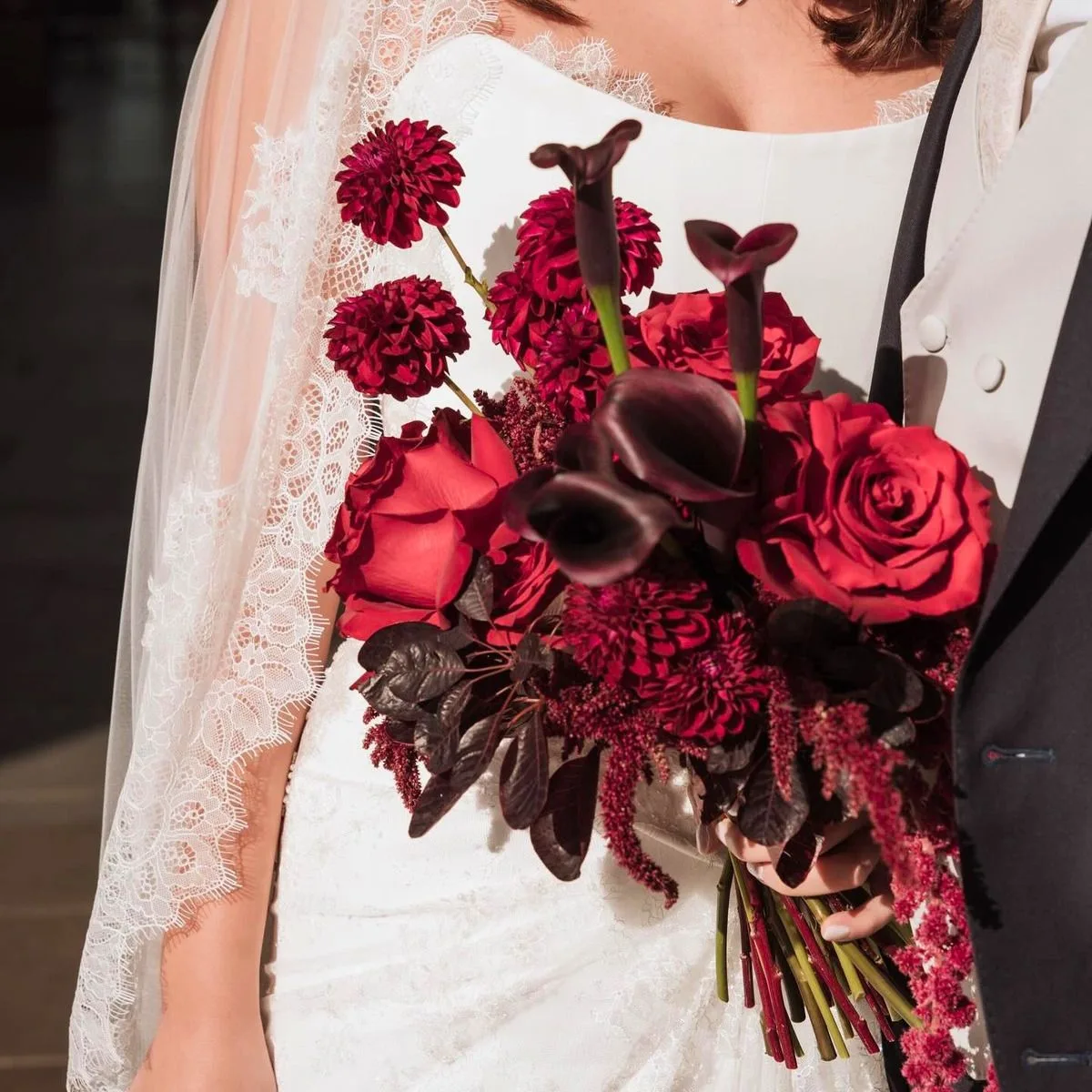
Modern Christmas floral arrangements break with the palette rather than with the season. Pastel pinks, magenta, gold leaves, white Hydrangea, and unusual shapes give designers freedom to play, and the trend color of the year often finds its way into December, as Violeta Veikniene's deep crimson design showed. A modern piece still needs the same three layers, though; it simply hides them better.

Photo: @stephcue1
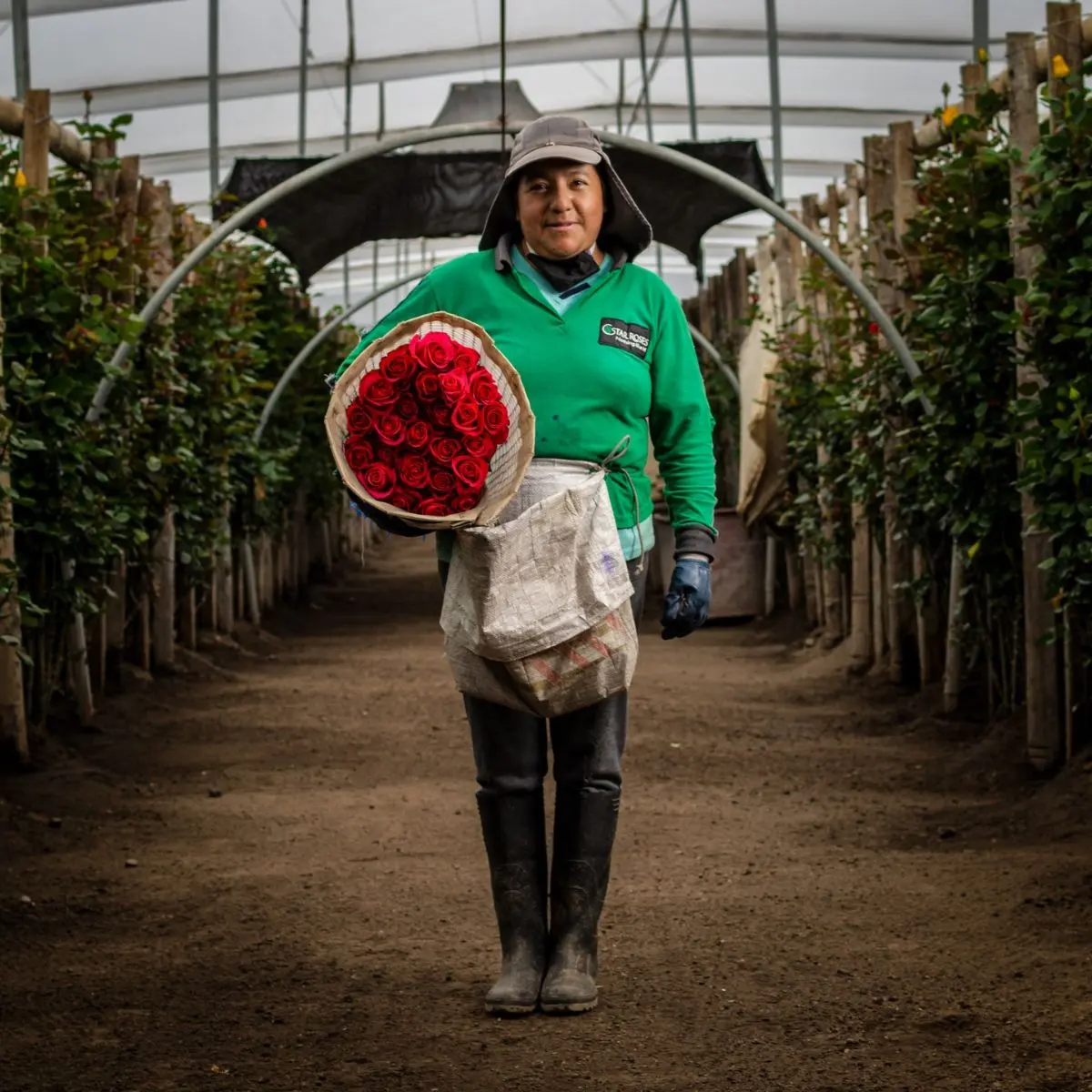
Thursd's own bloggers have shown many directions over the years. Anu Peri designed with fresh Adomex greens in Estonia, Claudia Tararache built a Christmas window with red roses from Porta Nova, and Katya Hutter laid a Christmas table runner of red roses. Karolien Tesselaar brought Christmas into the greenhouse, and Regine Motmans gathered designers from around the world in her Christmas flowers roundup. Partners have their own Christmas collections as well, from Decorum's Christmas floral designs and Christmas styling with Royal Van Zanten flowers to winter roses from Star Roses.
For more inspiration, see the top Christmas trends for the holidays, the trending Christmas decoration ideas on TikTok, and Christmas floral traditions around the world.
A Christmas table tells guests they were expected, and the same is true of a mantel or a front door. Start with natural, fresh greens, add a few good flowers, and keep the whole arrangement cool and watered. It will do its quiet work, and bring its share of joy, until the new year.
Sources: Candice Miller, Designing With Greens, University of Illinois Extension (2014); Lois Miklas, Holiday Plants and Pets, Penn State Extension (updated 2025); ASPCA, Getting to the Bottom of the Dangers of Easter Lilies; RMIT University, Floral foam adds to microplastic pollution problem (2019), on Trestrail and others, Foaming at the mouth: Ingestion of floral foam microplastics by aquatic animals, Science of the Total Environment 705 (2020).
Header image by @lacybird_uae.
About the author: Edwin Kirwa is Customer Success Manager and writer at Thursd. He works daily with breeders and growers worldwide and covers East African floriculture from up close. Connect with Edwin on LinkedIn.