My name is Valentina Pospelova, floral designer at Camelia Flowershop in Abu Dhabi. From commercial bouquets to wedding decorations and event flowers, we design it all. Inspiration is everywhere.
ARTISTRY COLLECTION was born spontaneously, without rigid boundaries. It began as a creative impulse that gradually took shape. Over time, we grew increasingly attached to this collection, and it evolved into an independent artistic statement.
Translating the Visual Language of the Painting into Floral Designs
This work began with an interest in how form can dissolve rather than assert itself. I was drawn to the idea of floristry not as an object with boundaries, but as a moment that feels ongoing and open-ended. That intention shaped every decision behind this composition. Rather than focusing on precision or structure, I wanted to work with perception, how the eye moves. How light behaves. How stillness can exist within motion. These ideas became the foundation of the design.
Inspired By 'The Water Lilies' by Claude Monet
Claude Monet’s series Water Lilies inspired this work. In these paintings, the artist focuses not on the precise form of objects, but on the surface of water, reflections, and the changing quality of light. The composition has no fixed center and is perceived as a fragment of a continuous, fluid space.
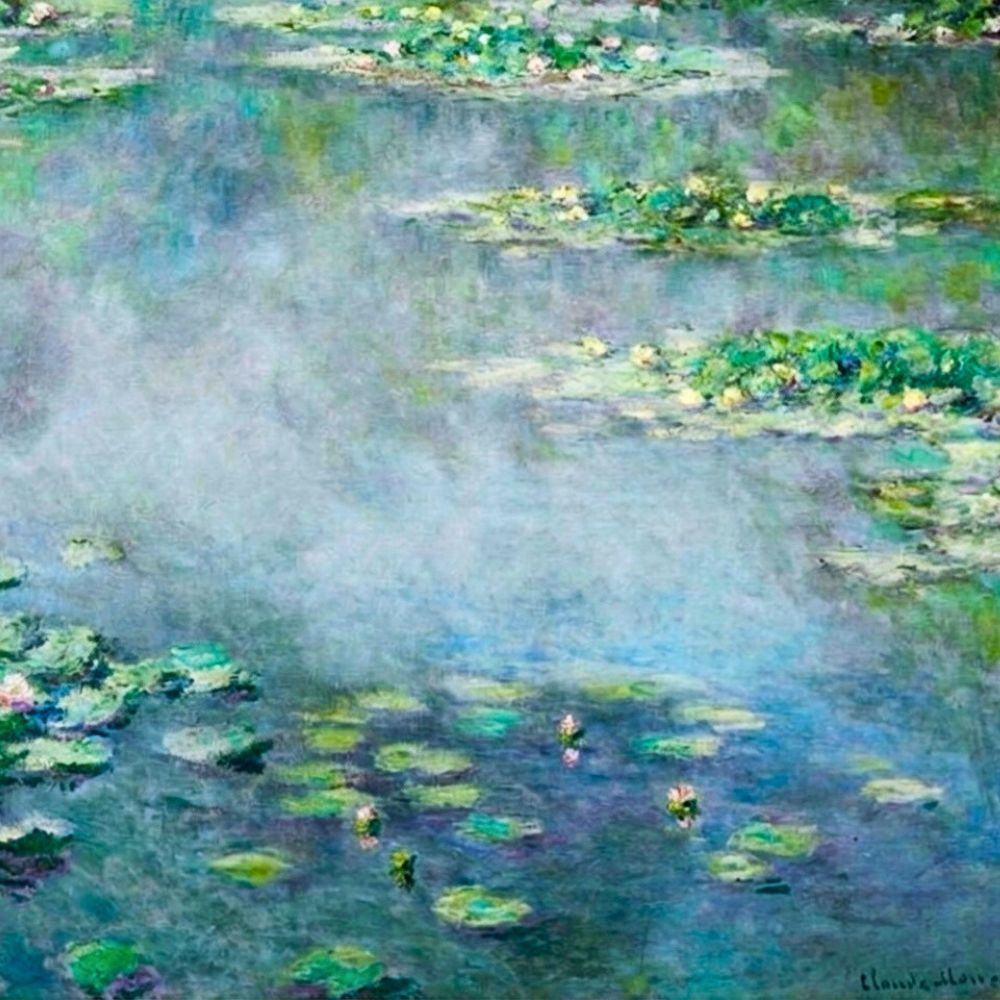
The elements of the composition are arranged to create a sense of smooth, natural movement, reminiscent of the flow of water. The form is not closed and visually extends beyond the vase.
Movement That Feels Natural and Unforced
In this composition, I deliberately used the principle of the 'line of beauty' – a soft S-shaped curve that sets the rhythm of the form, creates a sense of fluidity, and emphasizes the natural harmony of the composition.
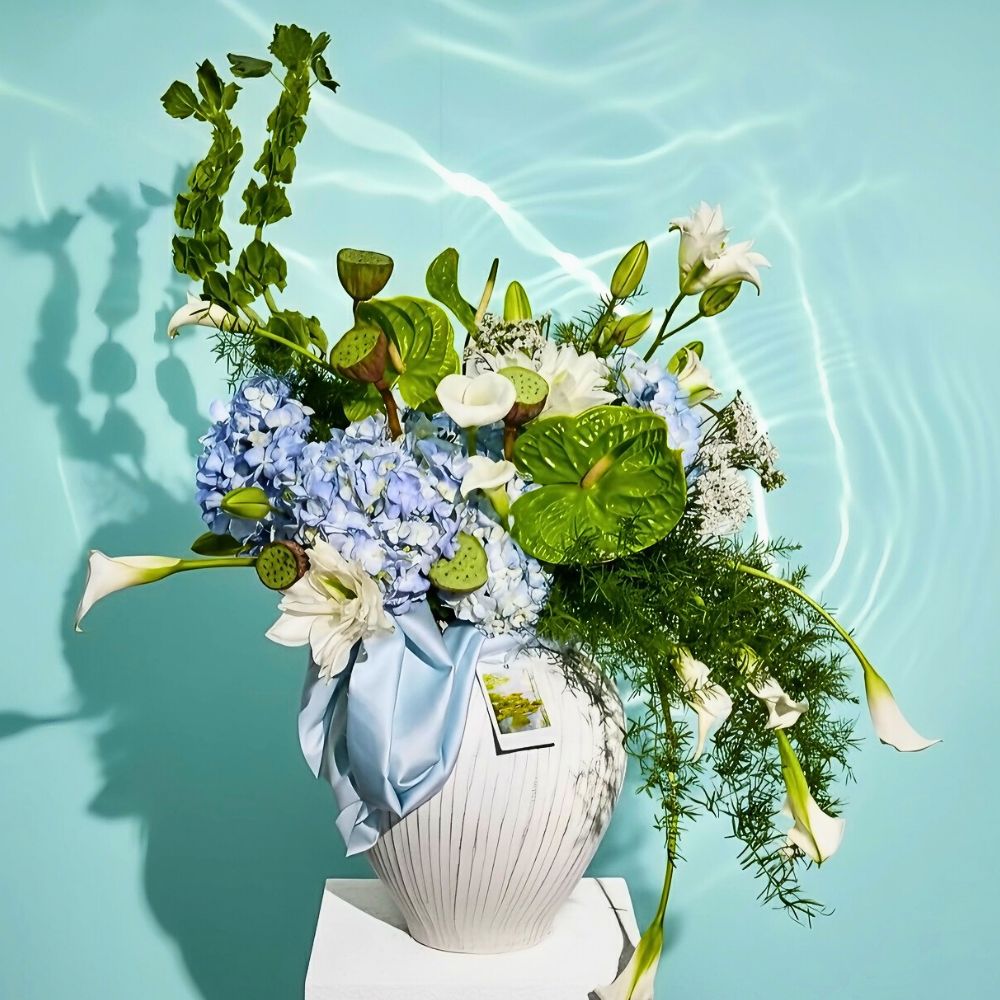
Lotus flowers were chosen as a direct reference to the water theme and to Monet’s images of water lilies, enhancing the feeling of the water’s surface, calmness, and contemplation. This line unites the individual elements into a single, continuous visual flow.
Color, Light, and Inner Balance
The color palette directly refers to Monet’s painting: cool blue and green tones recall the surface of a pond, while white flowers act as light accents, similar to water lilies on the water. Green foliage and elongated lines enhance the sense of depth and reflection.
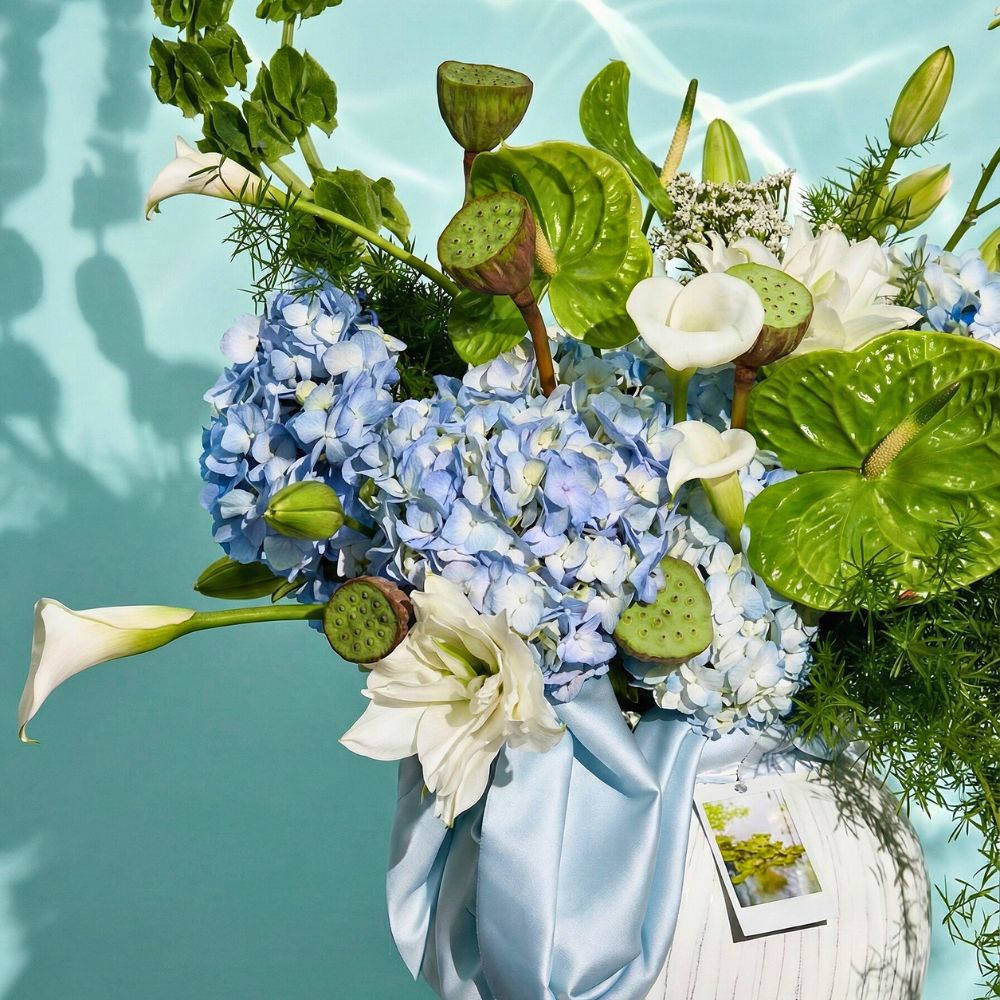
The above arrangement mimicking Claude Monet's water lilies project was made through a combination of different flowers like Hydrangeas, double Liliums, Anthuriums, Callas, Asparagus, and lotus flowers.
For me, it was important to convey a state of silence, contemplation, and inner balance that is characteristic of the water lilies series. Floristry here becomes a way to capture not an image, but the sensation of a moment.
All pictures courtesy of Valentina Pospelova