Black flowers are rare, and that's the whole point of them. A dark bloom in a bouquet or a garden bed pulls the eye before anything else does. But one thing first, before the list. No flower is truly black. What people call black flowers are very dark purple, deep maroon or almost-black red, and the darkest ones only look black in certain light. The best black flowers are the ones that get closest, hold that color on the plant and in the vase, and are actually available, as a cut flower or as a garden plant. Here you find the 15 best black flowers, why they look black at all, where you can buy them and how to grow them. Here they are.
Why No Flower Is Truly Black
The color comes from anthocyanins, the same pigments that make a red rose red and a blue delphinium blue. In black flowers the concentration is so high that the petal absorbs almost all the light that hits it, so what you see is a very deep purple or red that reads as black. There's a practical side to that too. Dark petals absorb more solar heat than light ones, which means the flower and its nectar run warmer, and bees prefer warm nectar over cold nectar. So a dark flower isn't a mistake of nature, it's a strategy.
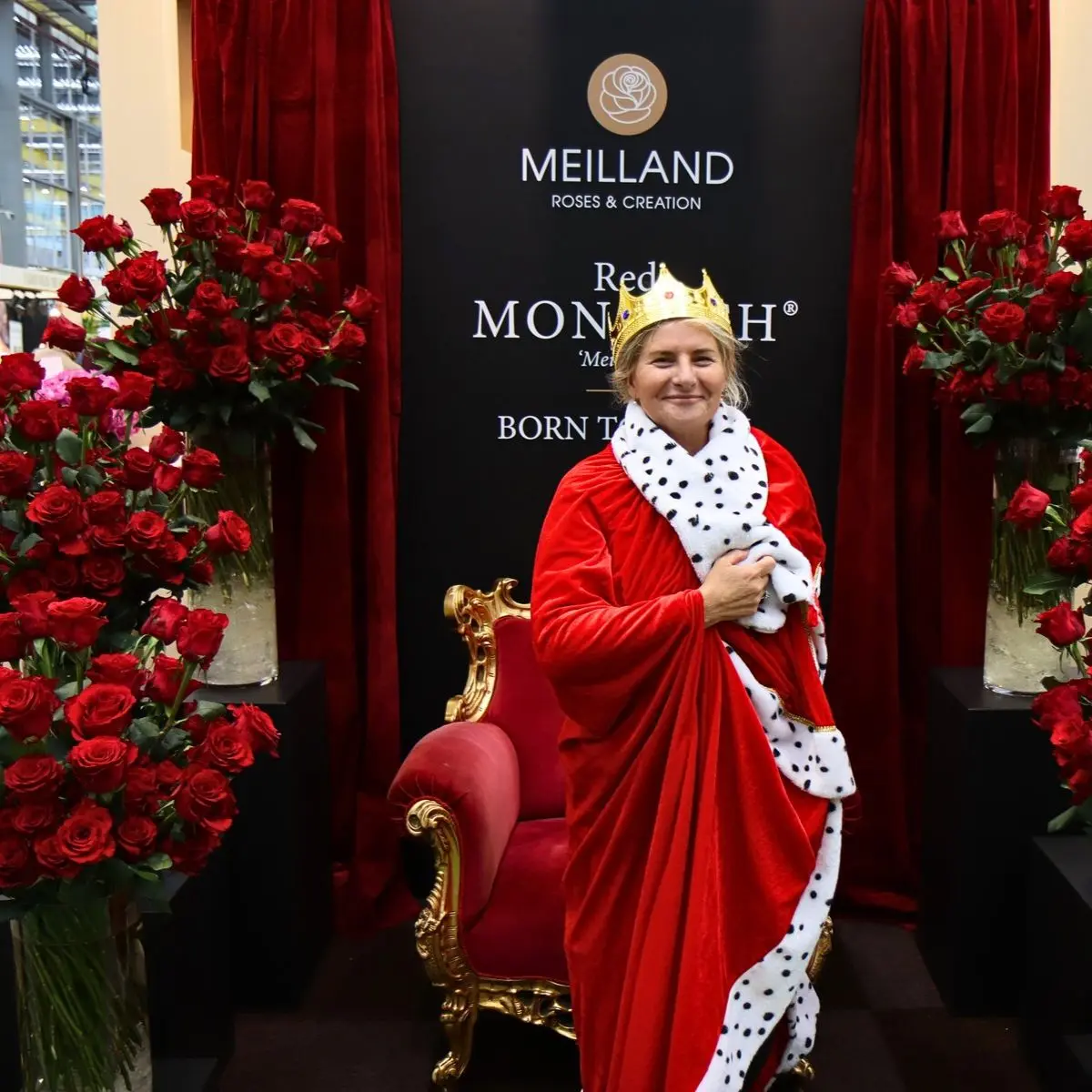
The reason breeders never get to real black was explained on Thursd by Matthias Meilland, fifth generation of the House of Meilland, in an interview about black roses. "The Black Baccara is one of the darkest roses in the world, cutting it from the plant it will stay black. But real black doesn't exist in roses. You miss the genes for real black." That's the honest answer, and it applies well beyond roses. There is more about it in Black Roses, Do They Exist Naturally?
What Black Flowers Mean
In the language of flowers, black stands for mystery, elegance and power. It can also represent farewell, mourning or the unknown, which is why you see dark flowers at funerals and in Halloween decor. In some readings black flowers also stand for transformation and new beginnings, the dark before the light. But the meaning has moved. Today a dark bouquet at a wedding says confidence and a bit of rebellion, and a black flower in a mixed arrangement is there for a striking contrast, not for grief. So don't be afraid of them. Just know what the person receiving them will read into it.
The 15 Best Black Flowers
From black roses to dark orchids, here you find the best black flowers to experiment with in your next arrangement or your garden. Each one comes with when they bloom and what they need, because that is where most of the questions come from. Most of them bloom from late spring through the season into fall, a few bloom in winter, and the tropical ones bloom whenever they feel like it. Check the list to find your next favorite.
1) Black Calla Lily Odessa and Others
The black calla lily or Zantedeschia makes a dramatic statement in a bouquet, especially a wedding bouquet, and it's one of the best black flowers there is. A black calla lily next to white or pink flowers is the easiest dramatic touch a designer can add. Calla comes from the Greek word "kallos," which means beauty, and it lives up to its name. Because of the trumpet-like shape the calla is also linked to victory, and in paintings of the Virgin Mary it stands for resurrection, faithfulness and purity. Besides the variety Odessa, the varieties Black Diamond, Escape, Cantor and Captain Beretta are available in the trade, and Odessa also comes as a pot plant.
Growing: a tender bulb for full sun to partial shade and moist, well drained soil. Plant after the last frost, lift the rhizomes in fall where it freezes. Flowers early summer to late summer, 40 to 60 cm tall. For the vase and the garden.

Photo: Thursd
2) Black Pansy, Viola Cornuta Molly Sanderson
Pansies are one of the most common garden flowers, and a black version of this species exists too. The black viola Molly Sanderson appears in spring and complements multi-colored pansies or yellow flowers thanks to its light yellow center. These black flowers do well in garden beds and in containers, so they work for table centerpieces or aisle decor as much as for the border.
Growing: a short-lived perennial, usually grown as an annual. Full sun to partial shade, moist, well drained soil with some organic matter. In bloom from early spring into summer and again in fall once the heat breaks, 15 cm tall. Garden plant, fast growing from a plug.

Photo: Thursd
3) Black Anthurium Nero
The black anthuriums Black Love and Black Queen are both very dark purple and red, looking almost black, and even more so when the flowers are a bit older. Those are cut flowers. Anthurium Nero is the almost black variety that is also grown as a plant. The dark spathe against the glossy green leaves gives you the striking contrast that makes anthurium a designer's flower.
Growing: a tropical houseplant. Bright indirect light, never full sun, a loose well drained mix, regular watering without sitting wet. Flowers year round indoors, out of direct sunlight. For the vase and as a houseplant.
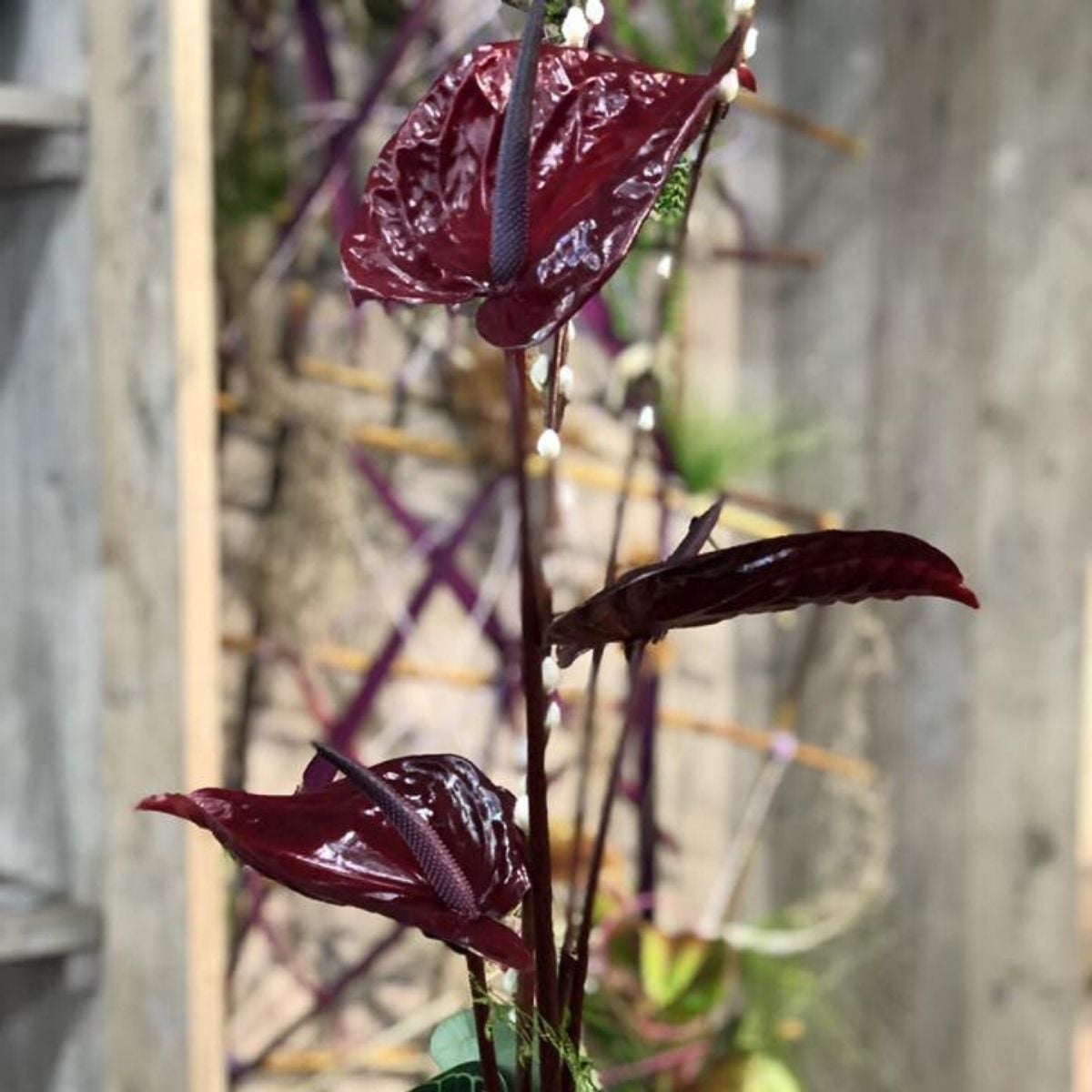
Photo: Thursd
4) Black Hellebore Kissi Royal Maroon
Most Helleborus species are pink or white, and the common name is hellebore. This rare form is a deep purple, almost black. It's lovely to look at, but every part of the plant is poisonous, which only adds to its dark reputation. Hellebores flower in late winter to early spring for about a month, when nothing else does, and that alone makes them worth having.
Growing: a hardy perennial for partial shade or dappled shade under trees, in rich, moist, well drained soil with plenty of organic matter. Flowers late winter to early spring, 30 to 45 cm tall. Garden plant, and it lasts in a vase once the seed pods form.
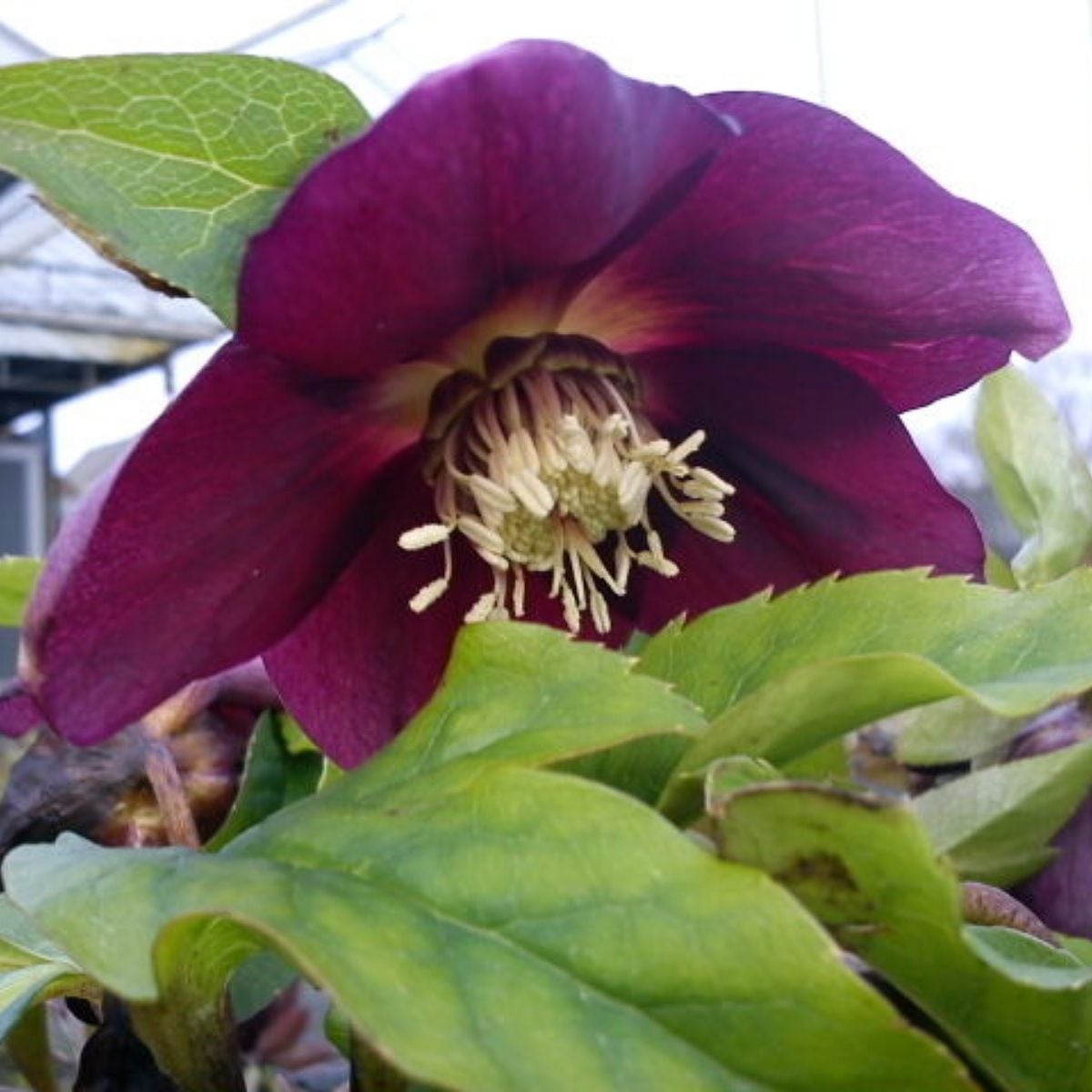
Photo: Thursd
5) Black Lisianthus, Eustoma Bohemian Black Violet
This fairly new variety of lisianthus is grown by Montana. Lisianthus Bohemian Black Violet is one of the Bohemian series of this grower and an enormous hit with floral designers all over the world, because it gives you the look of a dark rose with a much longer vase life.
Growing: as a cut flower it's a greenhouse crop. In the garden lisianthus wants full sun, well drained soil and no wet feet, and flowers from midsummer to late summer. For the vase first, garden plant for the patient.
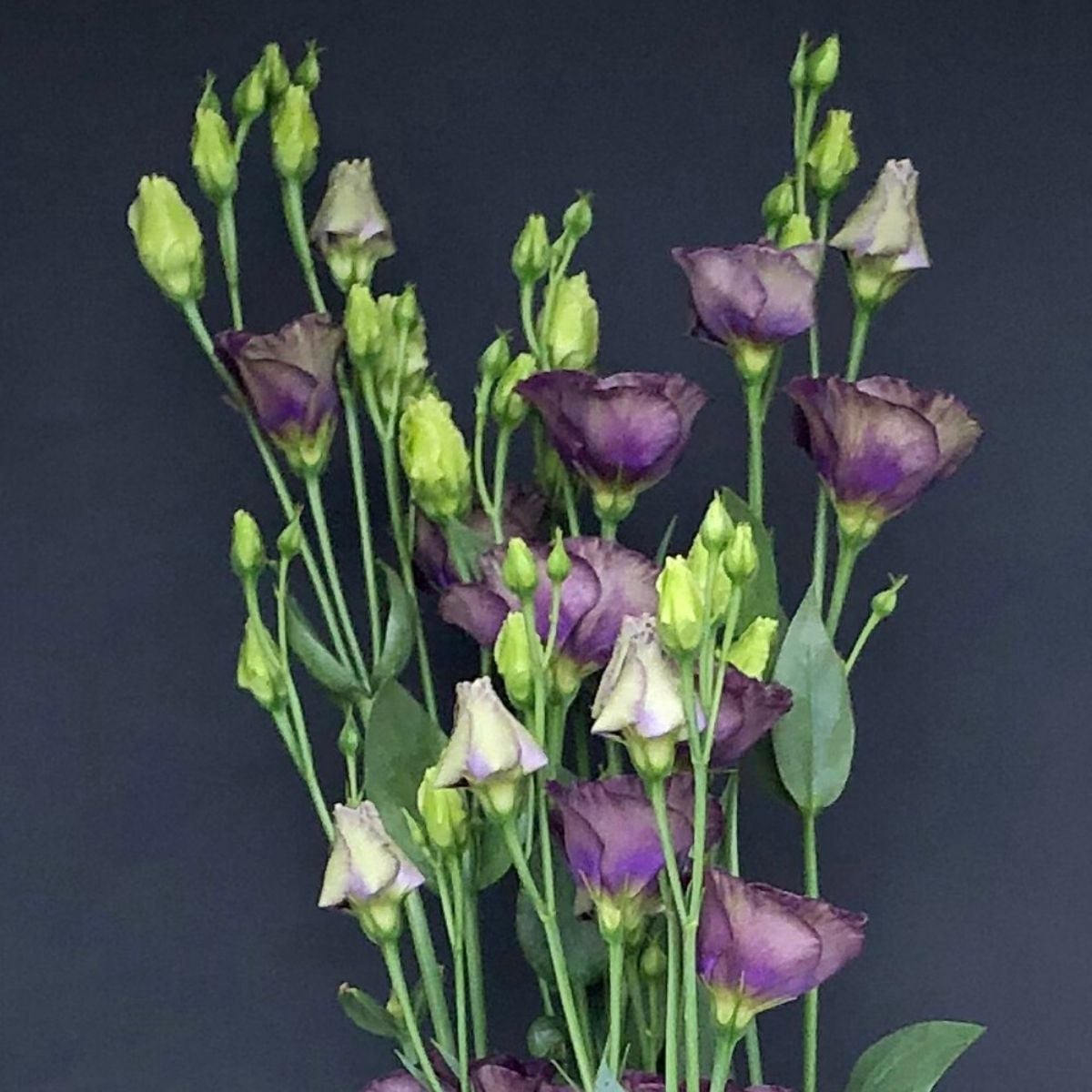
Photo: Thursd
6) The Black Tulip Queen of Night
The oldest and most famous black tulip was La Tulipe Noire, which appeared in 1891 and is no longer in production. The darkest tulip on the market today is Paul Scherer, found in 1986, but Queen of Night, introduced in 1944, is still in production and available. The flowers are a deep maroon-black with a satin sheen, on stems of about 60 cm (24 inches), and they bloom late in the tulip season. There are darker novelties now, but Queen of Night is the one everybody can get, as a bulb and as a cut flower. There is a separate list of the black tulips that get closest.
Growing: plant the bulbs in fall, 15 cm deep, in full sun (tulips want at least six hours of direct sunlight) and well drained soil. In bloom late spring, up to 60 cm. For the vase and as a garden bulb.
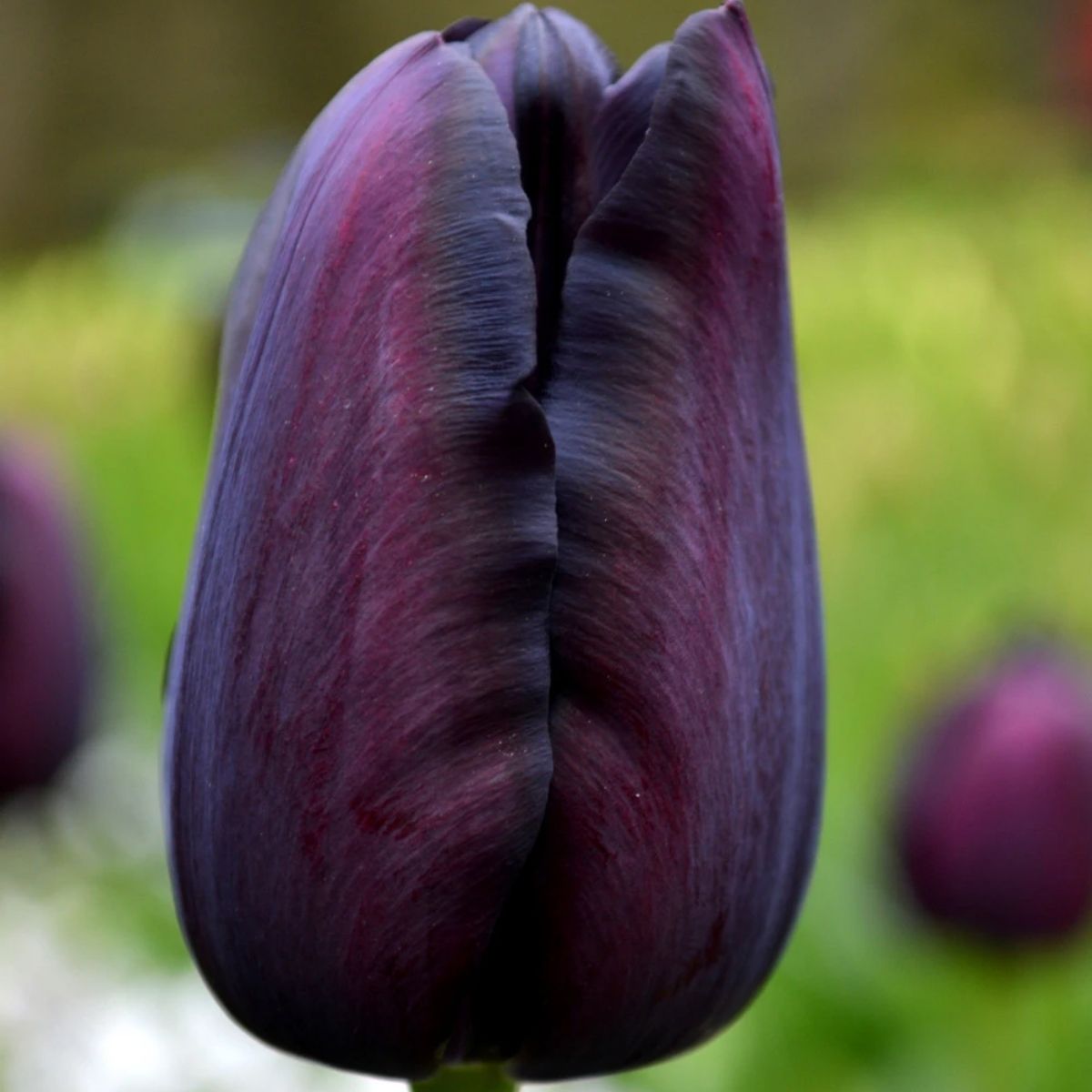
Photo: Thursd
7) Black Dahlia
Even though the black dahlia looks as dark as the night, it's in fact a very dark shade of red. It's an extremely mysterious-looking flower. In Victorian times the dahlia stood for a commitment, and the darkest ones for betrayal, which is where the name of the famous Hollywood murder case comes from. Karma Choc and Black Jack are the varieties to look for. Full sun gives you the most flowers, a bit of afternoon shade keeps the color deepest.
Growing: a tender tuber. Full sun, rich well drained soil, regular watering in summer, stake the tall ones. Flowers midsummer to frost, 90 to 120 cm. Lift and store the tubers where winters freeze. For the vase and the garden.

Photo: @Kyrnan
8) Black Bat Flower, Tacca chantrieri
The bat flower is often sold as a black orchid, but it isn't an orchid at all. Tacca chantrieri comes from Southeast Asia and belongs to the Dioscoreaceae, the yam family. The flower looks like a bat in flight, deep brown to black with long whiskers that can hang down 30 cm or more. It's a talking point in any collection.
Growing: a tropical for dappled shade or partial shade, high humidity and a loose, moist, well drained soil. Never full sun. Flowers late spring to early fall in warm conditions, 60 to 90 cm. Houseplant or conservatory plant, not a cut flower.
9) Black Hollyhock, Alcea Rosea Black Magic
Again, the black hollyhock is near to black but is actually a deep purple flower. The Black Magic hollyhock (some catalogs call it Nigra) is fast growing and blooms throughout summer on tall spikes that can reach 2 to 3 meters, up to 10 feet, at the back of a border. Hollyhocks symbolize friendship, and the deep purple hollyhock nobility. They're old cottage garden plants and they still stop people on the street.
Growing: a short-lived perennial or biennial. Full sun, well drained soil, shelter from wind and a stake. Sow in May for flowers the next year. Blooms from June to September at the back of borders. Garden plant.
10) Black Petunia Black Velvet
It was only in 2010 that this black flower was created. Petunia Black Velvet is the blackest flower in the world, known for its deep, dark velvet flowers. Scientists at flower breeder Ball Horticultural Company in the UK created the world's first all-black petunia through four years of conventional breeding, no genetic modification. See the news item of Channel 4 from 2010. In the garden it wants well drained soil and does best with some partial shade in hot climates, which keeps the black from fading.
Growing: an annual for containers, hanging baskets and garden beds. Full sun to partial shade, well drained soil, regular watering and feeding. In bloom from May to frost, 20 to 30 cm, spreading. Pair it with lime green or bright pink in containers. Garden plant.
11) Black Chocolate Cosmos
This maroon flower is native to Mexico. It was long thought to be extinct in the wild, but in 2014, researchers confirmed wild populations in mixed pine and oak forests in Guanajuato, Querétaro, and San Luis Potosí, according to the Cambridge University Botanic Garden. The Black Chocolate Cosmos smells of chocolate, really, and Gia Flowers grows it as a cut flower, so this is one of the few dark flowers on this list you can actually order for floral arrangements.
Growing: a tender tuberous perennial. Full sun, well drained soil, moderate water, drought tolerant once established. Blooms midsummer to fall, 40 to 60 cm. Lift the tubers before frost. For the vase and the garden.
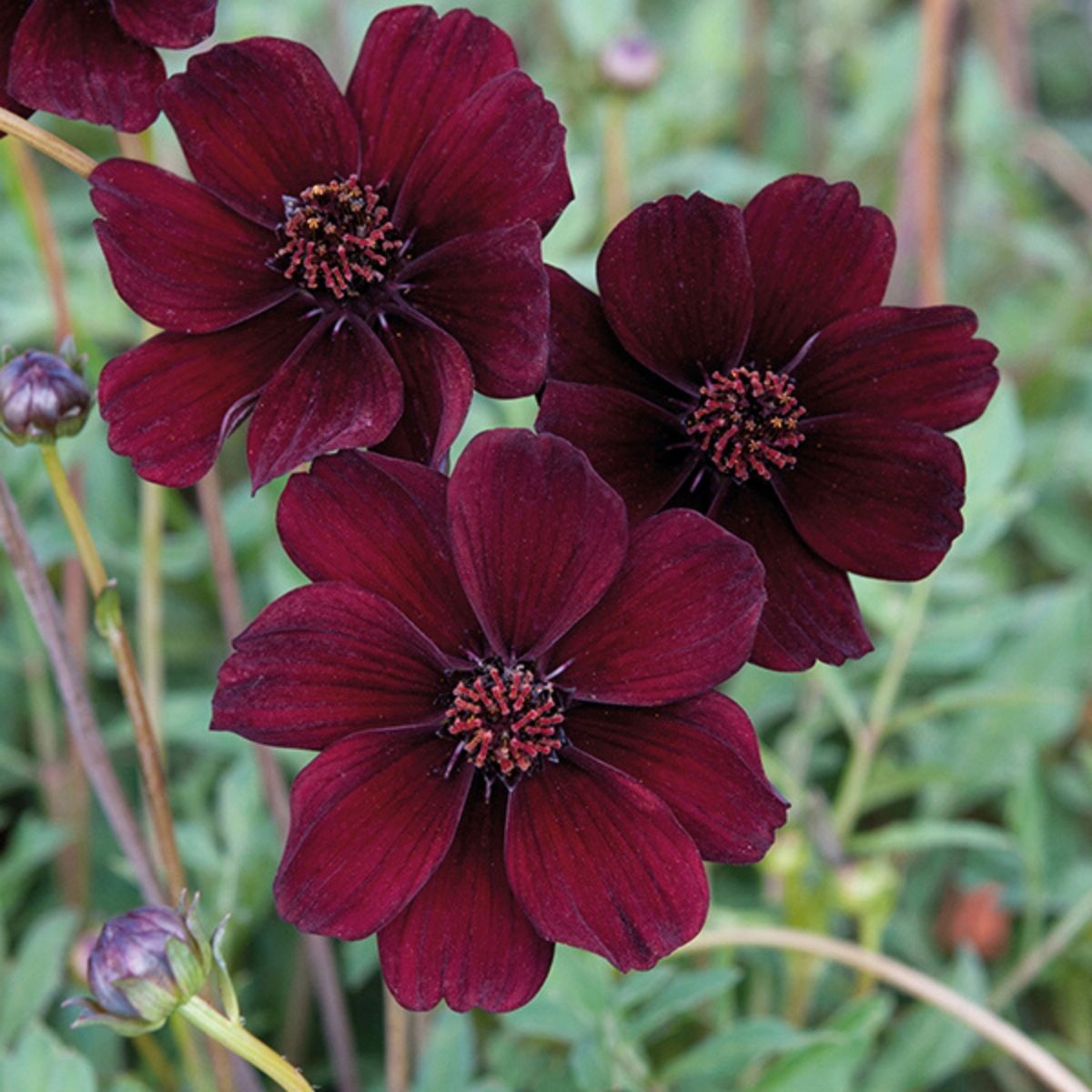
Photo: Thursd
12) Black Rose Black Baccara
This tea hybrid rose from breeder Meilland adds drama to any bouquet, vase or garden. It's one of the most loved black flowers on the market, and it has a long vase life to go with the looks. The Black Baccara rose opens very dark red, almost black in the bud, and warms up to a deep velvet red as it opens. Read the Meilland interview above for why even this one isn't truly black.
Growing: a hybrid tea rose for full sun and rich, well drained soil. Regular watering, feed in spring, prune in late winter. Blooms June to fall in full sunlight, 90 to 120 cm. For the vase and the garden.

Photo: Meilland
13) Black Iris Before the Storm
The iris comes in almost every color imaginable, including a deep purple-black. Before the Storm is a bearded iris, an Iris germanica hybrid, with sweet-scented, deep dark purplish-black flowers in May. A black iris is the national flower of Jordan, where a wild species grows in the hills around Amman, and in the language of flowers the dark iris stands for wisdom and royalty.
Growing: a hardy perennial rhizome. Full sun, well drained soil, plant the rhizome shallow with the top exposed, divide every three years. Blooms May to June, 80 to 90 cm. Garden plant, and good in a vase. Pair it with lavender and blue flowers.
14) Black Geranium, Geranium Phaeum
Also called mourning widow or black widow, Geranium phaeum is native to southern, central and western Europe, where it grows in shady, damp places. It has deeply cut green foliage and small dark maroon-purple flowers with reflexed petals, held in loose clusters from late spring. It's one of the few black flowers that's happy in shade, and it makes a good ground cover under shrubs, where other flowers give up.
Growing: a hardy perennial for partial shade to dappled shade and moist soil. Cut back after flowering for a second flush. Blooms May to June, 60 cm. Ground cover and garden plant.
15) Black Fritillaria Persica Purple Dynamite
The last on the list is Fritillaria persica, commonly called Persian lily, a bulbous perennial of the lily family. Purple Dynamite is a very special strain. It's a deep, shiny dark purple on both sides of the bell, up to 30 bells on a stem of a meter, and it flowers in mid spring when the tulips are just getting going.
Growing: plant the big bulbs in fall, on their side, 20 cm deep in full sun and very well drained soil. Blooms in April, 80 to 100 cm. Garden bulb, and spectacular in a vase.
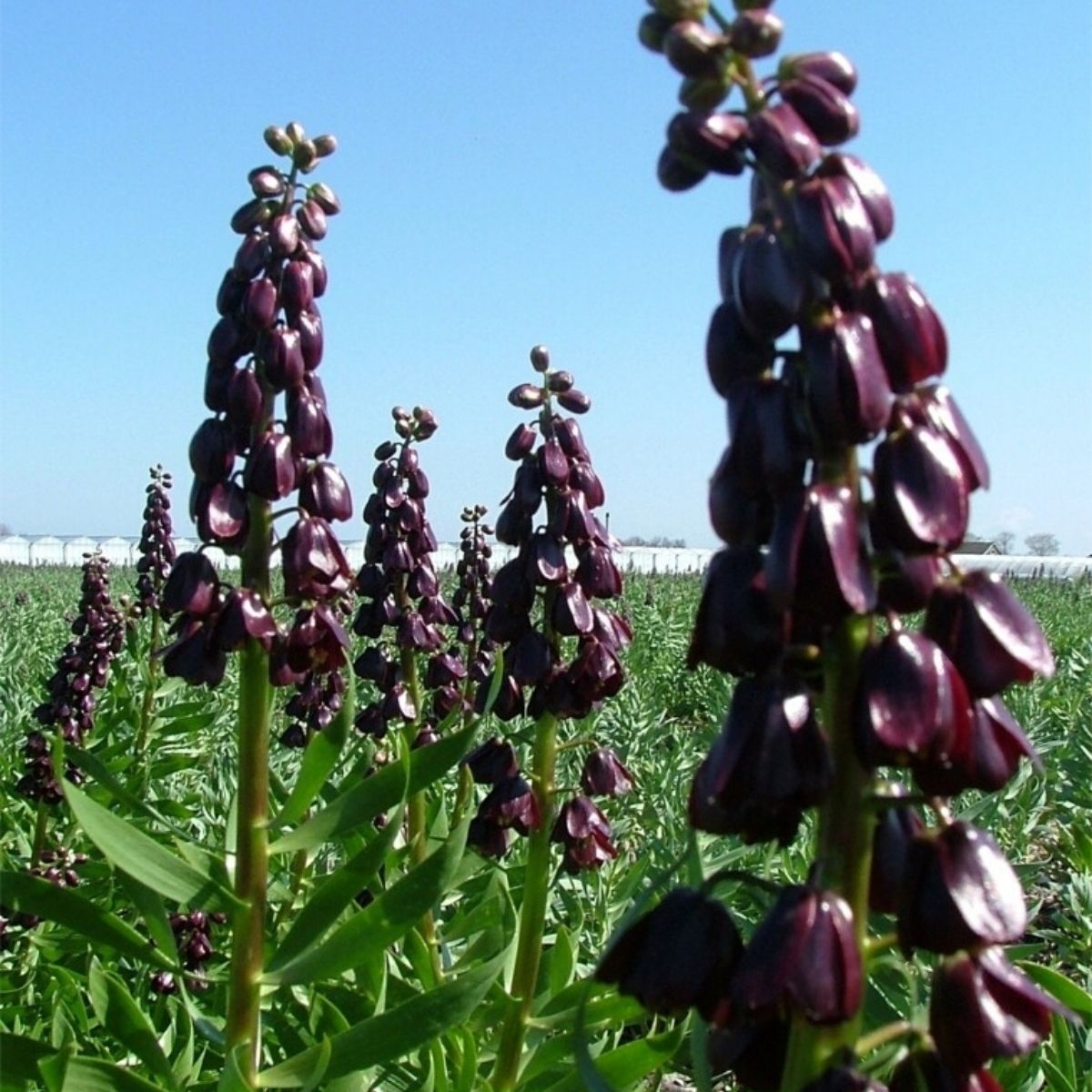
Photo: Thursd
More Black Flowers Worth Knowing
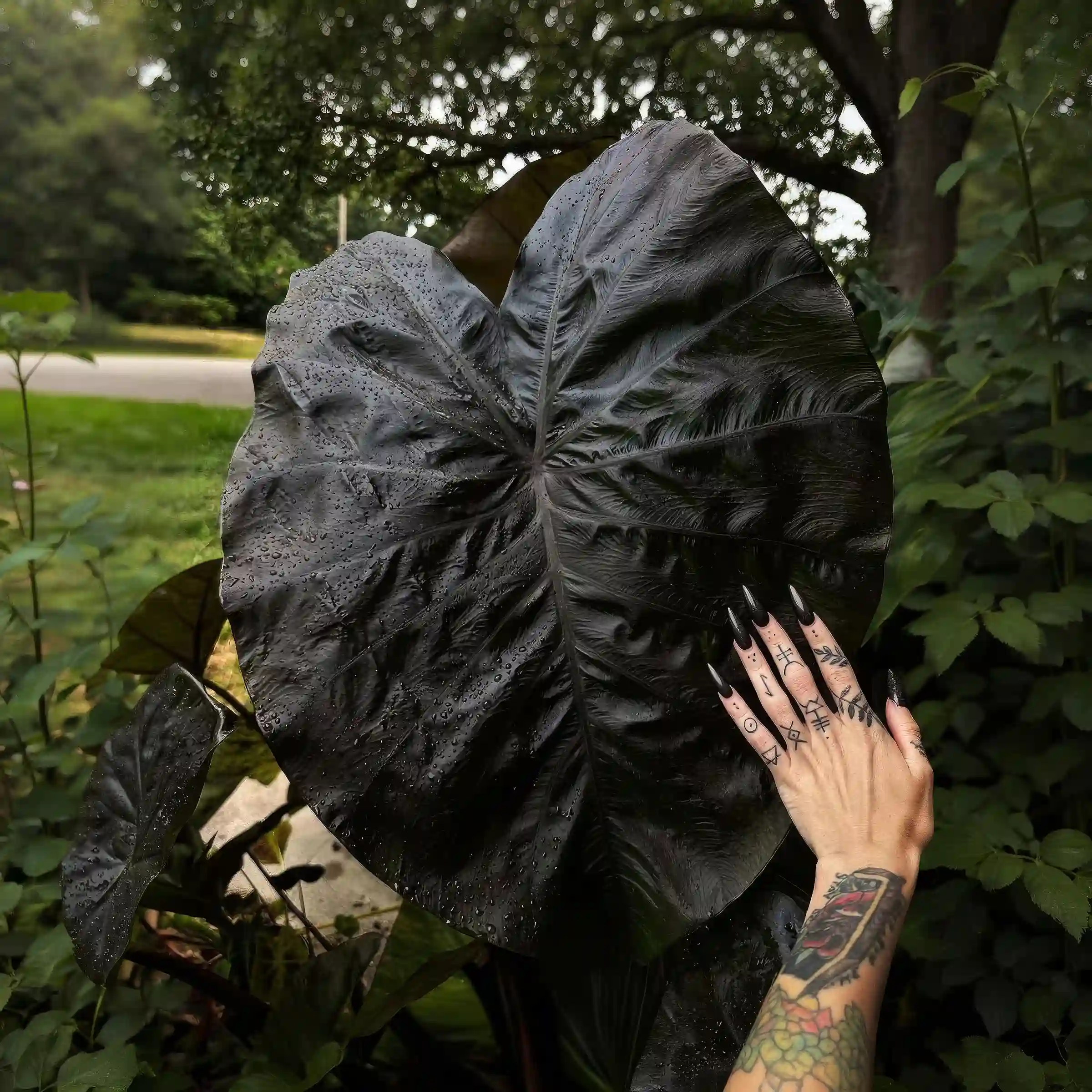
Fifteen is a list, not a limit. Midnight Mystic is a near-black hyacinth introduced in 2005. Black Velvet is also the name of a very dark petunia's cousin among the violas. The elephant ears Colocasia Black Magic and Black Coral aren't flowers at all, but they're the dark plants gardeners use to back up a black border. And the nearly black dahlia and calla families keep producing new dark varieties every year, so check what your supplier has.
Where to Buy Black Flowers
Most black flowers on this list are garden plants first. The ones you can order as cut stems through the trade are the callas, the anthuriums, Lisianthus Bohemian Black Violet, Queen of Night tulips, the black dahlias, Black Baccara roses, chocolate cosmos and fritillaria in spring. Arend Roses still grows Black Baccara as a cut flower, and Tambuzi in Kenya grows the old dark scented rose Papa Meilland in very limited numbers. Gia Flowers is the address for chocolate cosmos. For a black bouquet, a florist will usually build on dark roses or callas and add texture with dark foliage, dried elements and one or two of the lighter contrast flowers.
For the garden, buy bulbs and tubers in fall (tulips, fritillaria) or spring (dahlias, callas, cosmos), and buy the perennials and annuals as plants. Black flowers for a wedding are almost always dark roses, callas, dahlias and anemones, in that order of availability, and the unique varieties on this list sell out first in the season.
How to Grow Black Flowers
Light
Most black-flowering plants want at least six hours of direct sunlight a day, and full sunlight gives you the deepest pigment. Less sunlight, less black. Deep shade washes the color out and gives you fewer flowers. The exceptions on this list are the hellebore, the geranium, the anthurium and the bat flower, which all want partial or dappled shade. In very hot climates, a little afternoon shade stops the dark petals from scorching.
Soil and water
Rich, well drained soil with some organic matter suits nearly all of them. Overwatering is the fastest way to lose a black-flowering plant, because the dark tubers and bulbs rot before you see a problem above ground. Water deeply, then let the top of the soil dry. The drought tolerant ones, chocolate cosmos, hollyhock and the bearded iris, want even less.
Season and care
Plant bulbs in fall and tubers after the last frost. Deadhead the annuals and the dahlias every week to keep them flowering through the growing season, and lift the tender tubers before the first hard frost. Give the tall ones, hollyhock and dahlia, a stake before they need it.
Black Flowers in Arrangements
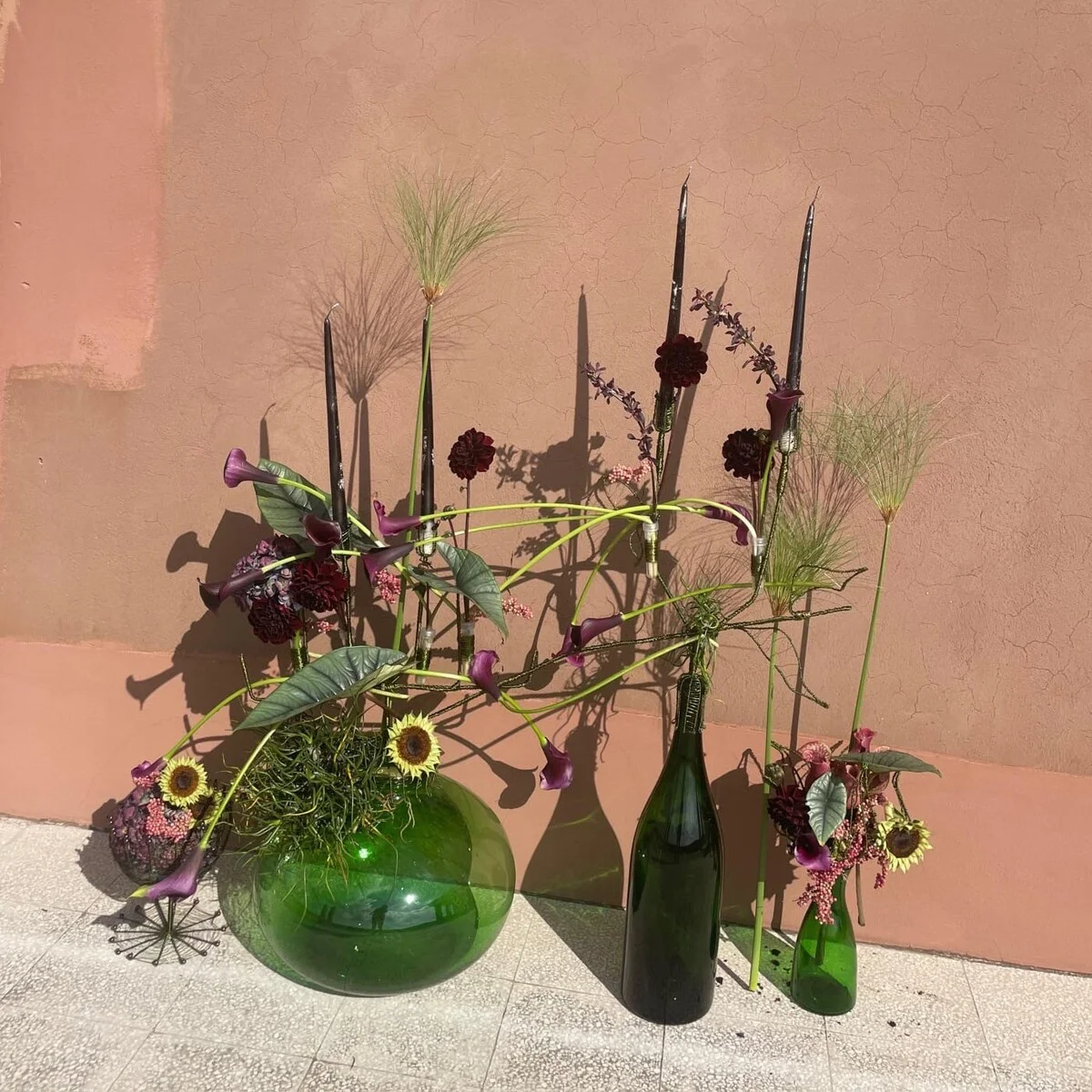
A dark bouquet works because of contrast. Pair black callas or Black Baccara with white, cream or pale yellow flowers and both get stronger. Pair them with lavender, blue or bright pink and you get a dramatic effect without the gloom. Put them next to other dark flowers and dark foliage and you get the gothic look, which sells around Halloween and for a certain kind of wedding. In a garden bed, black flowers disappear against dark soil and mulch, so plant them in front of silver foliage, lime green or pale pink, or against a light wall, and keep them to the front of the borders where the ground is lighter. One dark flower in a mixed border adds drama. Ten of them add nothing, because there's nothing left to contrast with.
Some of the 15 best black flowers are also to be found in Kat Von D's garden, about which you can read more in 20 Gothic Garden Flowers by Kat Von D. And if you're building the black cluster in your shop or garden, the pieces on black roses, black tulips and the black dahlia go deeper on each.
About the author: Arnold Wittkamp is the founder of Thursd. He spent 35 years in the floral chain, as a florist, an importer and an international marketer, before building the platform. Connect with Arnold on LinkedIn.