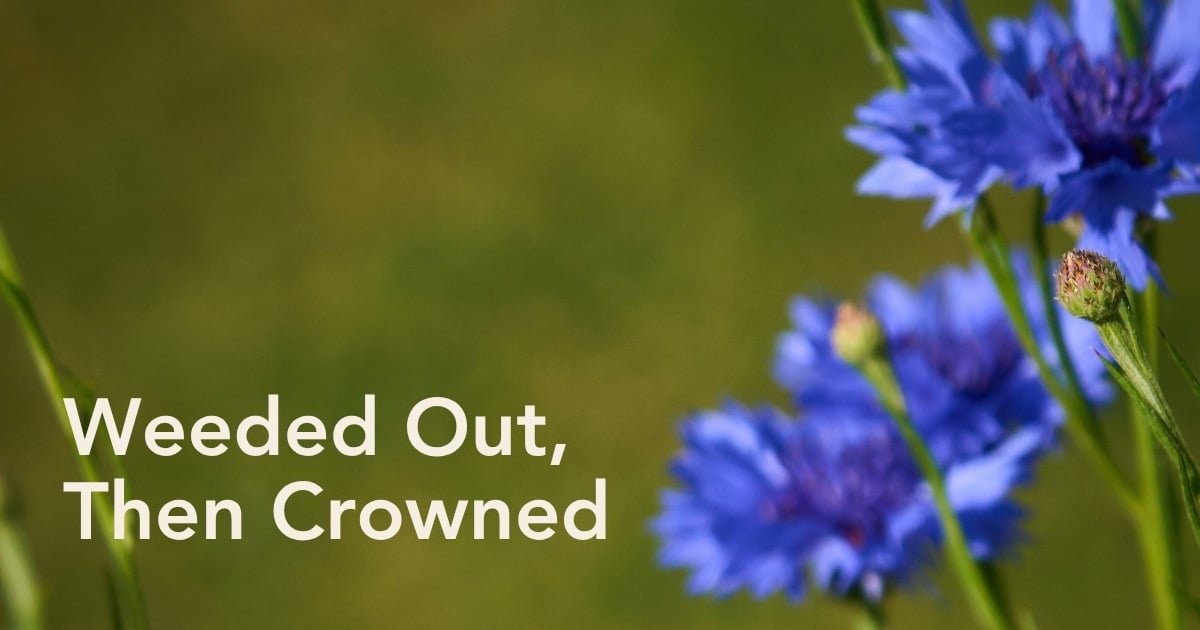
For centuries, farmers tried to get rid of the cornflower. It came up in their wheat, rye, and barley and turned the fields blue in summer. Then a Prussian queen wove it into wreaths for her children, and her son, the future German emperor, never forgot it. Estonia later made it its national flower. Today, the blue cornflower, Centaurea cyanus, also sold as bachelor's button, is an easy garden annual and a summer cut flower that Dutch growers send to auction. You can even put the petals on a salad.
This guide covers what the plant is, the cornflower meaning across 200 years of history, how to grow it from seed, and how to get a week out of it in a vase.
What Is a Cornflower?
The cornflower is an annual in the daisy family, Asteraceae, that grows to about 75 cm (30 in) on thin, branching, gray-green stems. It arrived in Central Europe with grain farming, most likely from the eastern Mediterranean and the Near East, and it grew among the crops for so long that it took their name: in British English, "corn" means any grain, not just maize.
What looks like one flower is a whole head of small tube-shaped florets. The outer ring is sterile, and those florets are enlarged and frilled to catch the eye of bees, while the fertile florets in the middle make the seed. That is where the ragged, star-like outline comes from. The names are Greek. Centaurea refers to the centaur Chiron, who in Greek myth knew the art of healing and treated the wound of a poisoned arrow with the plant, and cyanus comes from kyanos, the Greek word for dark blue.

Is Cornflower the Same as Bachelor's Button?
Yes. Cornflower and bachelor's button are two common names for Centaurea cyanus, and the Royal Horticultural Society also lists bluebottle, cornbottle, and blue sailors. The story usually told about bachelor's button is that young men wore the flower in a buttonhole when they were in love or ready to court. The name travels, though. In the US, bachelor's button is also used for globe amaranth, Gomphrena globosa, a different plant with round, papery flower heads. When you order seed, check the botanical name on the packet.
Why Cornflower Blue Is So Rare
True blue is hard for a plant to make, and the cornflower does it with a borrowed molecule. Its pigment, protocyanin, is built on the same anthocyanin that makes a rose red. In 2005, Japanese researchers published its crystal structure in Nature and found six anthocyanin molecules and six flavone molecules held together by one iron, one magnesium, and two calcium ions. That metal complex is what turns rose red into cornflower blue. The guide to blue flowers explains why so few flowers manage a true blue at all.
Cornflower Meaning and Symbolism
In the Victorian language of flowers, the cornflower stood for delicacy. Kate Greenaway's Language of Flowers (1884) lists it twice, as Corn Bottle and as Bluebottle, both with that meaning, and gives Bachelor's Buttons, a name the cornflower shares with other plants, an entry of its own: celibacy. The buttonhole tradition points the other way, toward courtship. Over the last 200 years, Prussia, Estonia, and France each gave the flower a meaning of its own, and those histories are what a cornflower still carries when you give it. Closer to home, blue cornflowers were part of Sky Blue, the Thursd floral trend color of 2024.
A Flower for a Prussian Queen
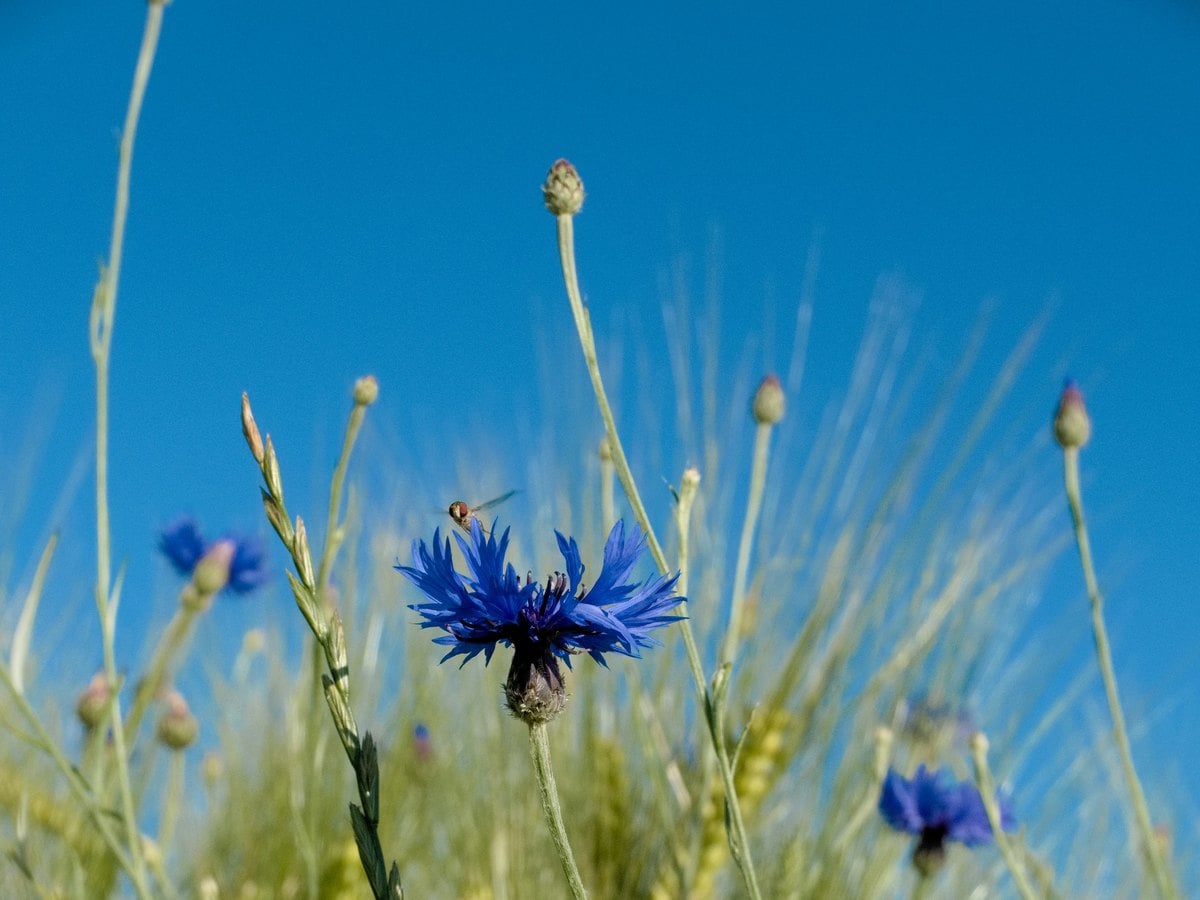
The cornflower's royal career started at the side of a road. In 1806, after Napoleon defeated Prussia at Jena and Auerstedt, Queen Louise of Prussia fled east with her children. When a wheel of their carriage broke, the family had to wait at the edge of a field, and Louise passed the time weaving cornflower wreaths for the children. Her son Wilhelm, nine years old at the time, never forgot it. As Kaiser Wilhelm I, he made the cornflower his favorite flower, and before he went to war, he laid a bunch on his mother's grave. Its blue matched the blue of Prussian uniforms, and his supporters wore it in their buttonholes, as Peter Schubert and Hilke Steinecke tell it in the journal of Frankfurt's Palmengarten. The symbolism later turned dark: in 1930s Austria, the then-banned Nazi party used the cornflower as a secret symbol, and in 2019, a new German far-right party chose it for its emblem, The Guardian reported.
Estonia's National Flower
In Estonian, the cornflower is rukkilill, the rye flower, because it grew in the rye fields. It was chosen as the national flower in 1968, in a selection that began on an Estonian television quiz show, according to the Estonian Environment Agency. Under Soviet rule, a blue flower was not a neutral thing. According to Schubert and Steinecke, the Soviet authorities saw the cornflower decorations at the 1969 Estonian Song Festival as an anti-communist symbol and ordered the flowers dyed red. In 2024, the Estonian central bank, Eesti Pank, put the cornflower on a two-euro coin.
The Bleuet de France
In France, the cornflower, le bleuet, is the flower of remembrance, much as the poppy is in the UK. During the First World War, French soldiers noticed that cornflowers kept growing on the shattered battlefields. Charlotte Malleterre and Suzanne Leenhardt, two nurses at the Invalides in Paris, had wounded veterans make cornflowers from fabric and sell them in the street, which gave the men work and raised money for them. The idea went national in 1928, the Bleuet de France association followed in 1934, and the first authorized street collection in Paris, on November 11 that year, sold more than 128,000 flowers. Since 1957, there has been a second collection on May 8, the French Ministry of the Armed Forces records. Victor Hugo had already given the flower a line of its own: Fantine's lullaby in Les Misérables starts with "Les bleuets sont bleus," as the story on the roses are red poem explains.
How to Grow Cornflowers From Seed
Cornflowers are among the easiest annuals to grow from seed, as long as they get full sun. Sow them straight into the ground where they are going to flower. Johnny's Selected Seeds, which sells them to cut flower growers, gives the numbers: sow about 6 mm (1/4 in) deep, keep the soil moist, expect seedlings in 7 to 14 days at a soil temperature of 16 to 18 °C (60 to 65 °F), and thin them to 15 to 23 cm (6 to 9 in) apart. Any well-drained soil will do, even a poor one. The flower farm and seed company Floret puts the time from sowing to first flowers at 65 to 80 days for its 'Classic Fantastic' mix.
When to sow depends on your winter. The RHS rates the cornflower hardy to between -20 and -15 °C (-4 and 5 °F), and it can be sown in fall or in spring, with fall sowings flowering earlier the next year. Where winters are hard, NC State Extension suggests starting seed indoors 6 to 8 weeks before the last frost, and sowing outdoors in fall only where winters are mild. Dutch grower Maurits Keppel sows his before winter in an unheated greenhouse in Maarssen, so the plants grow slowly through the cold months and make strong stems. For a longer season, sow a second batch a month after the first. Regular cutting or deadheading keeps new flowers coming.

Do Cornflowers Come Back Every Year?
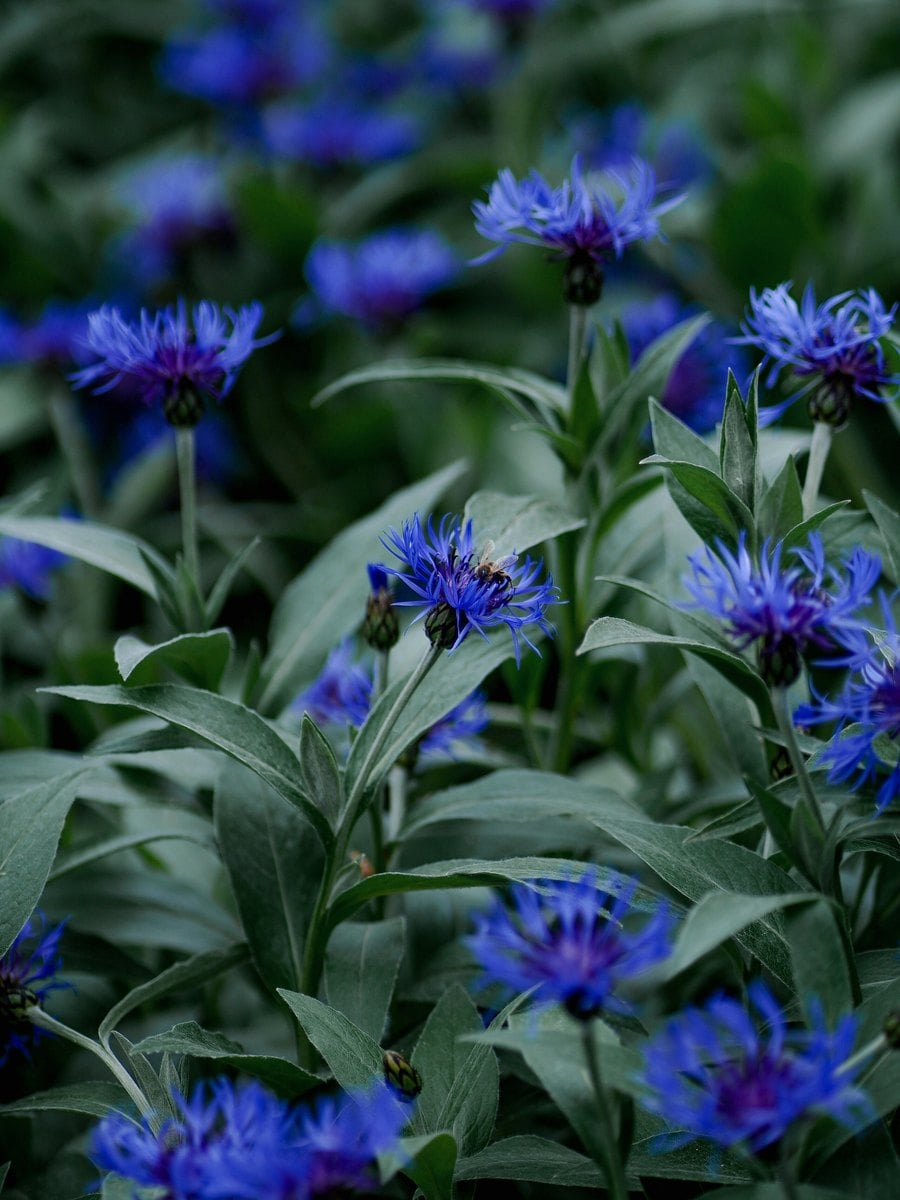
The plant itself does not. Centaurea cyanus is an annual: it flowers, sets seed, and dies in one season. It does come back in another way, because it seeds itself freely, which is one reason it shows up in lists of flowers for a wild garden look. NC State Extension warns that it reseeds and naturalizes so easily that deadheading is the way to control it. If you want a cornflower that returns from the same roots, grow its perennial cousin, Centaurea montana. Gardeners call it the mountain bluet or the perennial cornflower. It forms clumps of 30 to 60 cm (1 to 2 ft), is hardy from USDA zone 3 to 8 (NC State Extension), and has broader leaves and looser, spidery flowers. The RHS now files it as Cyanus montanus.
Is Cornflower Invasive in the US?
It is not native to North America. Centaurea cyanus comes from Europe and western Asia and has naturalized widely across the US, partly because it is a staple of "wildflower" seed mixes. Minnesota Wildflowers notes that it escapes from gardens and has been recorded as an agricultural pest in parts of the southeastern US. The irony is that it became rare in its old home. Herbicides, cleaner seed grain, and heavy fertilizing pushed it out of German fields, and Plantlife describes a dramatic decline in the UK, with some recovery since the late 1980s on unsprayed set-aside land. If you garden next to farmland or natural areas, deadhead before the seed ripens.
Cornflowers as Cut Flowers
For florists, the cornflower is a summer flower with a short window and a lot of charm. Maurits Keppel grows it organically, SKAL-certified, in his cold greenhouse. In May 2025, he told Thursd that blue and red come first, followed by white, soft pink, and more blue for the wedding season. "Blue is the main color of Centaurea because it grows the easiest, so it's always in the mix," he said. He sends out stems of about 80 cm (31 in) with the top flower fully open: "The side flowers will open at the florist's shop or later in the vase." His organic Centaurea season runs from spring into June.

Cut cornflowers when the flowers are a quarter to half open, put them in water straight away, and strip the leaves that would sit below the waterline. Expect about a week in the vase; Floret gives 7 days for its 'Classic Fantastic' mix. Cornflowers shatter when they dry out, so keep the water topped up, and build a mixed piece so they can be pulled after a few days without the design falling apart. When they fade, they are not finished. "They dry really well after blooming," Keppel says. The flowers shrink as they dry, but the petals hold their blue, which is why dried cornflower petals turn up in tea blends. The air-drying method in the guide on how to dry flowers works for them.
Colors and Varieties Florists Buy
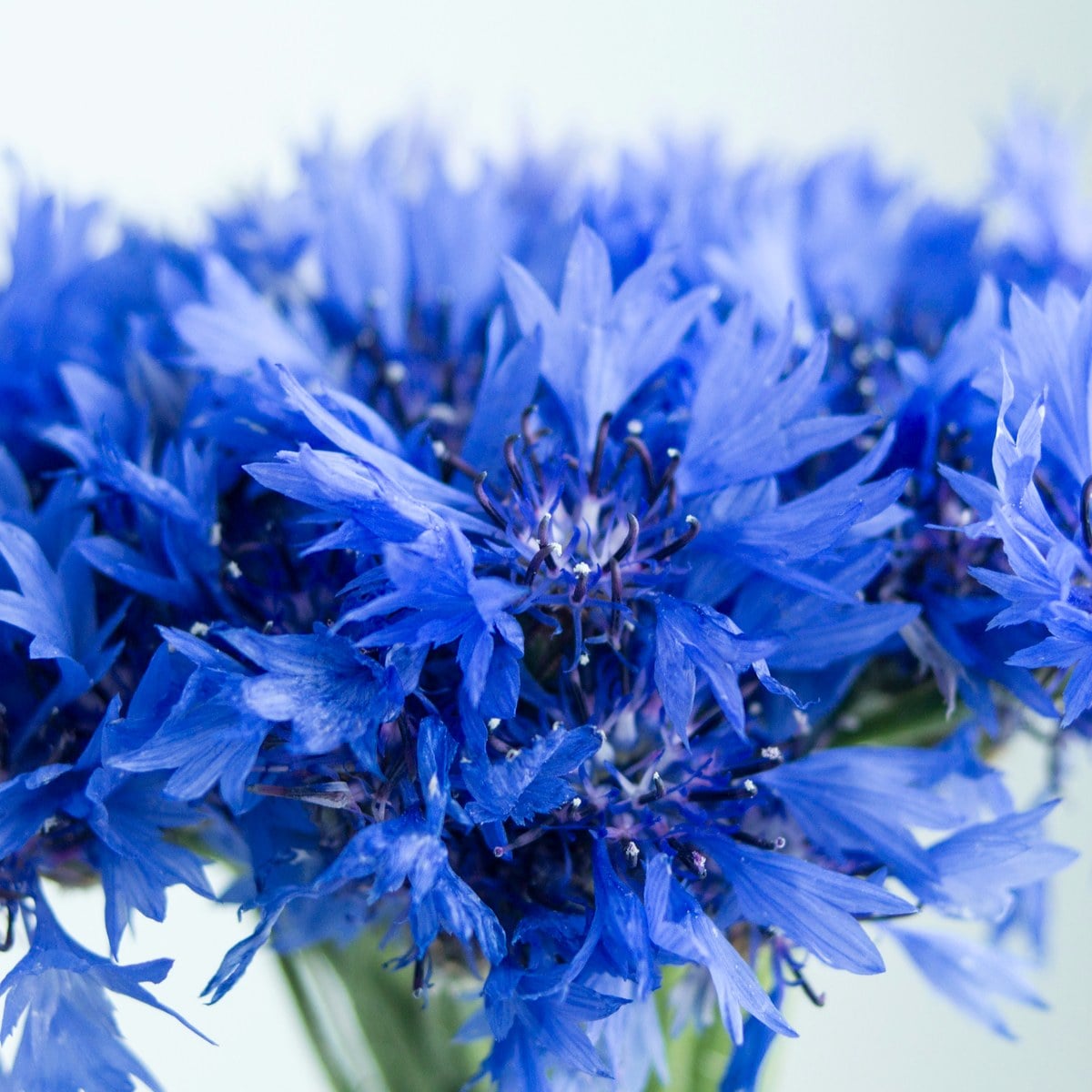
Blue is the wild color and still the one most people ask for, but seed companies offer the whole range. 'Blue Ball' is a double, bright cobalt blue of about 80 cm (31 in), and 'Black Ball' has very dark red heads of 3 to 4 cm (1.2 to 1.6 in) that read almost black in a bouquet; the RHS lists both, and names 'Black Ball' for cutting. Floret's 'Classic Fantastic' is a mix of sapphire, pale blue, and bicolor flowers on stems of 90 to 100 cm (36 to 40 in). White, pink, and lilac selections fill in the pastel side. Growers like Keppel send their stems to the Dutch auction clock under the botanical name, Centaurea, in buckets by color.


Are Cornflowers Edible?
Yes. NC State Extension lists the flowers as edible, and Johnny's Selected Seeds sells the plant as an edible flower as well as a cut flower. The petals are used mostly for color, fresh on salads, cakes, and drinks, or dried in tea. Keppel's cornflowers ended up on a salad at a King's Day festival in the Netherlands. "My cornflowers are perfectly edible, especially since they're organically grown," he said. That last part matters. Only eat flowers that were grown for eating or grown organically, never stems from a regular florist bucket, which were not raised as food. The list of edible flowers has more ideas.

A cornflower costs almost nothing to grow, and few flowers in the bucket come with this much history. Sow it in fall or spring and cut it a quarter open. For the other true blues, from larkspur and Delphinium to forget-me-not, see the blue flowers guide. For what the rest of the bucket says, there is blue flower meaning and the flower meanings A to Z.
Sources: RHS, Centaurea cyanus, 'Blue Ball', and 'Black Ball'; RHS, hardy annuals sown in autumn; Johnny's Selected Seeds, Centaurea key growing information; Floret, Bachelor's Button 'Classic Fantastic'; NC State Extension: Centaurea cyanus and Centaurea montana; Minnesota Wildflowers, cornflower; Plantlife, cornflower; Shiono, Matsugaki, and Takeda, Structure of the blue cornflower pigment, Nature 436 (2005); Kate Greenaway, Language of Flowers (1884), Project Gutenberg; Peter Schubert and Hilke Steinecke, Die Kornblume, Lieblingsblume der Preußen, Der Palmengarten; The Guardian, 11 January 2019; Estonian Environment Agency, national species; Eesti Pank, cornflower two-euro coin (2024); French Ministry of the Armed Forces, Le Bleuet de France; American Meadows, all about cornflower.
Featured image: a bunch of blue cornflowers by Nikita Turkovich on Unsplash. Header image: cornflowers in a field by Punit Chawla on Unsplash, mirrored and cropped for the header.