Ask three people what a spider lily is, and you can easily get three different plants. One is thinking of the red Lycoris radiata that comes up out of bare ground in September. One is thinking of a white tropical Hymenocallis on a windowsill. And a florist is probably thinking of Nerine, the autumn cut flower that actually turns up in the bucket on a Tuesday morning.
They are three genera, three climates and three completely different jobs. Most spider lily pages online quietly mix them together, which is how you end up with care advice for a tropical houseplant printed under a photo of a Japanese graveyard flower. So let's separate them first, then get to the meaning and the growing.
The Three Plants That Share the Name Spider Lily
Lycoris Radiata, the Red Spider Lily
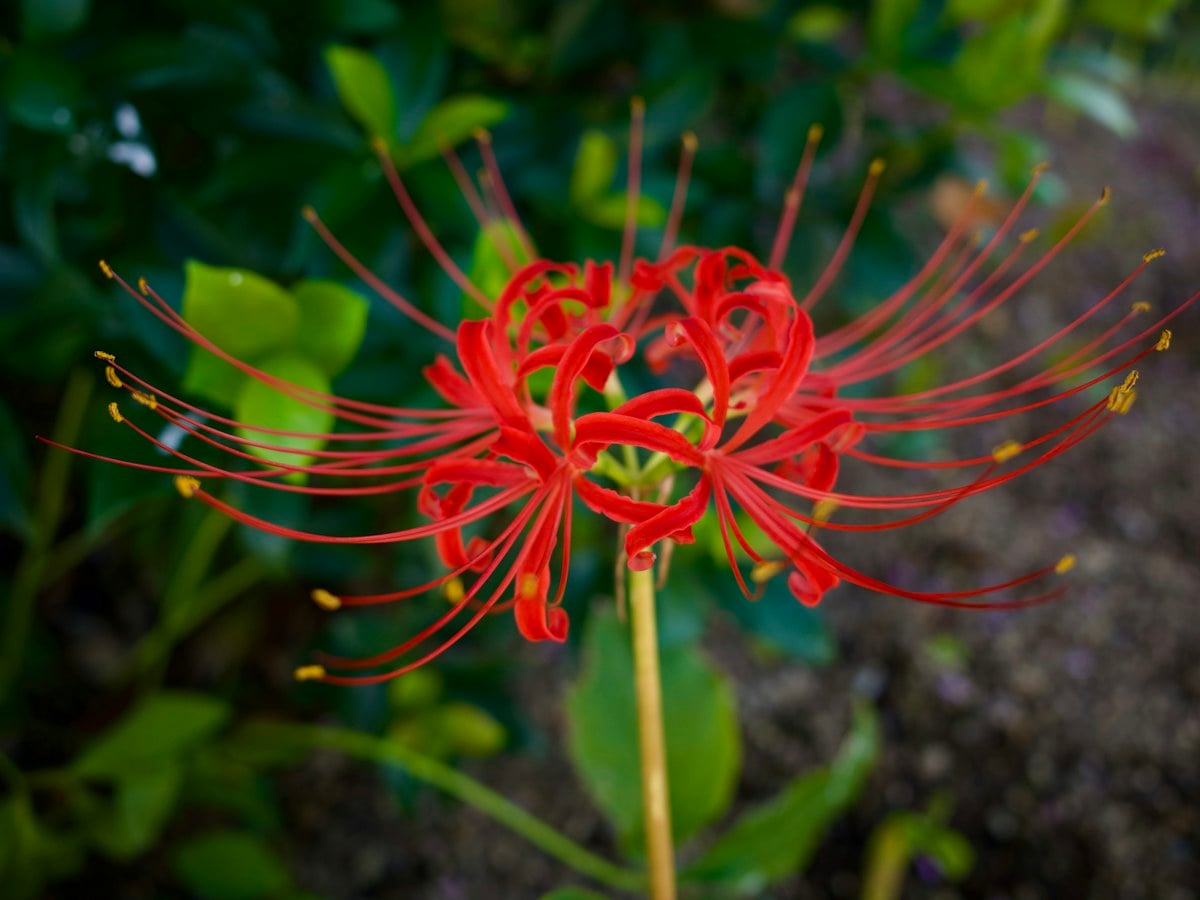
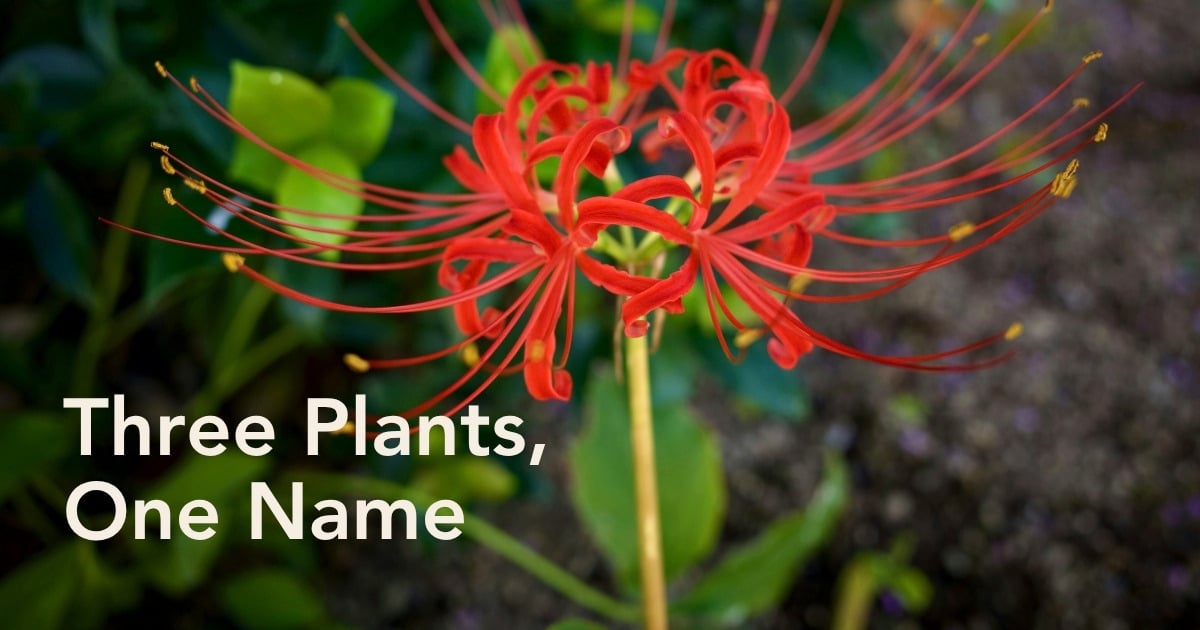
This is the one people usually mean. Lycoris radiata is a bulb in the Amaryllis family, native across China, Korea, Nepal and Japan, and it flowers in late summer and early fall. The flower is red, with six narrow, strongly recurved petals and long stamens that arc out well past them. That silhouette is where the name comes from.
Its odd habit is the real signature. The flower stem pushes up out of bare soil with no leaves at all, flowers, dies back, and only then do the gray-green leaves appear and sit through the winter. That is why the plant collects nicknames faster than most: equinox flower, hurricane lily, naked lily, red magic lily, red surprise lily. The North Carolina Extension Gardener Plant Toolbox lists all of them under the one species.
Two practical notes. The bulbs contain lycorine, an alkaloid, so they are mildly poisonous if eaten and can irritate skin on contact. That same toxicity is the reason deer leave them alone, and the reason Japanese farmers historically ringed rice paddies and burial grounds with them to keep rodents out of the soil. The graveyard association that follows this flower everywhere started as pest control.
Hymenocallis, the Tropical Spider Lily
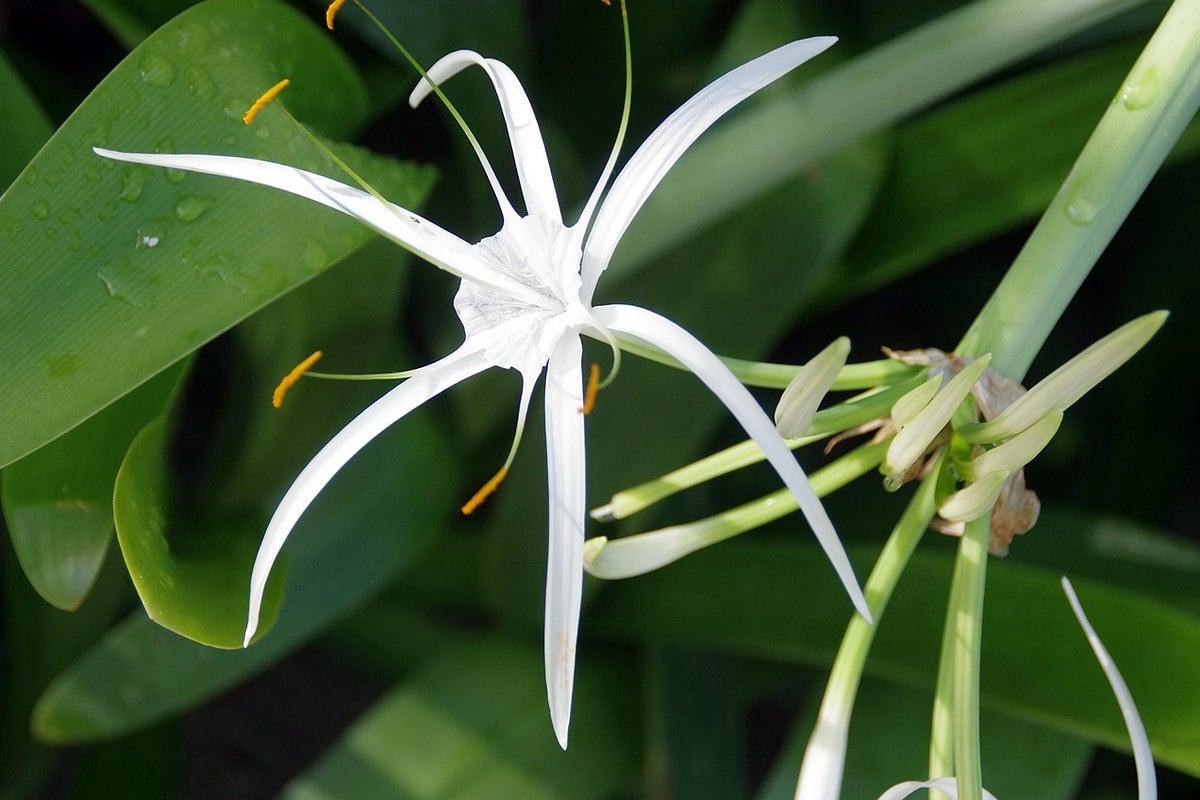
In the United States and the Caribbean, "spider lily" often means Hymenocallis, sometimes sold as Peruvian daffodil. White, heavily scented, and easy to tell apart once you know the trick: the stamens are joined by a thin membrane into a shallow cup at the center of the flower, with the free tips of the stamens sticking out beyond it. Lycoris has no cup. If you are looking at a white spider lily with a little crown in the middle, you are looking at Hymenocallis.
This is the group that most indoor care guides are actually describing. It wants warmth, humidity and bright light, it is not frost hardy, and it will sulk in a cold room. None of that applies to Lycoris, which is a hardy garden bulb.
Nerine, the Spider Lily Florists Buy
Then there is the trade answer. If you want that spidery, recurved, autumn look in a vase rather than in a garden bed, the flower you are almost certainly buying is Nerine, a South African bulb in the same family. Nerine is what fills the spider lily shape commercially, with autumn as its peak, and unlike the other two it comes with variety names, harvest windows, and vase life you can plan around.
The Dutch growers' collective All I Am, based in De Kwakel, has built its whole business on this group along with Allium, Agapanthus, and Amarine. Their Nerine range is specific in a way garden bulbs rarely are: Elegance Amor, deep red, gives 10 to 12 days in the vase when it is cut at the right stage and handled properly. Favoriet can carry up to 10 flowers on a single stem. Pink Wonder and Katjana are both Nerine bowdenii harvested in September and October, and Katjana's availability is limited enough that florists plan around it. Berenice, white with a pink edge, is named after the granddaughter of botanical illustrator Janneke Brinkman, who died young.
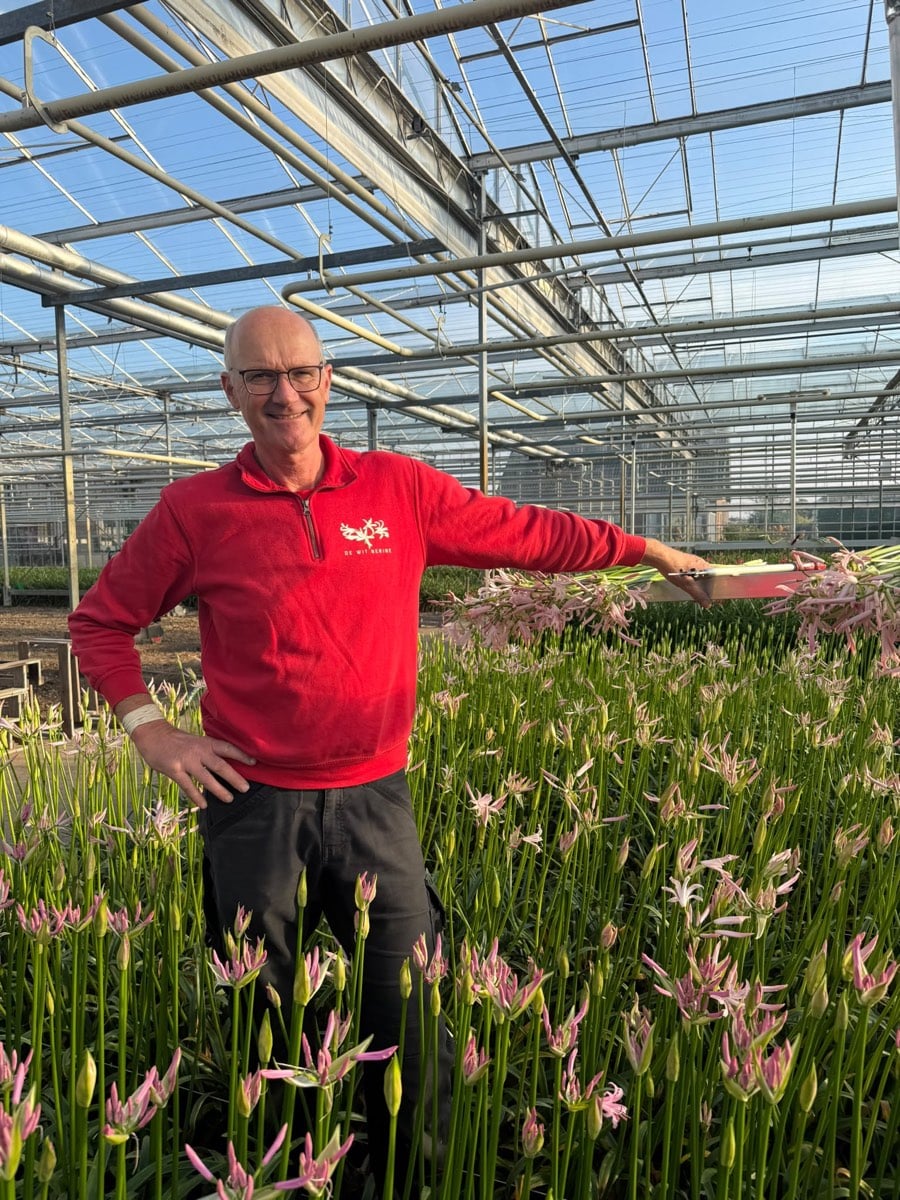
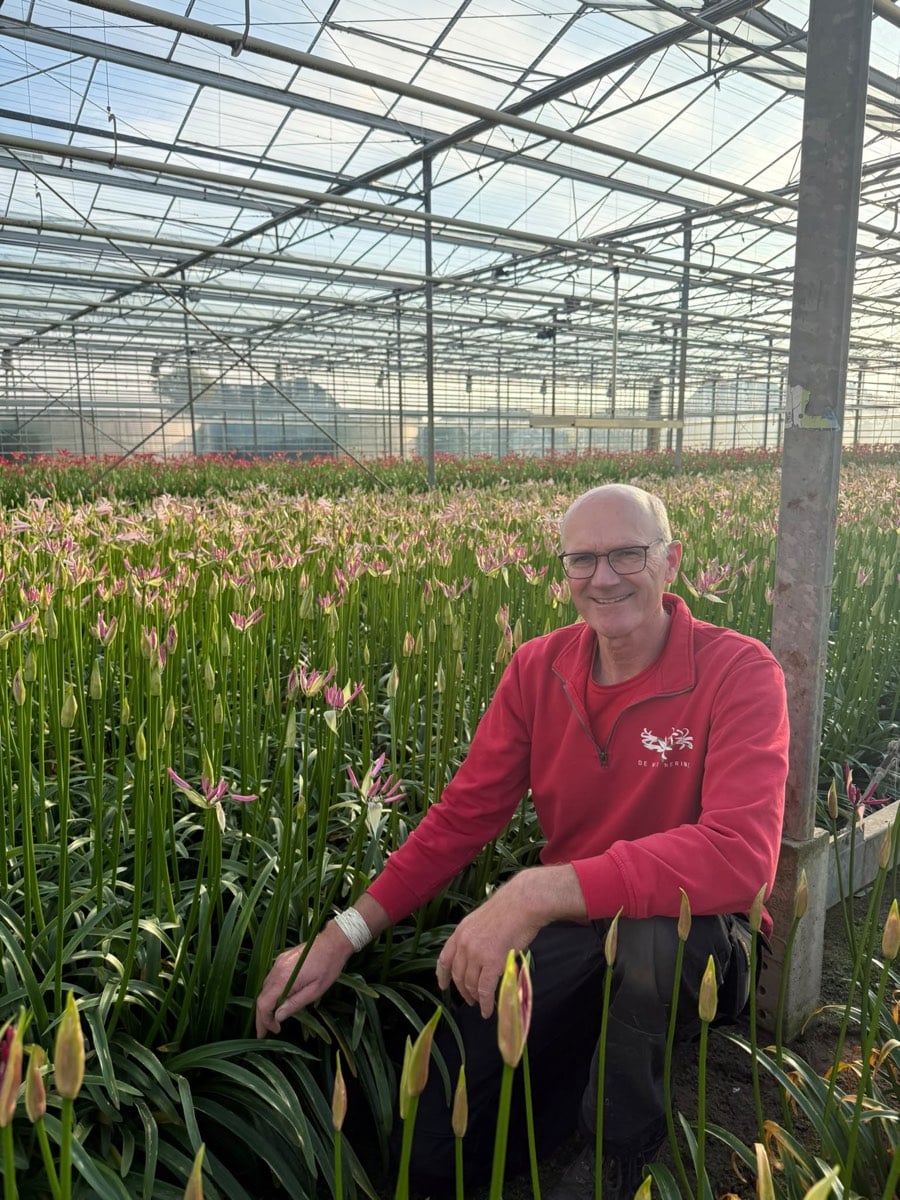
Autumn is not the whole story, though. De Wit Nerine in Heemskerk, a family grower since 1966, supplies Nerine all year. Robbert de Wit puts the natural season in its greenhouses at June to December. From June into January the crop needs some warmth, so the greenhouses are heated to about 13°C, and thanks to pretreatment the vase life holds up the whole year.
De Wit also sells what it calls artistic Nerine, and florists asked for it before it existed. "We noticed there was extra demand for crooked stems," De Wit says. For the varieties that work this way, the grower now bunches every stem above a set length together, crooked ones included, and how crooked depends on the variety and the season. These stems are harvested later, for a more intense color and a bigger flower, and still last at least 8 days in the vase, as long as a stem cut at the tight stage. Sofie is available almost all year, Sanne from late July to January, and Desi from August to December. Terri is new and limited.
There is also Amarine, the cross between Nerine and Amaryllis belladonna, which reads as a heavier, larger-flowered version of the same shape. Florists like Hanneke Frankema have used both in show work, and the group shows up regularly in the picking bouquet style where individual stems are meant to be seen.

Spider Lily Meaning and Symbolism
The symbolism attached to the spider lily is almost entirely about the Lycoris, and almost entirely Japanese. There the flower is higanbana, the flower of the equinox, because it opens around the autumn equinox and the Buddhist observance of Higan that falls at the same time. It is a flower of the turning point of the year, and by extension of the boundary between the living and the dead.
That is where the readings you see repeated everywhere come from: final goodbyes, remembrance of people who have died, and death followed by rebirth. The rebirth half is not sentimental filler. It is a description of what the plant does. The flower dies back completely, the leaves arrive afterwards, and the following autumn the whole thing repeats from a bulb that looked like nothing all summer.
In China the same plant carries a softer reading closer to memory and longing. In Western florist use the association is mostly with fall and with remembrance, which is why the red spider lily turns up in September and October arrangements and in Halloween planting alongside the darker end of the autumn palette.
One thing worth saying plainly, because a lot of pages get sloppy here: none of this symbolism belongs to Hymenocallis or Nerine. A white Hymenocallis is not a funeral flower and a Dutch Nerine is not an omen. They just share a common name.
How to Grow and Care for Spider Lily
The care split follows the same three-way division, so work out which plant you have first.
Lycoris in the Garden
Plant the bulbs in late summer, roughly 10 to 15 cm deep, in soil that drains. Full sun to part shade both work. In its native range, it grows on moist slopes in the shade and near stream banks, so it tolerates more shade than most bulbs, but flowering is better with real light. Leave them alone once they are in. Lycoris resents being moved and will often skip a year of flowering after a disturbance, which is the single most common reason people think their bulbs have failed.
Water is only a concern in the growing season. Once the leaves die back in spring, the bulb wants a dry summer rest, and that dry rest is part of what triggers the flower stem in fall. Do not keep watering an empty patch of soil. They naturalize well and are happiest left in a clump for years.
Hymenocallis Indoors and in Pots
Treat this one as a tender tropical. Bright indirect light, warmth, moderate humidity, and soil that is kept lightly moist but never wet. Below about 10°C it is unhappy, and it will not survive a frost, so in cool climates it is grown in a pot and brought in, or lifted and stored dry over winter like a Dahlia.
Nerine in the Vase
For the cut flower, the levers are simple. Choose the cut stage for the day you need the stem. For same-day use, De Wit advises an open flower, which gives the best color and is larger too. For a stem that has to stand in the shop for a week, there are two routes: a slightly tighter stem, which tends to sell less quickly, or one ripened longer on the bulb, with more intense color. Clean vase, fresh water, flower food, and recut the stem on arrival. Keep it out of direct sun and away from ripening fruit. Handled that way, the better varieties give you a week and a half, which is why the autumn flower mixes lean on Nerine so heavily. The Royal Horticultural Society has the garden side if you want to grow Nerine bowdenii outdoors, which works in a warm, sheltered spot at the base of a wall.
Which Spider Lily Do You Actually Want
Short version. Red, comes up leafless in September, hardy, heavy with meaning: Lycoris radiata. White, scented, has a little membrane cup in the middle, needs warmth: Hymenocallis. Anything you are buying by the stem in autumn with a named variety on the sleeve: Nerine.
Thursd's own spider lily product page covers the ornamental side in more detail, and the Nerine and Amarine collection is the place to start if it is the commercial flower you are after.
Header and featured image: red spider lily, Lycoris radiata. Photo by N Suma on Unsplash
About the author: Edwin Kirwa is Customer Success Manager and writer at Thursd. He works daily with breeders and growers worldwide and covers East African floriculture from up close. Connect with Edwin on LinkedIn.