Walk into a garden center, and you will find a shelf of pothos with a dozen names on the labels. Almost all of them are the same plant. The types of pothos sold as houseplants are nearly all one species, Epipremnum aureum, and the named pothos varieties, from Marble Queen and Neon to Manjula, Pearls and Jade, and N'Joy, each started as a single branch that grew differently. Somebody noticed it and rooted it. Then it got a name. Only a few, like Cebu Blue, belong to a second species.
This guide covers ten types of pothos. For each one, you will find what it looks like and how its care differs from the rest. Where it came from is taken from the plant patents and from the growers who sell it, and the care advice comes from university extension services and the ASPCA, all listed at the end. The last section deals with the two plants most often sold as pothos that are not pothos at all.
What Makes a Pothos a Pothos
Pothos is Epipremnum aureum, a climbing vine in the arum family, the same family as Monstera and Philodendron. The genus name says what it does: in Greek, epi means on, and premnon means trunk, a plant that climbs trees, the University of Florida explains in its guide for growers. Where it grows wild depends on whom you ask. The University of Florida calls it a native of the Solomon Islands, while NC State Extension lists the Society Islands in French Polynesia. The genus holds about 10 species by the University of Florida's count and about 15 by Wisconsin Horticulture's.
The names have been a muddle for a long time. Taxonomists only settled on Epipremnum in the 1960s, once enough flowers had been collected in Florida and Puerto Rico to study, and before that the plant was filed as Pothos aureus, Scindapsus aureus, and Rhaphidophora aurea. For a while, it was even treated as a form of its cousin, Epipremnum pinnatum, NC State notes, which is why some patents still use that name. A genus called Pothos does exist, Costa Farms points out, but it is a different group of plants. In parts of Asia, pothos also goes by money plant, the name behind the piece on money plants and feng shui.
Why Every Pothos Variety Started as a Mutation
Pothos hardly ever flowers. Indoors, it never does, because the plants grown indoors are in their juvenile stage, and flowers only come on mature vines, according to Wisconsin Horticulture. Even in the wild, flowering is rare. Without flowers, there is nothing to cross. In the words of the University of Florida researchers who made Pearls and Jade, "no hybridized pothos cultivars are known to exist."
So every named pothos is a mutation: a branch that came out different and was then multiplied by cuttings. Until 2009, only four cultivars were in commercial trade: Golden, Marble Queen, Jade, and Neon, according to a 2024 University of Florida patent. All the other types of pothos on the shelf arrived after that. Most of the newer varieties were spotted on a nursery bench. Pearls and Jade were forced with gamma rays, and in 2024 the University of Florida patented two more that it picked out of plants grown from tissue culture.
The leaves change with age, too. Climbing a tree in the tropics, a pothos vine can reach 15 meters (50 feet) and grow lobed, split leaves up to about 90 cm (3 ft) long, while the plants sold for indoors rarely make leaves longer than 15 cm (6 in), the University of Florida guide says. Give one a pole and a warm, bright spot, and the leaves start to size up.

The Dutch Trade Still Calls It Scindapsus
One of the old names never left the trade. In the Netherlands, pothos is still sold as Scindapsus. Kap Scindapsus in Honselersdijk, one of the few Dutch nurseries that specialize in the plant, has grown it since 1984 and now raises about two million plants a year, according to its own site. Its list shows Scindapsus Aureum and Scindapsus N'Joy, which are pothos, next to Scindapsus Pictus and Philodendron Scandens, which are not. Those two are the satin pothos and the heartleaf philodendron at the end of this guide.

The Four Classic Pothos Varieties
These four were the whole market until 2009, and they are still the pothos varieties most shops carry. The quickest way to tell them apart is color.
Golden Pothos
How to recognize it: medium green, heart-shaped leaves streaked and splashed with golden yellow, every leaf a little different. This is the plant most people picture when they hear the word pothos. In its list of Florida cultivars, the University of Florida also names a Hawaiian pothos, with the same pattern in a stronger yellow.
How its care differs: it is the baseline. Give it bright, indirect light, and water when the surface of the soil is dry. It survives in low light, but the yellow fades, and new leaves come out smaller. The University of Florida guide puts the line at about 1,600 lux (150 foot-candles) to keep color and leaf size, which the houseplant light guide helps you find in your home. Grown up a pole in warmth, the leaves can get very large. Costa Farms has seen them reach 30 cm (12 in) across outdoors, and it advises against planting pothos outside in South Florida, where it spreads.

Jade Pothos
How to recognize it: solid dark green leaves without any variegation. Costa Farms points out that Jade does not develop cream or green markings, even in bright light, which tells it apart from a Golden pothos that has gone green in a dark room.
How its care differs: this is the pothos for a dim corner. With no pale patches to lose, it keeps its looks where a Golden fades, and both Wisconsin Horticulture and NC State name it as the one for low light. Low light is not no light, though. At around 540 lux (50 foot-candles), the lowest level in the University of Florida guide, new leaves come out small on any pothos. For more plants that cope with little light, see the houseplants for dim rooms.

Marble Queen Pothos
How to recognize it: green leaves heavily marbled and streaked with creamy white, on stems that are marbled too, as NC State describes it. How much white you get depends on the cutting. Marble Queen can be more or less variegated depending on the branch it was propagated from, Costa Farms explains, which is why it propagates only from its most variegated mother plants. Snow Queen looks similar, and NC State lists it as highly variegated green and white.
How its care differs: more white means less chlorophyll, so Marble Queen grows more slowly than Golden and needs more light to keep its marbling. In a spot that is too dim, the new leaves come out greener and smaller, the University of Florida notes, and strong sun or heat burns the white parts first.
Marble Queen is also the parent of half this list. N'Joy, Pearls and Jade, and Jessenia all began on it, and the Neo Px is a Marble Queen too. Manjula did not, whatever you may have read: its patent names a compact Epipremnum pinnatum as the parent.

Neon Pothos
How to recognize it: bright chartreuse leaves with no variegation at all. The newest leaves are the brightest, and the color deepens as they age, Costa Farms notes. Two look-alikes can fool you. The heartleaf philodendron called Lemon Lime has the same color, and Champs-Élysées, a Japanese Teruno pothos, looks like Neon until you turn a leaf over and find small crests on the underside.
How its care differs: Neon needs bright light to stay neon. In a low-light spot, the color turns duller and darker, so give it the brightest indirect light you have.

The Newer Types of Pothos and Who Found Them
Since 2009, the list has grown fast. A plant patent is the best record of where a variety came from. It names who found the plant and what it grew from, and often where.
N'Joy Pothos
Who found it: Ashish Arvind Hansoti, in 2002, at a commercial greenhouse near Mumbai, India. It turned up as a branch mutation among more than 100 plants of superior Marble Queen clones that had been selected for short internodes and bright variegation, and it was patented as NJOY in 2009 (US Plant Patent 19,965). The patent files it under Epipremnum pinnatum, the older classification. In the Netherlands, Kap Scindapsus grows it as Scindapsus N'Joy.
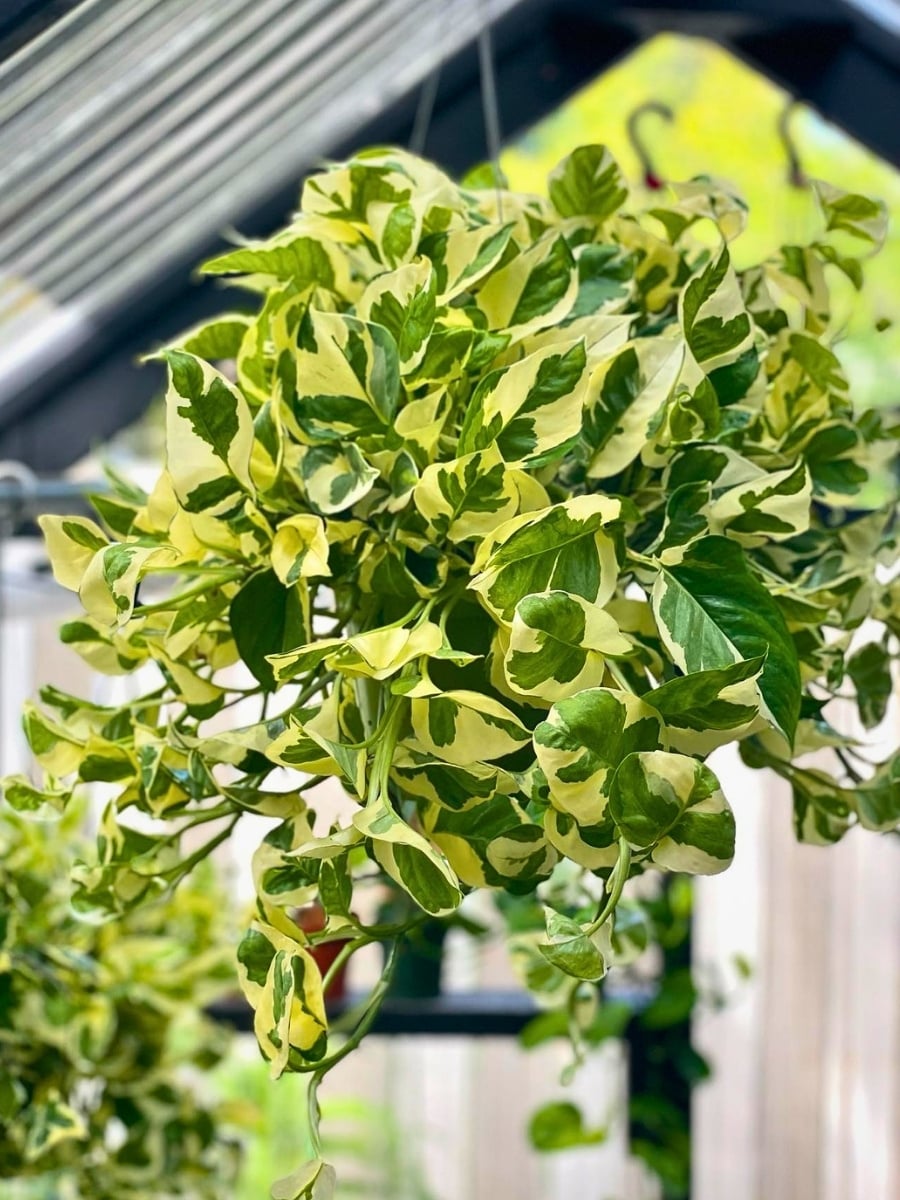
How to recognize it: small, broad leaves on a very compact plant with short internodes. The variegation is crisp, with a patch of green on either side of the midrib, in several shades, on a cream to white background.
How its care differs: it stays small and grows slowly, and with that much white, it needs bright, indirect light to keep its pattern. Glacier looks similar. Costa Farms describes it as green with crisp white variegation, splashed and flecked with silver and gray, and a little slower growing than most pothos.
Pearls and Jade Pothos
Who made it: Richard Henny and Jianjun Chen of the University of Florida's Mid-Florida Research and Education Center in Apopka. Because pothos will not flower, they exposed cuttings of Marble Queen to gamma rays from a cobalt-60 source and grew the treated plants on. About a year later, they selected a single branch mutation, patented as UFM12 (US Plant Patent 21,217) and released in 2009 as Pearls and Jade. The same program produced UFM10, a compact, dark green pothos sold as Green Genie.
How to recognize it: small leaves, 7 to 8 cm (2.5 to 3 in) long, compared with about 12 cm (4.5 in) on Marble Queen, marked with white, gray, and green in irregular patches and streaks. The pattern shows on both sides of the leaf, and the tops of the vines carry faint gray-green stripes. Costa Farms adds that the white tends to sit toward the leaf edges.
How its care differs: it grows slowly and stays small, but it copes with dim rooms better than its white might suggest. The University of Florida kept plants for three months at about 1,080 lux (100 foot-candles), 12 hours a day at 24°C (75°F), and they lost none of their leaf color.
Manjula Pothos
Who found it: Ashish Hansoti again, in 2010, at a commercial greenhouse near Mumbai. This time, the branch mutation appeared among more than 1,000 plants of a compact Epipremnum pinnatum selection called Compacta, not on Marble Queen. It was patented as HANSOTI14 in 2016 (US Plant Patent 27,117), and Costa Farms, which grows it in the United States, sells it as Manjula.
How to recognize it: wide, heart-shaped leaves with wavy edges that do not lie flat, variegated in silver, white, cream, and light green. There is rarely a crisp line between the colors, so the pale areas look flecked rather than painted, Costa Farms explains. The plant mounds at first and trails as it matures.
How its care differs: it grows slowly by design, and the patent lists slow, controlled growth among its traits. It also marks easily. Costa Farms found that Greenjula, a green sport its growers discovered on Manjula, grows faster and gets fewer brown spots under stress than its parent.
Global Green Pothos
Who found it: Hiroaki Asaoka, in May 2016, in a plant nursery in Aichi, Japan, as a naturally occurring mutation. It was patented in 2021 (US Plant Patent 33,530), and Costa Farms holds the exclusive rights to grow it in North America. In 2022, Max Snier put it on his list of the most wanted rare houseplants on Thursd, and he explained the name: "the name-giver wants to see that this variety conquers the whole world with its beautiful leaves."
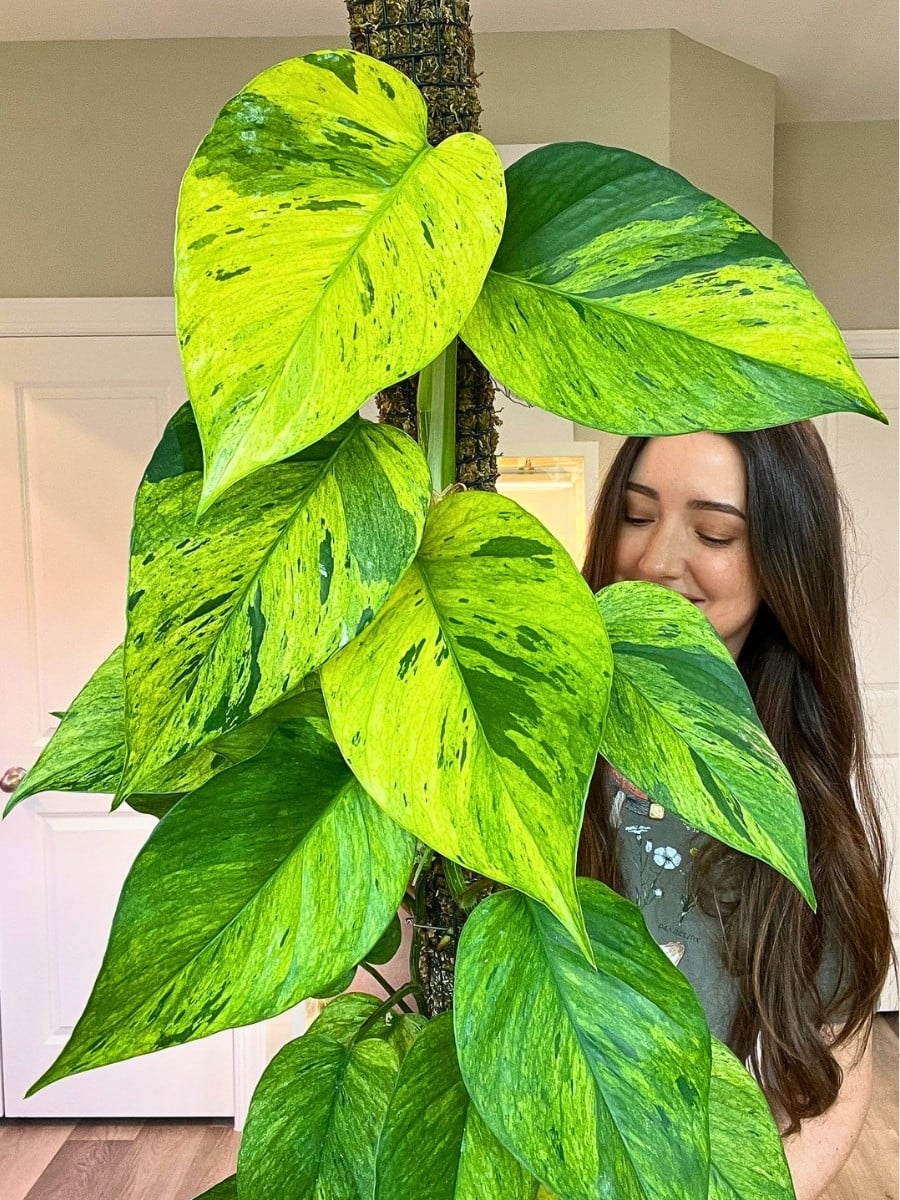
How to recognize it: two greens on one leaf. A light yellow-green patch sits on either side of the midrib, framed by darker olive green, on an egg-shaped leaf with a pointed tip. The plant grows fuller and wider than an ordinary pothos, with longer stems, and the odd streak of cream is normal.
How its care differs: treat it like Golden. Its longer stems and wider habit fill a hanging basket well. One of its sports, Lemon Meringue, found at Costa Farms in Miami (US Plant Patent 34,521), has yellow leaf edges that turn brighter in strong light and fade to green as the leaves age.
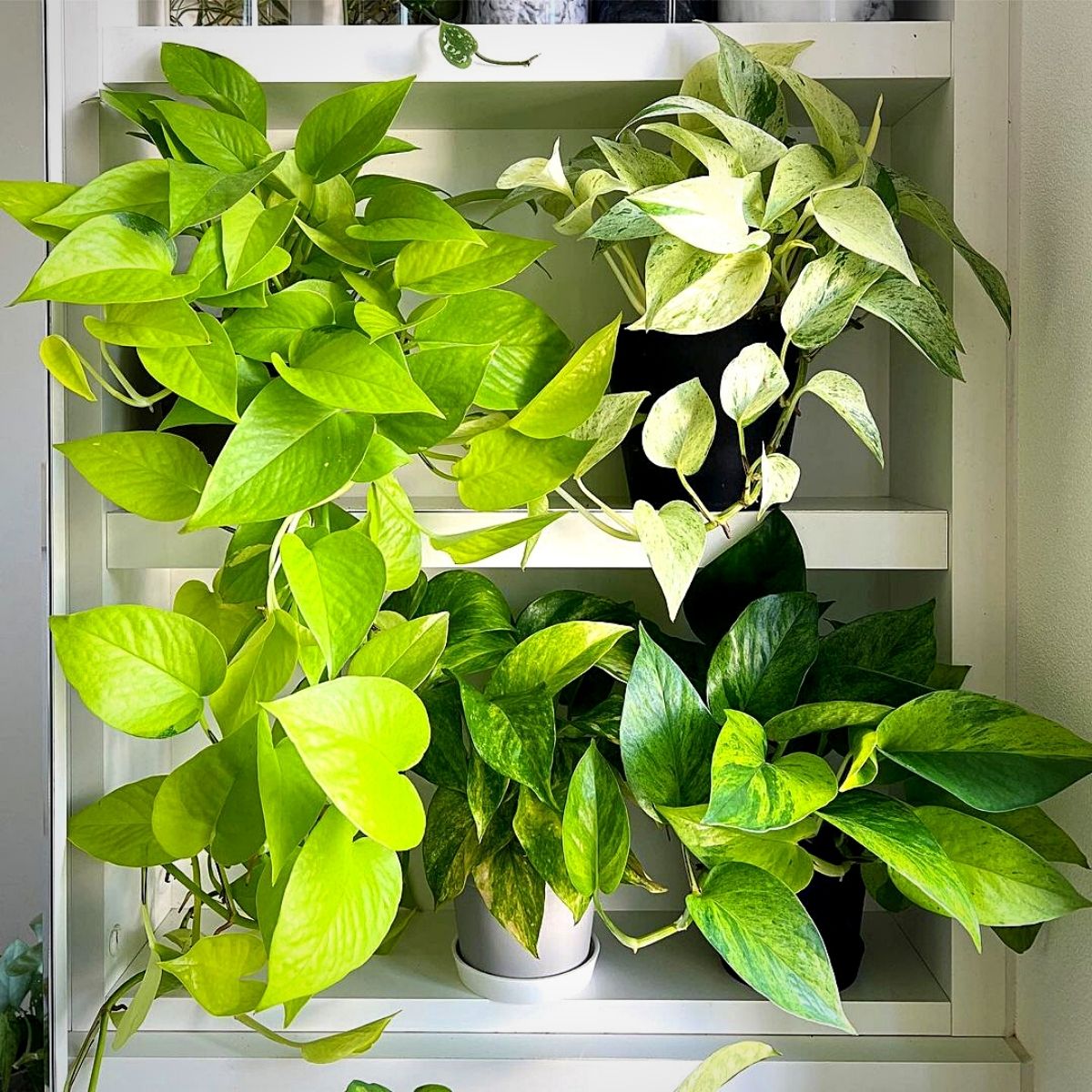
Japan has become a source of new pothos. The Teruno series from the breeder Terunoworld includes Shangri-La, whose leaves curl and twist instead of opening flat. Two other Teruno types, Robin and Carnival, stand in the photo at the top of this guide.
Jessenia Pothos
Who found it: growers at Costa Farms in Miami, in 2014, as a stable sport of Marble Queen.
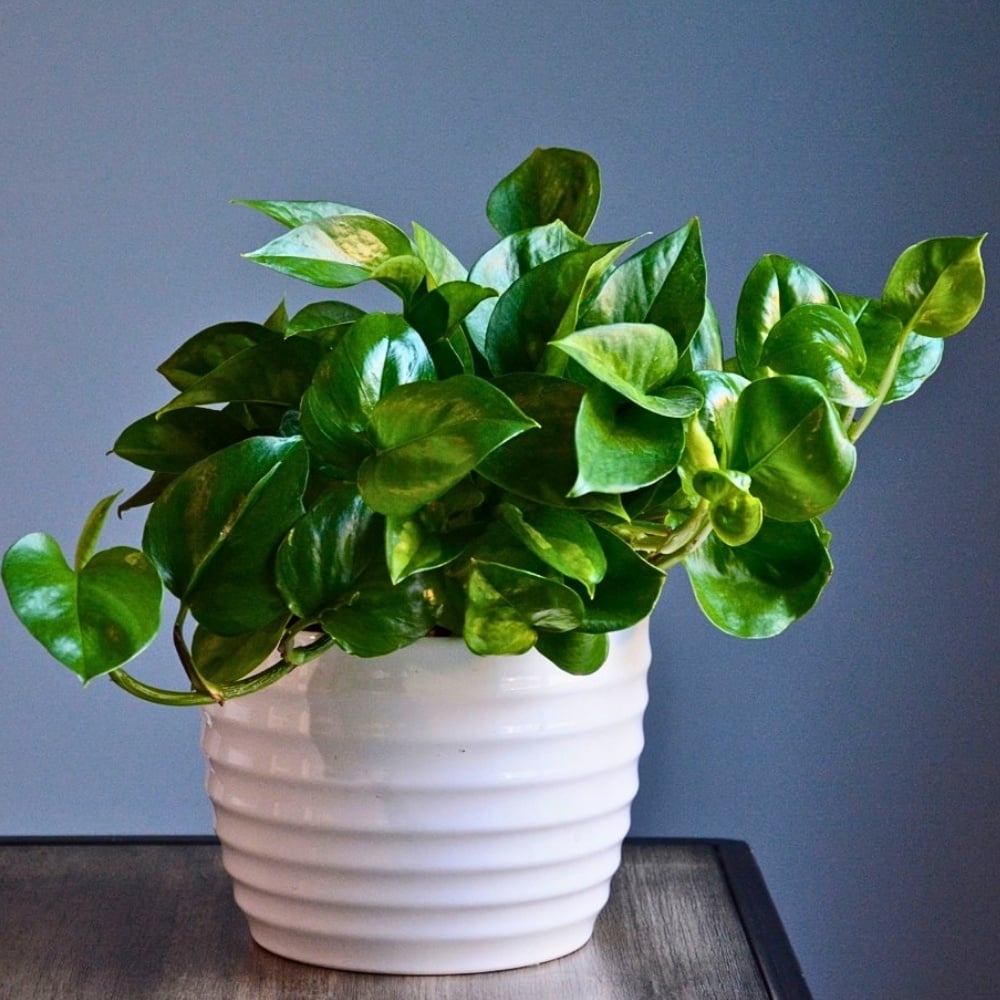
How to recognize it: medium green leaves splashed with chartreuse instead of cream. Next to a Marble Queen, the difference is obvious, because the marbling of Marble Queen is much lighter than the lime of Jessenia.
How its care differs: it grows more slowly than Golden, so give it time, and give it bright, indirect light to keep the lime from going dull.
Neo Px, the Engineered Marble Queen
What it is: not a new variety. Neo Px, from the Paris start-up Neoplants, is a regular Marble Queen pothos in a self-watering planter that the company calls the Shell, sold with Power Drops, bioengineered bacteria you add to the soil each month to break down indoor pollutants such as benzene, toluene, and xylene. Neoplants claims it purifies the air up to 30 times better than a regular houseplant, and it states that the plant itself is not genetically modified. Its launch is covered in Neo Px, the air-purifying houseplant.
The genetically modified one is Neo P1, a golden pothos with added genes meant to turn formaldehyde into sugar and other pollutants into amino acids. Neoplants says it is still reworking that plant, and the USDA approval is still pending. In October 2026, the Neo Px page on the Neoplants site no longer loaded, and the company said its team was busy building Neo P1.
How its care differs: it is Marble Queen care, plus filling the planter's water tank every two to three weeks and adding the Power Drops once a month.

Cebu Blue Pothos
How to recognize it: narrow, arrow-shaped leaves in a silvery blue-green with a metallic sheen and no variegation. It is Epipremnum pinnatum, not E. aureum, a species that grows wild from India and southern China through Southeast Asia to the Philippines, New Guinea, and Australia, according to NC State.
How its care differs: it wants to climb. On a moss pole in a warm, bright spot, the leaves mature, grow larger, and split like those of a Monstera, which is why it appears among the look-alikes in the guide to the types of Monstera. Kept trailing, it stays in its juvenile form.
Two other forms of Epipremnum pinnatum are often sold alongside it. Baltic Blue has darker green leaves that take on a blue cast as they mature and split readily in warmth and light, and Costa Farms warns not to confuse it with the silver-blue Cebu Blue. Skeleton Key looks plain while young, but once it climbs, its mature leaves grow a long, narrow tip, like the blade of a key.

Sold as Pothos but Not Pothos
Two plants turn up next to the real types of pothos in almost every shop, often under a pothos name.
Satin Pothos (Scindapsus Pictus)
What it is: Scindapsus pictus, a separate genus in the same family, native to Bangladesh and Malesia, the botanical region from the Malay Peninsula to New Guinea, according to NC State. The satin pothos has dark green leaves with silver-gray blotches on top and a paler underside without blotches. Its cultivars include Argyraeus, with small dark green leaves edged in silver, and Exotica, splashed with shimmering silver.
How its care differs: it likes bright, indirect light, 18 to 29°C (65 to 85°F), and moist, well-drained soil, and it shows you when the watering is off. Curling leaves mean it's too dry, and yellow leaves mean it's too wet, NC State notes. Like pothos, it is toxic to cats and dogs, and to horses, according to the ASPCA. Thursd also listed it among the trending houseplants.

Heartleaf Philodendron Versus Pothos
What it is: Philodendron hederaceum, also sold as Philodendron scandens, and at first glance a twin of a Jade pothos. NC State gives two tells. A philodendron's new leaf comes wrapped in a sheath, called a stipule, that dries and drops, so older stems look a little messy, while a pothos has none. And the leaf stalk of a pothos is grooved, while a philodendron's is not. The same tells separate a Neon pothos from the chartreuse Lemon Lime philodendron.
How its care differs: the heartleaf philodendron survives long periods in very low light and likes its soil kept slightly moist, NC State says, while a pothos prefers to dry out a little between waterings. Read more in the guide to the heartleaf philodendron and in how to tell a philodendron from a Monstera.

How to Tell Which Pothos You Have
Most types of pothos can be named from the leaf alone. Start with the color. A leaf in one color is Jade if it is dark green, Neon if it is chartreuse, and Cebu Blue if it is silvery blue-green. Yellow streaks mean Golden, cream-white marbling means Marble Queen or Snow Queen, lime means Jessenia, and two greens mean Global Green. If the plant is small and compact with white in the leaves, look at the pattern. Crisp green patches on white point to N'Joy, gray flecks on small leaves suggest Pearls and Jade, and wide, wavy leaves with blurred cream point to Manjula. Then check the leaf stalk for a groove to make sure it is a pothos at all.
One rule covers the care of all of them. The paler the leaves, the more light a pothos needs to keep its color, and the more white it carries, the slower it grows. Every pothos on this list is toxic to cats and dogs, so keep them out of reach, or pick one of the pet-friendly houseplants instead.
For everything else, from watering to taking cuttings, see the pothos care guide and the easiest houseplants to propagate. Pothos also roots happily in a glass of water, as the piece on growing houseplants in water shows, and you will find the plant itself on the pothos product page.
Sources opened for this guide, October 2026: University of Florida IFAS Extension, New Florida Foliage Plant Cultivar: Pothos 'Pearls and Jade' (Richard J. Henny, Jianjun Chen, and Terri A. Mellich, ENH1180, 2011) and Cultural Guidelines for Commercial Production of Interiorscape Epipremnum (Dennis B. McConnell, Jianjun Chen, Richard J. Henny, and Kelly C. Everitt, ENH894, 2003, reviewed 2024). US plant patents 19,965 (NJOY), 20,930 (UFM10), 21,217 (UFM12), 27,117 (HANSOTI14), 33,530 (Global Green), 34,521 (Lemon Meringue), and 35,876 (UF-Ea-0316). Wisconsin Horticulture, University of Wisconsin-Madison Division of Extension, Pothos, Epipremnum aureum (Susan Mahr, revised by Bruce Spangenberg, 2025). NC State Extension Gardener Plant Toolbox, Epipremnum aureum, Epipremnum pinnatum, Scindapsus pictus, and Philodendron hederaceum. ASPCA Animal Poison Control, Golden Pothos and Satin Pothos. Costa Farms, A Plethora of Pothos Varieties (Justin Hancock) and Pothos Plant Guide. Kap Scindapsus, company and assortment pages. Neoplants, FAQ and Neo P1.
Featured image: Neon, Marble Queen, and two Teruno pothos on white shelves, photo by @suno___yuka. Header image: Global Green pothos leaves against a slate blue wall, photo by @cycleofplant.