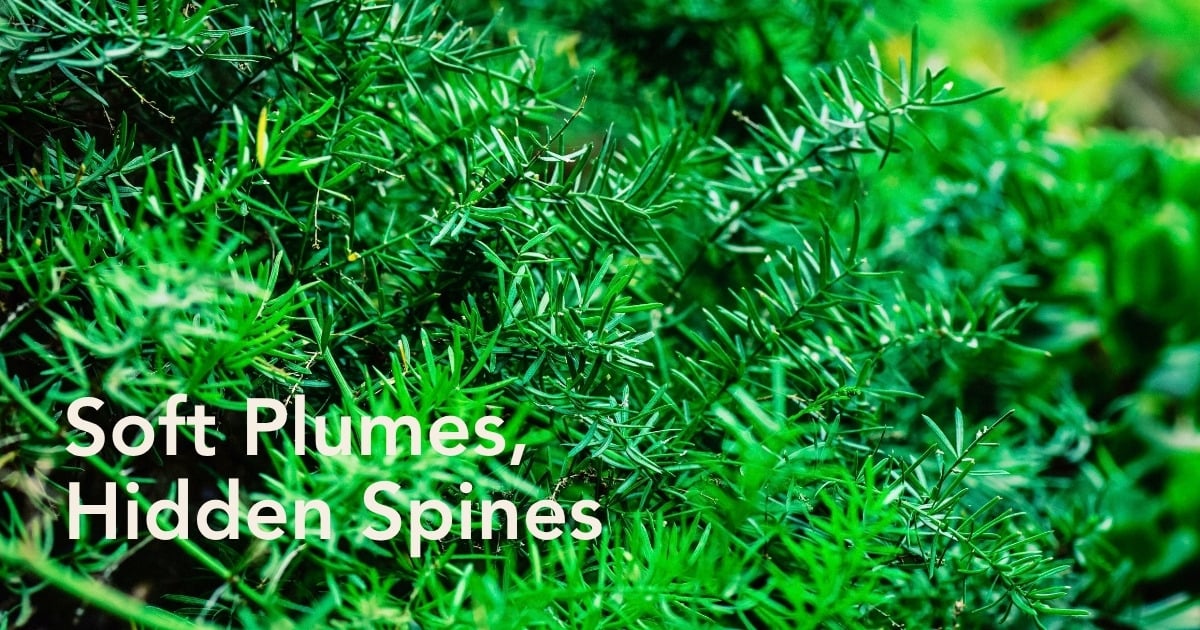
Grab an asparagus fern without looking, and you find out quickly that the name is a bit of a fib. The plumes are soft. The stems underneath carry small, sharp spines. And the plant is not a fern at all, but a cousin of the asparagus spears on your dinner plate.
The one in most garden centers is the sprengeri fern, sold as Asparagus densiflorus Sprengeri and filed by Florida's weed scientists as Asparagus aethiopicus. Good asparagus fern care is not hard: bright light, steady water in summer, and a big pot. The harder part is what the red berries do once they leave your porch. Below is what the plant is, how it differs from the foxtail fern and the florists' lace fern, how to keep it green, whether it is safe for cats and dogs, where it is listed as invasive, and how growers raise it from seed.
What Is an Asparagus Fern?
Despite the name, the asparagus fern is a flowering plant. It belongs to the asparagus family, Asparagaceae, and to the genus Asparagus, which holds garden asparagus, Asparagus officinalis, and about 300 other species, University of Wisconsin-Madison Extension explains. It grows wild in coastal southeastern South Africa, in shady, sandy places such as dunes, rocky ground, and open woods. Thursd readers have met the family before: lucky bamboo and lily of the valley belong to it too.
What looks like a needle is not a leaf. Each one is a cladode, a short, flattened stem that works like a leaf, and they grow in groups of four to eight along the stems. The true leaves are tiny scales at their base, Wisconsin Extension notes, and next to them sit stiff, sharp spines. Under the soil, the plant builds a dense mat of roots, creeping rhizomes, and fleshy white tubers that store water.
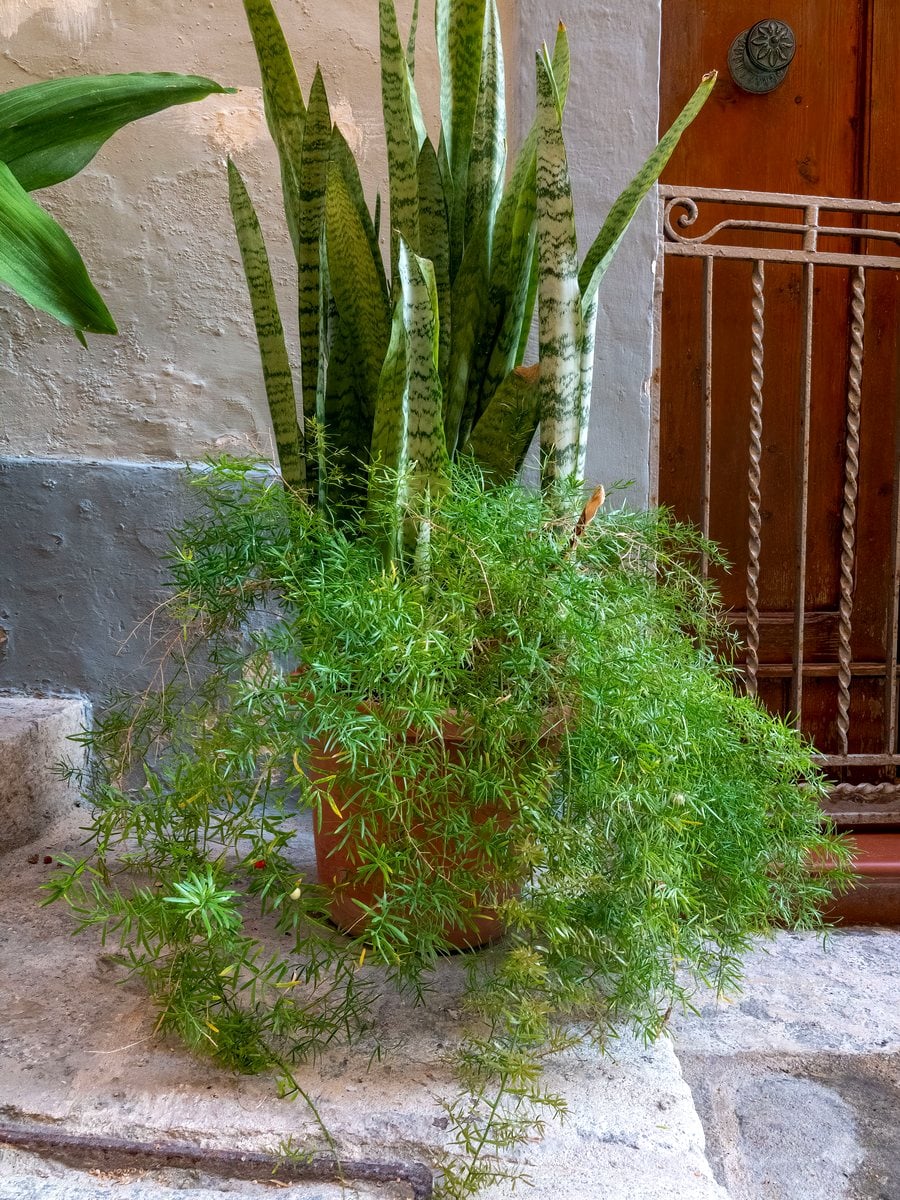
Not a True Fern: Flowers, Berries, and Seeds
Real ferns never flower. They spread by spores, the way a maidenhair fern does. An asparagus fern flowers and sets seed. On a mature plant with enough light, small white or pinkish-white flowers appear in clusters along the stems from spring through fall. They are fragrant, but so small that most people never notice them, and plants grown in temperate climates often do not bloom at all, according to Wisconsin Extension.
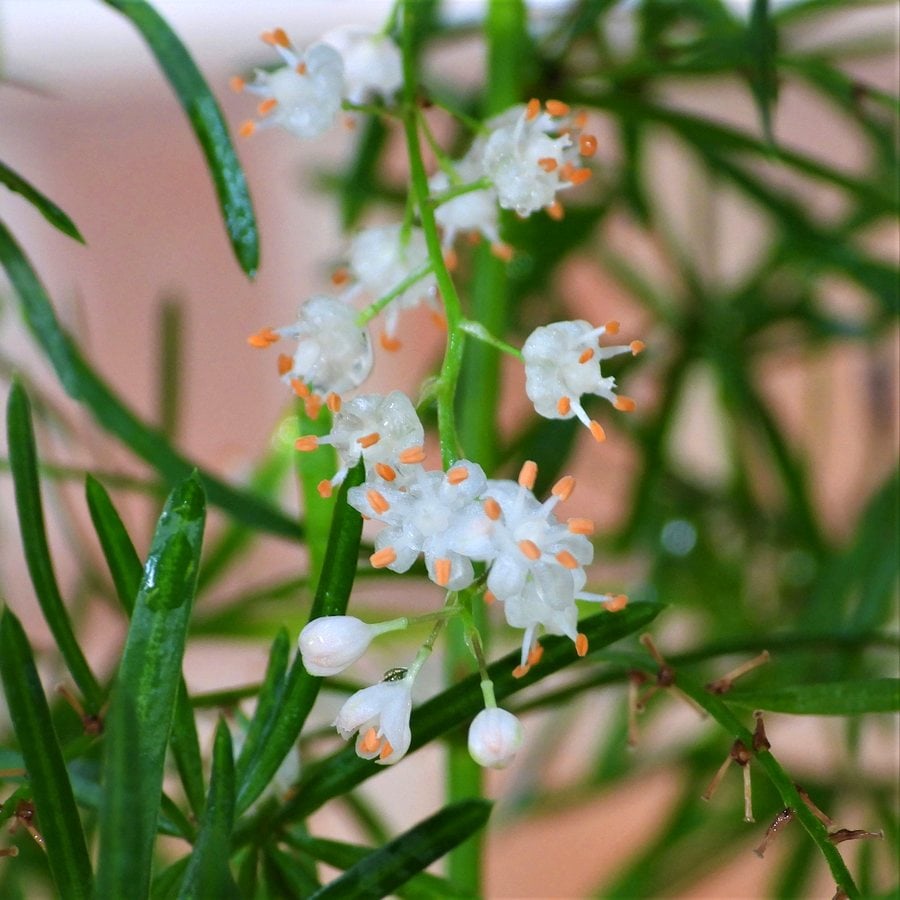
Every plant is either male or female. When a female flower is pollinated, it turns into a round berry of up to 6 millimeters (a quarter inch) that starts green and ripens to glossy red, with one to three black seeds inside. Those berries come back twice in this guide: once for your pets, and once for the woods and dunes where birds drop the seeds.
Sprengeri, Densiflorus, or Aethiopicus?
Expect the plant tag to argue with the textbook. Seed catalogs and garden centers sell the plant as Asparagus densiflorus Sprengeri, and Wisconsin Extension still files it under Asparagus densiflorus, with Asparagus aethiopicus and Asparagus sprengeri as older names that the plant trade sometimes still uses. The UF/IFAS assessment of non-native plants in Florida goes the other way. It lists the plant as Asparagus aethiopicus, gives Asparagus sprengeri as a synonym, and calls the densiflorus name misapplied. Florida's invasive species list and the Australian weed authorities use aethiopicus as well.
For your windowsill, the care is the same under every name. When you check whether the plant is a problem where you live, though, search for Asparagus aethiopicus, because that is the name the weed lists use.
Asparagus Fern Versus Foxtail Fern
The foxtail fern is the asparagus fern's tidier sibling. Sold as Asparagus densiflorus Myers, a name also spelled Meyeri or Meyersii, it grows stiff, upright plumes packed so densely with needles that each stem looks like a bottle brush or a fox's tail. The sprengeri fern does the opposite. Its stems are longer, looser, and arching, with the needles spaced along them, which is why it spills over the edge of a hanging basket. Wisconsin Extension gives Sprengeri a height of 45 to 60 centimeters (1.5 to 2 feet) and a spread of 90 to 120 centimeters (3 to 4 feet), and the foxtail type 30 to 90 centimeters (1 to 3 feet) in height with the same spread. NSW WeedWise adds a detail you can feel: foxtail needles grow closer together and are triangular in cross-section, while sprengeri needles are flat.
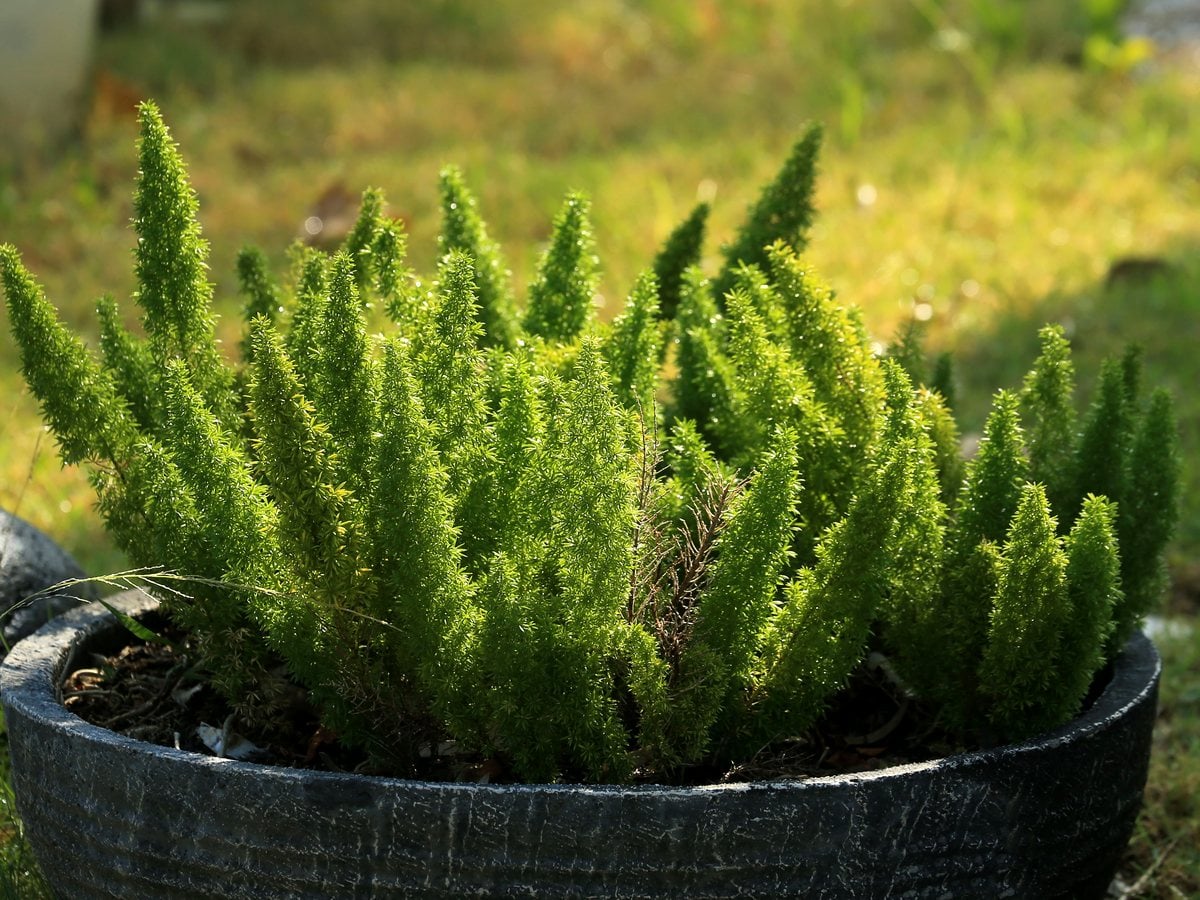
Thursd has its own foxtail fern care guide and a guide to buying a foxtail fern at the nursery. The two plants need much the same care, so most of what follows works for both.
Plumosa, the Lace Fern Florists Use
The third plant sold as an asparagus fern is Asparagus setaceus. Florists call it plumosa fern or lace fern, and it was sold for years as Asparagus plumosus. Its fine needles sit in flat, layered sprays, and the plumes look like delicate lace, which is where the common names come from, NC State Extension explains. Its berries ripen purple to black instead of red. It wants bright, indirect light, high humidity, and temperatures of 13 to 21 degrees Celsius (55 to 70 degrees Fahrenheit), and it will climb if you give it something to hold.
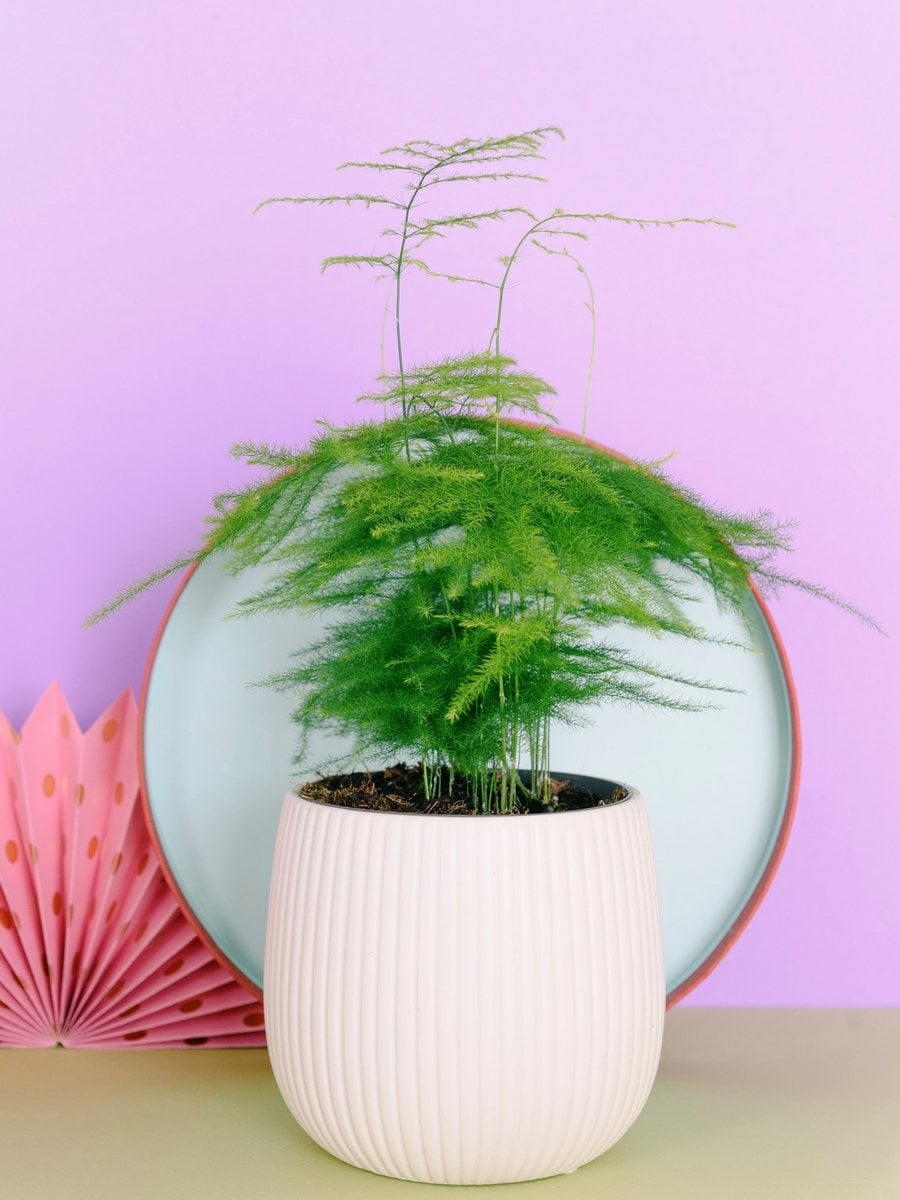
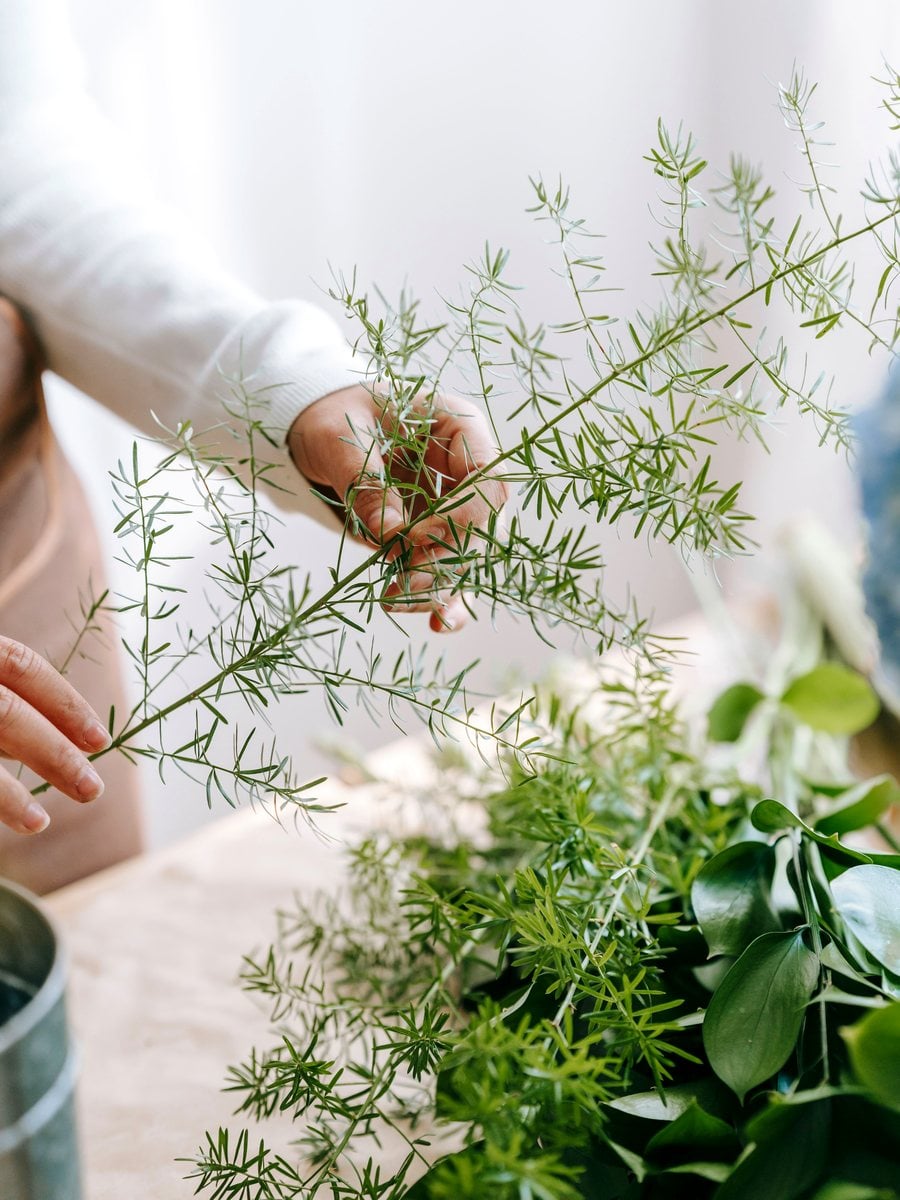
Florists know it as a cut green. In the Netherlands, Van der Valk Groenesier grows asparagus foliage for Decorum, and in Decorum's Grower for a Day series, florist Joseph Massie spent a full day there learning to tip, untangle, and harvest the stems. When St. Peter's Square in Rome was dressed in Dutch flowers for Easter 2025, the greens included 1,000 twigs of Asparagus setaceus from the same grower. In the United States, Thursd's report on Continental Floral Greens at the FLOWER Magazine Showhouse in Nashville shows asparagus fern in a rose and Dahlia arrangement. Thursd's piece on what ferns represent shows lace fern too.
Asparagus Fern Care Indoors and Outdoors
Asparagus fern care comes down to light, a steady water rhythm, and room for the roots. Wisconsin Extension calls it a great houseplant for beginners, and it is happy outside in summer too, as long as it comes back in before frost. Keep an eye on the berries, though.
Light
Light is where asparagus fern care starts. Indoors, give it bright, indirect light. The brighter the spot, the faster it grows, Wisconsin Extension notes. NC State Extension calls the indoor plant intolerant of direct sun and warns that afternoon sun in warm climates turns the foliage yellow, so an east window, or a spot a step back from a south window, is the safe middle. Outdoors, it grows in full sun or light shade, and plants in full sun stay more compact and dense than plants in shade. It even survives full shade, although the needles turn a lighter green there.
A hanging basket suits it best. The arching stems need room to fall, and up high, the spines and berries stay away from hands and paws. For more trailing plants, Thursd has a list of easy indoor hanging plants, with the spider plant among them.
Water and Soil
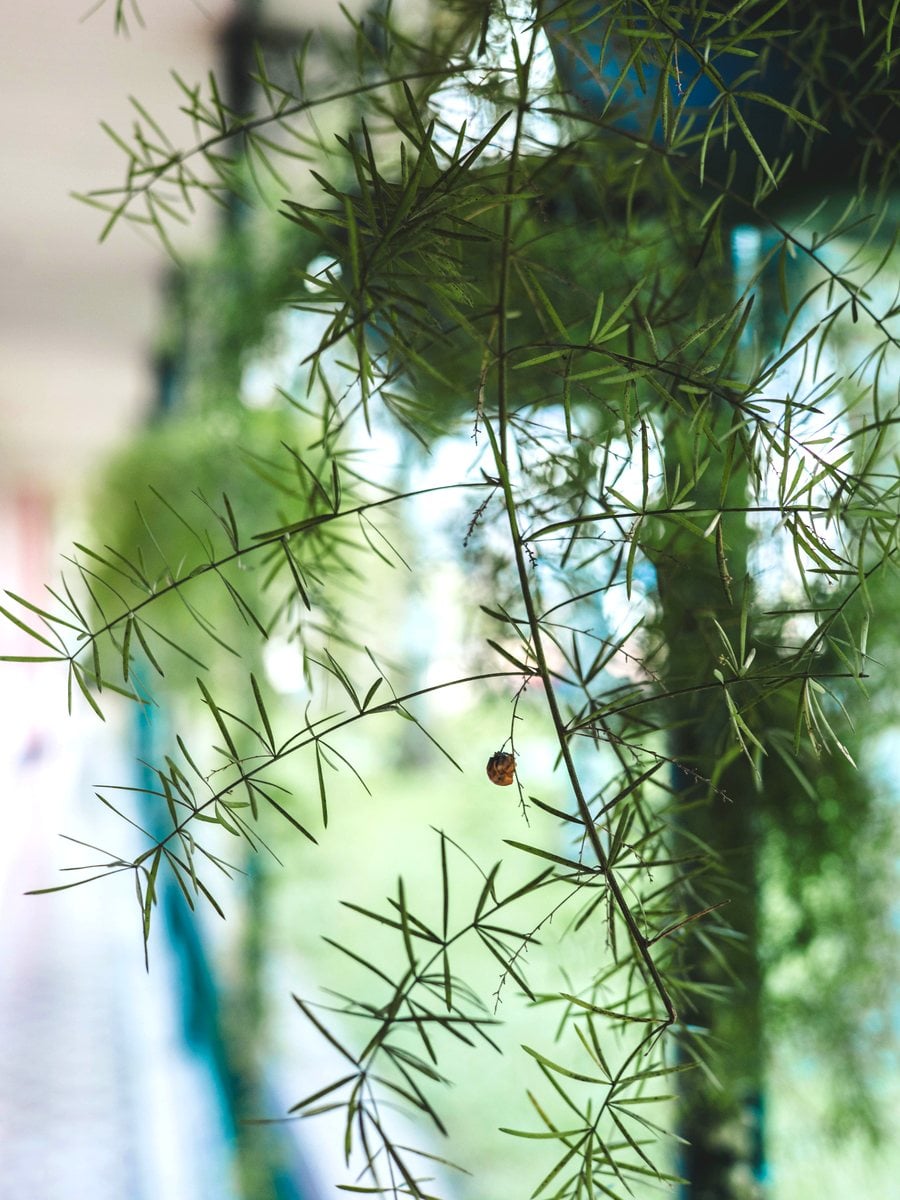
Water regularly from spring to fall, and sparingly in winter. The tubers store water, so the plant forgives a missed week, but it does best with consistent moisture in the growing season, Wisconsin Extension says. What it does not forgive is soggy soil: NC State Extension lists it as intolerant of wet soils and names root and crown rot among its problems. Use a moist but well-drained, peaty potting mix, the kind NC State recommends for the lace fern, in a pot with a drainage hole. Outdoors, it prefers moist soil rich in organic matter, yet it tolerates almost any soil and is fairly drought tolerant once established.
Temperature and Humidity
The asparagus fern is tender. Even a light frost kills the top growth to the ground, although the roots survive down to about -7 to -4 degrees Celsius (20 to 25 degrees Fahrenheit), and the plant regrows from them, NC State Extension explains. Outdoors, it is a perennial in USDA hardiness zones 9 to 11, and with protection, the roots often survive as far north as zone 7, Wisconsin Extension adds. Everywhere colder, it is a summer plant: bring containers inside before the first frost, and let indoor plants get used to stronger light gradually before you move them into full sun outside. Indoors, the sprengeri adapts to a wide range of conditions. The lace fern is fussier and wants high humidity, which a pebble tray or a humidifier gives it.
Feeding, Repotting, and Pruning
In spring, cut out the old growth and start feeding once a month for lush new stems, then stop feeding in winter, Wisconsin Extension advises. Expect to repot often. The plant outgrows its container quickly, and its roots are strong enough to break a pot, so choose a larger, thick-walled container and repot in early spring, before new growth starts.
Wear gloves when you prune. The stems carry spines, and Wisconsin Extension warns that the berries can irritate skin. Cut old or yellow stems out at the base, and trim the stem ends to keep the shape. Pinching the tips also makes the plant denser, NC State Extension notes, and a plant that has become ragged can be cut down to the soil to regrow from the roots. Watch for aphids, mealybugs, spider mites, and whiteflies, and expect some needle drop indoors.
Yellow Needles, Pets, and Spreading Berries
Why Is My Asparagus Fern Turning Yellow?
Yellow needles that drop are how an asparagus fern complains, and the cause is usually one of these:
- Dry soil: the foliage yellows and drops when the plant runs short of water, Wisconsin Extension notes. Water more steadily from spring to fall.
- Too little light: a spot that is too dark causes the same yellowing. Move it closer to a bright window.
- Hot afternoon sun: in warm climates, afternoon sun yellows the foliage, NC State Extension warns. Give it shade in the hottest hours.
- Soggy soil: wet soil leads to root rot and crown rot. Let the pot drain, water less often, and check the roots when you repot.
- Indoor shedding: some needle drop is normal indoors, and NC State Extension notes that it can be messy.
Yellow needles do not turn green again. Once conditions are right, new growth appears at the soil line, NC State Extension notes for the lace fern. So cut the yellow stems back to the base and wait for fresh ones.
Is Asparagus Fern Toxic to Cats and Dogs?
Yes. The ASPCA lists asparagus fern as toxic to dogs and cats, and its lace fern entry adds horses. Eating the berries can cause vomiting, abdominal pain, or diarrhea, and repeated contact with the plant can cause allergic skin inflammation, the ASPCA notes. Thursd's guide to houseplants that are poisonous for dogs counts it among the plants to keep away from your dog.
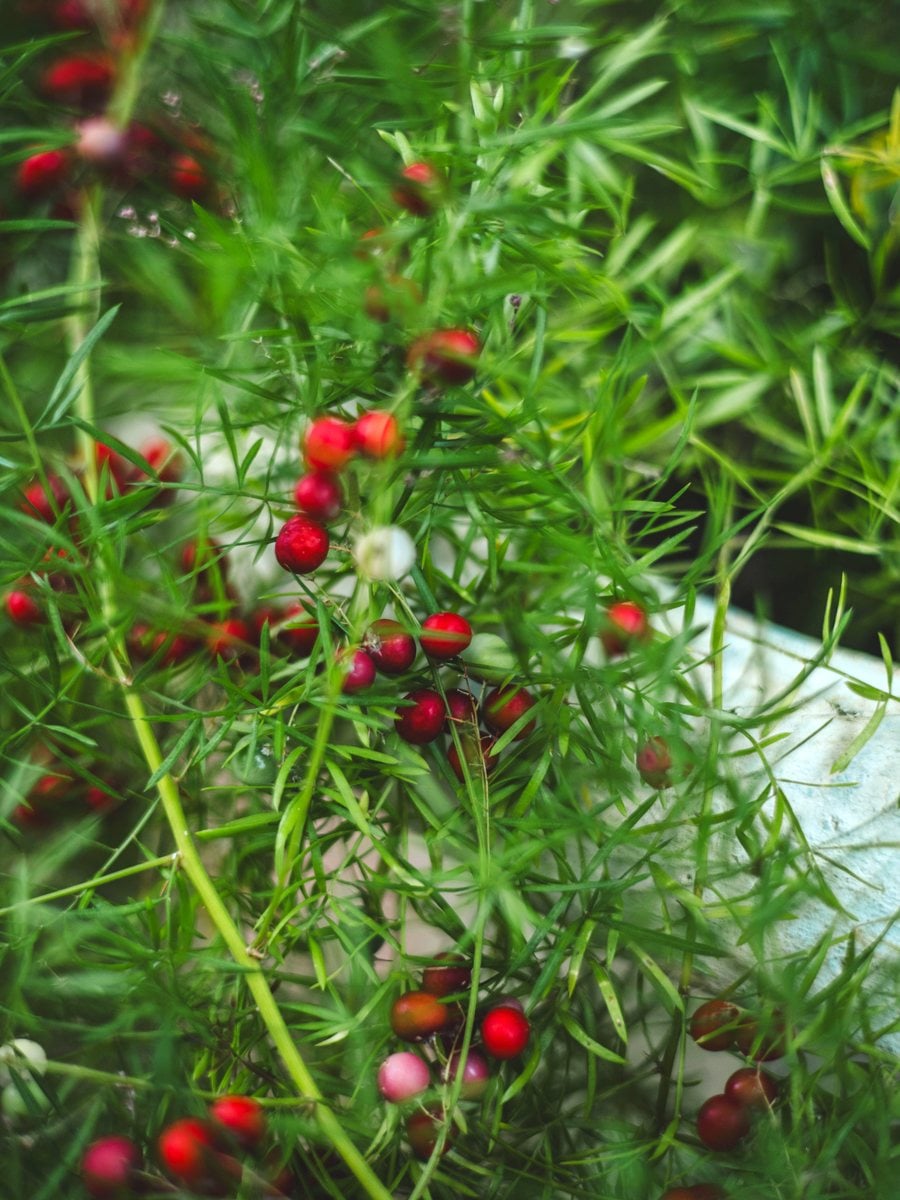
The berries are the main risk, and they only form on female plants that have flowered, so a plant kept indoors in a cool climate often never makes any. If yours does, pick them off and hang the plant out of reach. With a chewer at home, pick from Thursd's pet-friendly houseplants for cats and dogs instead.
Is Asparagus Fern Invasive?
In warm places, yes, and the berries are the reason. Birds eat them and drop the seeds, sometimes several kilometers from the parent plant, Weeds Australia notes. A single plant can produce up to 600 seeds a year, most of which germinate within the first year, according to NSW WeedWise. Dumped garden waste spreads it too, because pieces of the crown sprout again. These are the places where it is officially listed:
- Florida: the Florida Invasive Species Council lists Asparagus aethiopicus, Sprenger's asparagus-fern, as a Category I invasive in the north, center, and south of the state. Category I is for plants that are already altering native plant communities. UF/IFAS assessed it again in 2026 and rates it invasive and not recommended in central and south Florida, with a caution in the north.
- Hawaii: the Division of Forestry and Wildlife names it one of Hawaii's Most Invasive Horticultural Plants, and the Hawaii-Pacific Weed Risk Assessment rates it high risk. It has naturalized on all the main islands, according to Plant Pono.
- Australia: Weeds Australia lists it as a Weed of National Significance, and in New South Wales it must not be sold anywhere in the state.
- Texas: Wisconsin Extension names Texas as well as Florida and Hawaii among the states where it is considered an invasive weed. In areas with cold winters, it is not a problem.
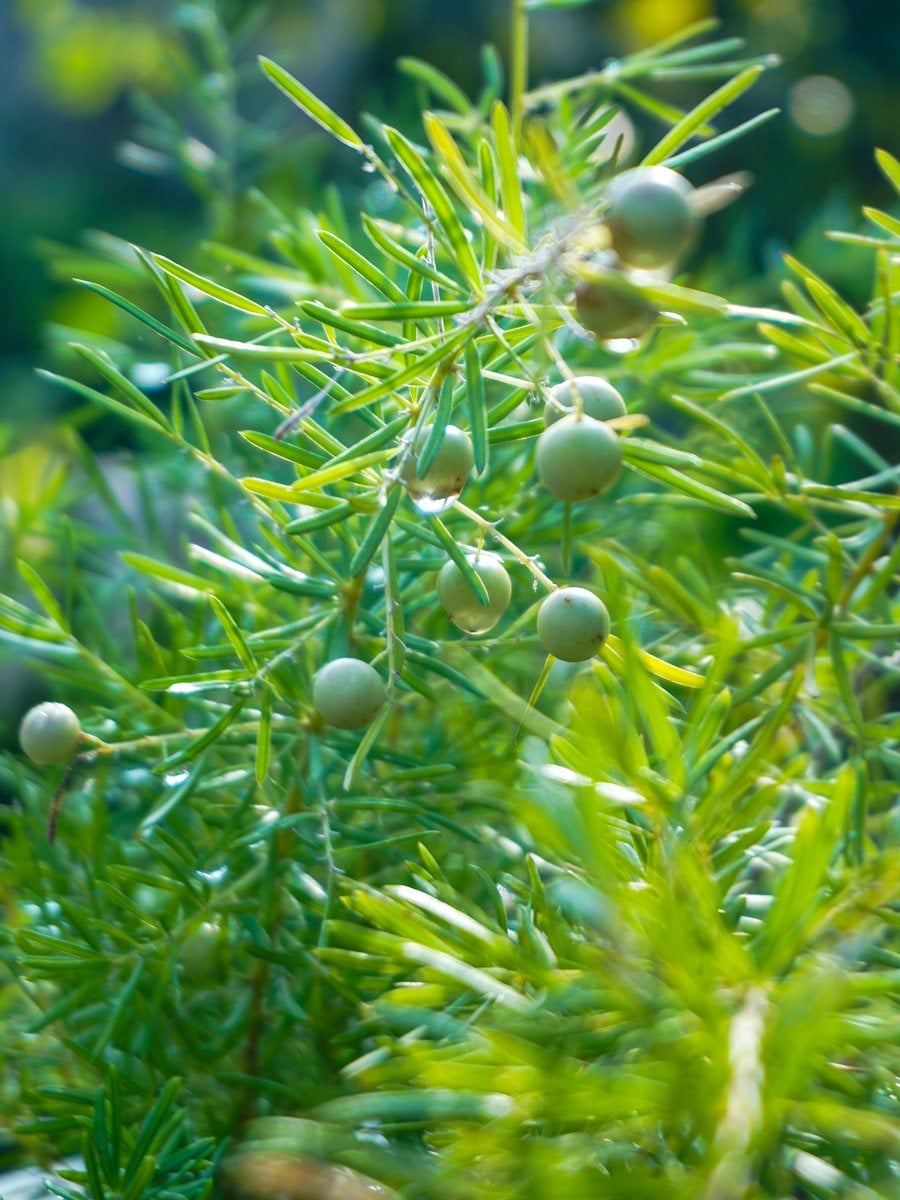
If you live in one of those climates, keep it in a pot, remove the berries before they ripen, and never dump cuttings or old plants with your garden waste. Everywhere else, enjoy it indoors and bring it in before frost. The foxtail fern is no free pass either: NSW WeedWise lists it among the similar-looking asparagus weeds.
How to Propagate an Asparagus Fern
There are two ways to get more asparagus ferns: divide an old plant or sow seed. Division is faster and the one to use at home.
Division
Spring is the best time, although these tough plants can be divided almost any time of the year, Wisconsin Extension notes. Wear gloves, take the plant out of its pot, and pull or cut the root mass into smaller pieces, each with some stems and a share of the white tubers. The tubers will regenerate plants. Pot each piece in fresh mix at the same depth and water it in. For more plants that are easy to multiply, see Thursd's seven easiest houseplants to propagate.
From Seed, the Way Growers Do It
Seed is how the plant trade does it. Soak the seed overnight before sowing, and at room temperature it germinates in three to four weeks, Wisconsin Extension says. Germination can be slow and irregular, though, and a steady seed supply has long been a problem for this plant. That is why FuzzyFern Frizz, an improved Sprengeri type, is sold on its more consistent seed supply and better germination.
At nursery scale, young plants come from specialists such as Evanthia in the Netherlands, which sells seed and young plants of the sprengeri, the foxtail, the lace fern, and several other Asparagus species. On its own product page, Evanthia gives the numbers for the sprengeri: about 25,000 seeds to a kilo, an ideal growing temperature of 18 to 20 degrees Celsius, seven to nine weeks from seed to young plant, and another 10 to 24 weeks to a finished plant. Part of that seed comes from the plant's home ground. "For Strelitzia (and Asparagus), we went a step further and set up our own seed production in South Africa, so that part of the seed comes from plants we manage," Louis Kester of Evanthia wrote in his Thursd blog on monstera seed germination. "Because you cannot run a nursery on a harvest you cannot forecast."
Once your asparagus fern care routine is settled and the sprengeri fern is spilling over its basket, Thursd has plenty more ferns. For the true ones, start with Thursd's seven indoor ferns with simple care tips, and for more on the foxtail, its own care guide.
Sources: University of Wisconsin-Madison Extension, Asparagus fern, Asparagus densiflorus (Susan Mahr, revised June 2026); NC State Extension Gardener Plant Toolbox, Asparagus densiflorus Sprengeri Group and Asparagus setaceus; UF/IFAS Assessment of Non-native Plants in Florida's Natural Areas, Asparagus aethiopicus; Florida Invasive Species Council, 2023 Invasive Plant Species; Plant Pono (Big Island Invasive Species Committee), Asparagus densiflorus; Weeds Australia, Asparagus fern, ground asparagus; NSW WeedWise, Ground asparagus; ASPCA Animal Poison Control: Asparagus Fern and Lace Fern; Evanthia, Asparagus densiflorus Sprengerii.
Featured image: an asparagus fern with ripe red berries by Rafael Rodrigues on Pexels. Header image: dense asparagus fern foliage by MAG Photography on Pexels.