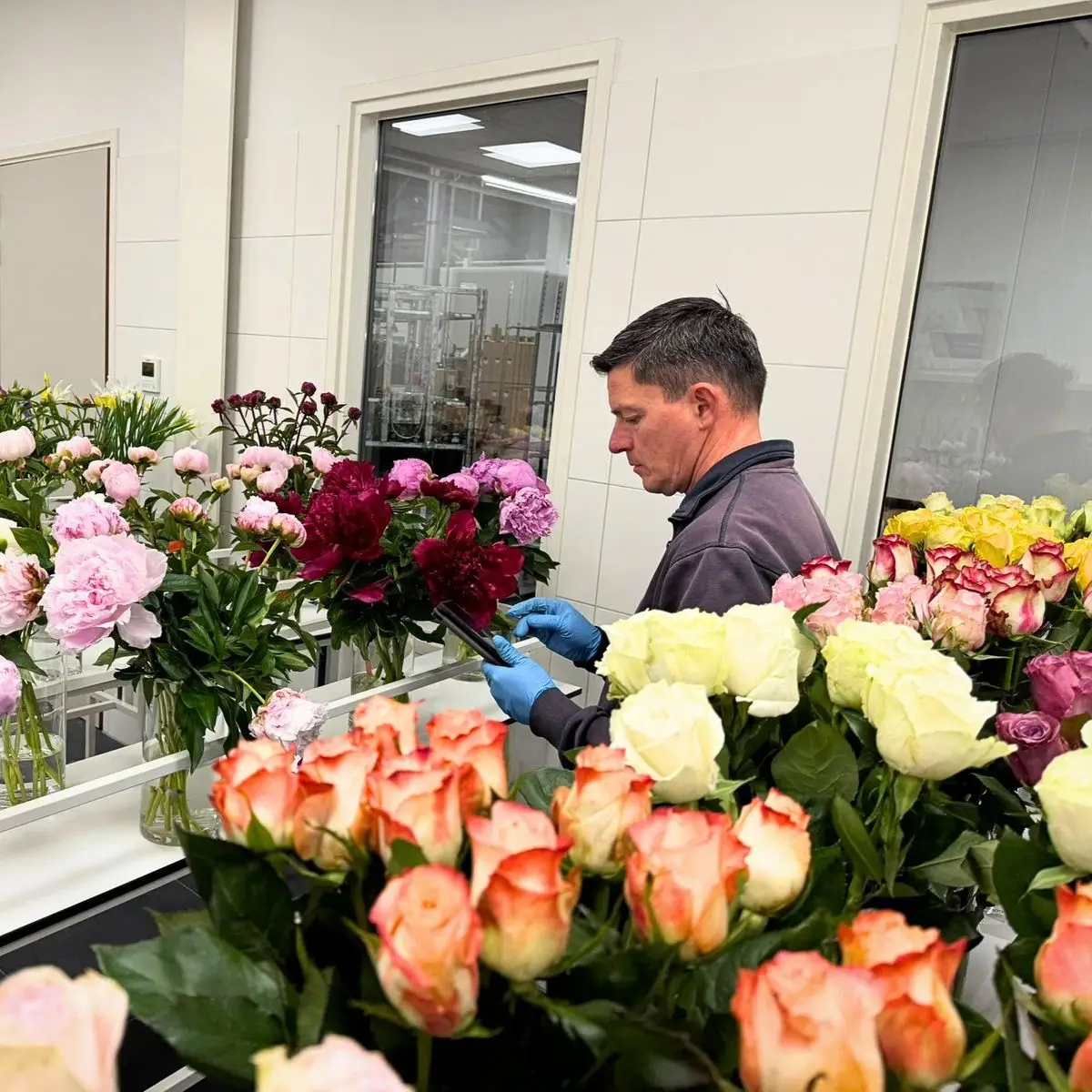
One greenhouse in Waddinxveen cut 56.1 million rose stems in 2025. That is a single Dutch company, Porta Nova, on roughly fifteen hectares of glass. The company itself usually says "over 50 million" in public, so that is the figure we print here.
Now the other half of the same country. In 2000 the Netherlands had 930 hectares of roses under glass. In 2025 the national statistics office counts 140, spread over 40 holdings. Growers themselves count lower still, around 110 to 115 hectares, because the official number keeps counting greenhouses that have stopped. So one company is now something like eight percent of what is left of Dutch rose growing.
Both numbers are true, and that is what this piece is about. The flower industry is enormous, and it is shrinking in some places at the same time. Below: what a hectare actually produces, what the farms behind the figures look like, what the sector is worth to the countries that grow for it, and the one thing that decides where this goes next.
What One Hectare Actually Produces
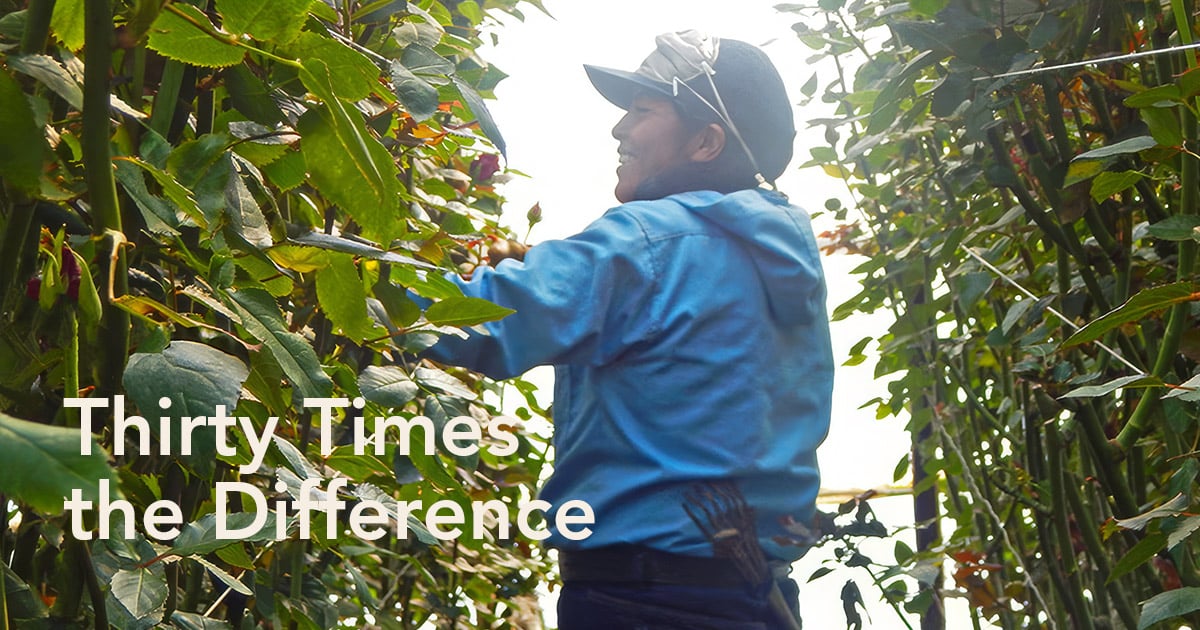
Ask ten people in this industry what a hectare yields, and you get ten answers, because the honest answer runs from under a million stems to more than twenty million. Same industry, factor thirty.
| Rose, Ecuador 2,600 to 3,000 m, large-head standards |
~0.85 million | Cayambe producer census, breeder plant-data sheets |
| Rose, Colombia Bogota savanna |
1.1 to 1.3 million | Breeder flowers-per-plant-per-month data, converted |
| Lily, Netherlands Year-round forcing |
~1.5 million | Forcing manual norms, four company figures |
| Rose, Kenya and Ethiopia Intermediate and sweetheart, unlit plastic |
1.5 to 2.0 million | Certification life-cycle study, two breeders' East Africa data |
| Chrysanthemum, Colombia Unheated, blackout |
1.8 to 1.9 million | Three dated company pairs that agree |
| Rose, Netherlands Lit glass, large-flowered |
2.3 to 3.3 million | Research station trials, national farm panel, breeder figures |
| Chrysanthemum, Netherlands Spray, year-round |
2.3 to 2.9 million | National average against top growers' printed figures |
| Gerbera, Netherlands Lit glass |
4 to 8 million | Full-year research trial, growers' own volumes |
| Tulip, Dutch water forcing Roughly a five-month season |
19 to 24 million | Forcing norms and a documented 55 million on 3 hectares |
The gap is not planting density. Roses go in at seven to eight plants per square meter almost everywhere. What differs is light, temperature, and cycle time. A Dutch rose plant gives about 33 to 39 stems a year. A Kenyan plant gives 20 to 24. An Ecuadorian plant at 2,800 meters gives 10 to 14, and those stems are longer, heavier, and worth more.
Take the same genetics to two continents, and you see it cleanly. Varieties that print 260 to 300 stems per square meter in Dutch glass print 120 to 140 in East Africa. Kenya does not win on stems per square meter. It wins on cost.
Tulips break the model entirely. One bulb gives one stem, so a field hectare is a bulb-multiplication number, not a flower number. The Netherlands had 14,410 hectares of tulip fields in 2025, and in the 2024/25 season Dutch forcers pushed 2,951 million tulips through water. That is where the top of the ladder comes from, and it is a system, not a farm.

The Farms Behind the Numbers
One company per country, picked because it is big enough to show the shape of its sector. Where a company has not confirmed a figure, the public source and its date are named, because a round number that has been repeated since 2016 is not the same thing as a measurement.
Netherlands: Porta Nova
56.1 million stems in 2025, "over 50 million" as the company puts it publicly. Nine hectares in production today plus six in renovation, which were still cropping in 2025. About 155 people. These figures were confirmed by the company in September 2026, and they are the reason this piece exists: the Dutch rose story is not growth; it is concentration. Fewer growers, bigger, cleaner, and each one a larger share of a smaller whole. Porta Nova's route to that position is covered here, and its carbon work here.
Ecuador: EQR
260 hectares of production space at 2,800 meters in Cotopaxi, more than 1,500 families attached to it, and a 27.8 percent drop in transport emissions in 2024 by moving volume onto ships. EQR has never published an annual stem figure. The one number in circulation comes from the company's own post in late 2025, which put 60 million stems shipped by sea in 2025 at nearly a quarter of total production. That implies something above 240 million, and it belongs in this piece as an order of magnitude, not as a company figure. Background on the farm is here.

Kenya: Sian Flowers
180 hectares of flowers across four farms, over 3,000 employees, exports to more than 30 countries, and Fairtrade certification on all four sites. The group does not publish annual volume, and no reliable split between roses and the rest exists in any open source. The nearest anchor is one of its own farms: Equator Flowers in Eldoret was reported at 100,000 rose stems a day in 2020. That is six years old, it covers one site, and it is the best public figure there is.

Ethiopia: AQ Roses
50.5 hectares across Ziway and Bishoftu, per the Ethiopian growers' association in May 2025, and over 1,500 people. The company figure for volume is "over 100 million stems a year," and that same round number has appeared essentially unchanged across five sources since 2016. Read it as a brand figure the company stands behind, not as a 2025 measurement.
Colombia: Flores El Capiro
The dated pair is June 2024: around 230 million Chrysanthemum stems from 127 hectares of greenhouse across seven farms, with 2,500 employees, as reported by El Colombiano. The company's own live counters say 296 million stems, 154 hectares, and 2,900 people, with no date attached, so this piece uses the dated pair and names the counters as the company's current claim. What makes this farm worth the space is the logistics: 92 percent of its volume leaves by sea, and it has been shipping that way since 2008.

And the Category Nobody Counts
Foliage. Every mixed bouquet in every shop contains it, almost no trade statistic breaks it out, and the big producers sit in Guatemala, Costa Rica, and Florida. There is no public dataset that gives hectares, people, and volume for that category the way there is for roses, which is itself the finding. When a category this large is invisible in the numbers, every total built on those numbers is short by an amount nobody can state.
What the Sector Is Worth to the Countries That Grow It
The Netherlands. Total floricultural exports reached 7.2 billion euros in 2025, of which 4.4 billion was cut flowers and 2.8 billion plants. Royal FloraHolland moved 5,410 million euros of product in the same year. Alongside that sits 1,710 hectares of cut flowers under glass, with Chrysanthemum at 470 hectares, Gerbera and lily at 150 each, and roses at 140. Which roses still earn that glass is in our look at the best selling roses in Europe.
Colombia. The area depends on who counts. The growers' association puts it at 10,500 hectares, and the agricultural authority at 11,173. Exports reached 2,376 million dollars and 338,000 tonnes in 2025, and formal employment is estimated at 200,000 to 240,000 jobs. Chrysanthemum is roughly 12 percent of the area and about 9 percent of export value. The association did not confirm which set it stands behind for 2025, so both are printed with their source. Its role in holding the sector together is worth reading, as is this interview with its long-serving president.
Ecuador. 184,000 tonnes exported in 2025 for 1,045 million dollars, with roses at 76 percent of that value. The association's own members account for 207 farms and 3,397 hectares. The national figures that circulate in the press, around 6,200 hectares and 120,000 jobs, come from a single spoken source and should be treated that way.
Kenya. Roughly 5,300 hectares, with a stated ambition to reach 10,000. Export earnings of about 845 million dollars in 2025. Roses are two-thirds of it. The Kenya Flower Council puts direct employment above 200,000, and its members account for around 80 percent of national rose production. Its chief executive has spoken to Thursd about exactly this.
Ethiopia. Here the honest reporting is the discrepancy. A ministry expert put the area actually planted at 1,600 hectares in January 2024, against 3,400 to 3,500 hectares allotted. Mirror trade data shows 231 million dollars in 2023, whereas official series show 400 to 620 million. That is a gap of about a third, and anyone writing about Ethiopian floriculture with a single confident number is quoting one side of it.
Wages, Water, and Certification
An impact story that skips this part is a brochure. So, plainly: this industry employs several hundred thousand people in East Africa and Latin America, many of them women, often at wages that sit above the local agricultural floor and below what campaigners consider a living wage. Naivasha and the Bogota savanna both draw hard on water. Certification has become the sector's answer to all of it, and it is a real answer that is also incomplete.
What is verifiable: Fairtrade covers all four Sian farms and AQ Roses in Ziway, and Colombia has its own standard in Florverde. The Fairtrade premium funds things you can point at, from daycare on the farms to training programs for women workers. What a label does and does not buy is set out in this piece, and the basics are here. What no public dataset gives you is how much of each country's area carries which standard, which is why "certified" is a weaker word in print than it sounds in a presentation.

What Needs to Happen: Demand, Not Supply
Read the table at the top again, and the strategic problem is visible in it. Every producing country is adding hectares, better genetics, and better yields per plant. Kenya wants to go from 5,300 hectares to 10,000. Ecuador's association counts 3,397 hectares among its members alone. Dutch tulip forcing sets records and then beats them. Production is not the constraint anywhere.
Now look at the buying end, where the numbers are just as clear and point the other way. The United States imported a record 1.98 billion dollars of cut flowers in 2024. Colombia supplied 1.24 billion of that, more than 60 percent, and Ecuador another 491 million, a quarter. Latin America together accounts for 92 percent. Meanwhile, American growers produced roughly 350 million dollars of cut flowers in 2023, down from a peak of 458 million in 2014, so nearly 80 percent of the value of flowers available in the US market now arrives from somewhere else.
That is the whole industry in one market. Production moved to where it grows best and costs least; it kept getting better at it, and the country doing the buying stopped growing its own. Which makes the question for the next decade a demand question, not a supply one. More stems keep arriving for roughly the same number of people buying flowers roughly as often as they did. That is why price pressure shows up in a sector that is objectively improving every year.
The encouraging part is that the industry is already acting on the fronts it can control. Sea freight is the clearest case: El Capiro at 92 percent by ocean since 2008, EQR cutting transport emissions by 27.8 percent in a single year. Certification is the second. Both are real work, and neither creates a buyer.
Creating demand is the open job, and it is nobody's department. Growers optimize production. Breeders optimize genetics. Traders optimize routes. Almost no one in this chain wakes up responsible for the number of people who buy flowers next year.
If you take one number from this piece, take the factor thirty. It says that a stem from Cayambe and a stem from Waddinxveen are not the same product and were never competing on the same thing. The industry has spent two decades getting extremely good at producing them. The next decade is about who wants them.
Sources: Statistics Netherlands (area and forcing), Royal FloraHolland annual reports and facts and figures, Expoflores statistical report 2025, Asocolflores, Kenya Flower Council, EHPEA, Wageningen University and Research trial reports, US import and production figures from farmdoc daily, University of Illinois (February 2025), and company statements dated in the text.