This recent Guardian article touches a sensitive nerve in floriculture, and that alone explains its reach. Fear-driven narratives travel faster than nuance, and suspicion consistently outperforms context in today’s media economy. The piece leans heavily on assumptions, anecdotal signals, and implication, while structural analysis, proportionality, and systems thinking remain largely absent. This approach is increasingly familiar across legacy media, which, over the past decade, has optimized for anxiety and moral positioning rather than for balance and depth.
Floriculture at the Crossroads of Media and Reality
That said, dismissing such coverage outright would be a strategic mistake. Critical attention, even when imperfectly framed, signals that the sector is being watched. And scrutiny, when engaged with intelligently, can serve as a catalyst rather than a threat.
Pesticides, Responsibility, and the Space for Legitimate Questions
There is a legitimate conversation to be had about pesticide use, worker safety, and the future of cultivation. Certain substances no longer belong in modern floriculture. Certain practices can and should be phased out faster. There are also parts of the supply chain where transparency has historically been avoided, not out of malice, but because complexity is inconvenient and honesty requires effort.

Acknowledging this does not weaken the sector. It strengthens it. Sustainability is not a binary position, nor is it a marketing exercise. It is a process of continuous improvement that involves trade-offs, regional realities, biological constraints, and economic pressures. Flowers are living products, grown in vastly different climates and regulatory environments. Any serious debate about chemical use must start from that complexity rather than reduce it to simplistic good-versus-bad narratives.
The Communication Gap That Fuels Distrust
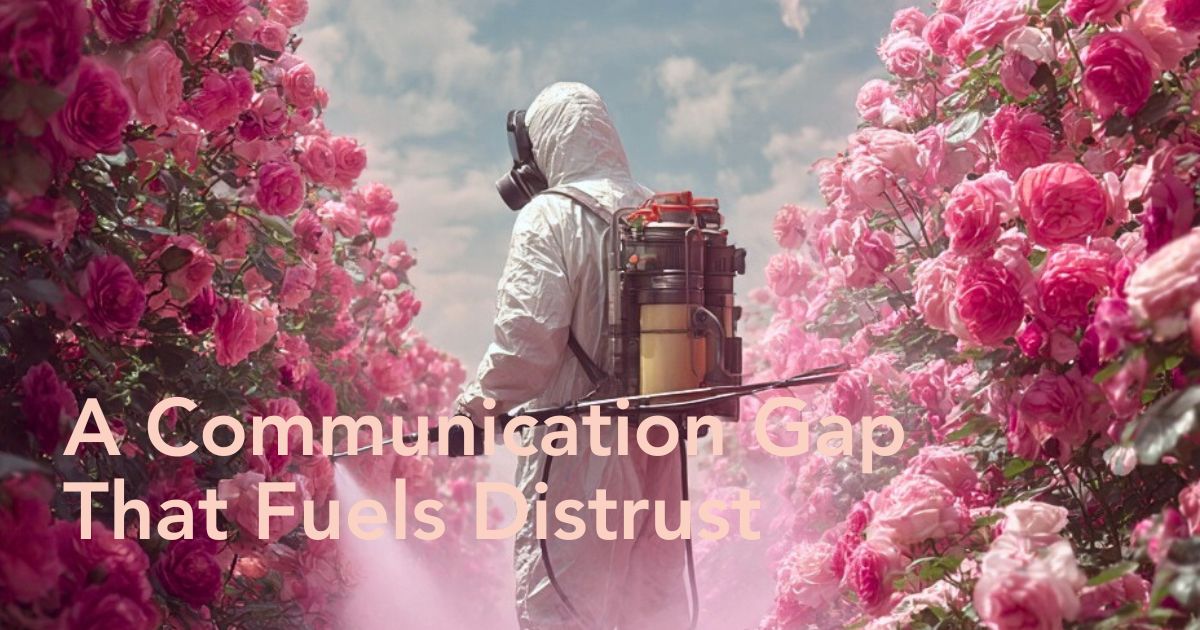
What remains most problematic is not the presence of criticism, but the one-dimensional way it is framed. On one side, media narratives reduce a global industry to a limited set of worst-case examples. On the other hand, the industry often responds with polished sustainability slogans, certification logos, and optimistic messaging that avoids harder, uncomfortable questions. Both sides raise their pamphlets. Neither side truly listens.
This stalemate creates distance rather than dialogue. As long as communication is limited to defensive positioning or greenwashed success stories, credibility erodes. The absence of open data, shared benchmarks, and honest discussion creates a vacuum. That vacuum is inevitably filled by suspicion-driven storytelling. Responsibility for that outcome is shared.
Why Criticism Can Be a Strategic Asset
Paradoxically, articles like this also serve a useful function. They keep the sector alert. They force reflection. They prevent complacency. They remind growers, traders, and platforms that standing still is not an option. The debate around alternative cultivation methods, reduced chemical dependency, biological solutions, and improved worker protection is not an existential threat to floriculture. It is a growth opportunity.
The industry is capable of more progress than it often shows publicly. Innovation is happening, but it is fragmented, undercommunicated, and rarely contextualized in a way that society understands. That gap between reality and perception is where trust is lost.
Reconnecting Flowers With Their Broader Value
The deeper missed opportunity lies in the lack of connection between sustainability debates and the broader value flowers bring to society. Flowers contribute positively to mental health, emotional expression, social bonding, and overall well-being. These effects are real, measurable, and scientifically supported. Yet they are rarely part of the same conversation as labor conditions or environmental impact.

As long as these narratives remain disconnected, floriculture will continue to be framed defensively rather than holistically. Society is clearly searching for authenticity, meaning, and reassurance. The flower industry already plays a role in that space, but it rarely claims it with confidence and nuance.
Toward Real Conversation and Real Progress
The strongest signal of progress is not agreement, but openness. When complexity is allowed, when doubts can be voiced without immediate judgment, and when improvement is framed as a shared journey rather than a moral contest, engagement follows. Not because everyone aligns, but because the conversation finally feels credible.
That is where the real leverage sits for floriculture today. Not in denying criticism, nor in amplifying fear, but in choosing transparency, dialogue, and long-term thinking. That path may be less comfortable, but it is the only one that leads to durable trust and meaningful progress.