Walk past a shelf of Philodendron varieties, and two kinds of plant look back at you. One kind sends long stems up a moss pole or over the rim of the pot. The other sits in a tight clump, every new leaf rising from the same short stem, and it will never climb anything. That split, climbing versus self-heading, is the quickest way to sort the types of Philodendron you meet in a shop, a greenhouse, or a collector's living room.
This guide works through 17 of them along that line. The climbers run from the heartleaf to the hairy-stalked Philodendron squamiferum. The self-headers and creepers run from Prince of Orange to the ruffled Philodendron plowmanii. A separate section covers the variegated Philodendron types, why their color can turn green, and what they cost. The facts come from university extension services, botanical papers, and Thursd's own guides, all listed at the end.
Climbing or Self-Heading: How Philodendrons Grow
Philodendron is a big genus. NC State Extension puts it at more than 600 species in the arum family, Araceae, native to the tropical forests of Central and South America, where they tend to climb tree trunks or grow as epiphytes. The name says as much: it joins the Greek phileo, to love, and dendron, tree. In 2003, the University of Florida counted 250 or so species and split the genus into three groups for growers: vining, self-heading, and tree-like. NC State keeps it to two, climbing and non-climbing, and that is the split this guide follows.

How to Tell a Climber From a Self-Header
Look at the stem. A climbing Philodendron makes a long stem with space between the leaves and puts out aerial roots that grab a pole, a trellis, or bark, NC State explains. The heartleaf and the Pink Princess both grow this way. A self-heading Philodendron has a very short stem and holds its leaves in a rosette, so every new leaf comes up from the center of the plant. Clemson Extension describes self-headers as plants that send out leaves from a heavy clump of growth at their base, often with large leaves in all kinds of shapes.
The habit decides the care. A climber's height depends on its support and on how you prune it, while a self-header keeps widening and can get very large, Clemson notes. Its long leaf stalks are brittle, so keep it out of the way of foot traffic. The line between the two is not rigid. NC State writes that Philodendron erubescens can climb a moss pole or spread outward, and that the tree Philodendron reclines or creeps with age and will climb if it gets support. A few species do neither and crawl along the ground; you will find those creepers further down.
Why the Split-Leaf Types Are Now Thaumatophyllum
Some of the best-known self-headers have changed genus. In 2018, Cassia Mônica Sakuragui of the Federal University of Rio de Janeiro and her colleagues, Simon Mayo of the Royal Botanic Gardens, Kew, among them, published molecular, morphological, and cytological evidence in PhytoKeys that the group long kept as Philodendron subgenus Meconostigma is a genus of its own, Thaumatophyllum. The paper deals with 21 names in the new genus. NC State now lists the tree Philodendron as Thaumatophyllum bipinnatifidum and the Xanadu as Thaumatophyllum xanadu. The old names hang on, though: the ASPCA still files the tree Philodendron as Philodendron selloum, and Thursd's own product page says Philodendron Xanadu. So this guide keeps both plants in and gives both names.
Philodendron, Pothos, or Monstera?
Three related plants share the same shelves and get mixed up all the time. A pothos is Epipremnum aureum, a different genus, and the pothos guide notes that the heartleaf Philodendron is often mistaken for a Jade pothos. NC State gives two tells: the Philodendron has conspicuous sheaths on its new growth that dry and fall off messily on older stems, and its leaf stalks have no groove. Monstera is a genus again, and as the comparison of Philodendron vs Monstera puts it, Monstera usually means larger leaves with holes and a stronger climbing habit. The guides to the types of pothos and the types of Monstera do for those plants what this one does for Philodendron varieties.
From Rainforest to Greenhouse
How a Philodendron is multiplied depends on its type. Commercially, most named self-heading Philodendrons are propagated through tissue culture, the University of Florida writes, while the heartleaf is grown from stem cuttings of just 2.5 to 4 cm (1 to 1.5 in) with one node and one leaf, and the tree Philodendrons are raised from seed. In the Netherlands, Persoon Potplanten in De Lier, which has traded as Plantanious since March 2023, grows large green plants, Philodendron and Monstera among them, and cultivates its new cuttings from its own mother plants. Kwekerij Mostert in Nieuwerkerk aan den IJssel started with Schefflera in 1976 and has since added Philodendron, Monstera, and Anthurium, among others.
Climbing Philodendron Varieties
These are the Philodendron varieties that want to go up, or down over the edge of a pot. Give the bigger ones a moss pole early. Growers know what a pole does: the University of Florida notes that stock plants are grown on a pole when larger-leaved cuttings are wanted.
Heartleaf Philodendron (Philodendron Hederaceum)
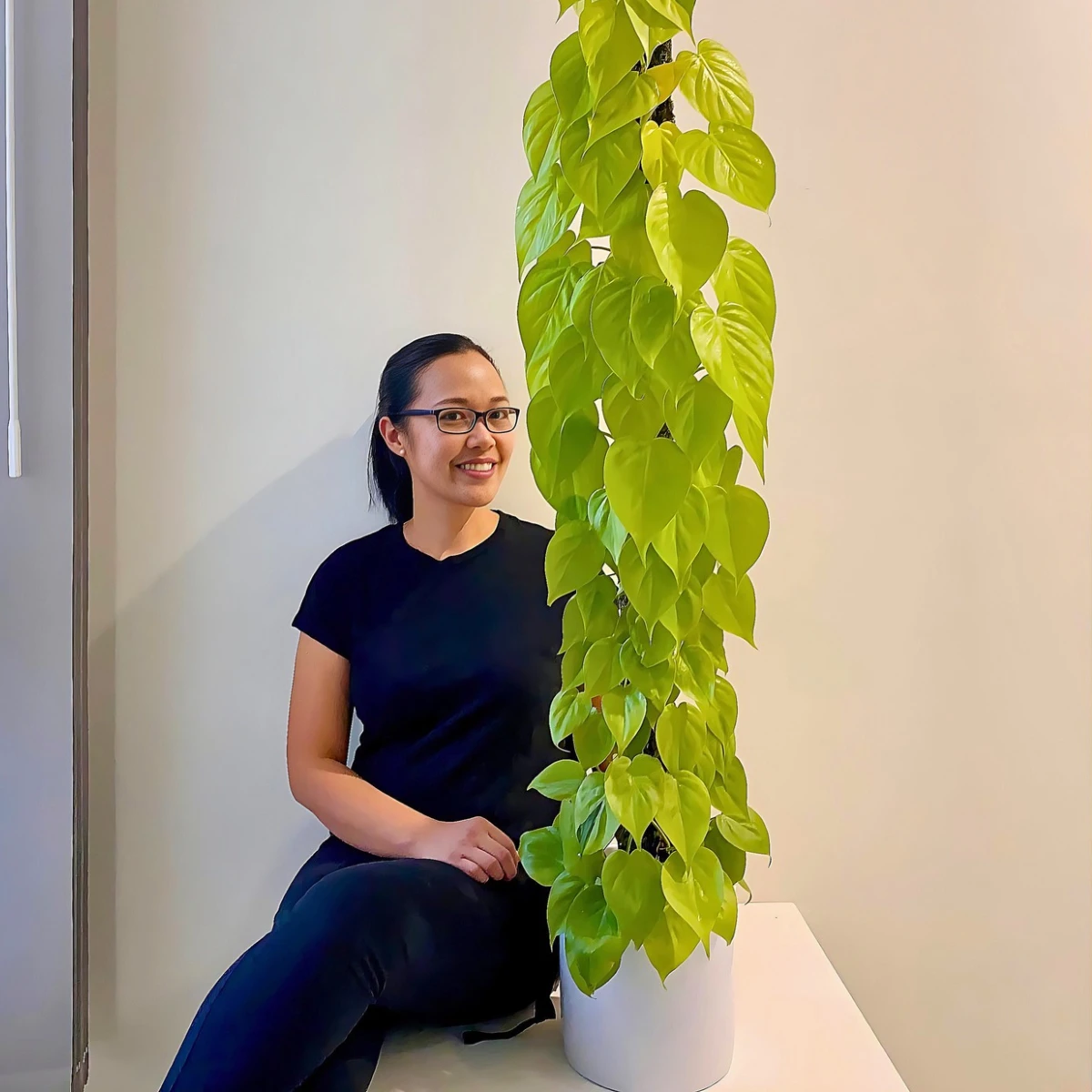
The classic, and still the one in most homes. NC State calls Philodendron hederaceum the most common houseplant Philodendron, with solid green, heart-shaped leaves on stems that trail or climb, and notes that it can survive long periods in very low light. In 2003, the University of Florida called it a foliage favorite of more than 60 years. You will also see it sold as Philodendron cordatum or Philodendron scandens, the names on Thursd's guide to the Philodendron cordatum and on the Philodendron scandens product page. How to tell it: small, glossy, all-green hearts and papery sheaths along the stem.

Philodendron Brasil
Brasil is the heartleaf with a stripe: dark green edges and a yellow to light green center on every leaf, in NC State's description. It started as a single plant with variegated leaves, found in 1991 in a planting of the heartleaf in Holambra, Brazil, according to its US plant patent. The patent also notes that low light enhances the variegation. The lime stripe down the middle is the tell; a Marble Queen pothos is marbled all over instead.

Philodendron Micans
Micans is the velvet one. The University of Florida describes heart-shaped leaves that are velvety green on top and dark copper underneath, on a thin-stemmed vine. It classes the plant botanically as the juvenile form of the heartleaf and adds that it takes less environmental stress than the adult form. Clemson lists it as the velvet Philodendron and describes its leaves as bronze with reddish brown undersides. Run a finger over a leaf: a micans feels like suede, while a plain heartleaf is smooth and glossy. The Philodendron micans page has more on its care, and the plant also appears as one that grows in water in the guide to hydroponic houseplants.

Pink Princess Philodendron
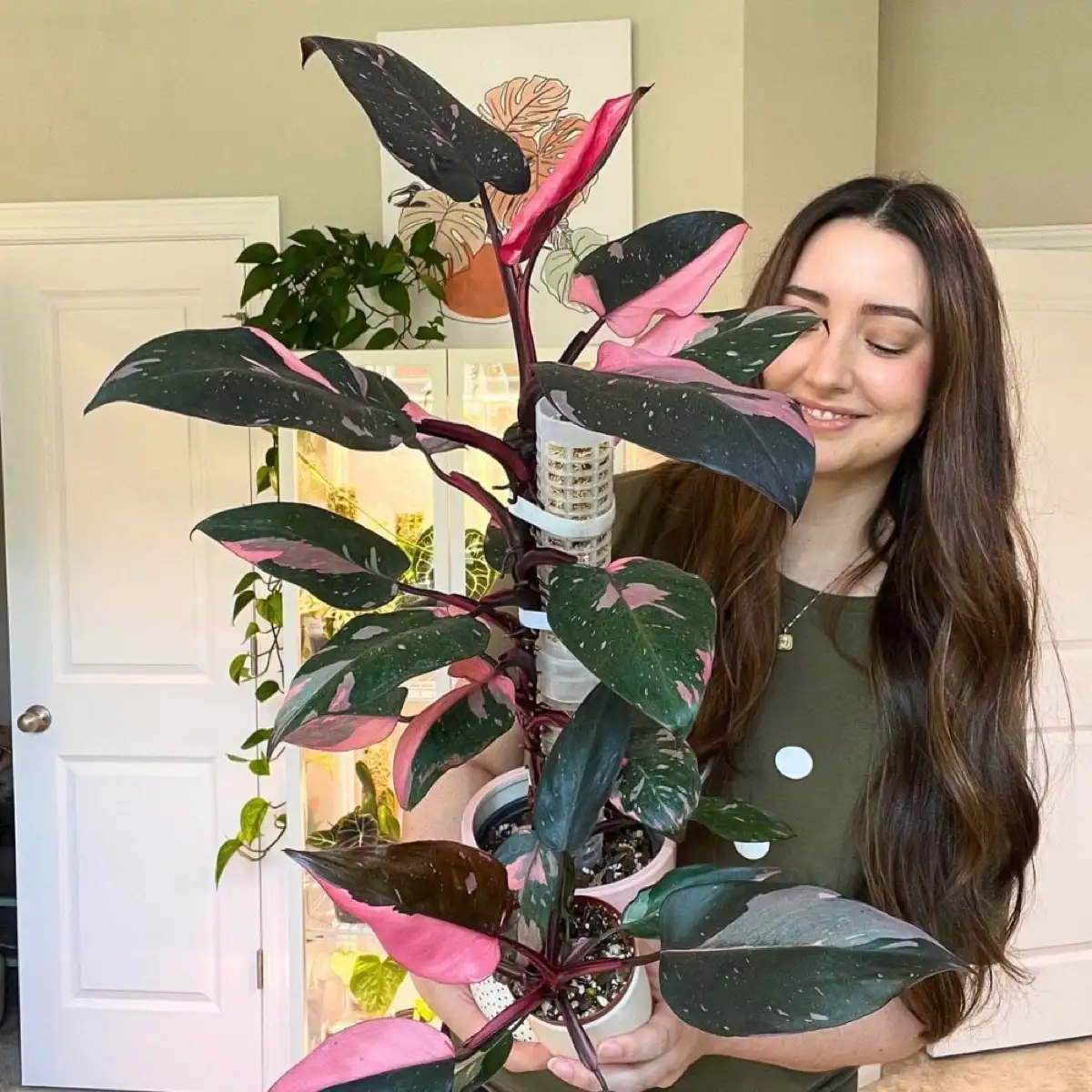
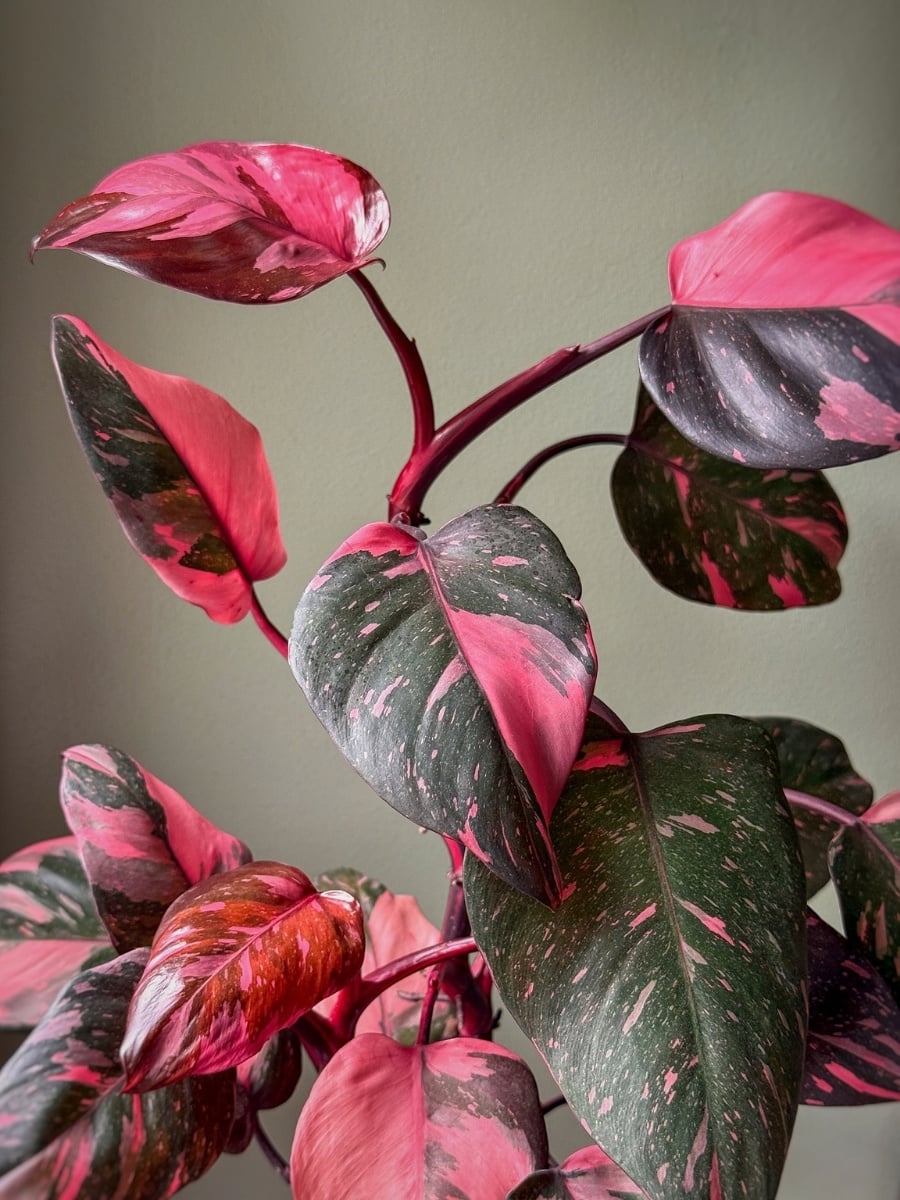
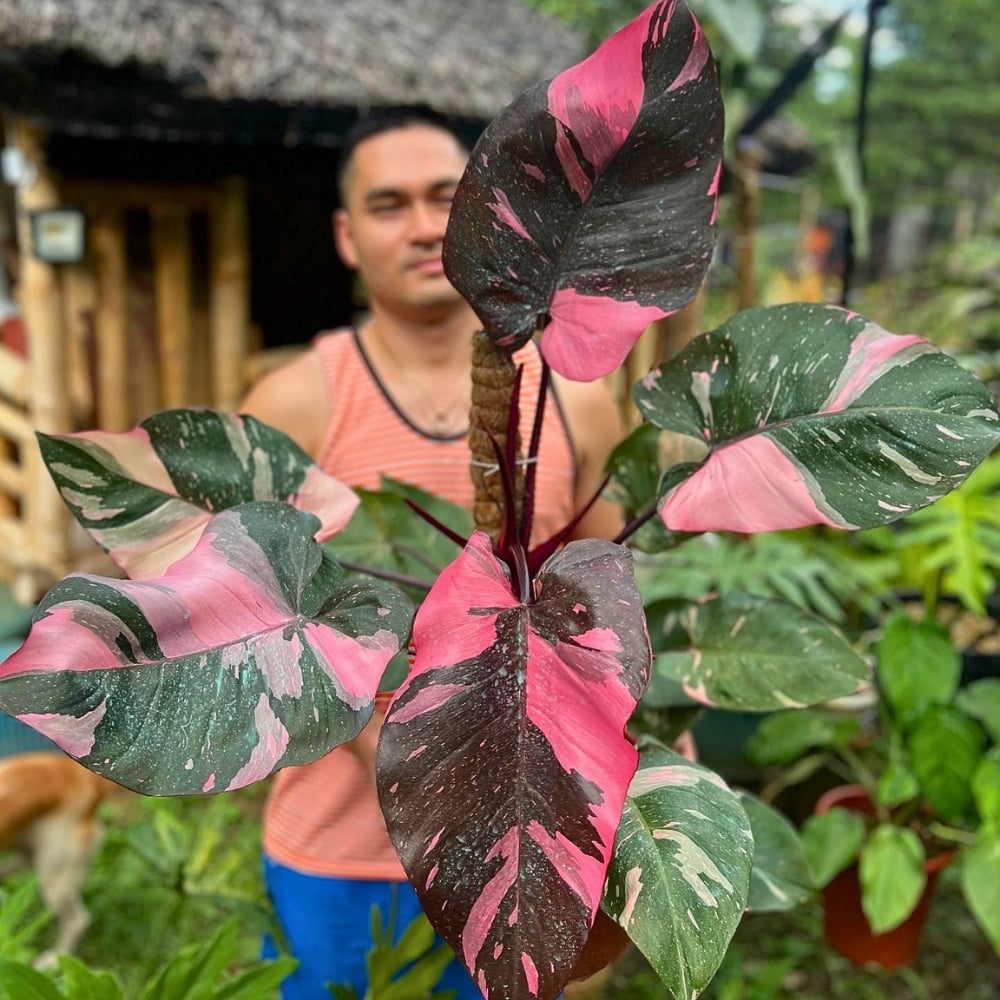
The Pink Princess is a cultivar of Philodendron erubescens, the blushing Philodendron. NC State describes it as upright and vining, with heart-shaped, dark purplish green leaves marked with pink, and describes the species as a climber that grows up to 18 m (60 ft) tall in the rainforests of Colombia. No two plants are marked alike, as the Pink Princess guide explains, and a plant that loses its pink loses most of its value. Look for near-black leaves with sections of pink, and be wary of a plant sold as Pink Congo, for reasons the section on variegation below explains.
White Princess Philodendron
Another erubescens cultivar, with green leaves splashed with white, in NC State's words. Thursd's White Princess guide describes it as upright when young, then leaning into a climbing vine once it has a moss pole to hold on to. It has two look-alikes, and the guide's fastest check is the stem. Green with pink means a Princess. Burgundy means a White Knight, and plain green means a White Wizard.

Philodendron Melanochrysum
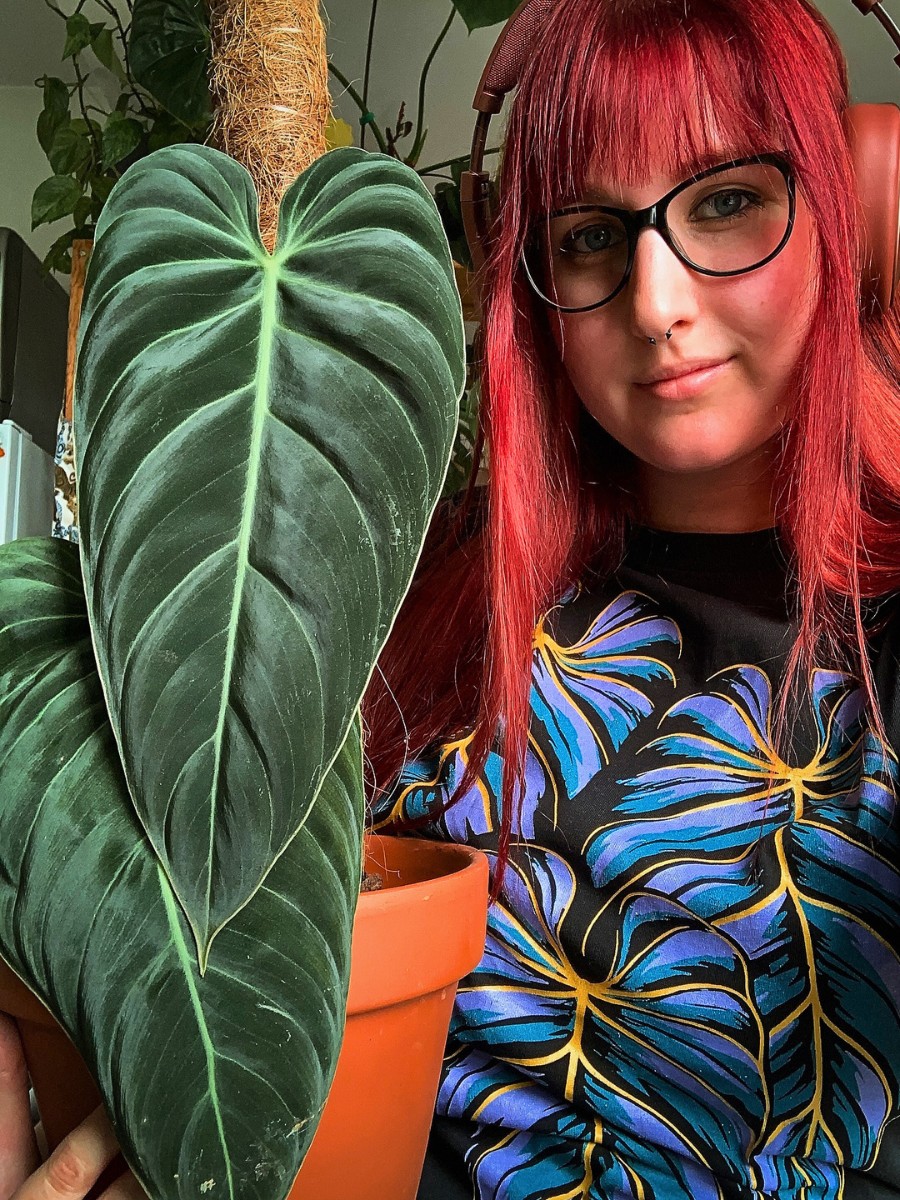
Melanochrysum, the black-gold Philodendron, is a collector's climber. NC State calls it rare and vining, with large velvet-like leaves of deep green crossed by yellow veins. Next to a micans, the difference is size and shape: long, velvety leaves with pale veins instead of small velvety hearts.
Philodendron Verrucosum
NC State lists Philodendron verrucosum as the Ecuador Philodendron: a vining plant with large, deep green, velvet-like leaves, light green veins, and burgundy undersides. At first glance, it looks close to melanochrysum. Turn a leaf over. A burgundy back points to verrucosum.
Philodendron Squamiferum
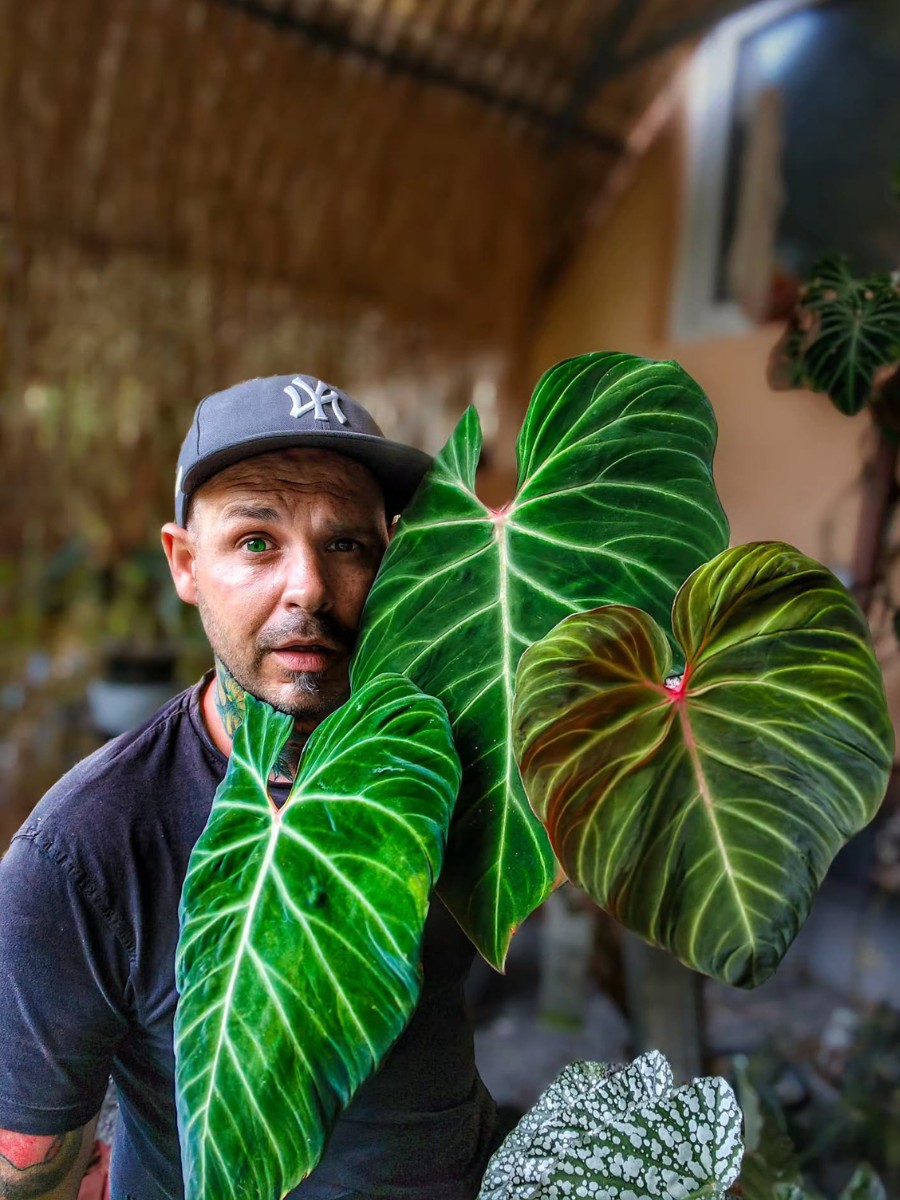
Squamiferum is the one with hairy stalks. The University of Florida calls it the red bristle Philodendron. Its long leaf stalks carry red bristles, and its deeply lobed, medium green leaf blades reach about 46 cm (18 in). Singapore's National Parks Board records its growth form as climber and epiphyte, native to French Guiana, Suriname, and Brazil, although the University of Florida's 2003 trade list filed it with the self-heading types. Given that, treat it as a climber and give it a pole. Red bristles on the stalks below deeply lobed leaves: that combination is what to look for.
Self-Heading and Creeping Philodendron Varieties
These Philodendron varieties stay put. The self-headers grow from a short central stem and widen rather than climb, and most of the named hybrids among them come out of tissue culture, as noted above. Then there are the creepers, which crawl along the ground. None of them needs a pole, although some of the big ones lean on one with age.
Philodendron Prince of Orange
Prince of Orange is the color changer. The University of Florida lists it as a patented, self-heading hybrid with elliptical leaves that come out orange, adding that it needs high indoor light to keep its color and keep growing. NC State calls it compact and bushy, with leaves that emerge orange, turn copper, and end up deep green. Thursd's Prince of Orange guide and the Prince of Orange product page go deeper.

Philodendron Imperial Red
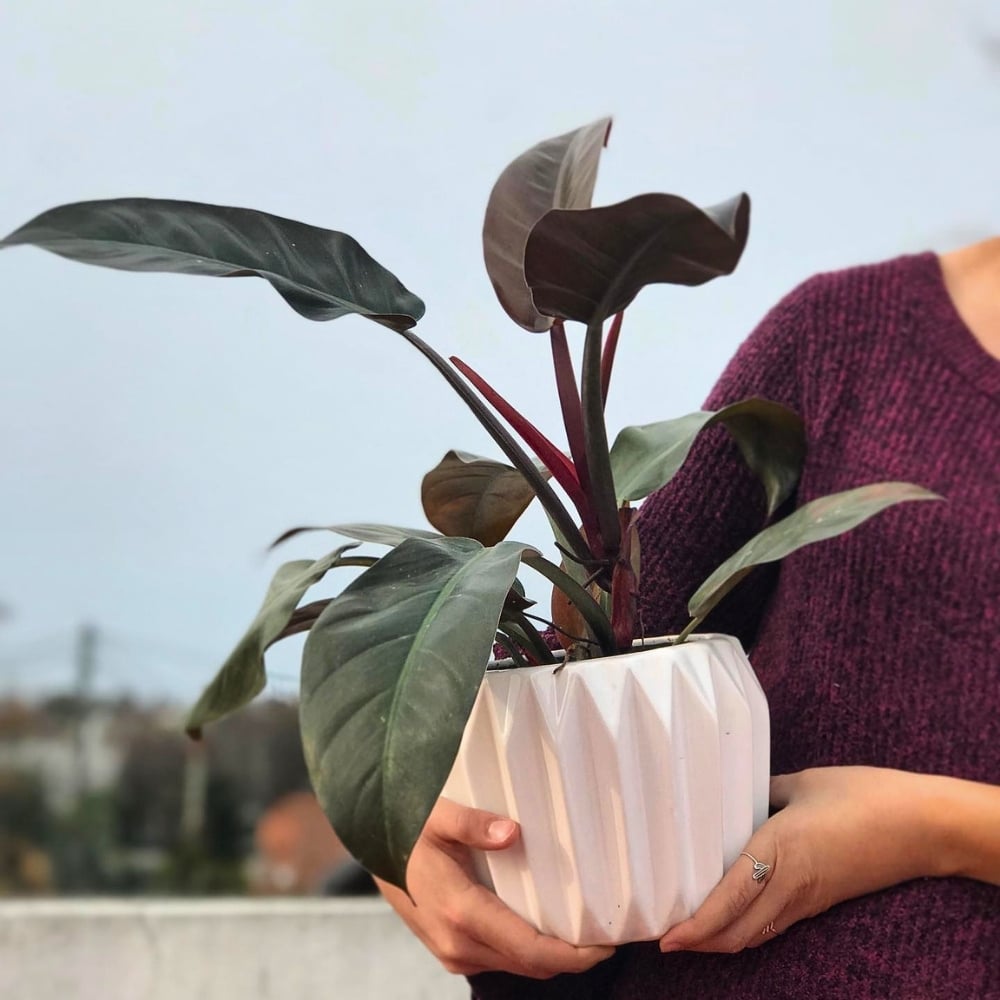
Imperial Red is a patented, self-heading hybrid with deep red leaves, according to the University of Florida. It forms a tidy rosette and needs no moss pole, as the Imperial Red guide explains. The color tells it from Prince of Orange: deep red leaves, not orange ones.
Philodendron Birkin
Birkin came onto the market in 2010, NC State writes, with glossy dark green leaves striped with fine creamy white, yellow, or light green lines that grow more pronounced as the plant matures. Its origin is unclear. It is believed to be either a rare mutation of Philodendron Rojo Congo or a hybrid of the cultivars Congo and Imperial Green. The habit is erect and compact, from 15 cm (6 in) to about 90 cm (3 ft) tall. The pinstripes give it away, since no other Philodendron on this list has them. It also made Thursd's list of houseplants that are hot on Instagram.

Philodendron Atom
Atom is a trade name more than a botanical one. It has its own Philodendron Atom product page on Thursd, and one US plant seller describes it as a self-heading, compact clump with deeply lobed, glossy green leaves. None of the extension services or botanical sources checked for this guide describes it, so judge the plant in front of you rather than the tag: a small, upright, lobed plant that never reaches for a pole belongs with the self-headers.
Philodendron Xanadu
Xanadu, now Thaumatophyllum xanadu, was in the nursery trade long before it had a formal species name, NC State writes, and it is believed to be native to southern Brazil and Paraguay. In 2003, the University of Florida still listed it as a patented hybrid developed in Australia, with leaves that look like smaller versions of the lacy tree Philodendron's and a maximum height of about 90 cm (3 ft). It forms a dense, low mound of deeply lobed, glossy leaves; Clemson gives about 90 cm (3 ft) tall and 1.5 m (5 ft) wide. See the Philodendron Xanadu page for its care.

Tree Philodendron (Thaumatophyllum Bipinnatifidum)
Sold as Philodendron selloum, Philodendron bipinnatifidum, or lacy tree Philodendron, this is the giant of the group. NC State describes an upright, woody plant of 1.2 to 3 m (4 to 10 ft) tall and 1.8 to 3 m (6 to 10 ft) wide, with gigantic, glossy, deeply lobed leaves on long stalks, a short stem marked with leaf scars, and aerial roots that help hold it up. It reclines or creeps with age and will climb if given support. The University of Florida gives a height of up to 4.5 m (15 ft) and leaves up to 1.2 m (4 ft) long, and notes that mature plants survive brief dips slightly below freezing. The Philodendron bipinnatifidum guide covers its care.

Philodendron Ring of Fire
Ring of Fire is believed to be a hybrid of Philodendron wendlandii and Philodendron tortum, with serrated leaves in shades of green, orange, red, and yellow, as the comparison of Philodendron and Monstera describes it. Thursd's Ring of Fire guide adds that a young plant is self-heading, sitting upright on a short stem with a rosette of leaves like its wendlandii parent. After two or three years, it starts to lean, sprawl, and put out aerial roots that will grip a pole. Long, narrow, toothed leaves in several colors make it easy to spot.

Philodendron Gloriosum
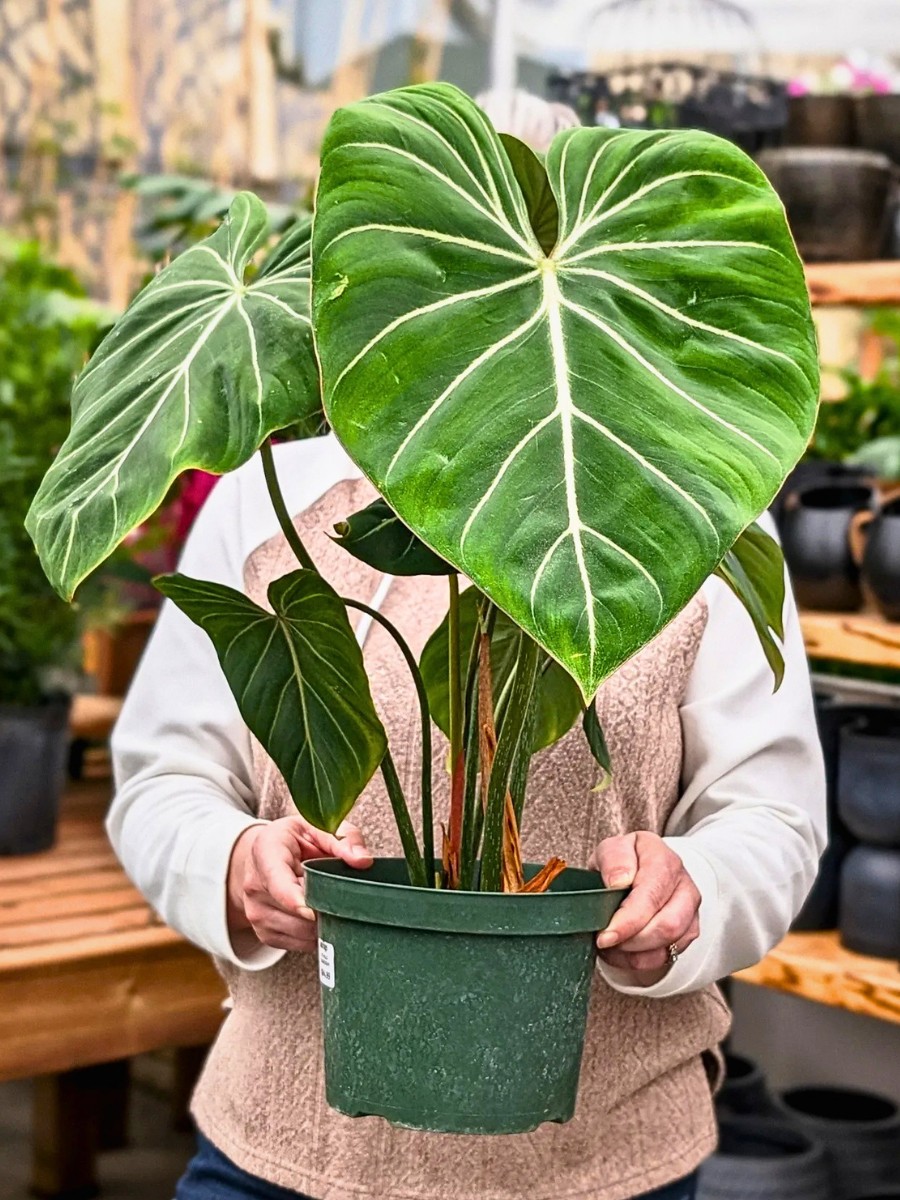
Gloriosum is a creeper. As Thursd's Philodendron gloriosum guide puts it, it is not a climber: in nature it crawls over the forest floor, so the stem belongs on top of the soil, never buried. It is slow, too. From the moment a new leaf stalk appears, it can take a month or more for the leaf to open fully. The leaves are large, velvety hearts with pale veins, and the guide traces the species to Colombia.
Philodendron Plowmanii
Plowmanii is the other well-known creeper. It comes from Ecuador and Peru, and the Exotic Rainforest collection describes a terrestrial Philodendron whose stem creeps along the ground, with the leaves close together and leaf stalks that carry a ruffled, wavy, winged edge, the feature collectors look for. The name honors the American ethnobotanist Timothy Plowman, who lived from 1944 to 1989, and comes from the aroid botanist Thomas Croat of the Missouri Botanical Garden. The same source calls the species yet to be officially published, the International Plant Names Index has no record of it, and GBIF lists the name as doubtful. So the plant is sold under this name, but the name is not formal yet. It is sometimes confused with Philodendron mamei, the Exotic Rainforest notes.
Variegated Philodendrons and Everyday Care
A variegated Philodendron is any of the Philodendron varieties with leaves in more than one color, and several on this list qualify: the Pink Princess and White Princess, the striped Brasil, and the pinstriped Birkin. NC State lists more heartleaf cultivars of the same kind, among them Cream Splash, Rio, Silver Stripe, and Gabby, which can turn almost entirely cream.
Why Variegation Reverts
Variegated plants are usually selected from a sport, a mutation of a plain green plant, and then kept going by cuttings, the RHS explains. That mutation can slip. Reverted shoots, the plain green ones, carry more chlorophyll than the variegated growth, so they are more vigorous and can take over the plant. The RHS advice is to prune them out completely or cut back to growth with variegated leaves. Light plays a part as well, and not the same part for every type: NC State warns that a Birkin kept in too little light can lose its variegation, while the Brasil's patent says low light enhances that plant's stripe. One more warning from the Pink Princess guide: plants sold as Pink Congo get their pink from chemical injections, and the color usually turns back to green within a few months.
What a Variegated Philodendron Costs
Variegation is where the money is. Thursd's Pink Princess guide puts a cutting without a pot at 45 to 125 US dollars, with reverted plants priced far lower because they have lost what buyers pay for. Some prices have come down: the White Princess guide found rooted starter plants from US online sellers at about 16 to 50 US dollars in September 2026, where a single well-variegated cutting changed hands for hundreds of dollars at the peak of the 2020 and 2021 houseplant boom. Either way, the price follows the variegation.
Care That Works for Every Type
Across Philodendron varieties, the basics overlap. NC State recommends bright, indirect light, temperatures between 18 and 29 °C (65 and 85 °F), protection from cold drafts, and moist, well-drained soil rich in organic matter, adding that most Philodendrons adapt to the humidity of an average home. Clemson says to keep the soil evenly moist but never soggy and names too little light or overwatering as the usual causes of yellow lower leaves. The University of Florida's numbers: most Philodendrons tolerate as little as 75 foot-candles (about 800 lux) indoors, and 150 foot-candles (about 1,600 lux) or more keeps their color and leaf size. The guide to how much light houseplants need helps you read your own rooms.
Treat all types of Philodendron as toxic to pets. Clemson says all parts of Philodendrons are toxic if eaten because of their calcium oxalate crystals, and the ASPCA lists both the heartleaf and the lacy tree Philodendron as toxic to dogs and cats. If you share your home with either, the list of pet-friendly houseplants is the safer route.
How to Tell Which Philodendron You Have
Start with the stem. A long stem with aerial roots means a climber, leaves rising from one central clump mean a self-header, and a stem lying on the soil means a creeper. Then read the leaf: velvet or gloss, hearts or lobes, stripes, splashes, or bristles on the stalk. The Philodendron varieties above take it from there.
Sources opened for this guide, October 2026. NC State Extension Gardener Plant Toolbox: Philodendron, Philodendron hederaceum, Philodendron erubescens, Philodendron Birkin, Thaumatophyllum bipinnatifidum, and Thaumatophyllum xanadu. University of Florida IFAS Extension: Cultural Guidelines for Commercial Production of Interiorscape Philodendron (Dennis B. McConnell, Jianjun Chen, Richard J. Henny, and Kelly C. Everitt, 2003, reviewed 2024). Clemson Cooperative Extension Home and Garden Information Center: Philodendron. Sakuragui and colleagues, Recognition of the genus Thaumatophyllum Schott, PhytoKeys 98 (2018). National Parks Board Singapore (Flora and Fauna Web): Philodendron squamiferum. Calazans and colleagues, iNaturalist record of the threatened aroid Philodendron spiritus-sancti, Oryx (2024). The Exotic Rainforest: Philodendron plowmanii. International Plant Names Index and GBIF, searched October 2026. US Plant Patent 12,956, Philodendron plant named Brasil. Royal Horticultural Society: Reversion. ASPCA Animal Poison Control: Heartleaf Philodendron and Lacy Tree Philodendron. Plant Detectives: Atom Philodendron (seller listing).
Featured image: a Pink Princess Philodendron with pink and dark green leaves, photo by @cubehousejungle. Header image: a Philodendron Imperial Red with red new stalks, photo by @basia_plantslover.