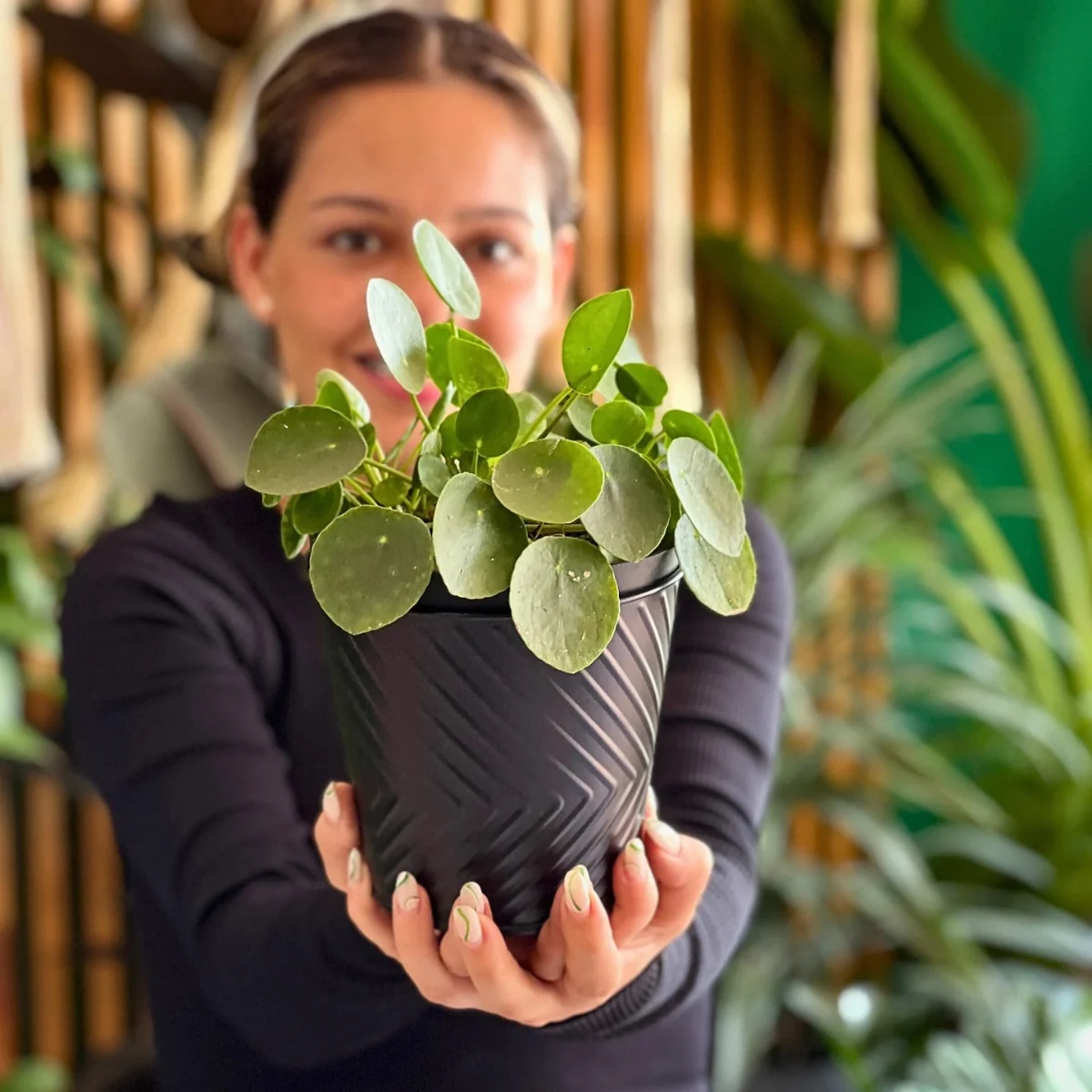
Ever noticed a houseplant that seems to say its prayers at bedtime? Well, the prayer plant does exactly that. By day, the oval leaves of Maranta leuconeura lie flat and soak up the light; at dusk, they rise and fold upward, like hands brought together in prayer. Quite a routine for a pot on a windowsill, you'd agree!
Keeping that routine going is what prayer plant care comes down to. For starters, this low, spreading tropical plant from Brazil wants bright light that never hits it directly, soil that stays moist without turning soggy, and air far more humid than most living rooms offer in winter. Get those right, and the leaves keep moving; get them wrong, and they curl and brown at the tips long before they drop.
The Prayer Plant in Detail
The prayer plant is an evergreen perennial of the Marantaceae, a tropical family that NC State Extension calls the arrowroot family. Its home is narrower than many care guides suggest. Kew's Plants of the World Online gives the native range of Maranta leuconeura as central and eastern Brazil; as a whole, it is the family spreading across the tropics of the Americas, Africa, and Asia. The genus name honors Bartolomeo Maranta, a 16th-century Italian physician and botanist.
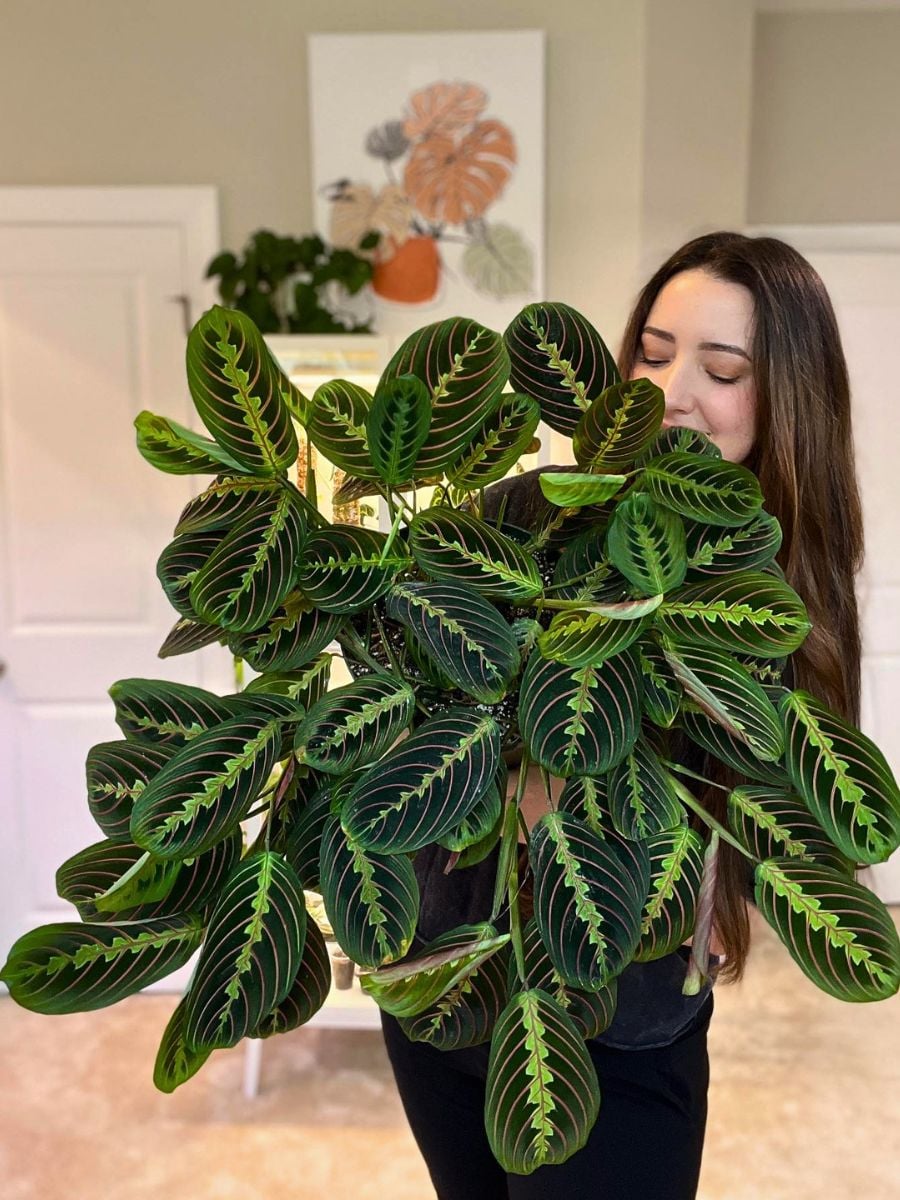
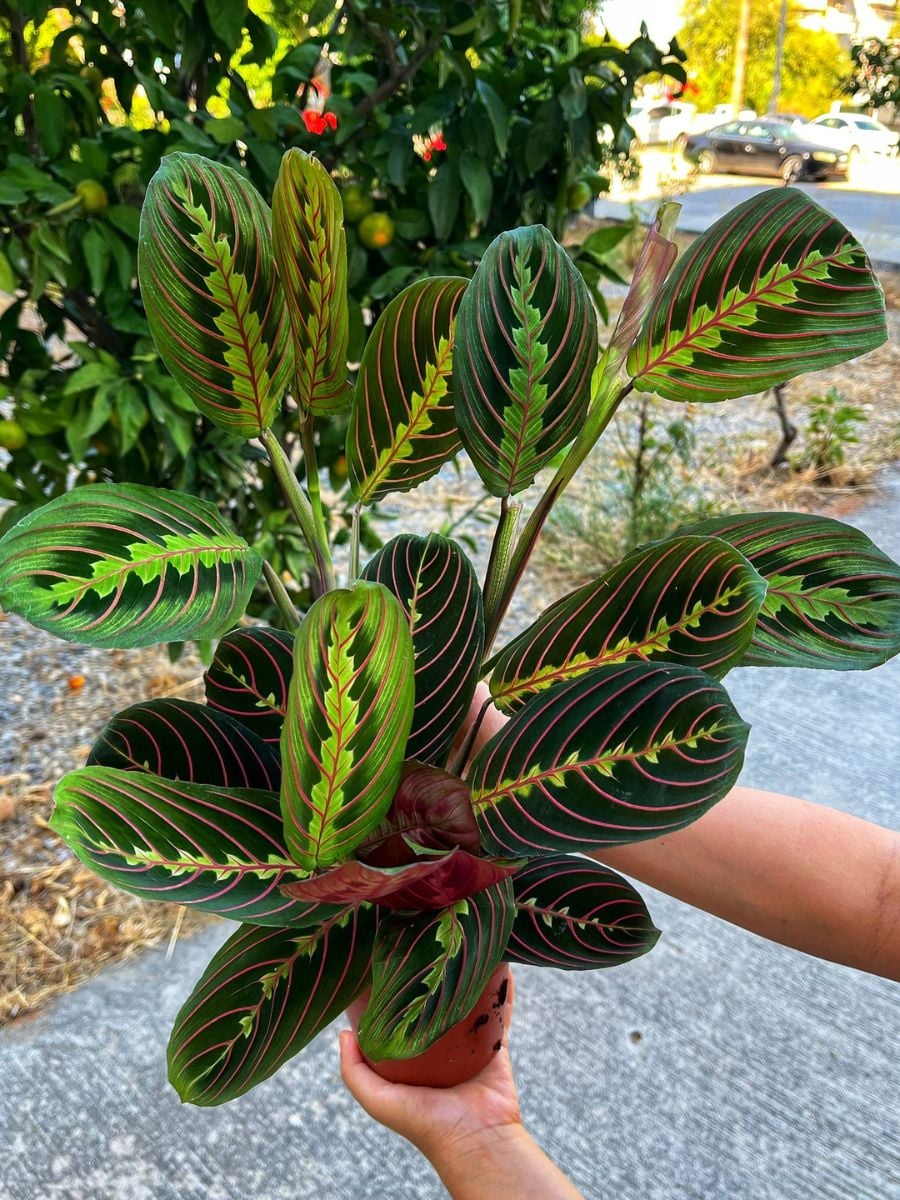
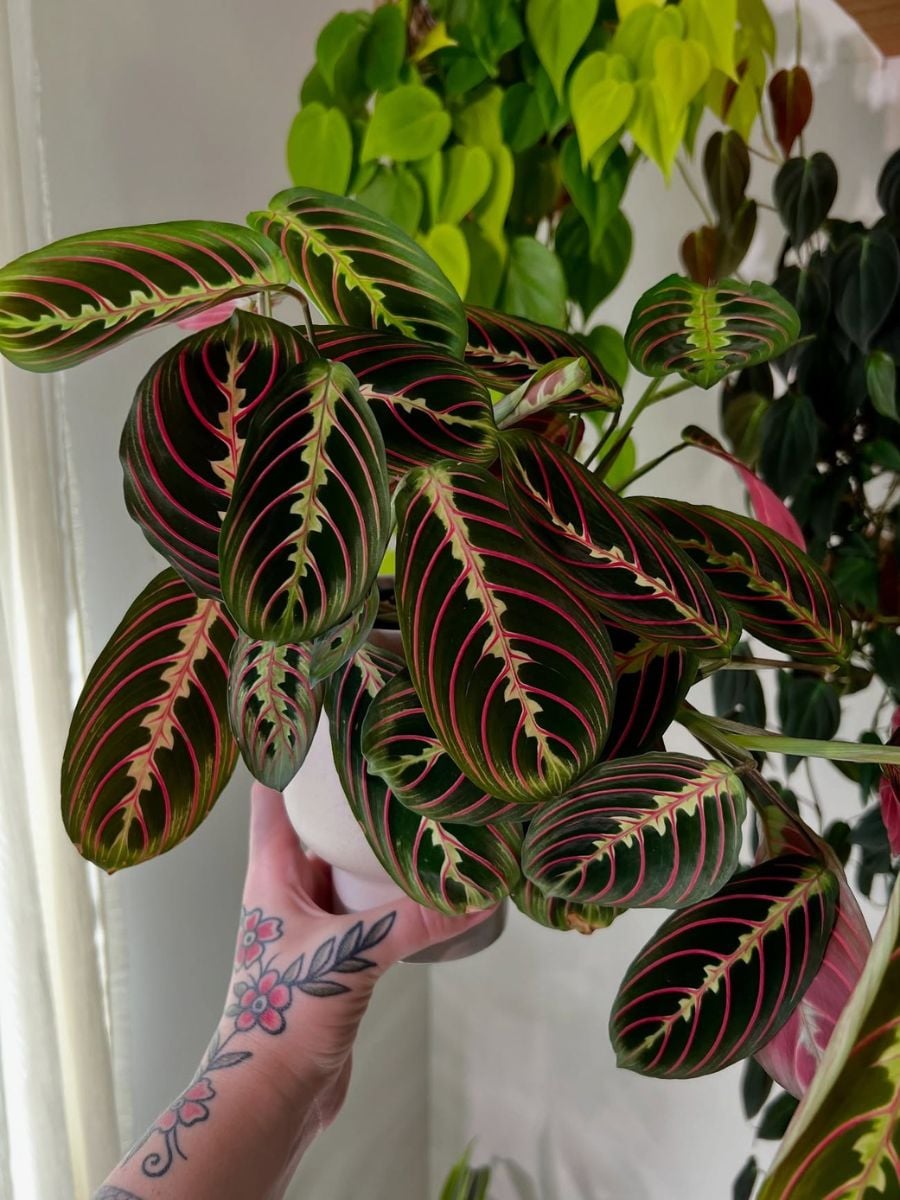
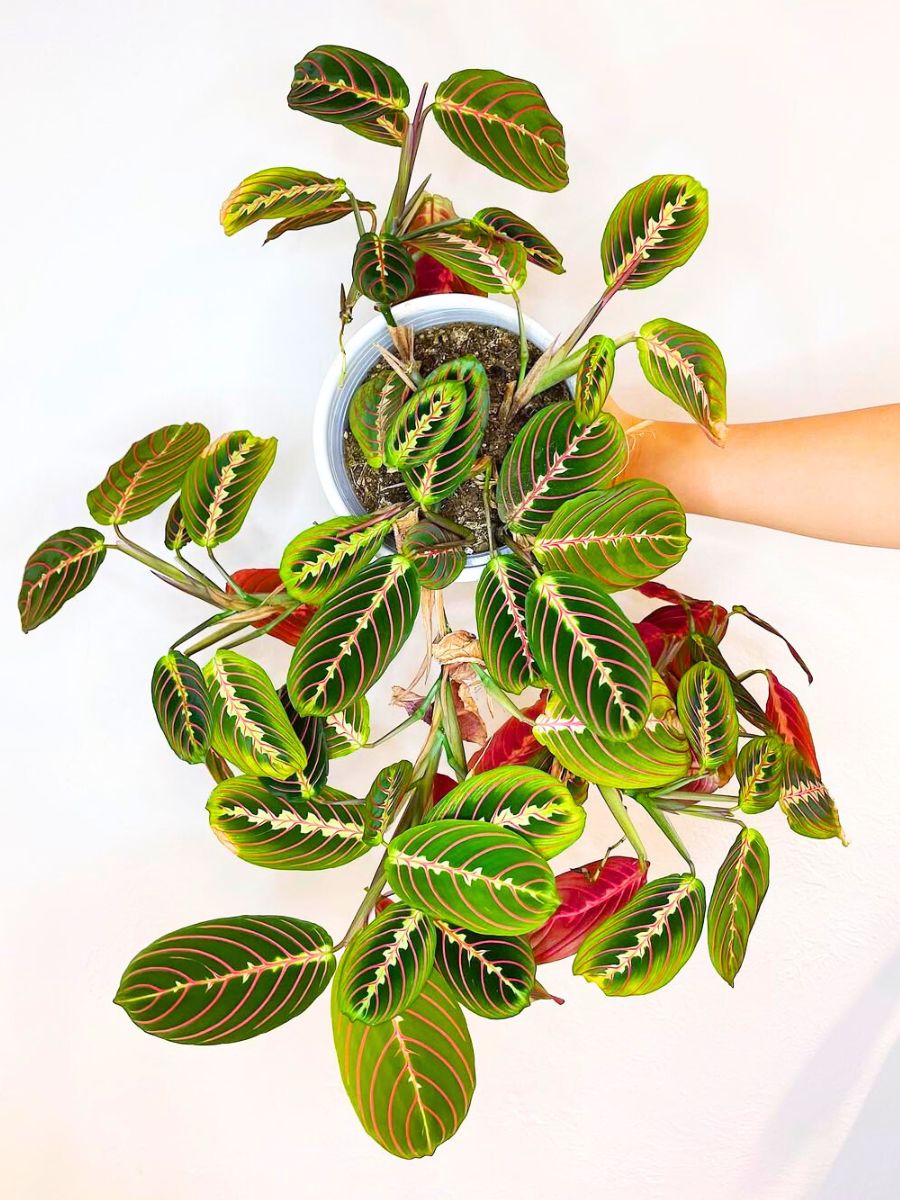
What earns it a place on so many shelves is the foliage. The common tricolor form has velvety, deep green leaves, yellowish-green markings down the midrib, and red veins that arc out to the leaf edges, while the Royal Horticultural Society (RHS) describes the undersides as deep purple or gray-green.
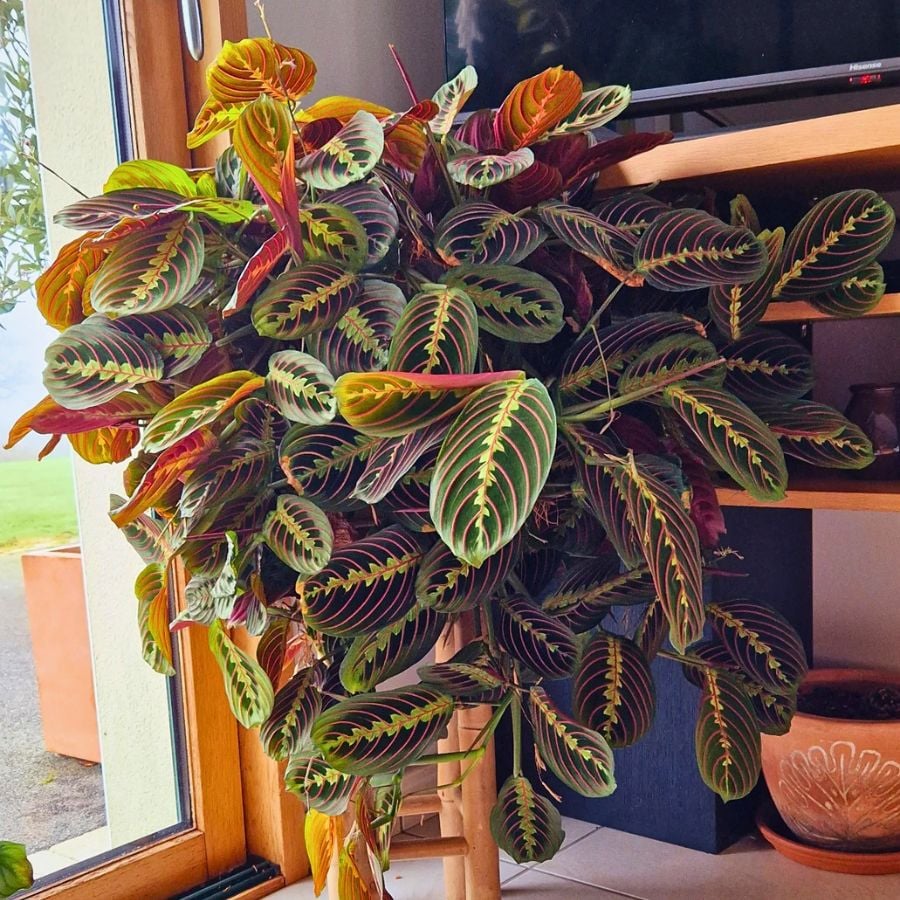
NC State Extension notes that it spreads horizontally rather than climbing, which is why it looks so good spilling over the rim of a pot or a hanging basket. Whether you are buying your first houseplant or your fiftieth, it is an easy plant to live with once its few demands are met. See also '15 Rare Houseplants You Will Love' to find a few more to add to your spaces.
Does it flower? Under ideal conditions, yes, but NC State Extension calls the flowers small and insignificant. The leaves are the show. Read 'Houseplants With the Most Unique Leaves' to see what other plants carry leaves this unusual.
Prayer Plant Care: Light, Water, Humidity, and Food
Think of where it grows wild, in warm, humid shade under taller plants. Indoors, prayer plant care is basically copying that, and each part has its own trap.
Light: Bright but Never Direct
Place your prayer plant near a window where it gets bright, filtered light. UF/IFAS Extension recommends bright, indirect light, and the New York Botanical Garden (NYBG) suggests a shady window or a spot behind a sheer curtain because strong sun fades the leaf color.
Direct sun can also scorch the leaves and leave pale, blotchy patches. Notably, the plant copes with less light better than many tropicals, which is why it sits among Thursd's houseplants for shade and dark rooms. Too little light shows up slowly, though: the stems stretch, and the new leaves come in smaller.

Watering: Moist, Never Soggy
During the growing season, roughly March to September in the Northern Hemisphere, NYBG advises keeping the soil thoroughly moist with tepid water; in winter, let the top 2.5 cm (1 inch) of potting mix dry out before you water again. Never let the pot stand in water, and never let the mix dry out completely, since the prayer plant handles neither well. A pot with a drainage hole and a loose, well-drained potting mix make both easier.
The water itself matters as much as the timing. An Ask Extension expert notes that Maranta is sensitive to fluoride in tap water, and to hard water or the sodium that water softeners add; NYBG adds that hard water leaves mineral deposits on the leaves. Rainwater or distilled water avoids the problem, and repotting into fresh mix every so often flushes out what has built up.
Humidity: The Part Most Homes Get Wrong
The prayer plant is not fastidious about much. Humidity is the exception. NYBG's Mertz Library puts the ideal at 70 percent humidity or more, well above what a heated room offers in winter, and the same NYBG answer calls a terrarium usually the most successful option, which suits a small Maranta (see these plants for closed terrariums). A humidifier close by is the surest fix in an open room, while a tray of wet pebbles under the pot helps a little.
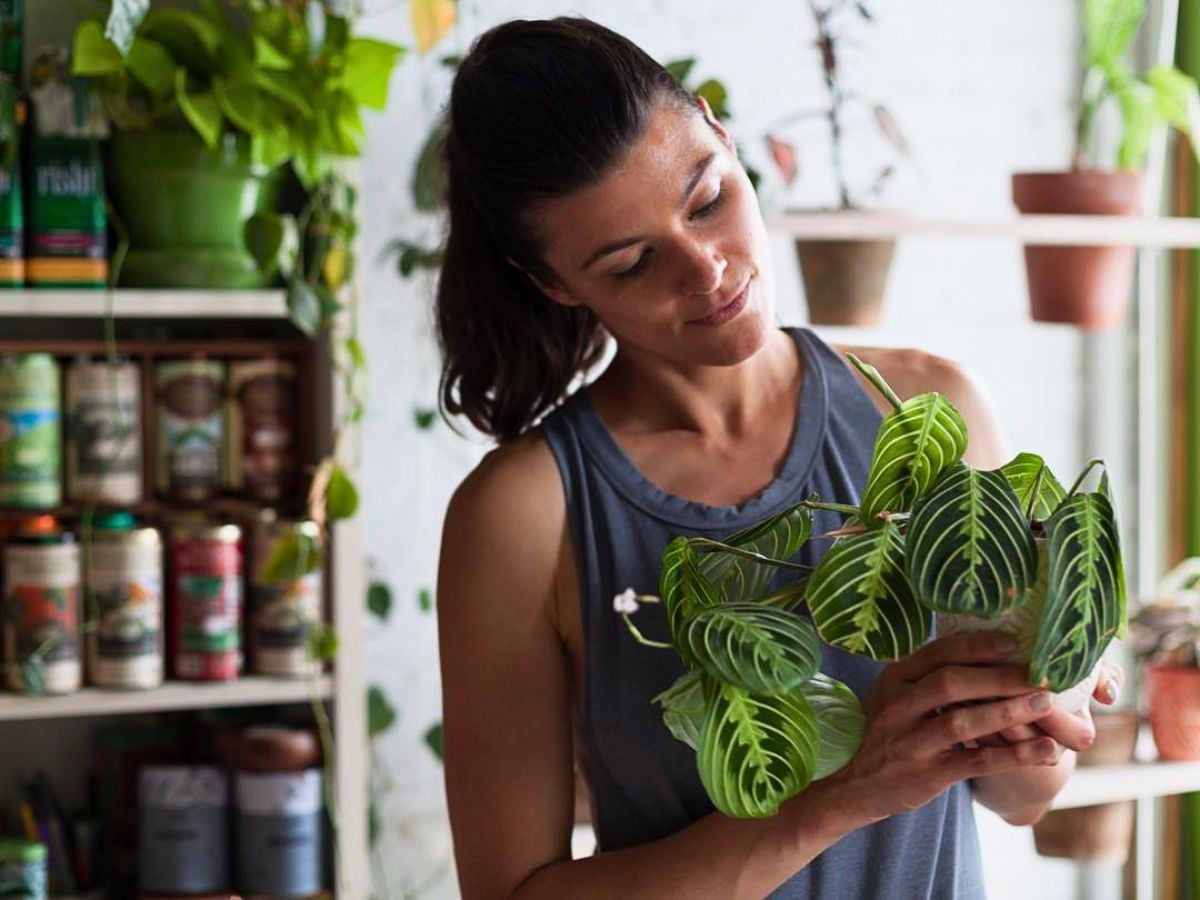
Misting gets a split verdict: NYBG lists it among the options, but an Ask Extension expert discourages it, because leaves that stay wet invite disease. Grouping plants together helps too, and so does a bright bathroom; here are more bathroom plants that like moisture.
Temperature: Warm and Steady
Keep it warm and keep it steady. UF/IFAS Extension gives a comfortable range of roughly 16 to 29°C (60 to 85°F). Cold drafts from a door or window in winter, or the blast of a heater or air conditioner, are what usually push a prayer plant out of that range, and lower temperatures for long periods can damage the leaves and make them drop.
Feeding and Repotting
Prayer plants are light feeders. A diluted, water-soluble houseplant fertilizer now and then while the plant is growing in spring and summer is plenty, with little or none in winter. Too little slows growth; too much is worse, since the same Ask Extension expert points out that over-fertilizing leaves salts in the soil that stress the roots. Repot in spring when the roots fill the pot, into a mix that drains well, and use that moment to divide the plant if you want more of them.
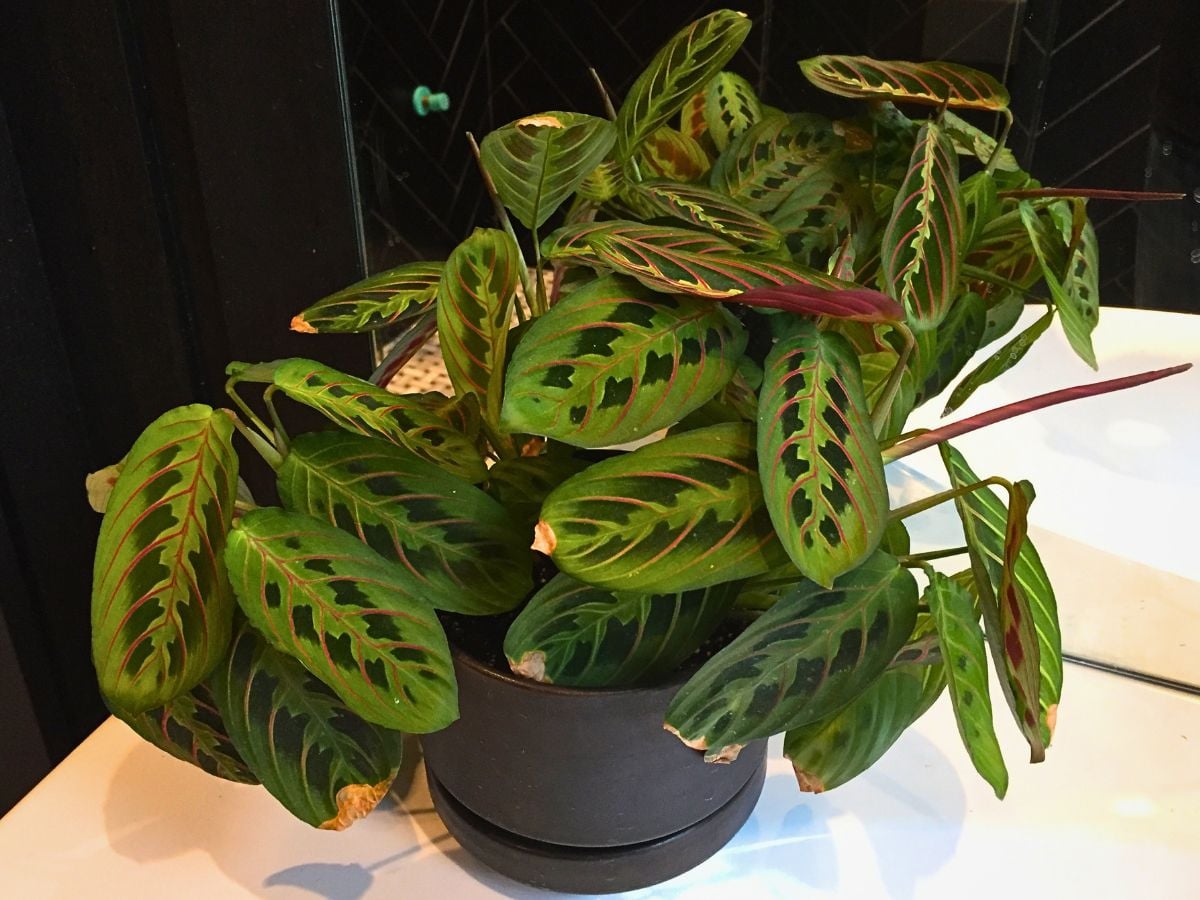
Prayer Plant Problems: Curling, Brown, and Yellow Leaves
A prayer plant tells you quickly when something is off, and most prayer plant care questions arrive through the leaves. They are the messenger; you only have to read them.
Why Are My Prayer Plant's Leaves Curling?
Curling is usually about water, in the soil or in the air. A leaf that rolls inward is shrinking the surface it loses water from, and the two usual reasons are soil that has dried out and air that is too dry. Check the soil first. Bone dry? Water thoroughly and keep it evenly moist from then on. Moist enough? Then the air is the problem, and a humidifier is the answer; Nebraska Extension lists leaf drying and curling as the symptoms of low humidity. Direct sun and a hot, dry draft from a heater can curl the leaves too.
Why Are the Leaf Tips Turning Brown?
Brown, crispy tips and edges are the most common complaint. NYBG reads them as a sign that the plant needs more consistently moist soil or higher humidity. Water quality is the other suspect: fluoride, hard water, softened water, or a buildup of fertilizer salts, as the Ask Extension answer above explains. Brown tissue will not turn green again, so trim the brown edge with clean scissors, following the shape of the leaf, and fix the cause; the new leaves will show whether it worked.
Why Are the Leaves Turning Yellow?
Yellow leaves usually point to watering, and both directions can do it. Soil that stays wet for days starves the roots of air and can end in root rot, especially in a mix that drains poorly, while soil that dries out completely stresses the plant just as much. One old leaf yellowing at the base now and then is normal turnover. Many at once is a watering problem.
Common Pests on Prayer Plants
Like many other houseplants, prayer plants can be prone to spider mites and mealybugs, and spider mites like dry air as much as the prayer plant dislikes it. Look under the leaves for fine webbing, tiny moving specks, or white, cottony tufts where the leaves join the stems. Rinse the leaves, wipe off what you can, and treat the plant with an insecticidal soap or neem oil, following the label.
Why Is It Called a Prayer Plant?
The name 'prayer plant' comes from the plant's unique leaf movement. During the day, its leaves lie flat, but at night, they fold upward, almost as though they are praying. Botanists call this nyctinasty, a leaf movement in response to the changing light. It is the plant's own crepuscular routine, and it runs every evening, whether anyone is watching or not.
What Makes the Leaves Move
The motion comes from the pulvinus, a small, joint-like swelling at the base of each leaf. Its cells swell or shrink as water moves in and out of them, and the change in pressure lifts the leaf or lowers it. These movements follow a roughly 24-hour clock and happen in all the leaves, whatever their size or age, yet no one is fully sure why the plant evolved to move this way.
Why the Leaves Stop Folding at Night
The movement runs on an internal daily clock as well as on the change from light to dark, so a prayer plant rarely stops for no reason. If yours has gone still, go back through the care basics above first, and give it a properly dark night. In fact, a prayer plant that is comfortable in its spot is the one most likely to keep praying on schedule.
The Spiritual Meaning and Symbolism of the Prayer Plant
The prayer plant is often associated with spirituality and prayer, owing to its name and its behavior. The folding of its leaves at night is read as a gesture of reverence, quiet reflection, or meditation, which is why many people treat it as a symbol of peace and contemplation. Among plant lovers, it is also said to bring good luck and positive energy, and it often sits in homes as a symbol of calm and harmony.
Some owners go further and keep one near the door to guard the home against negative energy, or in a bedroom or study where they want quiet. Just so that you know, these are beliefs rather than botany; they say more about the people who keep the plant than about the plant itself.
In the Victorian era, during the period of the language of flowers, plants were often given symbolic meanings. Though this plant was not as widely known in Western homes at that time, its association with prayer would likely have made it a symbol of devotion or gratitude.
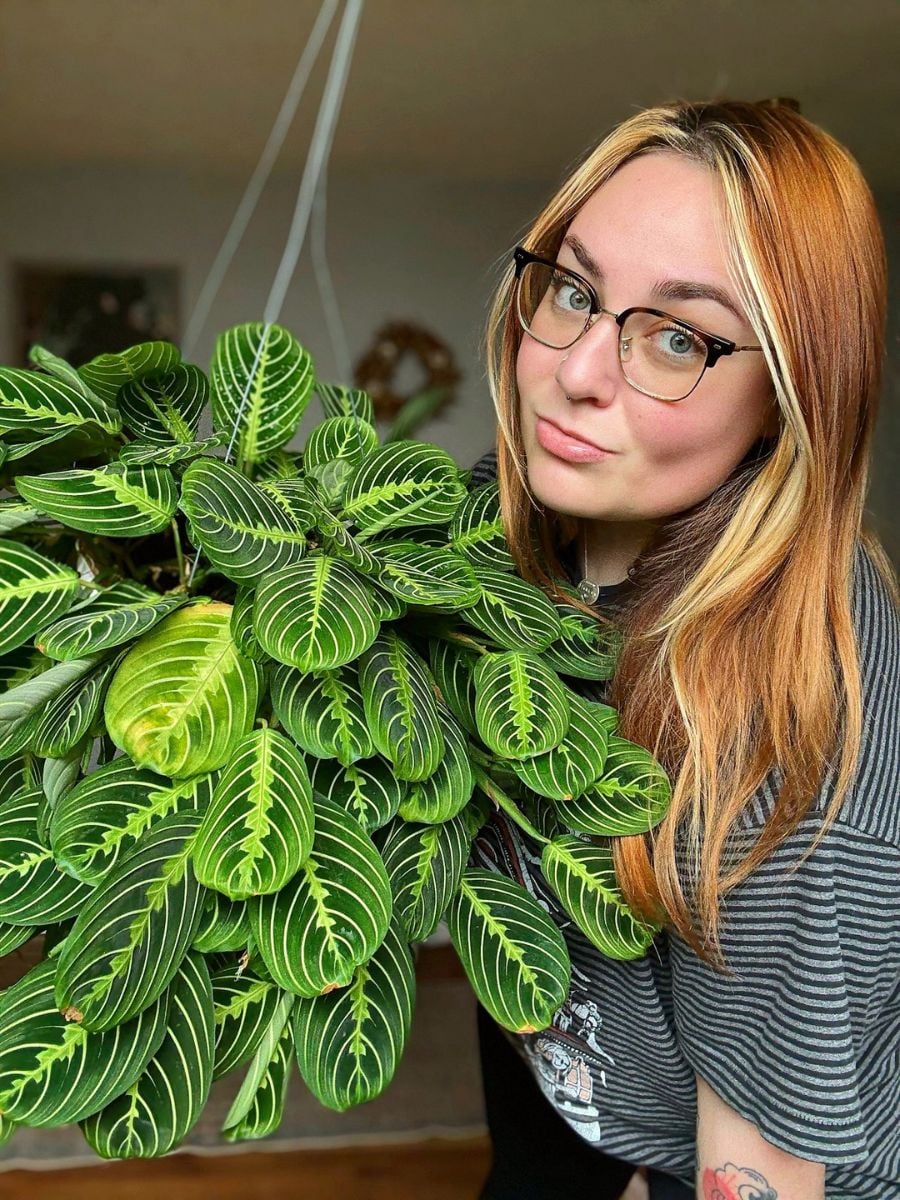
Today, the prayer plant is mostly valued as an easygoing indoor plant with a small daily ritual built in: a reminder, every evening, that the day is done.
Most Popular Types of Prayer Plants
Although there are several types of prayer plants, the red-veined form sold at many garden centers is by far the most popular. NC State Extension lists the common names that go with the species and its forms: prayer plant, red-veined prayer plant, herringbone plant, rabbit tracks, and cathedral windows. These are the ones you are most likely to meet.
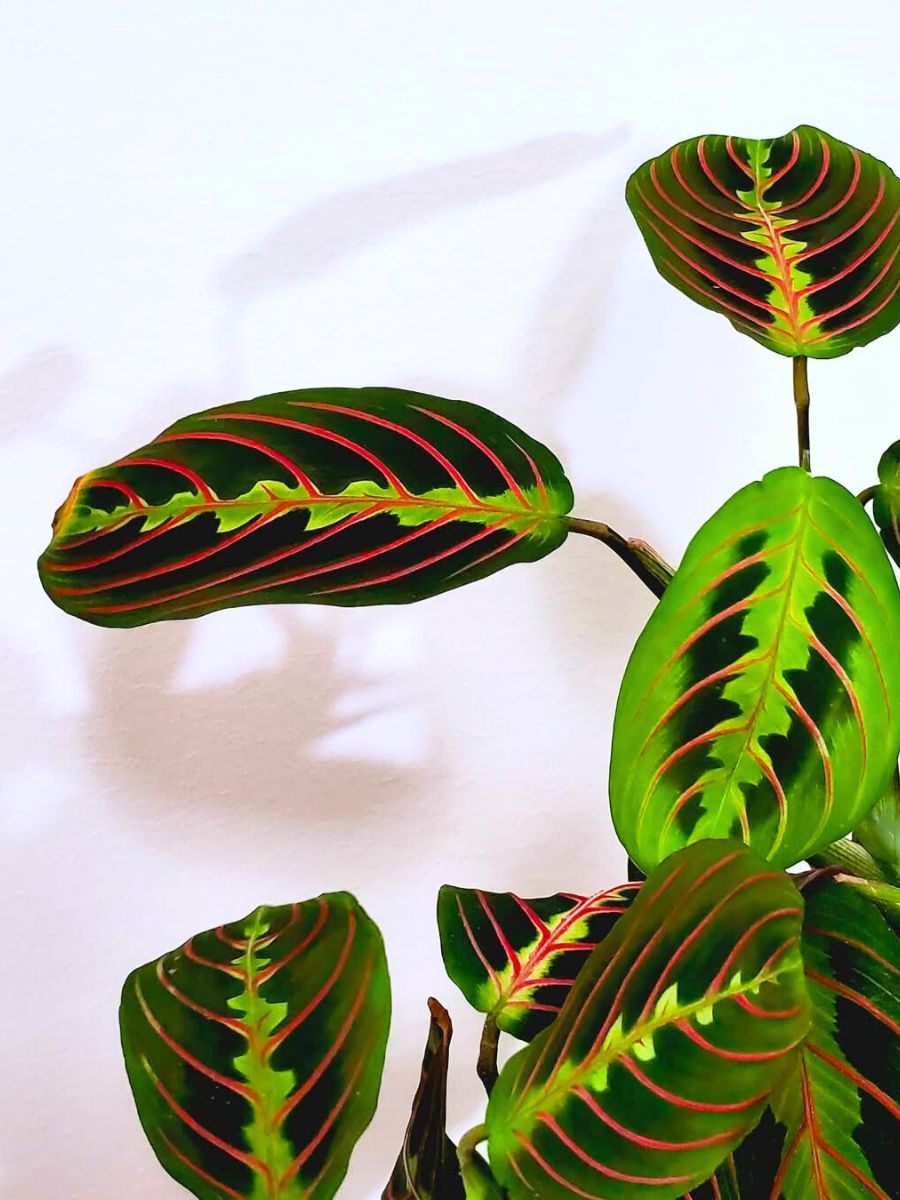
Red-Veined Prayer Plant (Maranta Leuconeura Erythroneura)
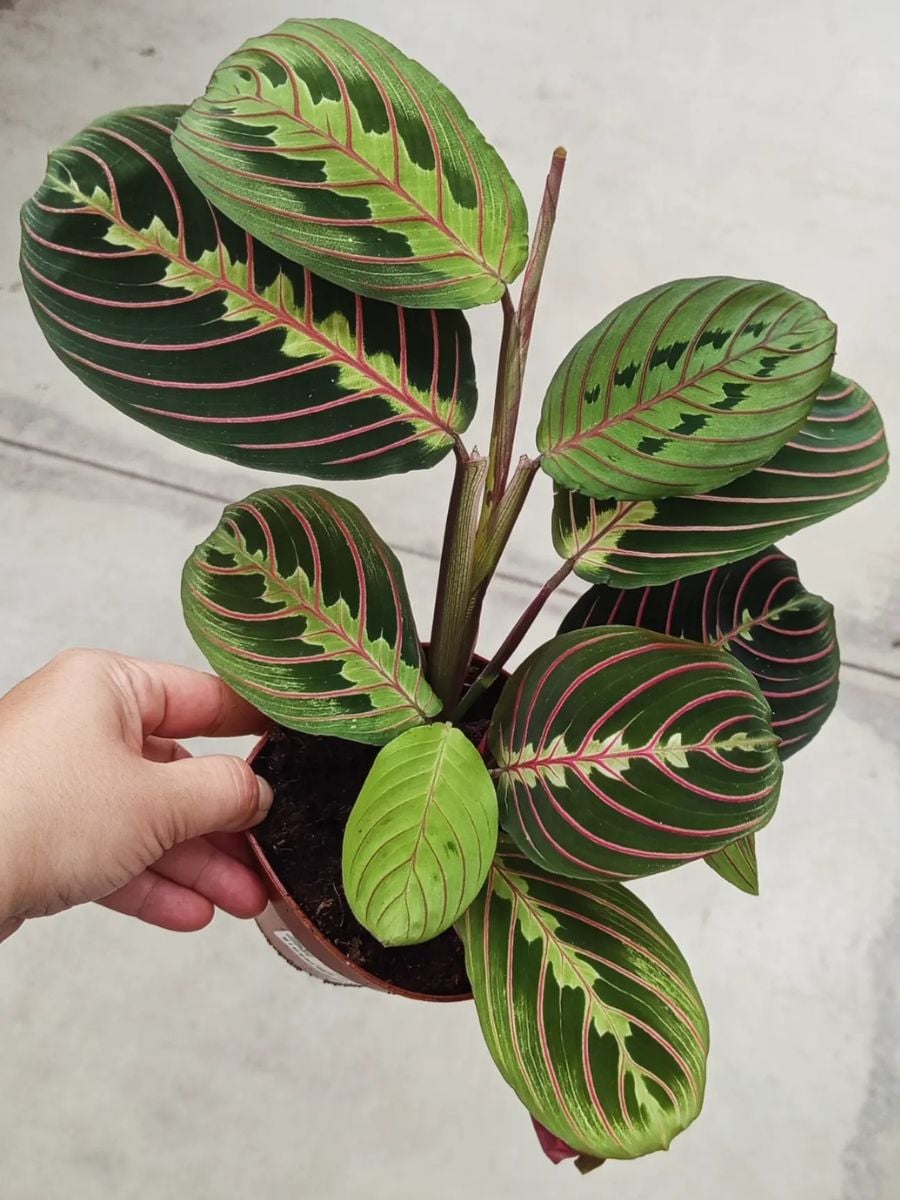
The most popular type, often known as the herringbone plant, has striking red veins running out from the midrib in a herringbone pattern, and in the trade, it is often sold as Erythrophylla. Thursd's Maranta product page describes the popular Maranta Tricolor Fascinator by its dark green leaves, deep pink veins, and wine-red underside.
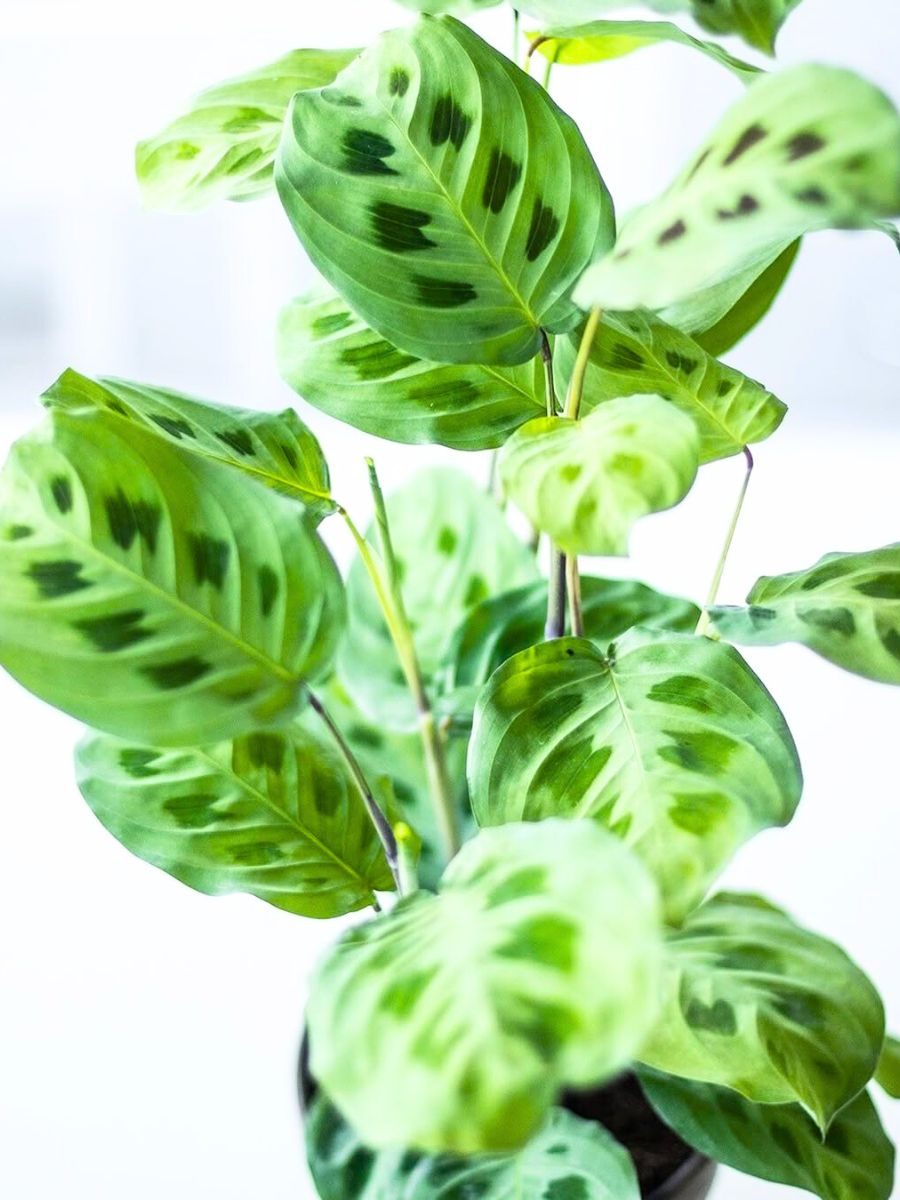
Rabbit Tracks (Maranta Leuconeura Kerchoveana)
This type of prayer plant has plain green leaves with two rows of darker splotches, one on each side of the midrib, and those splotches are the rabbit tracks of its name. It is the quietest of the four, and the easiest to pair with other foliage.
Maranta Leuconeura Massangeana
This variation has white leaf veins, a midrib covered with silvery spots, and a darker leaf background. It is the one to choose if you want contrast rather than color.
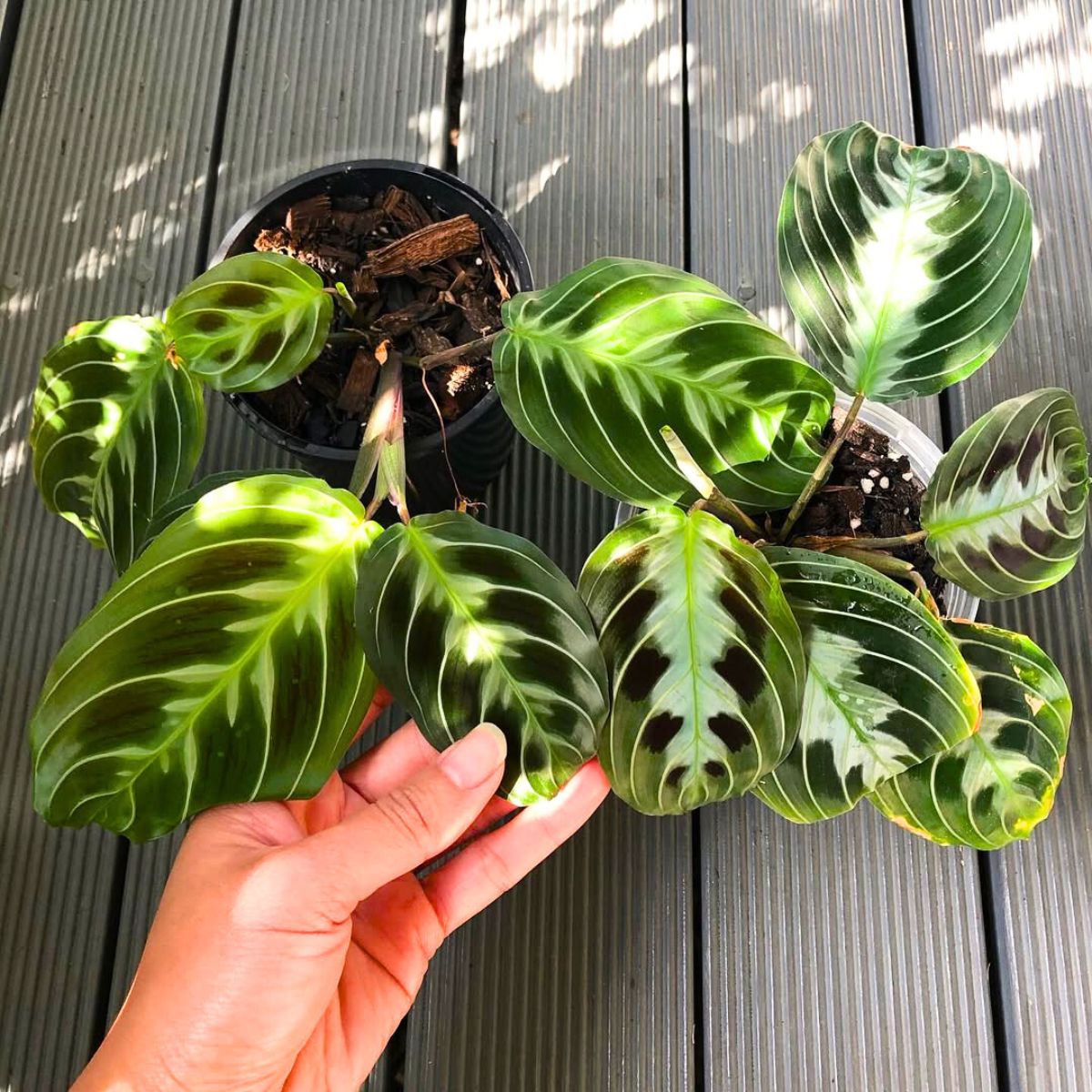
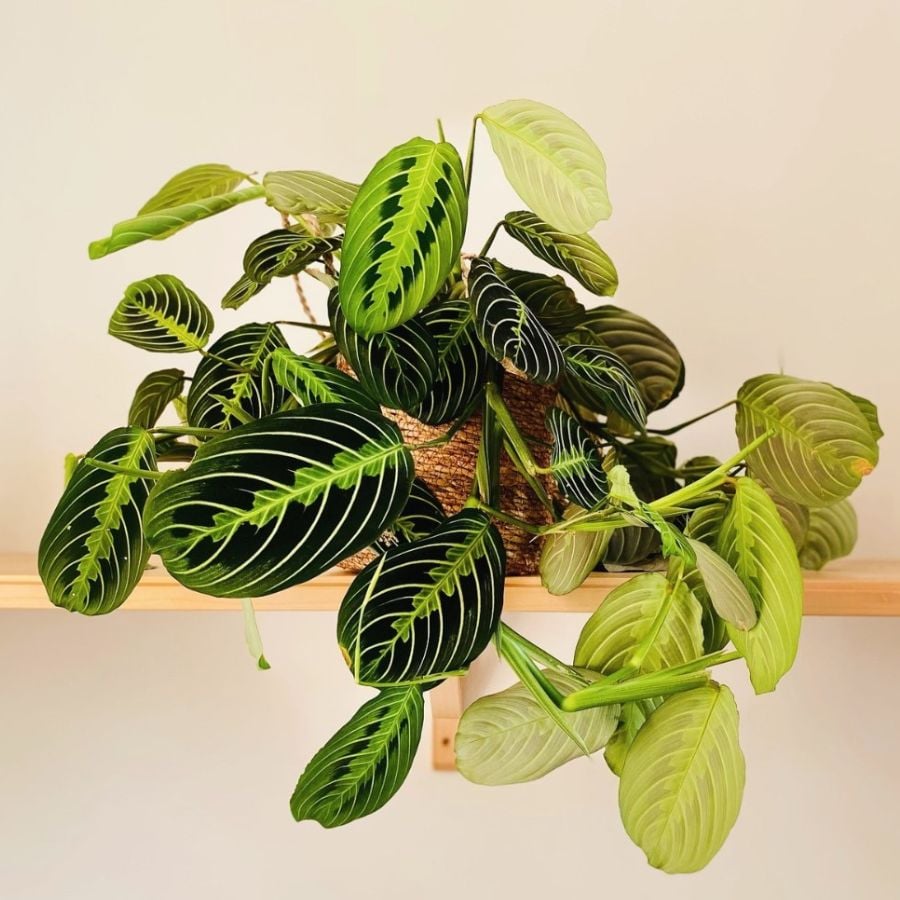
Maranta Lemon Lime
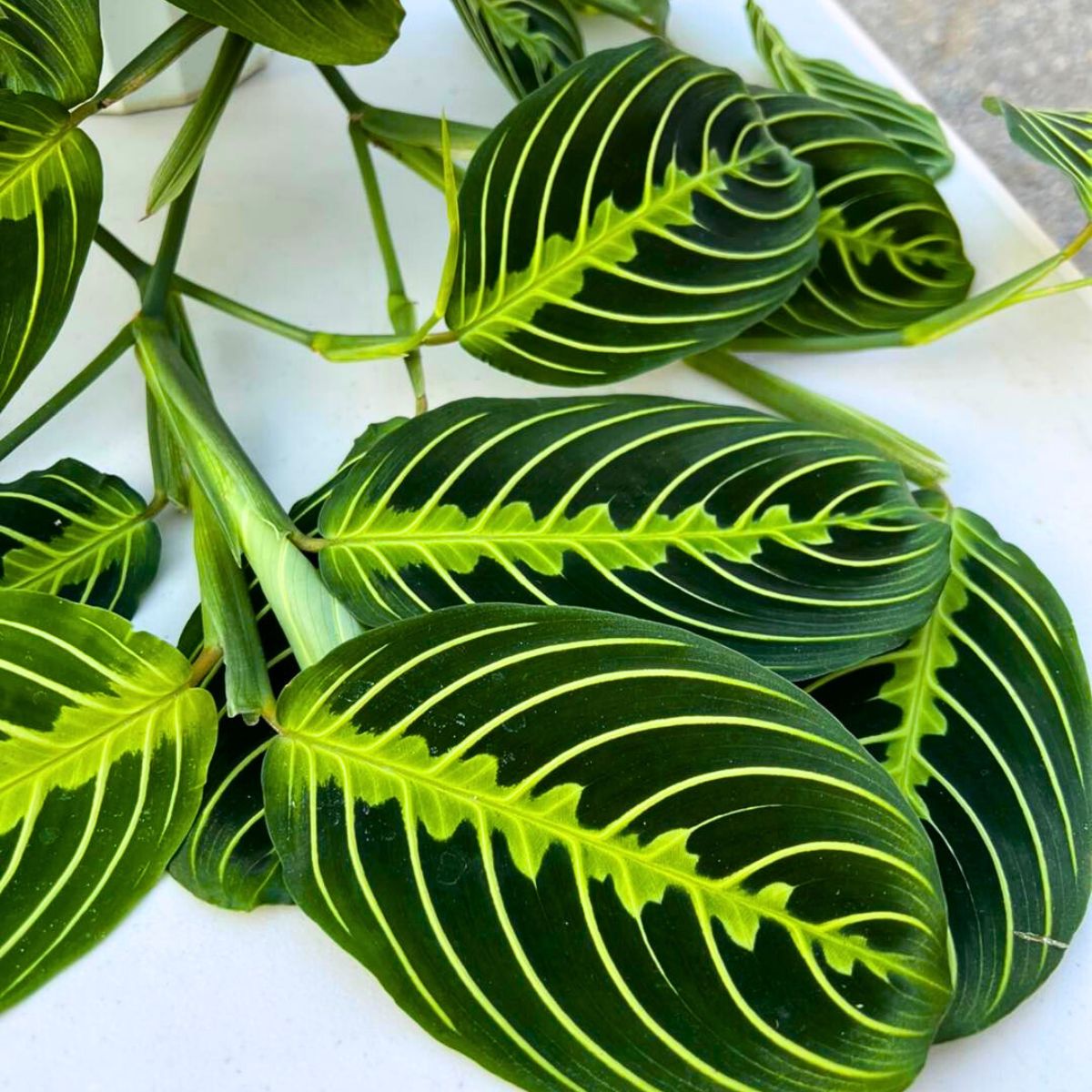
The RHS files Lemon Lime under the red-veined variety, yet there is no red to be seen: the veins and the feathered pattern along the midrib come in pale yellow-green and lime instead. It lifts a shelf without any red at all, and it wants exactly the same care as the others.
Prayer Plant or Calathea? Why the Two Get Confused
It is typical for prayer plants and Calathea plants to be mixed up, and with good reason: both belong to the Marantaceae, both have patterned leaves, and both move them. The Royal Horticultural Society notes that many Calatheas fold their leaves upward at night like hands in prayer, and plenty of Calatheas are sold as prayer plants too.
Even the ASPCA's plant list files its Prayer Plant entry under Calathea insignis, the rattlesnake plant, and lists Peacock Plant and Zebra Plant among its other names. The plant usually sold as the peacock plant is Calathea makoyana, which has its own peacock plant care guide.
Botanically, Maranta has always been a genus of its own; it is Calathea that changed. In 2012, a DNA study by Finn Borchsenius and colleagues split the old genus, and most of the houseplants sold as Calathea now belong, strictly speaking, to Goeppertia, although the trade still uses the old name.
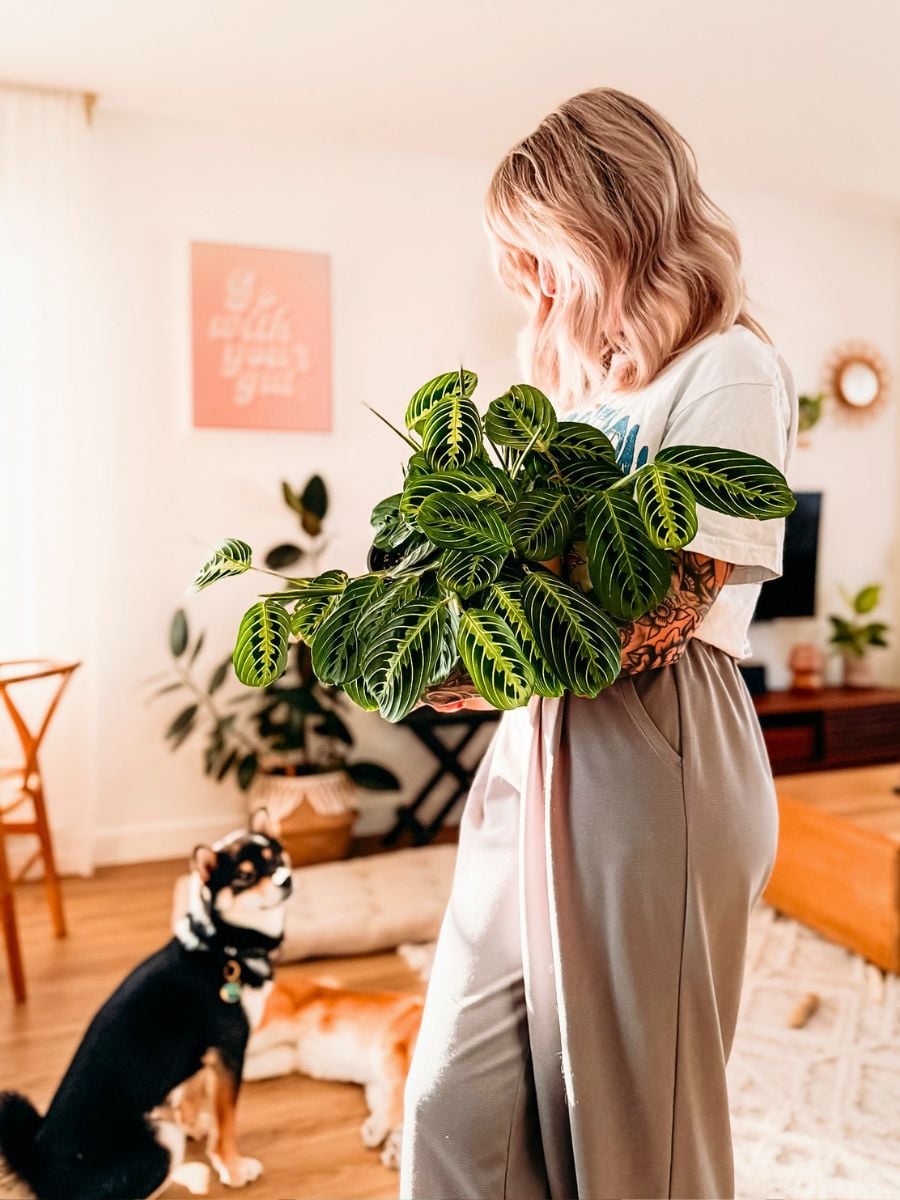
In the pot, the difference is mostly habit: a Maranta stays low and spreads sideways, while most Calatheas grow as taller, upright clumps with bigger leaves. Other relatives in the family include Stromanthe and Ctenanthe, such as Ctenanthe burle-marxii.
In the Netherlands, one family nursery has grown the Calathea side of the family for almost half a century. Gebr. Valstar was founded in 1978, when Jac. Valstar began cultivating Marantaceae in Honselersdijk; today, Oscar and Jörgen run nurseries in Maasland, Roosendaal, and Brazil, grow Calathea on around 10 hectares, and regularly travel to Brazil to search for new varieties.
The nursery's Thursd grower page sums up the appeal: "What makes this plant so special is its circadian rhythm: the leaves close up when it gets dark and open again at dawn." The same rhythm drives the prayer plant on your windowsill, and the care is close as well: for Calatheas, the RHS asks for warmth, humidity, bright but indirect light, and compost kept moist but not soggy.
How to Propagate a Prayer Plant
Propagating a prayer plant is a surprisingly easy way to grow your collection, and the most reliable method is to divide the plant while repotting; NC State Extension names division of the rhizomes as the way it is propagated. Here is how to go about it:
- Repot in spring, gently shake the soil from the roots, and separate the clump into sections.
- Make sure each new section has several stems and a good share of roots.
- Plant each section in its own small, shallow pot with fresh, well-drained mix.
- Keep the new divisions very warm and moist, out of direct sun, especially over the first two weeks, until new growth appears.
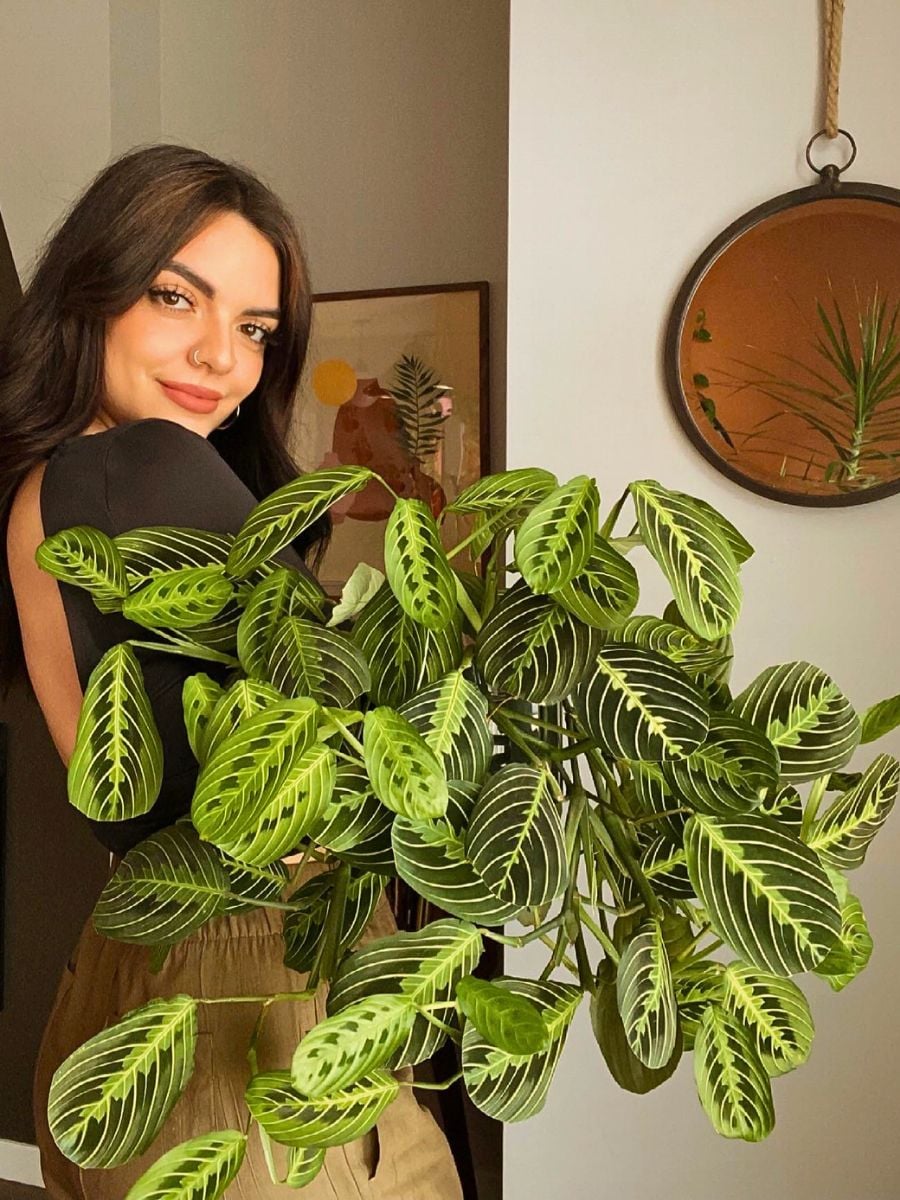
Stem cuttings work too. Cut just below a node, the slight bump where a leaf joins the stem, and root the cutting in water or in moist mix; a cutting without a node rarely roots. For more plants that multiply this willingly, see the easiest houseplants to propagate.
Is a Prayer Plant Toxic to Cats, Dogs, and Kids?
No. The ASPCA lists the prayer plant as non-toxic to dogs, cats, and horses, under the names Prayer Plant, Maranta, and Red Veined Prayer, and it rates Calathea as non-toxic as well. For children, the regional poison control center serving Massachusetts and Rhode Island includes the prayer plant on its list of safe plants. That makes it one of the easier choices for a home with pets or small children; Thursd keeps a longer list of pet-friendly houseplants for cats and dogs, and one of the houseplants that are poisonous for dogs.
Non-toxic does not mean it belongs on the menu, of course. If a child or a pet eats a plant you are unsure of, call Poison Control at 1-800-222-1222 in the US, or the ASPCA Animal Poison Control Center at (888) 426-4435, rather than guessing.
A Plant That Keeps Its Own Hours
Essentially, prayer plant care asks for attention more than effort. The plant is easy to keep, and it tells you when something is off. Give it soft light and keep both the soil and the air moist, and it closes its leaves every evening like clockwork. Neglect it, and the leaves report that too, curled and brown at the edges, usually well before the plant is in real trouble. So, is there a prayer plant on your windowsill yet?
Sources: Royal Botanic Gardens, Kew, Plants of the World Online: Maranta leuconeura; NC State Extension Gardener Plant Toolbox, Maranta leuconeura; UF/IFAS Extension Nassau County, Q: What Is a Prayer Plant?; New York Botanical Garden, Prayer Plant (Maranta leuconeura) and Mertz Library, How Can I Take Care of My Maranta leuconeura Without Getting Brown Leaf Edges?; Ask Extension, Prayer Plant Leaves Turning Yellow/Brown; Nebraska Extension, Guide to Growing Houseplants; Royal Horticultural Society, Maranta leuconeura, Maranta leuconeura var. erythroneura Lemon Lime, and How to Grow Calatheas; Borchsenius and colleagues, Molecular Phylogeny and Redefined Generic Limits of Calathea (Marantaceae), Systematic Botany (2012); ASPCA, Prayer Plant, Maranta, and Red Veined Prayer; Regional Center for Poison Control and Prevention serving Massachusetts and Rhode Island, Safe Plants.
Featured image: @theherbalmermaid. Header image: @stefyplants.
About the author: Brian Okinda is an editor at Thursd and a trained journalist specializing in agriculture, science, and sustainable floriculture. He covers the flower industry from the inside, from farms and expos to the people behind the flowers. Connect with Brian on LinkedIn.