Every December it goes the same way. An amaryllis bulb arrives in a gift box or a pot, pushes up a thick stalk, flowers for three weeks or so, and goes out with the Christmas tree. That bulb could have flowered again the next winter, and the winter after that. Good amaryllis care is not complicated, but it runs in a set order: plant the bulb high, keep the leaves after the flowers fade, give it a cool rest, and only then ask for flowers again.
This guide covers how to care for amaryllis from the shop to the second winter: planting, the weeks until it flowers, waxed amaryllis bulbs, cut stems, what to do after it flowers, and how to get it to rebloom. The care steps follow university extension services in the United States, which agree on almost everything, and the one point where they differ is spelled out below.
A word on the name first, because it trips up a lot of buyers. The amaryllis sold for the holidays belongs to the genus Hippeastrum, native to Central and South America. The true Amaryllis, Amaryllis belladonna, is a different plant from South Africa, and Thursd tells that story in its piece on the amaryllis flower meaning. Florists also know a third relative, the Amarine, a cross between Amaryllis belladonna and Nerine that is sold as a cut flower, such as Amarine Paris. This guide is about Hippeastrum: the bulb in the pot and the stem in the vase.

How to Plant an Amaryllis Bulb
Amaryllis care starts in the shop, with the bulb itself.
Start With a Big, Firm Bulb
Size is the one thing you can judge in the shop. Amaryllis bulbs run from about 5 to 13 cm (2 to 5 in) across, and a bigger bulb has more food stored inside, so it gives more flowers and thicker, stronger stems, according to the University of Illinois Extension. The largest bulbs usually send up two or three flower stalks, each with two to six flowers. Give the bulb a squeeze before you buy it. It should be firm and dry, with no mold, soft spots, or damage.
Where the bulb was grown sets the clock. According to Iowa State University Extension, bulbs produced in South Africa usually flower three to five weeks after potting, while Dutch bulbs take six to eight weeks. Today's large-flowered varieties come mainly from breeders in the Netherlands, South Africa, the United States, Japan, and Israel. In the Dutch Westland, Vreugdenhil Bulbs & Plants in 's-Gravenzande was one of the first companies to grow amaryllis when it started in 1938, and it still grows potted amaryllis among its bulb and corm crops.

Potting It Up
Use a pot with drainage holes that is only 2.5 to 5 cm (1 to 2 in) wider than the bulb. Amaryllis grows best when it is slightly pot-bound, and the University of Illinois adds that the pot should be about twice as tall as the bulb, so the roots have room to go down.
Fill it with a well-drained potting mix, set the bulb in the middle, and firm the mix around the roots. Leave the top third to half of the bulb above the soil, with about 2.5 cm (1 in) between the soil and the rim so water does not run over. Some bulb kits come with a compressed disk of coir. Iowa State's advice is to skip it, because the disk often holds too little mix to pot the bulb properly, and ordinary potting soil does the job.
Water it thoroughly once, let it drain, and then hold back. Until you see growth, the mix only needs to stay barely moist, because a wet bulb without leaves tends to rot. Bought one already potted? Check the bottom for drainage holes before the first watering, and repot the bulb if there are none.
Where to Put It While It Grows
Start the pot somewhere warm. Iowa State gets bulbs going at 21 to 24 °C (70 to 75 °F), while Susan Mahr of the University of Wisconsin keeps them at room temperature, 18 to 21 °C (65 to 70 °F), and warns that a warmer spot gives weak stalks and smaller flowers. Once growth appears, move the plant to your sunniest window and water a little more often, whenever the top 5 cm (2 in) of the mix feels dry.
While the stalk stretches, Iowa State turns the pot every day so it grows straight, and it stakes any stalk that leans badly. With three or four big flowers open at the top, a stalk gets heavy.
Where it stands also matters if you have pets. The whole plant is poisonous, the bulb most of all, and the ASPCA lists amaryllis as toxic to dogs, cats, and horses. Keep bulbs and plants out of reach, and call your vet if a cat or dog has chewed on one.
How Long Until an Amaryllis Blooms
Count on six to eight weeks from potting for a Dutch-grown bulb and three to five weeks for one from South Africa. That is why Iowa State tells anyone who wants flowers for Christmas to pot bulbs in early to mid-November. A bulb bought already sprouting is simply further along the same clock.
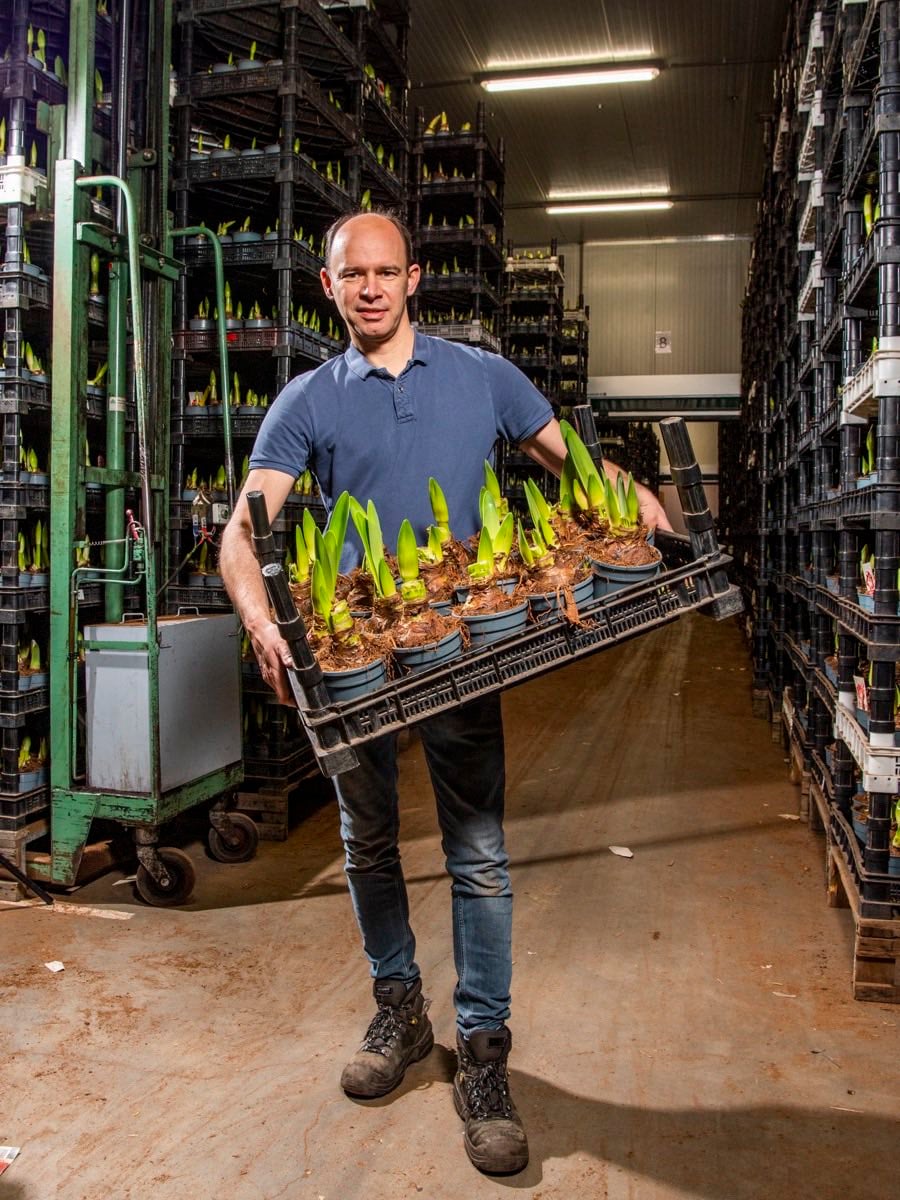
Growers work to the same calendar you do. "There is a difference between amaryllis varieties in how fast they grow," says Marjolijn Vreugdenhil of Vreugdenhil Bulbs & Plants in 's-Gravenzande. "We pot up between 10 and 20 November for Christmas flowering. We put them in a greenhouse at a temperature of 20 °C (68 °F)."

When the first buds show color, move the plant out of direct sun to a cooler spot, 16 to 21 °C (60 to 70 °F). The flowers last noticeably longer there, and NC State Extension puts the flowering of a potted amaryllis at three to four weeks. The flowers on a stalk do not all open at once, and Thursd has followed that change from closed bud to open flower in the metamorphosis flower.
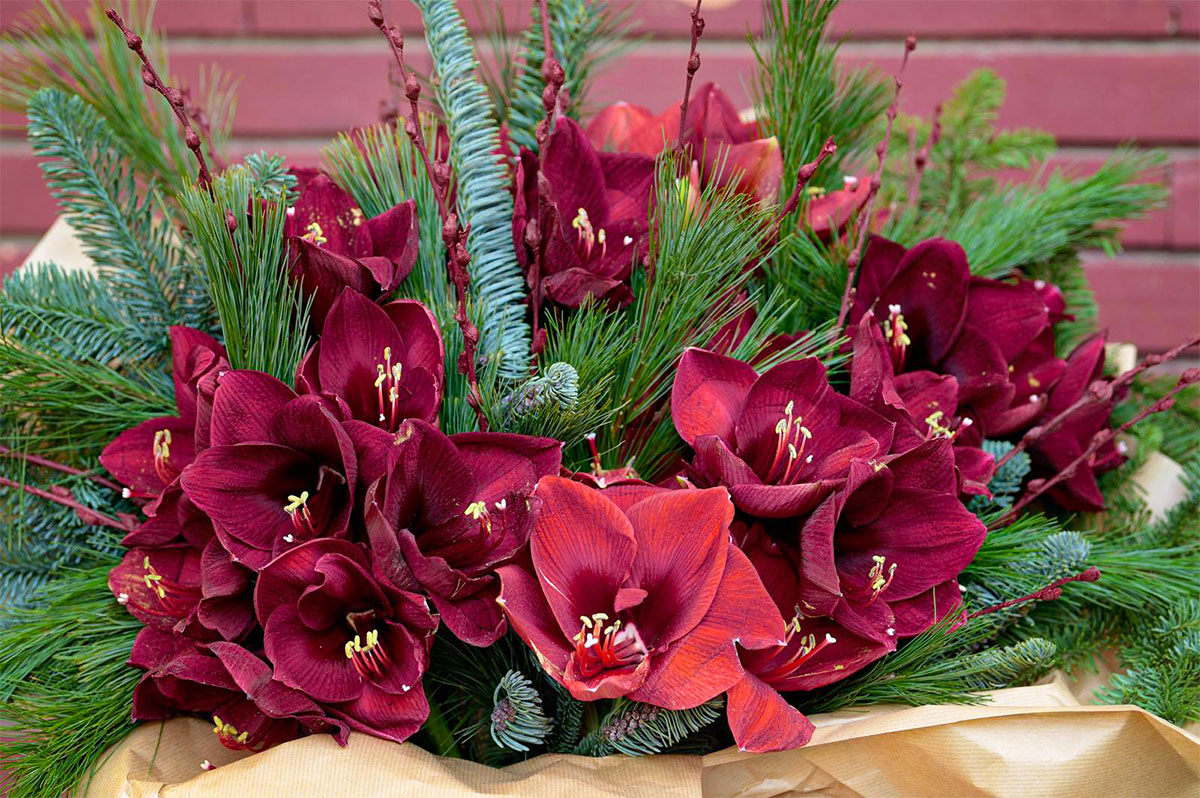
That slow opening is what people fall for. Romanian floral designer Laura Draghici of Chic Fleuriste made a New Year bouquet of Amaryllis Ferrari and Night Fever, and in her winter bouquet story on Thursd she put it like this:
"Amaryllis doesn't rush. The buds swell, petals unfold gradually, and the color deepens as the room light shifts."
Waxed Amaryllis Bulbs
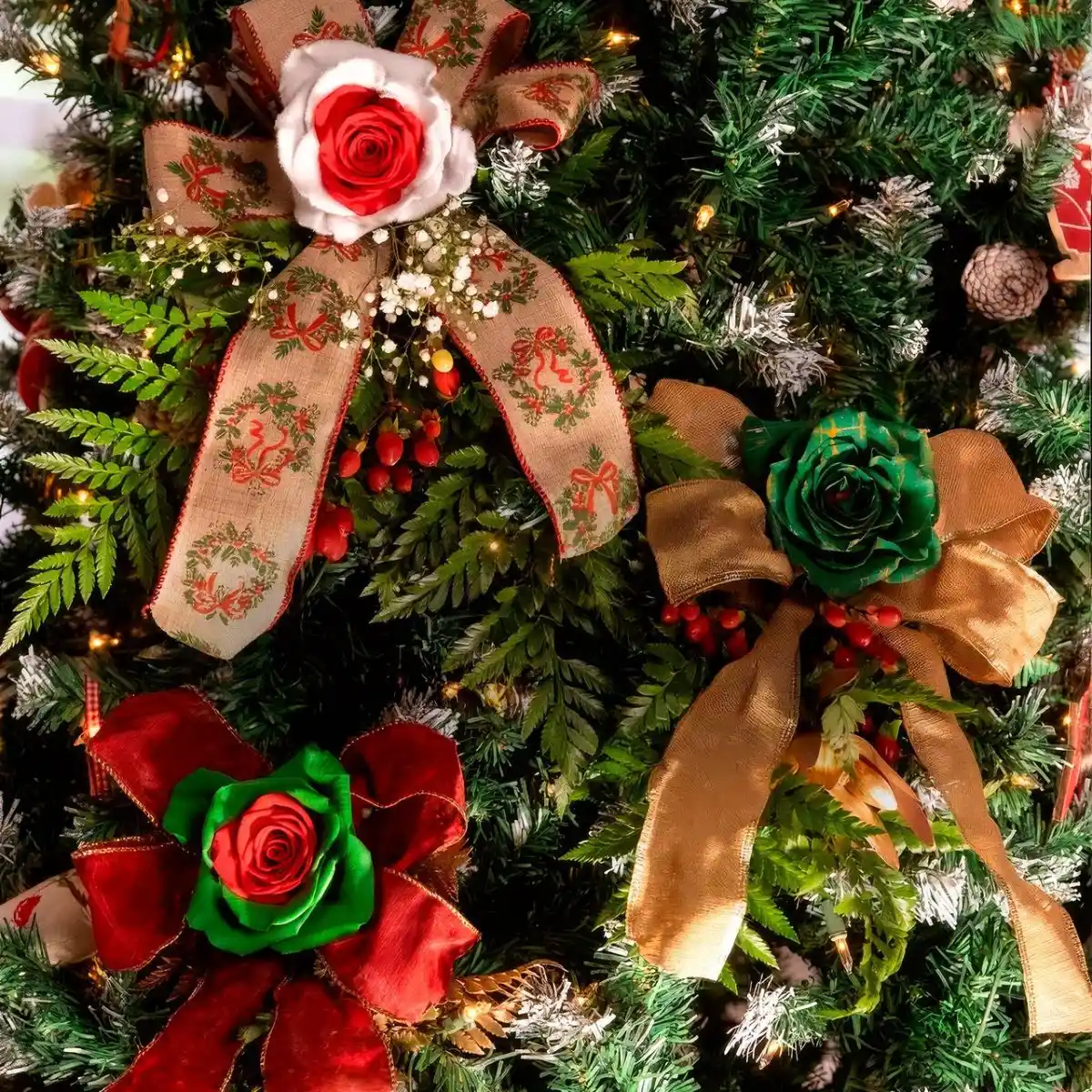
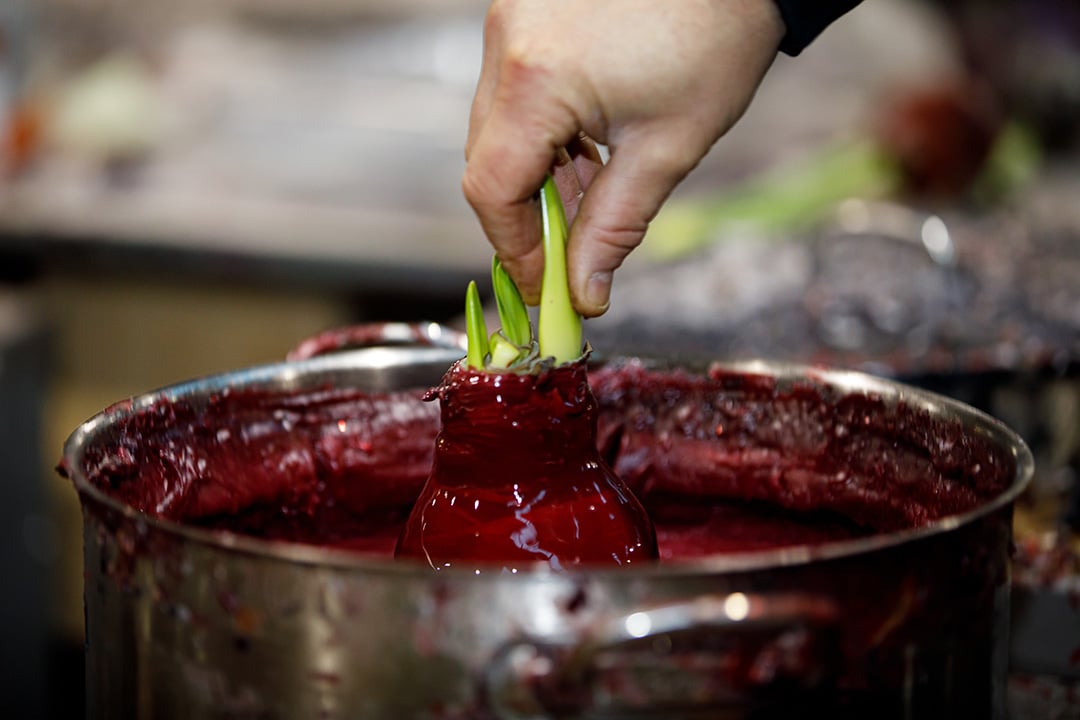
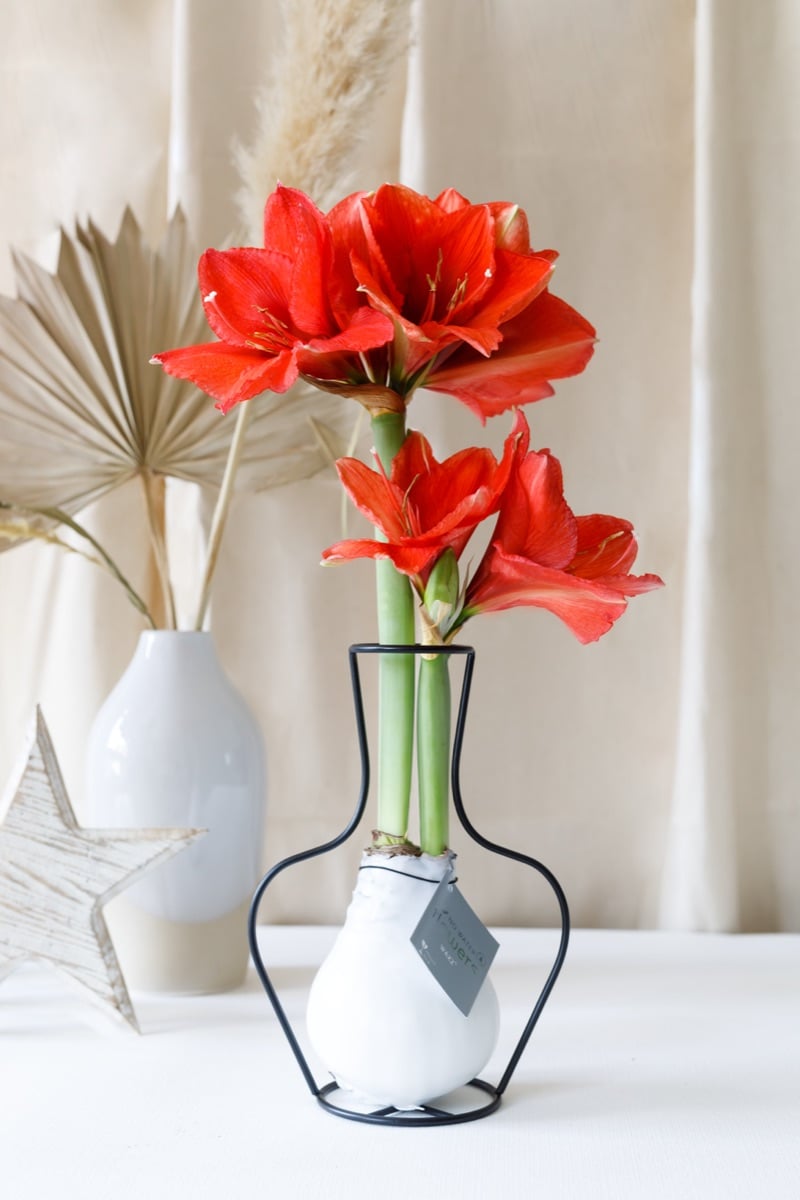
Waxed amaryllis bulbs are the no-pot version sold as gifts. The roots are cut off, a wire goes into the base so the bulb stands on its own, and the bulb is sealed in wax, often red, green, or white. They need no soil and no water, so amaryllis care comes down to light. Put one in bright, indirect light and turn it every few days. A stalk appears in four to six weeks, sooner in a warm room and later in a cool one, and most bulbs send up two stalks, sometimes three or four, that flower for up to three weeks. When one stalk is spent, cut it off as close to the bulb as you can, and the other keeps growing and flowering.
So how does a bulb flower on nothing at all? The answer comes from Greencre8 in Honselersdijk, which makes waxed bulbs under the name No Water Flowers. Not every amaryllis variety can grow and flower without water, they say, so they only use varieties selected for it. The roots are carefully removed, the bulb gets its wax layer, and a metal wire support of their own design and a label finish it off. The wax is partly decoration, but its main job is to limit moisture loss. "The amaryllis bulb naturally has enough moisture and nutrients to grow and flower on its own," Greencre8 says. "Thanks to the protective wax layer, these reserves are better retained, so the amaryllis can grow and flower without any need for water or potting soil." And when is it over? If no new stalk appears within four weeks of cutting off the last spent one, the bulb has finished flowering.
Skip bulbs that are already in flower or carry a spent stalk, since they may not flower for you at all, or only briefly. And know what you are buying. A waxed bulb flowers on the food it already holds, with no water or soil to take up anything new, which is why Iowa State treats it as a single-use bulb. When it's done, the wax doesn't belong on the compost heap. Greencre8 compares it to the wax used for candles and advises taking off the wax, any glitter, and the metal support after flowering. The wax and glitter go in your general waste, and the metal support can be collected separately for recycling. The bulb itself doesn't have to go in the bin. You can try planting it again to give it a second life, and Greencre8 shows how in its recycle and rebloom video.
Saving one is possible, with patience. When the last flower fades, carefully cut away the wax and pull out the wire without breaking the new roots, which often grow into the wax. Throw away any bulb with soft, sunken, or dark patches. A firm bulb goes into a pot like any other, and it needs a full season of light and feeding to rebuild, because it has shrunk inside its shell. Flowers the next winter are possible, not certain.
Aaron Steil of Iowa State confirmed it. You can save a waxed bulb by taking the wax off after flowering and potting it up, but "The size of the bulb reduces significantly when they bloom out of soil." It needs a good summer of growth before it can flower again, and he gives no fixed number of seasons for that. Iowa State's own answer to whether a waxed amaryllis bulb can rebloom walks you through the steps.
Cut Amaryllis in a Vase
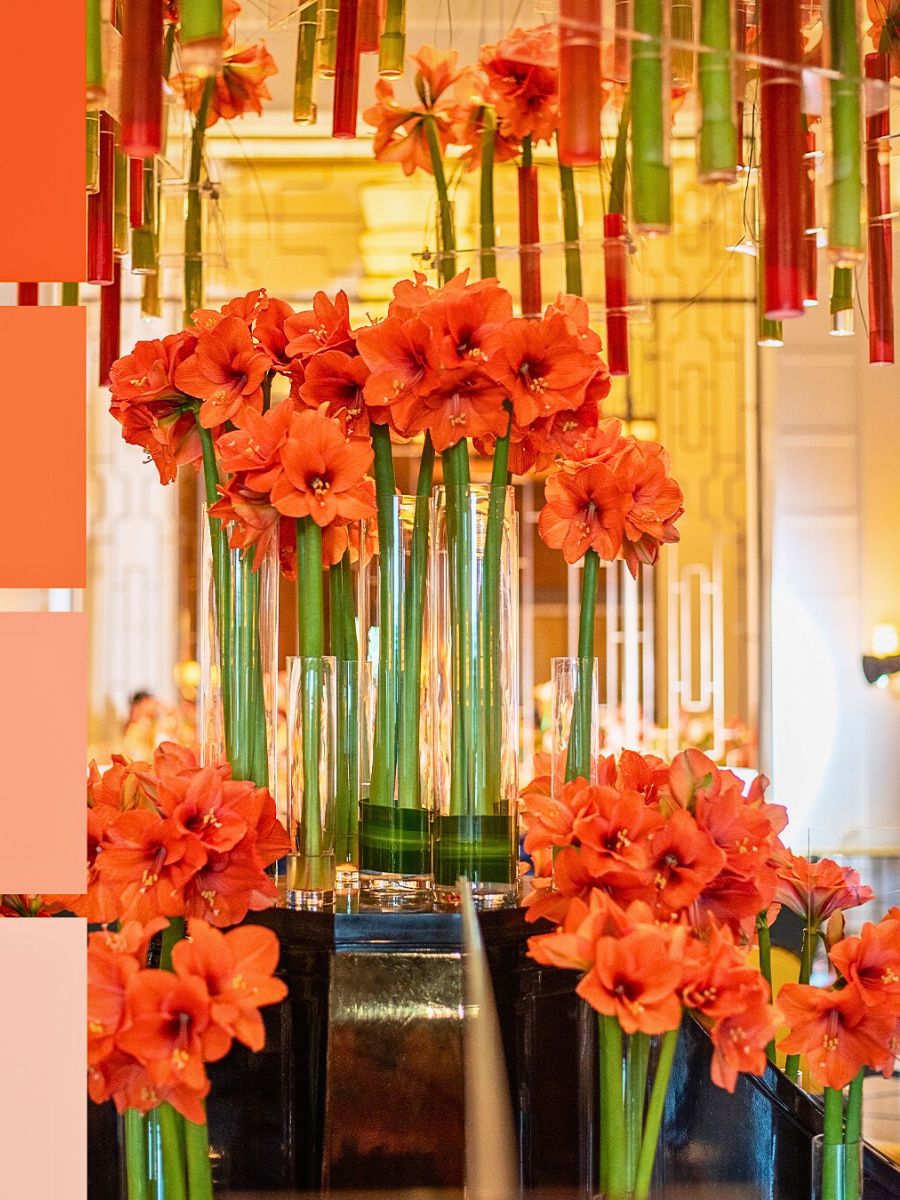
The amaryllis flower also sells by the stem, and cut stems need their own kind of amaryllis care. Cut amaryllis are harvested while the buds are still closed, and the flowers open in the vase. Boers Amaryllis in 's-Gravenzande, a family business for fifty years, cuts from October through February with a peak for Christmas, mostly in red, white, and two-toned varieties. Van der Ende Flowers in Maasdijk offers amaryllis from October to June, from small-flowered to double types, including its spider-shaped Cybister varieties. W.F. Leenen in Voorhout grows Sonatini, a small-flowered amaryllis. Amaryllis Ferrari is a deep red example of the classic cut amaryllis.
The Dutch growers of cut amaryllis also promote their season together, and Thursd covered its start in 2022 and in 2024.

Put a stem in water, and it does the rest. When Thursd asked Marcel de Romph, its managing editor, which flower best represents him in his People Behind Thursd interview, he did not need long:
"I think it would be an amaryllis. This flower starts as quite a small bud. Very modest. It does not shout for attention. It stands on a strong, long stem, yes, but it is still quiet at first. Then you put it in water, let it open, and a really beautiful, large bloom appears, full of color and strength."
The stems are hollow, and that shapes the handling. As a stem drinks, its base splits and curls, so florists slide a cane inside or tie the base, as Thursd's guide to winter flowers that are actually in season explains. Change the water often and keep the vase clean. Flower food helps too, because it feeds the flower as well as keeping the water clear, and the sugar in it makes a measurable difference. In a 2023 Brazilian study at about 22 °C (72 °F), stems of the variety Minerva began to lose market quality after 10 days in plain water, while stems with sucrose added lasted about 12. Thursd has more on why flower food matters for amaryllis.
What to Do With an Amaryllis After It Flowers
This is the step of amaryllis care where a lot of bulbs get lost, and where next winter's flowers are made. As each flower fades, cut it off together with the small swollen part behind it, so the plant does not spend its energy on seed. The stalk is the one point where the extension services differ. Iowa State cuts it 2.5 to 5 cm (1 to 2 in) above the bulb once the flowers are done. Illinois and New Hampshire leave it standing until it turns yellow, because a green stalk still makes food for the bulb. Both work. The leaves stay, whatever you do with the stalk.
The question went to Aaron Steil of Iowa State University Extension and Outreach whether that green stalk feeds the bulb enough to matter. Cutting it is mostly about looks, he says, and about stopping a seed pod, which is unlikely indoors because the flowers rarely get pollinated there. "I would not expect to see any notable difference in the amount of carbohydrates returned to the bulb should the stem be retained." So pick the one you like. In his words, "either practice is fine."
Amaryllis care after blooming is mostly about those leaves. The long straps refill the bulb, so give them the sunniest window you have, ideally one facing south. Water when the surface of the mix is nearly dry, and feed every two to four weeks with a balanced fertilizer at half strength, or monthly at the rate on the label. More than that, or a stronger fertilizer, lets salts build up and burn the roots.
A Summer Outside
Once the danger of frost has passed, the plant can spend the summer outdoors. Harden it off first: a few days in a shady, sheltered spot, then gradually longer spells of direct sun over a week or so, until it gets at least six hours of sun a day. The easiest way is to sink the whole pot into a garden bed. Planting the bulb straight into the ground and digging it up later is not recommended, because the roots are brittle. Keep watering in dry weather and keep feeding through July. The pot comes back indoors before the first frost, and Iowa State brings its plants in by mid-September.

How to Get Amaryllis to Rebloom Next Year
Getting an amaryllis to rebloom comes down to one thing: a cool spell. Commercial bulbs do not need a dry rest to flower again, and a plant kept green can still rebloom. What sets the flowers, according to Iowa State, is 10 to 13 °C (50 to 55 °F) for at least eight to ten weeks. A rest is simply the easiest way to give the bulb that, and it lets you choose when the flowers come.
Iowa State describes two ways to do it. The first is a proper rest: in late September, move the plant to a cool, semi-dark place and stop watering. Cut the leaves off once they turn brown, keep the dormant bulb at 10 to 13 °C (50 to 55 °F) for at least eight to ten weeks, then water it and move it to a bright, warm spot at 21 to 24 °C (70 to 75 °F). The second skips the dry rest: keep the plant green in a well-lit spot at 10 to 13 °C through the fall, and move it somewhere warmer in early to mid winter. Illinois gives a slightly wider range for the rest, 7 to 13 °C (45 to 55 °F) for eight to twelve weeks, and the University of New Hampshire suggests ten to twelve weeks if you want to time the flowers for the holidays.
From the moment the bulb gets warmth and water again, count on four to six weeks to flowers. So count backward. Start the rest in late September, as Iowa State does, and expect flowers around the turn of the year. Start in early September if you want them open by Christmas. Keep the soil barely moist until new growth shows, then water and feed as before.

Why an Amaryllis Won't Rebloom
When a saved bulb makes leaves but no flowers, one of two things usually went wrong, according to Iowa State. Either the bulb did not store enough food in spring and summer, and more light and more feeding next season is the fix, or it never had its eight to ten weeks at 10 to 13 °C (50 to 55 °F). A bulb can also need another year to build up again, as can happen after a waxed bulb. Repotting is rarely the answer. Amaryllis likes a snug pot and only needs a bigger one every three or four years, best after the rest. Red spots or streaks on the stalk and leaves usually point to red blotch, a fungal disease that disfigures the plant but rarely kills it.
And what if the coolest spot in your house sits at 15 to 17 °C (59 to 63 °F)? That one went to Aaron Steil too. A cooler rest brings new growth and flowers sooner, he says, while a warmer one slows everything down, and "for some cultivars, it may suppress or prevent flowering." Don't count on extra weeks to make up for it. "You cannot 'offset' warmer temperatures with a longer rest or storage period." A bulb that keeps coming back with leaves only may simply need a colder rest next fall. Marjolijn Vreugdenhil, who rests and forces bulbs for a living, draws the line for you in one sentence: "17 °C (63 °F) is really the upper limit."
With a year of steady amaryllis care, a saved bulb gets better with age, because it grows a little every year, and a bigger bulb gives more stalks. For the Christmas side of the flower, Thursd has amaryllis for Christmas and red amaryllis in festive decor. For the other plants that arrive in December, there are guides to Poinsettia care and Christmas cactus care, and a round-up of Christmas plants and flowers to grow or gift.
Sources opened for this guide, September 2026: Iowa State University Extension and Outreach, All About Amaryllis (Richard Jauron and Aaron Steil), What should I do with my amaryllis after it blooms? (updated December 2024), and Why Won't My Amaryllis Bloom? (Richard Jauron, December 2024). University of Illinois Extension, How to take care of amaryllis and get them to rebloom (Ken Johnson, December 2021). University of Wisconsin-Madison Division of Extension, Amaryllis, Hippeastrum (Susan Mahr). University of New Hampshire Extension, Can I Get My Amaryllis to Bloom Again? (January 2019). NC State Extension Gardener Plant Toolbox, Hippeastrum. ASPCA Animal Poison Control, Amaryllis. De Brito and others, Application of melatonin and sucrose in prolonging the vase life of amaryllis cut flowers, Ornamental Horticulture 29(4), 2023.
Featured image: red and white amaryllis in a copper pot, photo by @whiteflowerfarm. Header image: red amaryllis in front of a Christmas tree, photo by nicbog on Pixabay.