A Cyclamen plant in a shop in November is hard to walk past: a dome of silver-marked leaves, with swept-back flowers held above it like a flight of butterflies. Then it goes home to a sunny windowsill above a radiator. A few weeks later, the leaves are yellow, and the flowers hang over the rim of the pot. Often, nothing is wrong with the plant itself. The room is too warm, and that is the first lesson of Cyclamen care.
That makes sense once you know where it comes from. The florist's Cyclamen is a hybrid of Cyclamen persicum, a wild plant of the eastern Mediterranean and North Africa, found from Turkey, Cyprus, and Crete to Algeria. In its home climate, it comes into growth in autumn, flowers through the rainy winter and early spring, and sleeps through the hot, dry summer. To a Cyclamen, a heated living room feels like summer.
The rest of Cyclamen care follows from the same fact: bright light, cool nights, water from below, and a rest when the flowers are done. This guide covers how to care for a Cyclamen indoors, why it droops or turns yellow, whether it comes back after flowering, and the types of Cyclamen you are likely to meet, from the florist Cyclamen in the shop to the hardy Cyclamen that returns in the garden every year. The care advice comes from university extension services, the RHS, and the ASPCA, all listed at the end.

How to Care for a Cyclamen Indoors
A Cyclamen grows from a tuber that sits at the surface of the potting mix, with the leaves and flower stalks rising from its top, the crown. Even the name points to it: Cyclamen comes from the Greek kyklos, circle, after the round tuber, Penn State Extension explains. Keep that tuber in mind, because most Cyclamen care mistakes end there. Too much heat, and the plant stops making buds. Too much water on top, and the crown rots.
Give It Bright Light but Keep It Out of Hot Sun
Put your Cyclamen in the brightest spot you have that does not get strong, direct sun. Wisconsin Horticulture, the extension service of the University of Wisconsin-Madison, recommends bright, indirect light and names an east window as a good place, adding that in a Wisconsin winter, a south-facing window may be better. The Missouri Botanical Garden warns that too much direct sun can scorch the leaves. Too little light is a problem as well: Wisconsin lists it among the causes of yellow leaves and buds that shrivel before they open.
Keep It Cool, Especially at Night
This is the part of Cyclamen care that matters most. Clemson Cooperative Extension puts the ideal at 16 to 18 °C (60 to 65 °F) during the day and around 10 °C (50 °F) at night, and warns that above 21 °C (70 °F) the buds fail to develop. Wisconsin Horticulture gives the same numbers, and the University of Maryland Extension adds that warmer temperatures shorten flowering and signal the plant to go dormant. Few heated living rooms are that cool in winter, and that alone explains a lot of short-lived Cyclamen.
So keep it away from radiators, fireplaces, heating vents, and warm drafts. A cool bedroom, a hallway, or a porch that stays frost-free often suits it better than the living room. In a spot like that, a Cyclamen can keep flowering for up to three months, according to Wisconsin Horticulture.

How to Water a Cyclamen From Below
Watering is the other half of Cyclamen care. Water when the surface of the potting mix looks and feels dry, and then water thoroughly. What matters just as much is where the water goes. The crown on top of the tuber should stay dry, because a crown that stays wet can rot, and that is why many people water from below.
To water a Cyclamen from below, stand the pot in a saucer or bowl of water for about 15 minutes, so the potting mix drinks it up through the drainage holes. Then lift it out and let it drain. The New York Botanical Garden lets it drain for 15 minutes in the sink and never leaves it standing in the water that runs off. If you water from above, pour along the edge of the pot, as Clemson advises, and not into the center of the plant.
One more check: if the plant sits in a decorative pot or a foil sleeve, look inside after watering, because that is where water collects without anyone seeing it.
Feeding, Deadheading, and Humidity
While it flowers, feed it every two weeks with a dilute fertilizer for flowering houseplants. Iowa State University Extension and Wisconsin Horticulture both advise every two weeks, Clemson says monthly, and Wisconsin suggests a low-nitrogen food. Do not overdo it, because the Cyclamen Society notes that overfeeding tends to give you leaves rather than flowers. Feed less, and then stop, as the plant goes dormant after flowering.
Take off faded flowers and yellow leaves at the base. Wisconsin Horticulture advises twisting the stem and pulling it sharply so it comes away cleanly, and the Cyclamen Society and Clemson describe the same sharp tug. The New York Botanical Garden simply cuts yellowed leaves off. Either way, keep the plant clean: gray mold, the fungus Botrytis, takes hold on dying and dead plant parts.
In a dry, heated house, stand the pot on a tray of wet gravel for a little extra humidity, as Wisconsin Horticulture suggests. Give the plant some air as well, because the RHS warns that gray mold spreads in humid conditions.
Keep It Away From Cats and Dogs
Cyclamen is poisonous to pets. The ASPCA lists it as toxic to dogs, cats, and horses because of the terpenoid saponins in the plant, and NC State Extension adds that the roots and tubers are the most dangerous part. Chewing on the plant can cause drooling, vomiting, and diarrhea, and after large amounts of tuber, the ASPCA lists heart rhythm problems, seizures, and even death. Keep the pot out of reach, and call your vet or an animal poison control center if a pet has been chewing on it. For homes with pets, Thursd also has a list of low-maintenance plants that are safe for dogs and cats.
Why a Cyclamen Droops or Turns Yellow
Most questions about Cyclamen care start with a plant that droops or turns yellow. The potting mix usually tells you why, so feel it before you reach for the watering can, because a plant that is too wet can look a lot like a plant that is too dry.
| What you see | Likely cause | What to do |
|---|---|---|
| Leaves and flowers flop, and the potting mix is dry | Thirst. Wisconsin Horticulture: if it seems soft, it probably needs water. | Water from below, then let the surface dry before the next watering. |
| Leaves and stems flop, but the potting mix is wet | Too much water. The New York Botanical Garden calls this fainting and says it usually means the plant has been kept too wet. | Let the mix dry out, pour off water in the saucer or sleeve, and water from below from now on. |
| Yellow leaves, and buds that shrivel before they open in a warm, dry, or dim room |
Heat, dry air, or too little light, according to Wisconsin Horticulture. | Move it somewhere cooler and brighter, away from warm drafts. |
| Leaves yellow one by one in late spring after a long flowering season |
The start of its summer rest, the New York Botanical Garden explains. | Water less and let it go dormant (see below). |
| Brown, scorched patches on the leaves | Too much direct sun. | Move it out of strong sun, to an east-facing window, for example. |
| Gray fuzz on flowers or leaves, and stalks that collapse | Gray mold, the fungus Botrytis. The RHS notes that it makes developing leaf and flower stalks collapse. | Pull off everything affected, keep the plant clean, and give it more air. |
Watch the second row. The Cyclamen Society notes that leaves that go yellow or flop from too much water are often taken as a sign of thirst, so the plant gets even more water. Check the potting mix first, every time.
Types of Cyclamen: Florist Cyclamen and Hardy Cyclamen
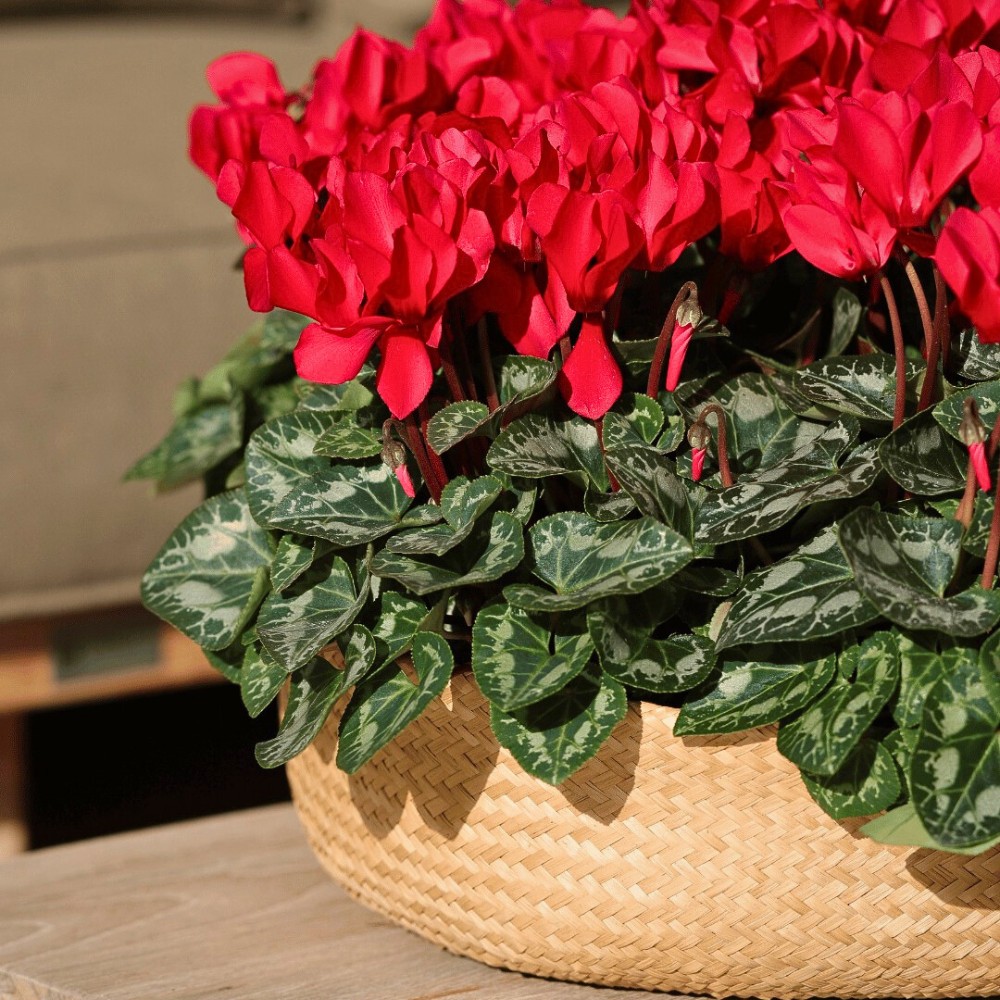
There are some two dozen wild species of Cyclamen, native around the Mediterranean basin: Wisconsin Horticulture counts 23, and the Cyclamen Society counts 24. For most people, two groups matter: the florist Cyclamen sold as a pot plant from late summer to spring, and the small hardy species that live in gardens and come back every year.
Florist Cyclamen (Cyclamen Persicum)
The Cyclamen on the shelf in a florist, a garden center, or a supermarket is a hybrid of Cyclamen persicum, and the breeders behind it work on size, color, flower shape, heat tolerance, and even scent. Iowa State describes miniature types of 15 cm (6 in) tall or less, intermediate types, and standard types of around 30 cm (12 in). Schoneveld Breeding sells micro, mini, midi, and large, and Morel calls its biggest class maxi: its Halios series is made for pots of 12 to 22 cm (4.7 to 8.7 in), while its smallest minis go into pots of 6 cm (2.4 in). Some series are bred to take heat, others for the cool season, which is worth asking about when you choose a plant for a sunny balcony.
Behind the series are breeders, and three of them have a page on Thursd. Morel was founded in France by Pierre Morel in 1919 and breeds its F1 hybrid Cyclamen in Fréjus, on the Mediterranean coast. Schoneveld Breeding in Wilp, in the Netherlands, specializes in cold-loving pot plants such as Cyclamen, Primula, and Ranunculus. Syngenta Flowers has Cyclamen in its pot plant range, too.
The plants themselves come from growers, and several of them have a profile on Thursd. Willem Kuipers in Roelofarendsveen grows Begonias all year and adds Cyclamen and Poinsettia in the autumn. Ten Have Plant in Honselersdijk delivers Cyclamen in season next to its Campanula, Apartus in Poeldijk supplies its Fiorita Cyclamen, and in Quito, Ecuador, ConAn Multiflor grows Cyclamen next to Phalaenopsis, Begonias, and Kalanchoe.
The Cyclamen care above works for all of them, but these four series are worth knowing by name.
Petit Moulin
Morel launched Petit Moulin in 2024 as the first double-flowered Cyclamen in Europe. It is a mini, so the flowers are small, but each one carries extra petals, and Morel says it flowers for more than 100 days, indoors or outside on a terrace. The story of how Morel bred it with Japan's Hirohara Flower Farm is in Cyclamen Petit Moulin Gives You Lush Double Flowers for Much Longer.

Macaron
Macaron is the most compact mini in Morel's range, made for the start of the season. Morel calls it ideal for late summer and early autumn sales and says it keeps its quality under high temperatures and does very well outdoors, which makes it one of the first Cyclamen in the shops each year. There is more on the series in Macaron Is the New Standout in Compact Cyclamen.

Merita
Merita is the midi series of Syngenta Flowers: compact, mounded plants that, Syngenta says, hold up longer and flower up to a week earlier than other compact midi types, from October to March. Syngenta also sells it as a bedding plant for the cool season. Thursd has product pages for Cyclamen Merita Red and Merita Shine Mix, and for the Syngenta mini series SeeWhy, which flowers from September to November and copes with higher temperatures.

Super Serie
Schoneveld Breeding sells its Cyclamen persicum under the name Super Serie, with lines for almost every look. Crayon has flowers with pencil stripes, Petticoat and Djix have petals that point down instead of up, Odora is a fragrant mini, and Leopardo is a large, heat-tolerant type developed in the Mediterranean. For outdoor use, Schoneveld points to Verano, Carino, and the silver-leaved Picasso and Donatello. Thursd visited the company for Cyclamen Are the Super Surprise for Any Occasion.

Hardy Cyclamen for the Garden
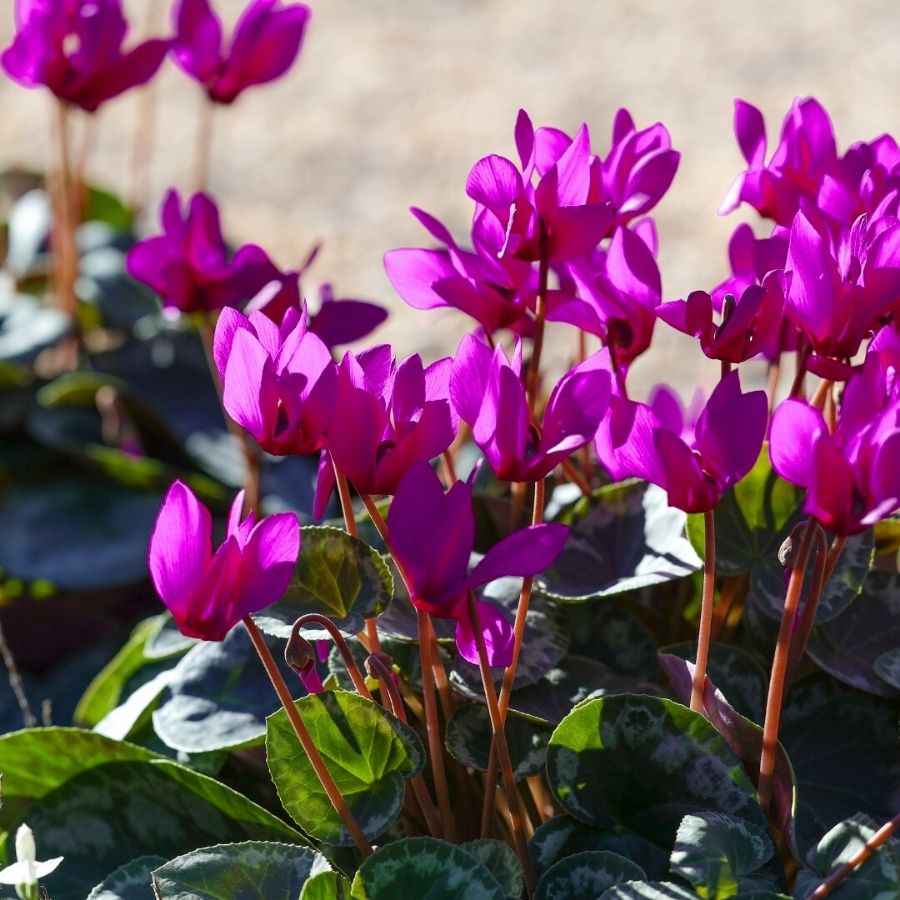
Hardy Cyclamen are small wild species, and in the garden, they are easy as long as they get what they like: the shade of deciduous trees, shrubs, or hedges, and soil that drains well. Penn State Extension advises planting the tubers shallowly, about 2.5 cm (1 in) deep or less, and warns that standing water rots them. Once settled, they spread on their own. Their seeds are carried off by ants, according to NC State, and Cyclamen hederifolium self-seeds freely, says the RHS. Penn State rates the two species below as cold-tolerant in USDA zones 5 to 7, while NC State and the Missouri Botanical Garden give Cyclamen hederifolium zones 5 to 9.
Cyclamen Hederifolium
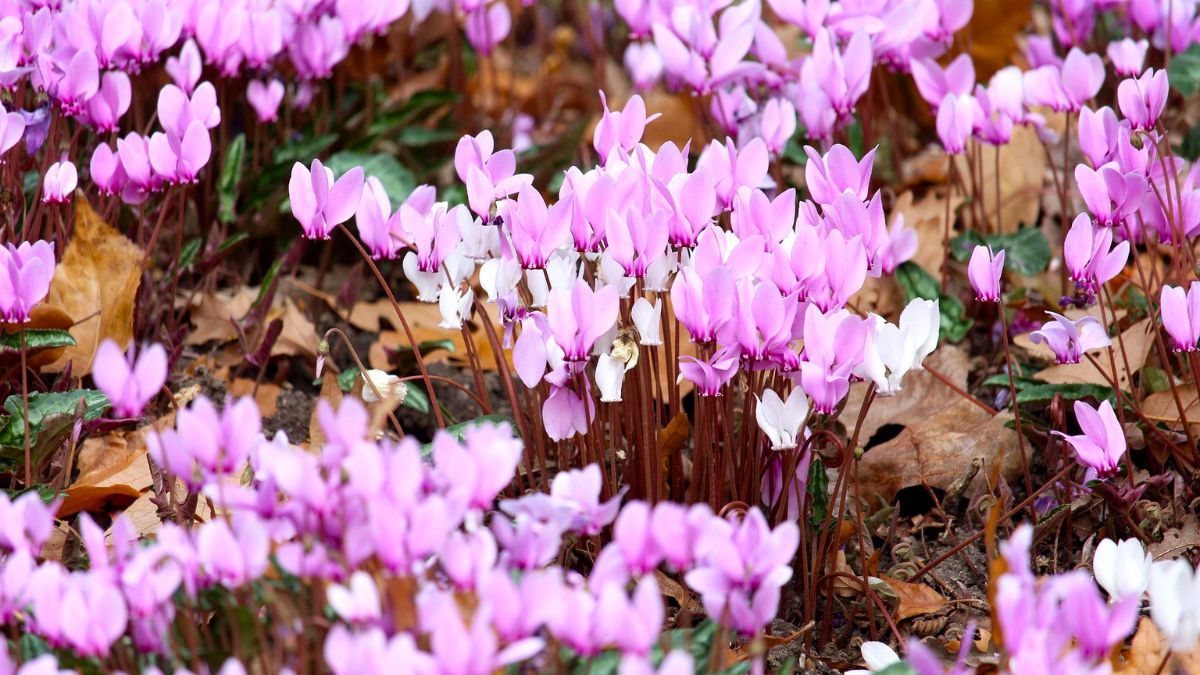
This is the hardy Cyclamen of late summer and autumn. Its pink flowers appear before the leaves, according to the RHS, and the ivy-shaped leaves that follow give the species its name. Morel sells its selections as LIFY and rates them hardy to -15 °C (5 °F), and Schoneveld Breeding has Avalon, which it calls the first F1 hybrid Cyclamen hederifolium on the market. Thursd shows Morel's hardy range in A Natural Touch for Your Garden and Landscape Design.

Cyclamen coum
Cyclamen coum flowers in the depths of winter, from January to March according to the RHS, with small pink to magenta flowers above round leaves. It is the one to plant with snowdrops and early Hellebores, as in Thursd's piece on the winter aconite. Morel sells its selections as KOUMY and rates them hardy to -20 °C (-4 °F).

Elixia
Elixia sits between the two groups. Morel crossed the florist Cyclamen persicum with Cyclamen purpurascens, a hardy species with very fragrant flowers in mid to late summer, and calls the result the first interspecific Cyclamen bred from seed. It is a perennial for outdoors, frost-hardy to about -7 °C (19 °F) in the ground according to Morel, with a strong scent and flowers through the year that peak in spring and autumn. Plant it in spring or autumn, while the weather is still mild, so the roots settle before the cold. In a pot the roots are more exposed to frost, so Morel advises moving containers against a wall or into an unheated porch when hard frost is forecast. Thursd covered its launch in The Cyclamen That Changes Everything.
Florist Cyclamen Versus Hardy Cyclamen
| Florist Cyclamen | Hardy Cyclamen | |
|---|---|---|
| Species | Hybrids of Cyclamen persicum | Wild species such as Cyclamen hederifolium and Cyclamen coum |
| Size | From miniature, 15 cm (6 in) or less, to standard types of about 30 cm (12 in), per Iowa State | Smaller, typically 5 to 13 cm (2 to 5 in) tall, per the Missouri Botanical Garden |
| Frost | Frost tender: winter hardy only in USDA zones 9 to 11, per NC State | Much better winter hardiness, USDA zones 5 to 8 in the Missouri Botanical Garden's rating |
| Flowers | Autumn to spring, in many colors, sizes, and flower shapes | Late summer and autumn (hederifolium), January to March (coum) |
| Where it lives | A pot in a cool, bright room, or on a patio where winters stay frost-free | Shade under deciduous trees and shrubs, in soil that drains well |
| After flowering | Goes dormant in summer and can flower again after a cool, dry rest | Comes back by itself every year and seeds around |
Does a Cyclamen Come Back After Flowering?
A florist Cyclamen can flower again, but it needs its summer rest first, the way it would in the wild. Cyclamen care after flowering is mostly a matter of doing less. When flowering slows down in spring and the leaves start to yellow, that is not the end. It is the plant going dormant.
- As the leaves yellow, water less and less. Iowa State advises this to imitate the dry season.
- Keep the dormant tuber in a cool, shaded place, 7 to 10 °C (45 to 50 °F) in Iowa State's advice, and nearly dry. The Cyclamen Society lets it go virtually dry over the summer, while Clemson keeps the soil from drying out completely, so a small drink now and then is fine.
- In mid to late summer, after six to eight weeks of rest, give it more warmth, 10 to 18 °C (50 to 65 °F) in Iowa State's advice, and start watering again. The Cyclamen Society waits until early autumn.
- If it needs a bigger pot, repot it now in fresh potting mix, with the top of the tuber slightly above the surface. Wisconsin Horticulture keeps the upper half of the tuber above the mix.
Be realistic about the result. Clemson notes that most people throw the plant away after flowering, because getting a compact, high-quality Cyclamen to flower again at home is difficult, and Wisconsin Horticulture says many people treat it as a short-lived indoor plant. So expect a plant that is less compact than the one you bought. It costs nothing to try, though.
Hardy Cyclamen need none of this. They come back by themselves, year after year, as long as the tubers sit shallow in soil that never stays waterlogged. Plant a few under a tree, and over the years they spread into a carpet.
Cyclamen is not the only winter pot plant with habits of its own. Thursd has guides to amaryllis care, Poinsettia care, and Christmas cactus care, a round-up of Christmas plants and flowers to grow or gift, and for the garden, the flowers that bloom in winter. Florists who want to know what is really in season can read Winter Flowers That Are Actually in Season.
Sources opened for this guide, September 2026: Wisconsin Horticulture, University of Wisconsin-Madison Division of Extension, Cyclamen (Susan Mahr, updated 2025). Clemson Cooperative Extension Home and Garden Information Center, Cyclamen, HGIC 1564 (revised November 2023). Iowa State University Extension and Outreach, All About Cyclamen (Cynthia Haynes and Aaron Steil). University of Maryland Extension, Q&A on caring for a Cyclamen received as a gift (Christa Carignan, December 2017). Penn State Extension, Hardy Cyclamen for the Home Garden (Annette MaCoy, November 2025). NC State Extension Gardener Plant Toolbox, Cyclamen persicum, Cyclamen hederifolium, and Cyclamen. Missouri Botanical Garden Plant Finder, Cyclamen persicum and Cyclamen hederifolium. RHS, growing guide for Cyclamen and page on gray mold in Cyclamen. The Cyclamen Society, FAQs and a guide for gardeners. New York Botanical Garden, Cyclamen. PNW Plant Disease Management Handbook, Botrytis blight on Cyclamen. ASPCA Animal Poison Control, Cyclamen. Native ranges: World Flora Online, from the World Checklist of Vascular Plants. Breeder information from Morel (who we are, Petit Moulin, Macaron, Elixia, KOUMY, LIFY, Halios), Schoneveld Breeding (Cyclamen Super Serie, Avalon), and Syngenta Flowers (pot plant catalog 2024-2025, Merita and SeeWhy).
Featured image: pink Cyclamen Petit Moulin in a textured pot, photo by Morel. Header image: Cyclamen coum in a winter garden, photo by Morel.
About the author: Vaibhav Sharma is Thursd's SEO Specialist and Team India lead. He runs the search and technical side of the platform, and his guides are built on what readers actually search for.