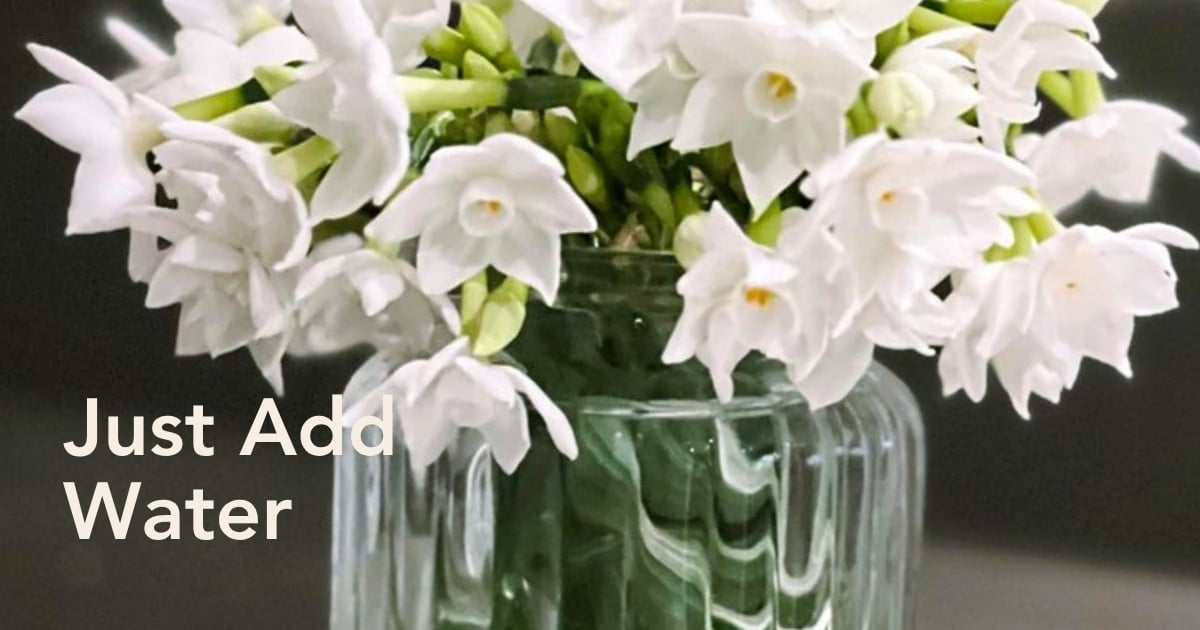
Every November a small ritual starts in a lot of homes. A bowl, a layer of stones, a handful of bulbs, some water, and about a month later the whole room smells of paperwhites. Some people love that smell. Others carry the bowl out to the garage. Both have a point, and the reason follows.
Paperwhites are Narcissus papyraceus, a daffodil that doesn't need a winter to flower. That one fact makes these paper white flowers the easiest bulb to bring into bloom indoors, and it's why how to force paperwhites is one of the first garden questions people ask when the days get short. Here you find what paperwhites are, how to force them in water, gravel, or soil, how to keep the stems from falling over, what is going on with the scent, how they work next to Amaryllis on the December table, how to handle them as a cut flower, and whether they're safe with cats and dogs around. If you know them as the December birth flower, this is the practical side of the same plant.
What Are Paperwhites?
Paperwhites are a daffodil, but not the big yellow trumpet you see in spring. They belong to the tazetta group of Narcissus, the daffodils that carry a cluster of small, star-shaped flowers on every stem instead of one large flower. In Dutch, that group is called trosnarcis, spray daffodil, and that is a good description. The botanical name is Narcissus papyraceus, after the papery white petals. Kew's Plants of the World Online gives its home as the Mediterranean, from Portugal, Spain, and Morocco to Italy and Greece, and it has gone wild outside that range too, in California, Texas, and Louisiana among other places.
Ziva and the Other Paperwhites You Can Buy
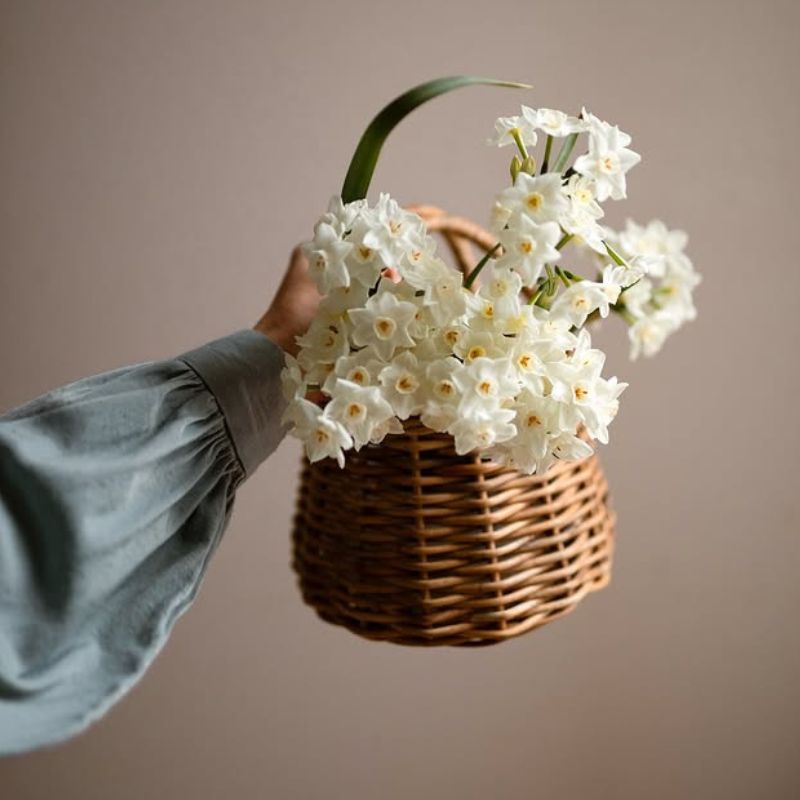
The paperwhite you are most likely to buy is Ziva, which Illinois Extension calls the most widely grown. The RHS describes it as a tazetta daffodil with up to ten very fragrant flowers on a stem. Next to Ziva, you can find Inbal and Galilee, both pure white, Bethlehem with creamy petals and a pale yellow cup, and Wintersun, white with a yellow cup. And then there's the yellow one. Grand Soleil d'Or has yellow petals and an orange cup, and Illinois counts it among the paperwhites too, although botanically it's a Narcissus tazetta and not a papyraceus. Both have their own page on Thursd, Narcissus Paperwhite and Narcissus Grand Soleil d'Or.
Why Paperwhites Need No Cold
Most spring bulbs, tulips and hyacinths among them, need a cold spell before they will flower indoors, and that is what makes forcing them a project. Paperwhites skip that step. They come from the Mediterranean, where winters are mild, and Illinois Extension points out that they have no chilling requirement, which is why they are such easy candidates for forcing. The other side of the coin is that they're only hardy to USDA zone 8. So in colder regions, Illinois among them, they're grown as an annual, and after flowering you can put the bulbs on the compost. If you want to know what a bulb actually is and how it stores the food for that flower, it is explained in a separate piece.
How to Force Paperwhites Indoors
Forcing sounds technical, but with paperwhites it only means you give a bulb water, light, and warmth. Then you wait. There are two ways to do it, in a bowl of gravel with water or in a pot of soil. Here are both.
Forcing Paperwhites in Water and Gravel
This is the classic way and the one most people picture. Take a bowl or vase without a hole in the bottom and put in at least 3 to 5 cm (1 to 2 inches) of gravel, pebbles, or glass beads. Set the bulbs on top with the pointed end up. Plant them close, about 2.5 cm (an inch) apart, as Illinois Extension advises, so the bowl looks full when it flowers. Add a bit more gravel around them to hold them in place, but leave the tips free. Then pour in water until it just touches the bottom of the bulbs, and keep it at that level. Don't drown the bulb. It sits above the water and sends its roots down into it.
Illinois suggests a cool spot for the first week or two, around 10 to 15 °C (50 to 60 °F), to help the roots get going. After that, the bowl wants a bright, warm place of about 21 to 23 °C (low 70s °F). Once the buds swell and open, move it somewhere cooler and out of direct sun, and the flowers will last longer.
Forcing Paperwhites in Soil
Paperwhites grow just as well in a pot of ordinary potting soil. Fill the pot about two-thirds with soil, set the bulbs in, and cover them so only the tips show, Illinois Extension says. Water well and keep the soil moist. A pot of soil is also heavier than a bowl of glass beads, and that helps when the stems get tall. For a shop, potted paperwhites sold in bud are the easy version for the customer, who gets the flowering at home without any of the waiting.
How Long Paperwhites Take to Bloom
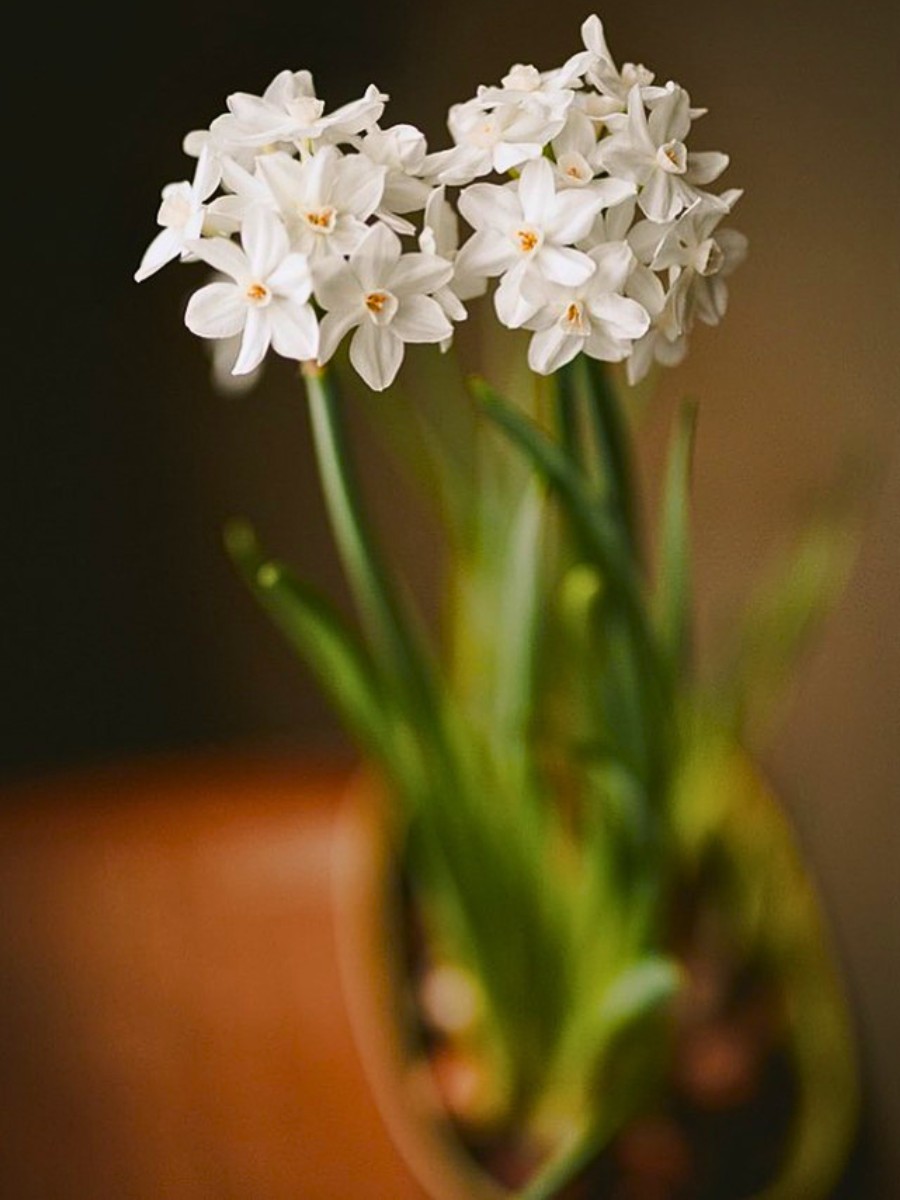
Count on four to six weeks from planting to flowers. That is the range Illinois Extension gives, and a warm room gets there faster than a cool one. So for paperwhites in flower on Christmas Day, plant somewhere between November 13 and November 27. For a birthday in the first week of December, start at the end of October. And if you want flowers all winter instead of one wave, plant a new bowl every ten days, which is what Illinois recommends as well. Florists can use the same rhythm. One tray every ten days from late October keeps pots in bud on the shop floor right through December, instead of one batch that peaks too early.
How to Keep Paperwhites From Flopping
The most common complaint about paperwhites is that they flop. Indoors, the stems stretch toward the light, they get tall and soft, and the whole bowl falls open just when it flowers. Illinois Extension gives three fixes. Give them as much light as you can, so they don't have to reach for it. Keep them cooler, between about 15 and 20 °C (the 60s °F), so they grow less lanky. And when they start to lean, stake them or tie them in.
The fourth fix is the famous one, and it comes from Cornell University. In 2005, a reader wrote to the garden editor of The New York Times that gin had kept their paperwhites from growing tall and floppy. William Miller, director of Cornell's Flower Bulb Research Program, tested it with his student Erin Finan on Ziva paperwhites, first with ethanol and later with about a dozen drinks, from gin and vodka to tequila, wine, and beer. The Cornell Chronicle reported the results in March 2006, ahead of the paper in HortTechnology. Between 4 and 6 percent alcohol made the paperwhites 30 to 50 percent shorter. The flowers didn't suffer. They were as big and as fragrant as on untreated bulbs, and they lasted just as long. Above 10 percent, the alcohol was toxic to the plants.
To try it, start the bulbs in water and gravel as usual. Cornell's advice is to wait until the shoots are several inches long. Then pour off the water and refill with a 4 to 6 percent alcohol solution, and use that solution every time you top up. With a 40 percent spirit such as gin or vodka, that's one part liquor to seven parts water. With 70 percent rubbing alcohol, it's one part to ten or eleven parts water. Don't use beer or wine. The sugars in them cause trouble, and Illinois warns they invite mold and bacteria. Miller's own guess at why it works is mild water stress. The alcohol makes it a little harder for the plant to take up water, enough to slow the leaves and stems but not enough to touch the flowers.
There's an even simpler fix, which is to choose a shorter paperwhite. The gardener behind @flowerprincegarden grows Nir and describes it as a paperwhite whose stems are shorter and stronger and whose flowers are bigger.

Living With Paperwhites in December
Once they flower, paperwhites become part of the house. That's where the questions change, from how to grow them to how to live with them.
The Paperwhite Scent and Why Some People Can't Stand It
Paperwhites are sold on their scent, and that is where opinions split. Illinois Extension writes that some varieties, Ziva in particular, have a strong, musky fragrance that some people find objectionable. Others can't get enough of it. You can have one person in a house who wants a bowl in every room and another who won't sit at the table with it.
Ben Julian, who grows scented narcissi on the Isles of Scilly, hears it from his customers every winter. "Paperwhite is obviously a bit of a Marmite scent for people." The ones who don't like it often do like the more floral scent of the other narcissi, he says.
Gardening writers often blame a compound called indole for the bad side of that smell. But when researchers actually measured the scent of 20 wild Narcissus species for a study published in Applications in Plant Sciences in 2023, they found something else in Narcissus papyraceus. It gave off a lot of p-cresol, a substance the authors describe as mainly associated with feces, and it lacked linalool, one of the main compounds in the scent of its closest relatives. They found indole in two other species, not in the paperwhite. That was the wild plant, not the Ziva in your bowl, so I wouldn't call it settled for every cultivar. But it would explain why the paperwhite smells so different from the other daffodils.
Temperature plays a part too. A 2021 study in Frontiers in Plant Science on cut Narcissus from Spain found that the scent changed when the flowers were kept warmer, at 20 °C by day and 10 °C at night instead of 15 °C and 5 °C, and that indole only showed up in the warmer setting. PubChem, the chemistry database of the US National Institutes of Health, describes indole as pleasant when diluted and unpleasant in high concentration. So a cool room is the better place for a bowl of paperwhites, for the flowers and for the nose. And if the smell is still too much, Illinois names Inbal, Wintersun, and Grand Soleil d'Or as varieties with less or a more pleasing scent. If fragrance is what you're after, paperwhites are on the list of fragrant indoor plants next to Gardenia and jasmine.
Paperwhites Next to Amaryllis
Paperwhites and Amaryllis both get forced for Christmas, and they work well together. The Amaryllis brings the color and the height, and the paperwhites bring the white and the scent. The one thing to know is that they don't run on the same clock. A Dutch-grown Amaryllis needs six to eight weeks from potting to flowers, according to Iowa State University Extension, and paperwhites need four to six. So pot the Amaryllis first and the paperwhites about two weeks later, and they should open around the same time.
| Bulb | Weeks to flower | Plant for December 25 |
|---|---|---|
| Paperwhites Illinois Extension |
4 to 6 | November 13 to November 27 |
| Amaryllis, Dutch-grown Iowa State University Extension |
6 to 8 | October 30 to November 13 |
| Amaryllis, South African Iowa State University Extension |
3 to 5 | November 20 to December 4 |
The Christmas Amaryllis guide has the full countdown, the styling, and what to do if you start late, and the Amaryllis care guide covers the bulb from the shop to the next winter. Unlike a paperwhite, an Amaryllis bulb can flower again the next winter.

Cut Paperwhites in a Vase
Paperwhites are also a cut flower, and a lovely one for a small vase. You can cut a few stems from a bowl in full flower, or buy them by the bunch in winter. But keep them out of a mixed bouquet at first. Like other daffodils, Narcissus stems leak a slimy sap when they're cut, and that sap is bad news for other flowers.
How bad? A 2008 review in the journal Chemical Reviews summed up the vase tests. A rose alone in a vase lasted about 11 days. A rose with one daffodil next to it lasted about 3. A tulip went from about 7 days to about 4. In the roses, the sap held back the water uptake, so they wilted, and in the tulips, the alkaloids in it turned the leaves yellow early. Those tests used the daffodil Carlton, not a paperwhite. I'd still treat every cut Narcissus the same way.
So do what florists do with daffodils. Give fresh-cut paperwhites a few hours in a bucket of their own, then move them into the arrangement without cutting them again, because a new cut starts the sap flowing again. The December birth flower guide gives the same advice, and the daffodil care piece with Chrysal goes into flower food for mixed bunches.

Are Paperwhites Toxic to Cats and Dogs?
Yes. The ASPCA lists paper white as toxic to dogs, cats, and horses. The toxic substances are lycorine and other alkaloids, and the bulb is the most poisonous part. Eating it can cause vomiting, drooling, and diarrhea, and a large amount can lead to seizures, low blood pressure, tremors, and an irregular heartbeat.
With paperwhites, the bulb sits on top of the gravel, out in the open, which makes it easy for a curious cat or dog to get to. So put the bowl where pets can't reach it, and don't leave loose bulbs lying around in November. If you think your pet has eaten part of a paperwhite, call your vet or the ASPCA Animal Poison Control Center at (888) 426-4435, where a fee may apply. For something green that is safe, the list of pet-friendly houseplants is a better start, and the Poinsettia care guide has its own section on pets for the other Christmas classic.
Who Grows Paperwhites for the Trade
At home, paperwhites start as dry bulbs. The cut stems in a florist's bucket come from growers who force the bulbs in greenhouses. One of them is W.F. Leenen & Zn. in Voorhout, in the Dutch bulb region. It's a family company that has grown Narcissus since 1954, and the brothers Jaco and Dirk Leenen are the third generation to run it. According to its grower page on Thursd, it supplies about 20 Narcissus varieties from October to the end of April, forces them on shells so they stay clean, and uses fields outside Europe to stretch the season. In a 2020 interview on Thursd, the company named Paperwhite, Grand Soleil d'Or, and Avalanche among its best-known varieties. And the same brothers grow Sonatini, a small-flowered Amaryllis, so both December bulbs of this article come out of one nursery in Voorhout.

Scented Narcissus From the Isles of Scilly
Not every winter Narcissus comes out of a greenhouse. On the Isles of Scilly, off the southwest tip of England, Ben and Zoe Julian of Scilly Flowers pick scented narcissi in the fields of Churchtown Farm from autumn to spring. So I asked Ben if they grow Paper White too. They don't. "No. We don't grow any paperwhite currently." His father did, years ago. But the soil on the farm is particularly sandy, and they couldn't grow Paper White of the quality their customers demand, not consistently.

What they grow instead are the other tazettas, the paperwhite's cousins. Next to them come jonquils and other scented hybrids. Their season starts with Soleil d'Or and runs through about ten varieties, among them Island Pride, Grand Primo, Aphrodite, Scilly Valentine, Golden Dawn, Winston Churchill, Silver Chime, Geranium, and Acropolis. Compared with those, Ben describes the paperwhite stem as slimmer and less sturdy, with fewer florets than a Soleil d'Or. The vase life is probably similar across the varieties, he says, but on a white flower you see the damage and the aging sooner.
Picking starts in mid to late October and goes on to mid April, and the weather decides the rest. "Mild winters usually mean an earlier finish and taller stems. Cooler winters will tend to give shorter stems and a later finish." After picking, the stems are trimmed, bunched, and put in clean cold water in a cold store at 2 to 3 °C (36 to 37 °F). They can stay there up to two weeks without losing vase life, but ideally not longer than seven days. Every box goes out with a care leaflet and a sachet of flower food. And there is one thing Ben says above all else.
"Trimming stems with a clean, sharp knife is absolutely front and foremost amongst the things we preach! More than once if necessary."

If you start one bowl this year, start it in the middle of November, give it the coolest bright room you have, and find out which side of the paperwhite debate your house is on. For more plants to grow or give in December, see the Christmas plants and flowers.
Sources: Kew Plants of the World Online, Narcissus papyraceus. University of Illinois Extension, How to grow and care for paperwhites (Ken Johnson, December 13, 2024). RHS, Narcissus papyraceus Ziva. Cornell Chronicle, Why tipsy flowers don't tip over (March 31, 2006). Losch and others, Applications in Plant Sciences (2023). Terry and others, Frontiers in Plant Science (2021). PubChem, Indole. Kornienko and Evidente, Chemical Reviews (2008). ASPCA Animal Poison Control, Paper White.
Featured image: Nir paperwhites in a blue and white pot, photo by @flowerprincegarden. Header image: cut paperwhites in a ribbed glass vase, photo by @flowertothepeopleig.