Ask a florist why a bunch looks tired, and the answer is often the wrong one. The flowers were not old. They were cut at the wrong cutting stage, or at the right one and then left in the cooler until the color never came. Ripe or raw is the oldest argument in the flower chain. The grower wants to leave the flower on the plant a few hours longer. The trader wants it closed, safe in the box, and easy to hold. The customer thinks a bud is fresher than an open flower and buys the bud. In 2020, Thursd asked three growers and one buyer to settle it, crop by crop, and in 2024, a lily grower added his answer. This page brings the five interviews together: what ripe and raw mean, when roses, spray roses, lilies, and Alstroemeria leave the plant and why, and what that does to vase life and to the price on the clock.
The voices are Porta Nova on roses, Voorn Spray Roses on spray roses, Tesselaar Alstroemeria on Alstroemeria, Bredefleur on lilies, and Van Vliet Flower Group on what a wholesaler does with all of it. Every quote below is lifted from the interview it came from, with the year it was said, and each interview is linked so you can read the whole conversation.
What Ripe and Raw Mean: The Five Cutting Stages
Ripe and raw are not vague words in the Dutch trade. Auctions grade a lot's maturity on a scale of 1 to 5, and growers cut to that scale. Stage 1 is a closed bud, and stage 5 is a fully open flower. A lot is offered with a two-digit code, 2-3 for instance, which tells the buyer the range of maturity inside the bunch: every stem in that lot sits at stage 2 or 3. Trainer Lucas Jansen of Floweracademy walks through the code and what to look at per flower in Ripe vs. Raw: Floweracademy, the long read behind this page.
| Stage | What you see | Who cuts here, from the interviews |
|---|---|---|
| Stage 1 raw |
Closed bud, little or no color showing | Lilies leave Bredefleur at stage 1, close to jumping open |
| Stage 2 slightly open |
Bud loosening, color visible at the tip | The stage transport asks for: Alstroemeria at 2-3, spray rose Aerobic at 2-3 |
| Stage 3 starts to open |
Outer petals moving, the flower recognizably itself | Most Voorn spray roses; Ecuador roses land at 3-3 at Van Vliet |
| Stage 4 clearly open |
Open but not fully, the center still closed | Galina, Luna Trendsetter, and Coral Bubbles at 3-4; the stage Tesselaar calls best for vase life |
| Stage 5 fully open |
The flower as the consumer will see it | Anthurium, Gerbera and most spray Chrysanthemums are cut and sold here; so were Tesselaar's lockdown bunches |
Two things follow from the scale. A stage describes the flower on the day it is cut, not its quality, so stage 4 is not "old" and stage 1 is not "fresh". The right stage differs for every crop and often for every variety, because some flowers keep developing in the box and others do not. That is what the growers below sort out.
When to Cut, Crop by Crop
Roses: Porta Nova and Red Naomi
Porta Nova built its name on Rose Red Naomi and on selling that rose more open than the trade was used to. When Thursd asked commercial director Stefan van Vuuren in 2020 what the ideal stage looks like, he started with the person at the end of the chain.
"The consumer wants a 'living' flower that lasts a long time and opens slowly. In addition, the flower must come through the trade phase well. It may not be too ripe and needs to remain undamaged. The combination of these makes the ideal stage."
Then the reason a rose is worth waiting for.
"If we harvest too early the rose will not open uniformly. Because roses only receive sugar (energy) as long as they grow on the plant, waiting as long as possible and harvesting relatively late will give us bigger and stronger roses that last much longer because they contain more energy."
A rose builds its reserves on the plant and spends them in the vase. Cut it early, and it opens on an empty tank, if it opens at all. Cut it late, and it opens big and stays. Waiting has a cost, and Porta Nova pays it in labor: "That is why we harvest twice a day, and during warm summers we even harvest three times a day," Van Vuuren said. The limit is the box. "It is a delicate balance between harvesting a stronger, more open rose and being able to transport it undamaged."
His summary of the whole debate is the sentence this page is built on. The difference between raw and ripe can be a rose that "spent just a couple of hours extra on a plant before being harvested. Allowing it to grow a bit stronger. I think growers, traders, and florists play a crucial role in explaining and communicating this in a better way."

Porta Nova is not alone among rose growers. Wans Roses makes the same case for garden-rose types such as Rose Vuvuzela, which never shows its inner color when cut too raw, in True Beauty Takes Patience. And for event work, some growers will leave roses to open fully on the plant, at a price, which Thursd covers further down.
Spray Roses: Voorn Spray Roses
Spray roses are harder, because one stem carries several buds of different ages. Frank Voorn of Voorn Spray Roses started with spray roses in 2017 and decided from day one not to cut to what the auction or the wholesaler asked for.
"Right from scratch we already said clearly that we as Voorn Spray Roses only provide a cutting stage that we support ourselves and just go ahead with it. You will see that it works."
What he supports is tested, not guessed. Voorn keeps harvested stems in its own cold store for a number of days to mimic the chain and see how each variety looks by the time it would reach a florist, then works backward from the consumer to the nursery.
"I take a very critical look at the right cutting stage for every single cultivar. That is a complex story, but it is very important that you do it correctly. We recalculate this from the use by the consumer back to our nursery. One spray rose ripens in the chain and the other does not. You are also dependent on the season. In winter, for example, you can harvest a little more mature."
The result is a stage per variety, not per crop.
"I harvest most varieties on cutting stage 3. Aerobic is one of the varieties that we harvest a bit rawer, between cutting stages 2 and 3, because it continues to grow in the chain. Galina, Luna Trendsetter, and Coral Bubbles are harvested more mature, between cutting stages 3 and 4."
The target is the shop counter. "When the flower arrives at the florist, it must be within two or three days to have the right stage of maturity to sell so that the consumer can also enjoy the flowers." And the comments from traders stopped. "I do what I think is good, so I determine it myself. Nowadays, everyone knows this, and nobody comments on that anymore."
Why the stage counts double for spray roses, and how varying it per variety changes what the consumer gets, was the subject of a six-week campaign in 2025 that Thursd covered in Why Cut Stage Matters for Spray Roses.

Alstroemeria: Tesselaar Alstroemeria
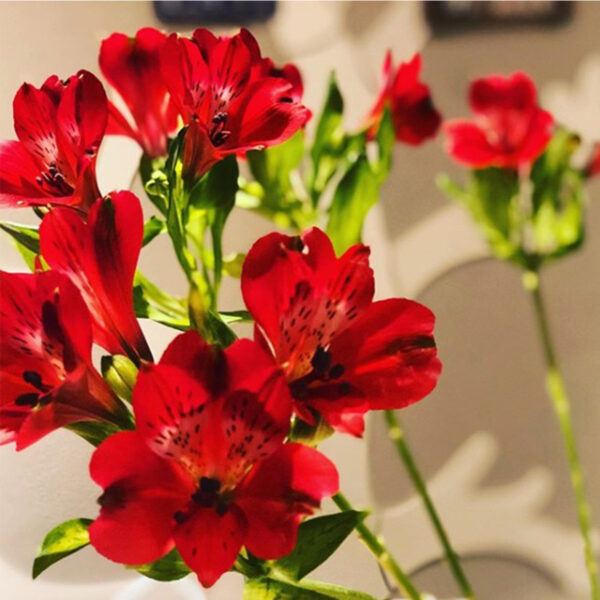
Karolien Tesselaar of Tesselaar Alstroemeria ran a test she never planned. During the 2020 lockdown, with the clocks braking hard and direct demand collapsing, she cut Alstroemeria riper than she would ever send to a wholesaler and gave the bunches to her neighbors. They lasted for weeks, the compliments kept coming, and she wrote her view down for Thursd under one line: "Give the flower its full power."
Her starting point is the trade habit that keeps the crop in bud.
"In the Netherlands, the flower is delivered to the clocks and directly to wholesalers at cutting stage 2-3. A product that is delivered at cutting stage 4-5 (as it opens in the vase) is classified as 'old' or of poor quality. This is a fable that we would like to get rid of."
Stage 2-3 is where the grower's logistics work: enough color to see, little damage to the bud, time to move the flowers through the chain. It is also where the flower is sold short.
"When we harvest the flowers riper, the colors become even more intense, but it becomes more difficult in handling; a flower is still a delicate product. The fewer links in the chain, the riper the harvest could be."
The lockdown bunches were cut at stage 5, open on the plant. "A week and a half later this bunch was still full of color in people's homes!" Her conclusion for the crop:
"We think cutting stage 4 is best for a long shelf and vase life. We understand that for transport and handling reasons cutting stage 2 is required, although it means less power to the flower."
Since the chain will not change overnight, her ask goes to the last link. "My call would then be for the last link in the chain, the bouquet maker or florist, to keep the flowers out of the refrigerator for a day so that the flowers can open and show their color." An Alstroemeria that can last three weeks loses nothing by being sold "about two to three days older," as she puts it, and gains a customer who can see what they are buying. Wouter Jongkind of Royal Van Zanten made the same case for spray Alstroemeria in Hey Pretty Charmelia Flower, where the breeder and grower Together2Grow together set a riper standard for Charmelia Pink, and the florists' reaction was relief at finally seeing color on the stem.
Lilies: Bredefleur
Lilies are the sensitive case, and Bredefleur is the one grower on this page that answered in 2024 rather than 2020. A lily flower is fragile from the moment it opens, so the trade wants it closed. Levi Evers of Bredefleur delivers exactly that and disagrees with it at the same time.
"This is maturity stage 1. Open flowers are always more beautiful, but that is not feasible with transport. The riper is more beautiful, but the vulnerability increases."
Stage 1 at Bredefleur is not a green bud. "I have to deliver the lilies at a maturity stage close to jumping open. However, the riper the lily is cut, the better. So, the longer the flowers remain on the plant, the higher the quality." And the ideal on arrival: "The ideal situation for everyone would be if, on delivery of the lilies, there is 1 flower open per branch. This way everyone in the chain can fully enjoy the lilies."
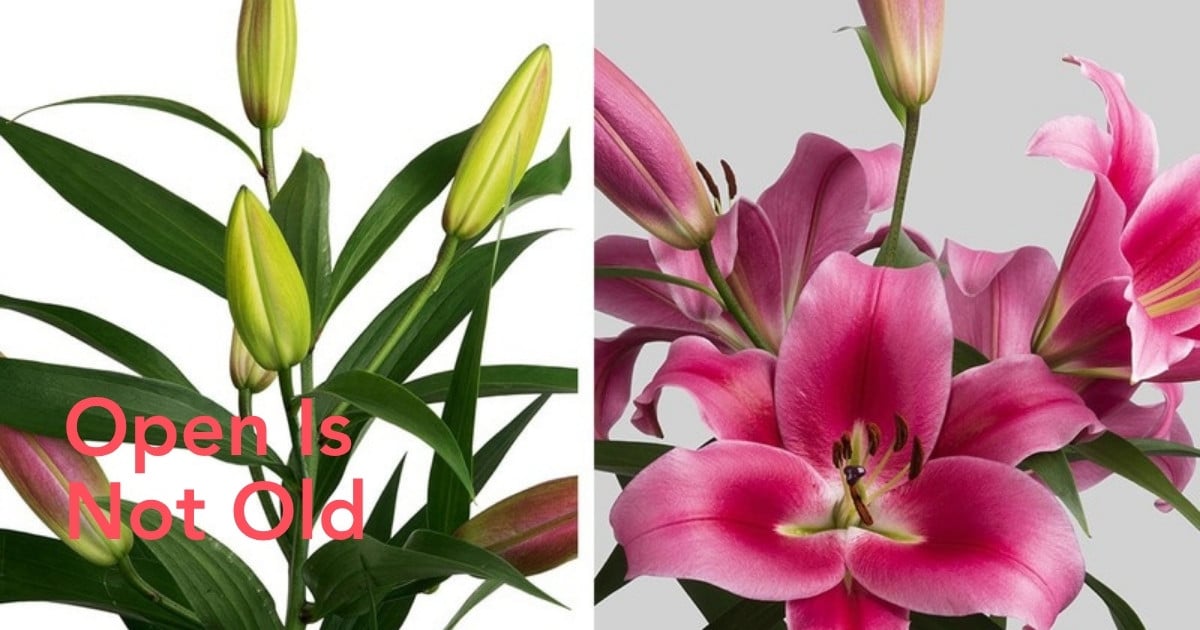
His argument on vase life is Porta Nova's argument from a different crop. "Many people do not understand this, but the vase life can really get longer if the flowers are longer on the plant. The intensity of the flowers also improves!" The pictures Bredefleur supplied for the interview show what that looks like on Lily Zambesi and Lily Dalian, raw next to ripe.

"We have been making a difference for years by cutting more mature flowers. We sometimes play on the edge because it is not always practical in trade. Mature flowers are thought of as older flowers. That mindset should be changed once and for all."
The cost, he admits, lands on the shop. "A florist should also learn to work with a more mature product. The quality of the flower then becomes optimal. Even if this means a shorter sales time."

Peonies, Sunflowers, and the Flowers Sold Fully Open
Some crops settle the question by themselves. Anthurium, Gerbera, and most spray Chrysanthemums are cut at stage 5, fully open, and judged on the flower itself: the spadix on an Anthurium, the rings of stamens in a Gerbera heart, as the Floweracademy piece explains. Other crops are cut closed because they keep developing after the cut and travel better that way. Sunflowers are the wholesaler's example. Tom de Ridder of Van Vliet showed Thursd a bunch of closed sunflowers as his ideal: "These are ideal for us to transport to the customers because they still have to open completely and can therefore be on the way for a while. Customers of the cash & carries can also work with this for a long time because these flowers open slowly." What a sunflower needs after that is in the secrets of long-lasting sunflowers.

Peonies are the crop where the argument gets loudest, because they are cut once a season from open fields and shipped dry, lying in crates. Thursd's Many Peonies Systematically Sold Too Raw sets out the three reasons: loading for transport, one pass through the field, and shops that read an open peony as an old one. The advice there is simple: buy the ones already showing color, or ask your wholesaler for the smaller growers who go through the field more than once. Traders such as My Peony Society make a point of sourcing at the right stage. Which side of that a buyer wants depends on where the buyer is, as the wholesaler explains next.
What the Cutting Stage Does to Vase Life
Put the four growers next to each other, and they say one thing in four ways. Porta Nova: a rose only takes in sugar while it is on the plant, so a later cut means more energy to open and to last. Bredefleur: the longer a lily stays on the plant, the longer it lasts and the stronger its color. Tesselaar: stage 4 gives the best vase life; stage 2 means less power to the flower. Voorn: the right stage per variety is whatever brings the flower to its selling stage within two or three days of arriving at the florist.
The exception proves it. A flower that is cut raw and never opens in the vase has not gained vase life; it has lost all of it, and that is what the almost-green tulips of twenty years ago taught the trade, and what Alstroemeria sold so raw that you cannot tell its color still teaches it, as Lucas Jansen describes in the Floweracademy piece. Raw is a storage property, not a freshness property. It buys days in the cold store and on the truck, and it pays for them with days in the vase. Ripe is the opposite trade. What a florist does with those days is a separate subject. Flower food and clean water add to what the grower put into the stem; they do not replace it.
What It Means for Buyers and Florists
For the Wholesaler: The Code Has to Be True
Tom de Ridder was Head of Flower Buying at Van Vliet Flower Group, a post he had held since 2006, when he spoke to Thursd in 2020. He buys for importers around the world and for Van Vliet's own cash and carries, so he sees every preference at once. His first demand is not a stage. It is honesty about the stage.
"It does depend on the information we are given during the auctioning. As long as this information is reliable and does not deviate from what we receive it is fine. Flowers should not be open when auctioned at maturity stage 1-3 or 2-3."
Origin changes the code, not the rule. "An example is Ecuador roses that will never give the maturity stages 2-3 but always 3-3 because they are already more open." And a flower keeps ripening while it moves: "A peony will be more open at all times if it leaves compared to when it came in."
Asked whether a flower delivered one stage riper gains or loses value, he would not give one answer, because his customers do not agree with each other.
"Our location in Prague, for example, and more Eastern European countries do not want raw peonies, but rather open ones. The United Kingdom does want raw peonies. So there is actually a market for everything and one grower will deliver in this way and the other in that way."
"It is often the case that the open varieties get less money because they will have a shorter life after the chain than the ones that still have to open up completely. That is the consequence, so I think most growers deliver a bit rawer. This makes sense to me."
That is the economics in two sentences. The riper lot has less time left after the chain, so it fetches less; so growers cut rawer; so the consumer sees buds. Every grower on this page is working against that loop from their own side. The wholesaler can only tell you which customers will pay to break it, and he does: open peonies sell in Prague, raw ones in the United Kingdom, and the receipt has to say which is which.

For the Florist: Give It a Day
Four things come out of the interviews for the shop. Take Alstroemeria out of the cooler a day before it goes on display so the color comes up, as Karolien Tesselaar asks. Sell lilies when one flower per stem is open, the point Levi Evers calls ideal for everyone. Ask what code a lot was cut at, and buy from growers whose code you can check, which is Tom de Ridder's whole method. And when a customer says an open flower looks old, that is the moment every grower here keeps pointing at. The explaining, as Stefan van Vuuren put it, is the job of growers, traders, and florists together.
For event work, the rule flips. Designers who want roses fully open can ask a grower to leave them on the plant until the day, at a price, because the grower loses a cut in the season and an open rose cannot be boxed. Thursd's Need Open Roses for an Event? Walks through it with wholesaler Patrick Dobbe of Dobbeflowers and florist Bart Bresser. In India, the clients of floral designer Baisakhi Ghosh want open and full bloom flowers for hotels and events, a reminder that the raw preference is a market habit, not a law of the trade.
The Short Version
Raw is a transport stage, not a freshness stage. Ripe is what the plant gives a flower if you let it, and every grower here says the same about the vase: longer on the plant, longer in the vase, more color. The trade cuts rawer than the growers would like because the box and the clock reward it, and so does the customer who reaches for the bud. The five interviews are the evidence, crop by crop: Porta Nova on roses, Voorn on spray roses, Tesselaar on Alstroemeria, Bredefleur on lilies, and Van Vliet on what a buyer can do with it. Read the one for your crop, then look at the next bucket and ask what stage it was cut at.
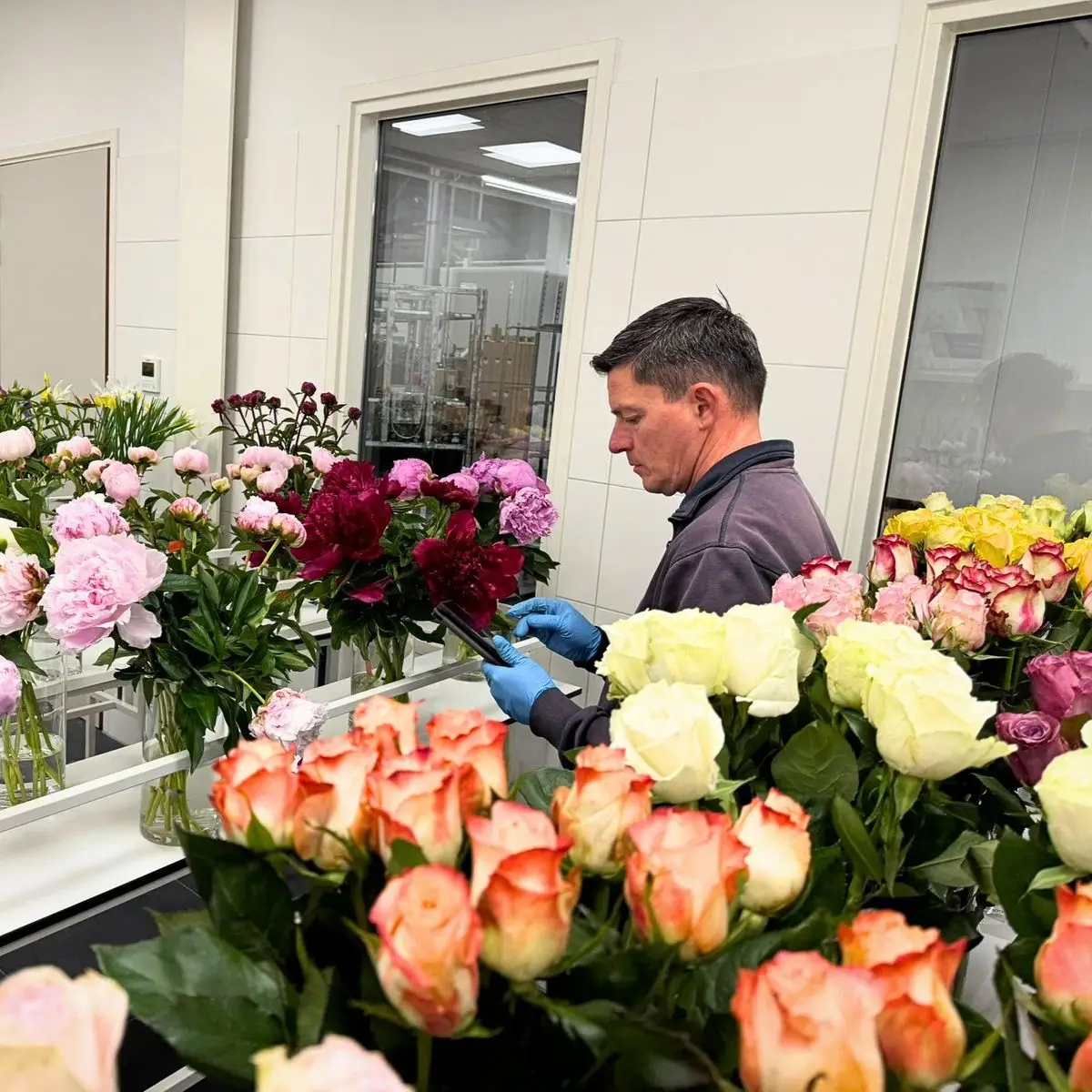
Feature image: Levi Evers from Bredefleur with Lily Original Love. Header image: Lily Dalian raw and ripe. Both from Thursd's 2024 interview with Bredefleur, whose credit reads: All photos courtesy of Bredefleur. Body photos from Thursd's 2020 Ripe vs. Raw interviews with Porta Nova, Voorn Spray Roses, Tesselaar Alstroemeria, and Van Vliet Flower Group.