Flowers follow the climate, and money follows the flowers. Both of those journeys started in earnest around 2003, when small-headed roses left Dutch glasshouses for the highlands of Kenya and Ethiopia. Two decades on, East African flower farms supply a large share of what European florists sell every week, and the question in the trade has shifted. It is no longer about whether the growing works. It is about where the earnings settle.
Three people who watched that shift from three different positions said so out loud on the Dutch podcast Goede Bloemen en Goede Planten, hosted by Thursd founder Arnold Wittkamp. Those conversations were in Dutch, and their quotes below are translated. Alongside them are the numbers the sector publishes about itself, and two voices from Kenya.
The Move That Happened in One Decade
Arno van der Zwan started in roses at fifteen and worked in them for eight years. He describes the change without drama, as something the sector lived through rather than debated.
"I worked in roses for eight years. Until in 2003 the small-headed roses were taken over by Kenya and Ethiopia. So a lot of companies here stopped," he says.
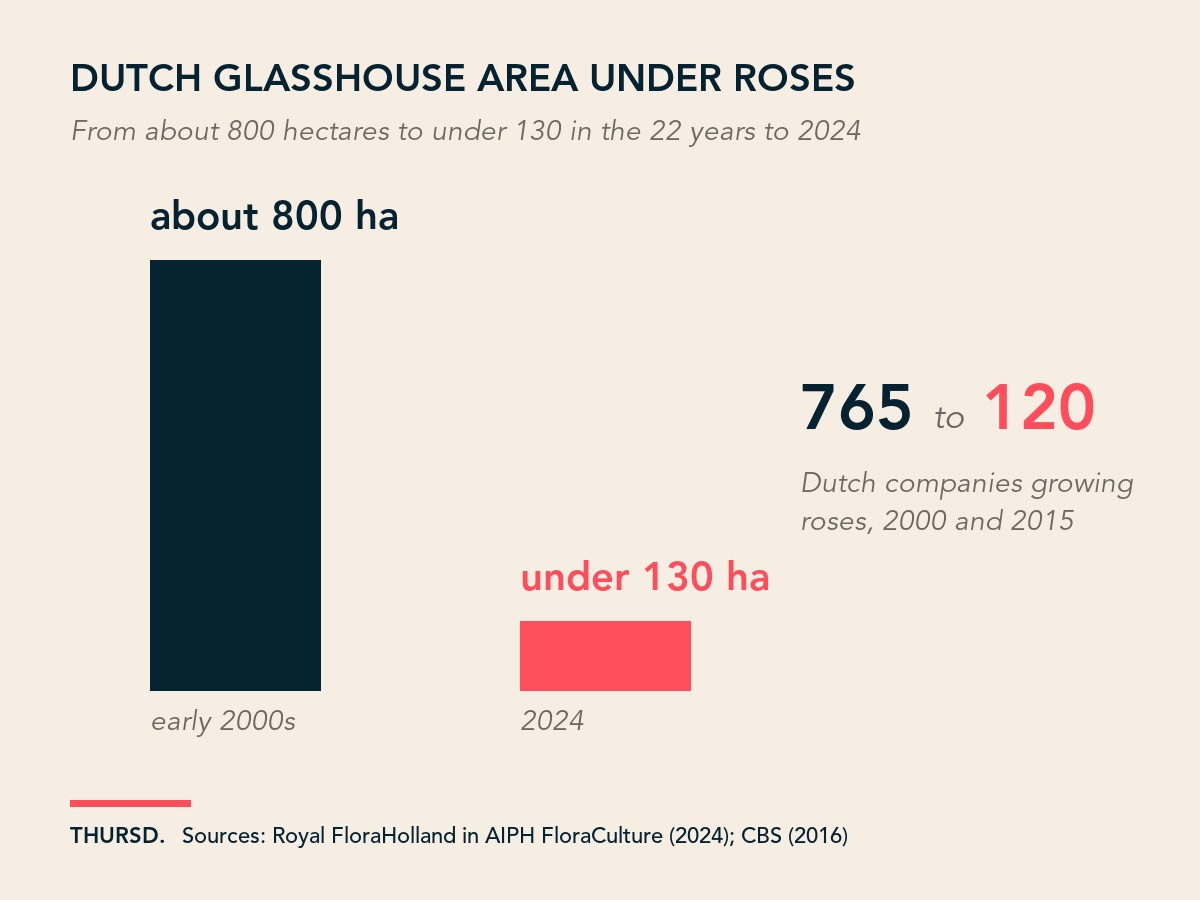
The scale of that is easy to underestimate. Dutch glasshouse area under roses fell from about 800 hectares to under 130 in the 22 years to 2024, according to Royal FloraHolland, and Statistics Netherlands counted 765 companies growing roses in 2000 against 120 in 2015. Energy is the reason most often given: it accounts for 20 to 30 percent of a Dutch rose grower's costs, and the energy crisis finished what competition had started. Thursd covered the consequence of that in why the Netherlands stopped growing roses.
So the same event reads as a loss in one country and as an arrival in another. Neither reading is wrong, and that is precisely what makes the subject difficult to discuss in one language.
What East Africa Built Instead
The arrival side now has hard numbers behind it. Kenya exported 130,581 metric tons of cut flowers in 2025, worth KES 81.3 billion, or about USD 630 million, according to Agriculture and Food Authority figures published by the Kenya National Bureau of Statistics. Earnings rose 12.8 percent in 2024 while volume rose 27.4 percent, so in shillings the average kilogram exported earned about 11 percent less. Cut flowers made up about 57 percent of the value of Kenya's fresh horticultural exports and went to 143 destinations, with roses at about 69 percent of flower exports. Kenya is Africa's largest flower exporter and, by the Floriculture Sustainability Initiative's count of 2024 trade data, the fourth-largest cut flower exporter in the world, after the Netherlands, Colombia, and Ecuador.
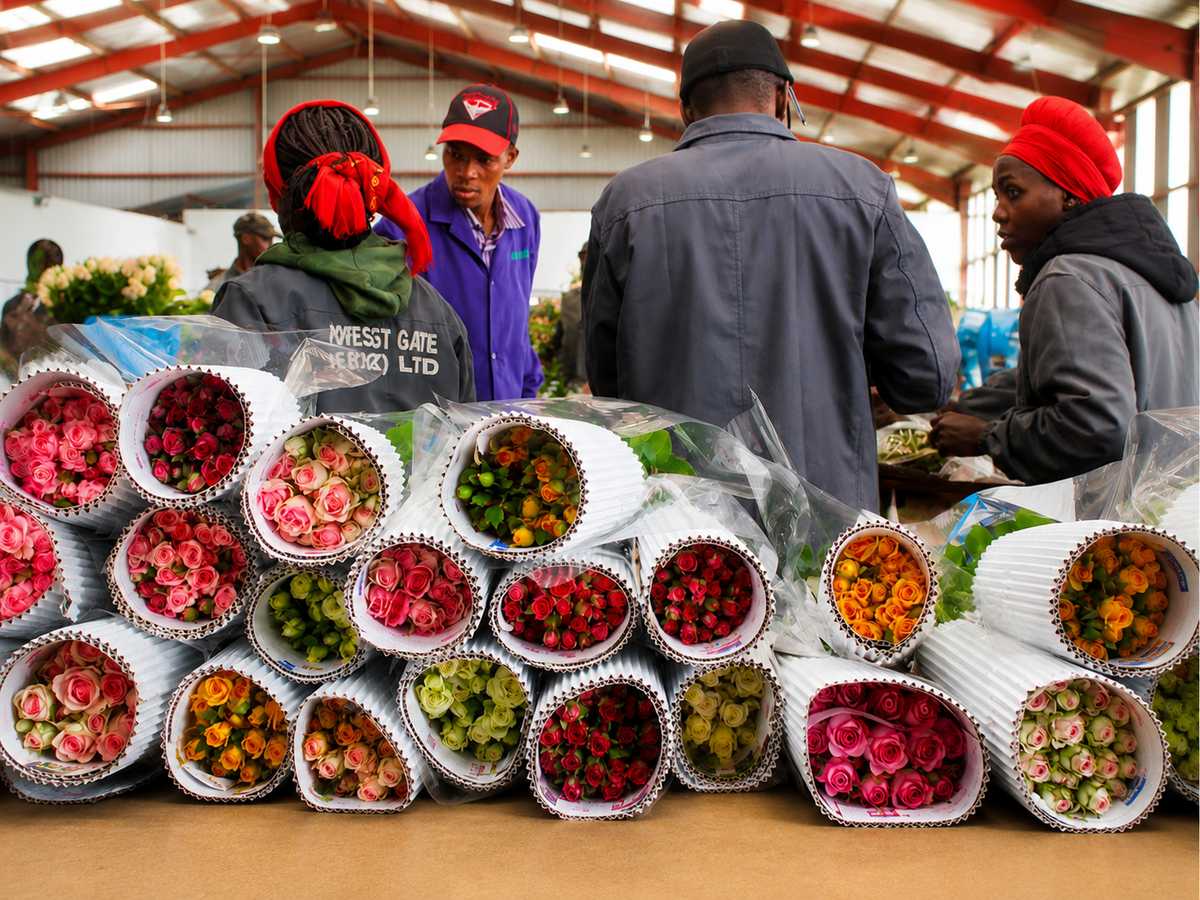
Behind those figures are people rather than pallets. The sector supports about 200,000 direct jobs, and more than a million livelihoods, and over 60 percent of its workforce is women.
Yvonne Tirop, Head of Commercial at Mona Flowers, a high-altitude farm in Eldoret in the Rift Valley, put it this way in a Thursd interview.
"I draw inspiration from the women working in our farms every day, their resilience, skill, and care help create a beautiful product that reaches the world. They show that everyone, no matter how small their role may seem, can create an impact that is felt worldwide through the beauty of flowers," she says.
Ethiopia followed the same path a few years later. Its flower farms now employ an estimated 183,000 to 200,000 people, according to a 2026 report on the Ethiopian Horticulture Producer Exporters Association. The producers organize through that association, EHPEA, led by executive director Tewodros Zewdie, which runs training on occupational health, safe pesticide handling, and workplace rights across its member farms. Thursd looked at how that industry organized itself in a piece on EHPEA and Ethiopian floriculture.
Five Thousand People Behind One Bunch
Helena van Achterberg, who also writes for Thursd, works at Marginpar, a group that grows specialty summer flowers across Kenya, Ethiopia, Tanzania, and Zimbabwe. Asked how many people the operation employs, her answer is specific.
"Four thousand in Ethiopia and Kenya, and then another thousand at the partner farms. Five thousand in total," she says.
Set that against the national figures and the scale becomes clear: one specialty grower, spread over several countries, employs the equivalent of one in forty of Kenya's direct floriculture jobs. That is what a single supplier line means before a stem is ever priced.
The company did not begin with flowers. It began with vegetables in Zimbabwe in the mid-1980s and switched when the founders concluded that vegetables did not return enough. Summer flowers were the experiment, and Hypericum was among the first crops they brought to Africa.
What keeps that operation moving is not a fixed map. Varieties are relocated between countries when the growing tells them to.
"It is all in consultation. They simply belong. And we often move varieties. When we see it does not work well in Ethiopia but it would do very well in Zimbabwe, then it goes there. So we really look at what is the right place to grow something. Where is it most beautiful," she says.
Astilbe is the clearest example of a crop nobody predicted. It arrived at the group almost by accident, and it needs cold to regrow, which is not what one associates with equatorial farms. They tried it anyway, and it worked. Readers who want the botanical background can find it in this Astilbe cut flower guide.
Sea Freight Is Not Solved, It Is Being Learned
Transport is where the sustainability conversation usually lands, and it is also where the honest answer is least tidy. Roses have years of sea freight experience behind them. Specialty summer flowers do not.
"We are testing it on land now. We have rebuilt the whole thing, so it stands in the same conditions but stationary. The difficulty is that a lot of sea freight was always done with roses, for instance. So there is a lot of knowledge about that. But not yet with summer flowers. And then we have summer flowers, take Astrantia. A white Astrantia might do very well in sea freight, while a red one does not," she says.
The direction of travel is not in doubt, but the pace is often overstated. RaboResearch put sea freight at about 5 percent of Kenyan cut roses going to Europe in 2024, rising to an expected 19 percent by 2030. In March 2025, the first reefer container of flowers to travel by rail in Kenya left the Naivasha Inland Container Depot on a trial run, reached the port of Mombasa the same day, and went on by sea to Rotterdam. A container like that holds 320,000 to 400,000 roses, depending on the type, according to the logistics firm Flying Swans, which is a different economic unit altogether from an airfreight pallet.
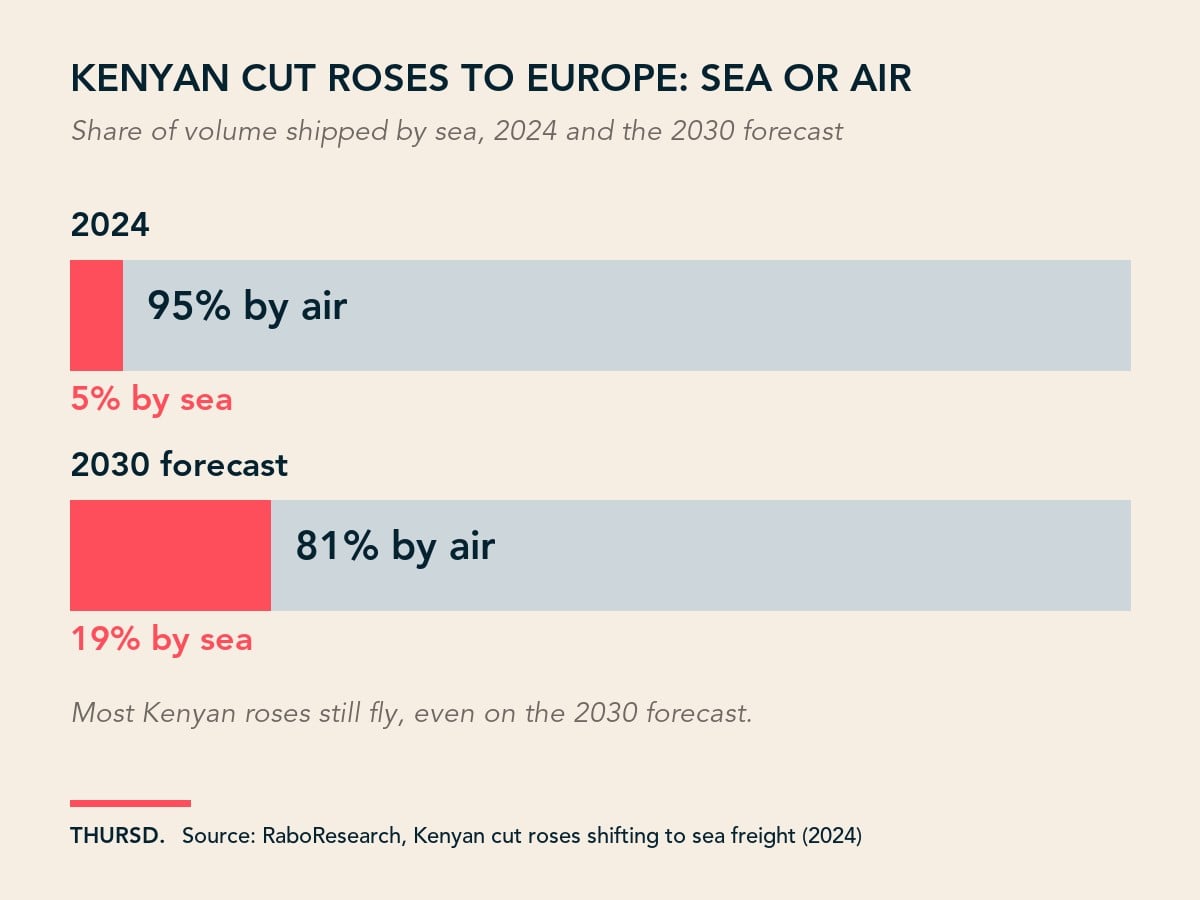
So nineteen in twenty Kenyan roses for Europe still flew in 2024, and on the 2030 forecast it is still about four in five. Van Achterberg's caveat holds: sea freight is not a switch a farm flips. It is a per-variety result, and sometimes a per-color result within the same variety.
The Same Rule, Read Differently in Two Countries
Certification is where the conversation turns uncomfortable, because the rules themselves are not the problem. Van der Zwan, who works on certification and sustainability, points at the gap between two legal frameworks rather than at the farms.
"From a certifying perspective you also certify a product. So suppose I certify in the Netherlands, or I issue a GAP certificate. Then you check what may be used in that country. But you do that in Ethiopia too. So they do nothing above the law. Or nothing that is not allowed by law. It is just very strange that we here in Europe have a norm, and that they do have products that go beyond that norm, or do not even fit in it, because that product is not allowed here in the EU. And that you can still import that," he says.
He would draw the line at the border.
"Level it. Make sure those products are not allowed on those flowers either. I know not everyone will go along with that, but it is the fairest way. Even though they do nothing illegal, at least you make it equal within Europe," he says.
Read that carefully, because it is not an accusation. An East African farm that follows its national rules is compliant, in the same way a Dutch farm following Dutch rules is compliant. Van der Zwan has no quarrel with the European norm. His point is that it stops at the border. Cut flowers, unlike food, carry no EU residue limits, so a product a Dutch grower may not use can still arrive on an imported stem.
The sector has built its own machinery for this. GlobalG.A.P covers production and adds GRASP for worker welfare and pay; the Kenya Flower Council runs its own scheme covering the same ground in one place; and the Floriculture Sustainability Initiative, whose members represent more than half of global market volume, sets the shared bar. What none of them can do is harmonize two national pesticide lists.
Retailers come closest. Van der Zwan worked in the flower trade for British retail from 2006 to 2016, where a supermarket would refuse products that were allowed in the Netherlands. As he puts it, a supermarket draws one line for all its suppliers, and in many cases that line sits above the law.
From Nairobi, the same subject looks different again. Clement Tulezi, CEO of the Kenya Flower Council, has said in a Thursd interview that sustainability is one of the sector's real challenges, but not for the reason outsiders assume.
"This is usually about the perception of some individuals, perhaps, holding the belief that flower production isn't up to the required standards when it comes to sustainability. This isn't correct. The truth is that our growers observe the most optimal sustainability standards," he says.
He puts the heavier burdens elsewhere: unpredictable local taxes and levies, and tariff and non-tariff barriers that make some export markets hard to reach. Those are the costs that decide how much of a stem's value stays in the country, and no certificate addresses them.
Tirop names the same pressures from the farm side and says where she thinks the answer lies.
That is a policy question, and it is one the sector cannot solve farm by farm.
The Question the Trade Keeps Circling
Wouter de Vries built and sold specialty rose businesses and now runs Belle Epoque. His position on Africa is commercial before it is moral, which is why it lands.
"Money may be earned. Money must also be earned in the country itself. And there we do have to watch out that the money keeps being earned in Africa," he says.
That is the whole argument in three sentences. Not charity, but retained value. And it is the one place where the sector's own measurements are least comfortable. Fairtrade's living wage risk map puts the living wage gap for Kenyan flower workers at 48 percent. Movement is happening: in October 2016, a collective bargaining agreement between the Agricultural Employers' Association and the Central Organization of Trade Unions (COTU) gave more than 60,000 Kenyan flower farm workers a 25 percent pay rise, and Fairtrade is lifting the floor wage on its certified flower farms in steps to the World Bank's international poverty line of USD 3.00 per person per day, which it reaches on 1 March 2027.
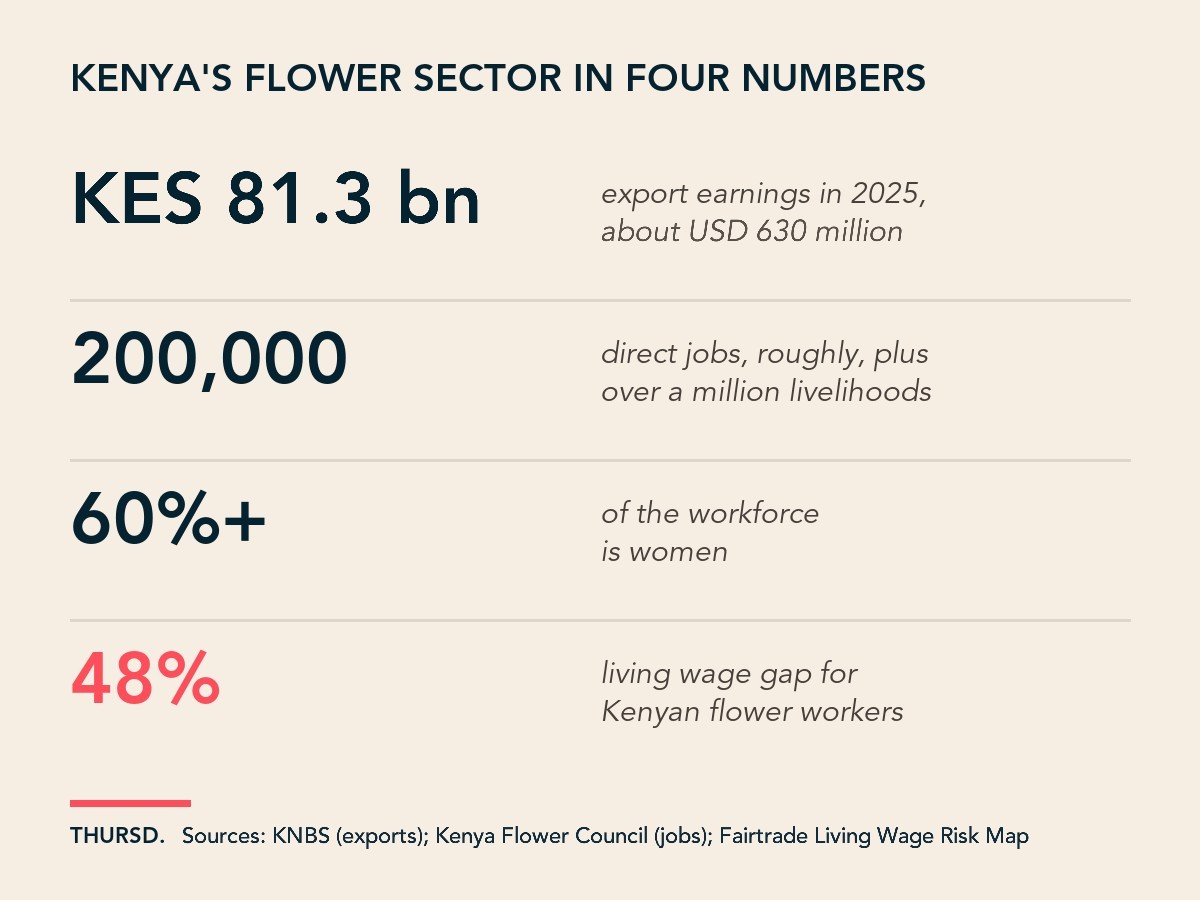
Two things follow from that, and they are worth keeping apart. A gap measured across an industry says nothing about what any individual farm pays. But when an industry earns about USD 630 million from exports in a year, and Fairtrade measures a 48 percent living wage gap among its workers, De Vries's question has been answered with a number. A chain that pays for stems while the margin accumulates elsewhere may be legal, efficient, and still hollow at the origin.
The alternative is not to buy less from East Africa. Thursd has argued the opposite case for why you should buy flowers grown in Ethiopia. The alternative is to make sure the growing region keeps enough of what the flower is finally worth.
What This Means for Your Buying
For a florist or a buyer sourcing from East African flower farms, the practical takeaways are small and concrete. Ask which country a specialty variety was grown in this month, because the group behind it may have moved it. Ask whether a stem traveled by sea, and if so, which color of that variety was tested, since colors of the same variety can behave differently, and remember that the honest answer today is usually that it flew. Treat certification as evidence about a national norm rather than a global one, and ask which scheme, because GRASP and the KFC code cover pay and welfare where a plain GAP certificate does not. And when a supplier can tell you how many people the farm employs and what it pays them, that number is usually a sign the rest of the story is available too.
Flowers follow the climate, and money follows the flowers. The first of those movements finished twenty years ago. The second one is still being decided, week by week, in the orders that leave for Nairobi and Addis Ababa.
Sources: Royal FloraHolland in AIPH FloraCulture (13 February 2024); CBS, Statistics Netherlands (12 February 2016); RaboResearch on Kenyan roses shifting to sea freight (8 August 2024); Flying Swans on the first reefer container by rail in Kenya (19 March 2025); Kenya Flower Council and Agriculture and Food Authority figures in Bizcommunity (27 May 2026); Kenya National Bureau of Statistics, Economic Survey 2026 (April 2026, Agriculture and Food Authority data; dollar figure converted by Thursd at the Central Bank of Kenya's 2025 average of KES 129.30); The Standard (24 September 2026); Floriculture Sustainability Initiative, Annual Report 2025; Agritechmea on EHPEA (16 February 2026); Fairtrade Risk Map, living wage; The Standard on the 2016 flower farm wage agreement (21 October 2016); Fairtrade on flower worker wage increases; World Bank poverty lines (updated June 2025).
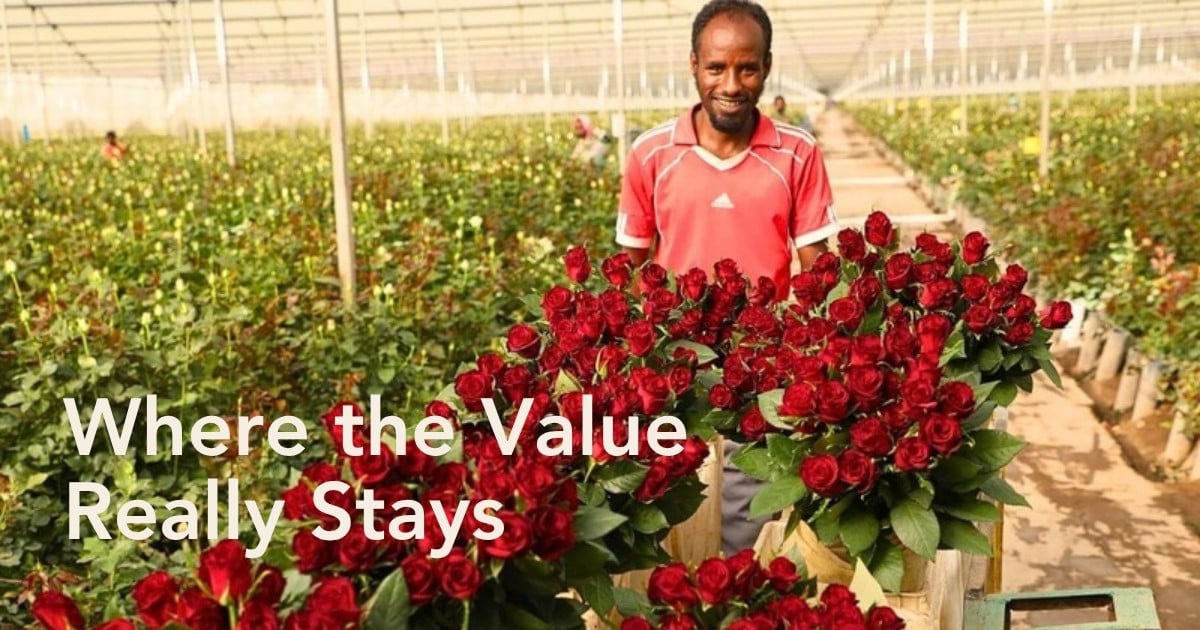
Featured image: Kenyan roses packed for export, photo by KEPHIS. Header image: rose harvest on an Ethiopian flower farm, photo by EHPEA. Portraits of Arno van der Zwan, Helena van Achterberg, and Wouter de Vries: Goede Bloemen en Goede Planten podcast. Portrait of Clement Tulezi courtesy of the Kenya Flower Council. Portrait of Yvonne Tirop from her Thursd 10 Questions interview. Charts: Thursd.