Everyone in the trade knows one flower poem, and it is the one on the Valentine's card. Thursd traced that quatrain back to 1590 earlier this year, and Marcel de Romph put the reason for this follow-up in one line there: "Useful if you sell flowers in February and are tired of writing the same four lines on a card." There are better poems about flowers, and most of them never leave the classroom.
Here are twenty flower poems worth knowing, in two halves. The first ten were written between 1648 and 1917, are out of copyright everywhere, and are printed in full below, so a florist can actually use them: on the card in a bouquet, on the shop window, in a newsletter. The second ten are newer or too long, and appear by title, poet, and year, with a line on why they matter. For those, you buy the book.
One pattern shows up fast. Poets are drawn to the same flowers the trade sells most: roses, daffodils, tulips, peonies, poppies, lilacs. And nearly every poem here is about the thing a florist sells every day and never says out loud: the flower does not last.
Ten Flower Poems in the Public Domain, Printed in Full
1. To Daffodils, Robert Herrick (1648)
From Hesperides, Herrick's collected poems. The oldest poem on the list and the most florist-minded: twenty lines about a stem that fades before the day is out. It fits a folded card if you print small.
Fair daffodils, we weep to see
You haste away so soon;
As yet the early-rising sun
Has not attain'd his noon.
Stay, stay,
Until the hasting day
Has run
But to the evensong;
And, having prayed together, we
Will go with you along.We have short time to stay, as you,
We have as short a spring;
As quick a growth to meet decay,
As you, or anything.
We die,
As your hours do, and dry
Away,
Like to the summer's rain;
Or as the pearls of morning's dew,
Ne'er to be found again.
2. Ah! Sun-flower, William Blake (1794)
Eight lines from Songs of Experience. The sunflower turns after the sun all day and never gets there, and Blake makes that longing the whole point. Why everyone else reads the sunflower as happy is a separate question. Blake's own spelling and punctuation are kept.
Ah Sun-flower! weary of time,
Who countest the steps of the Sun:
Seeking after that sweet golden clime
Where the travellers journey is done.Where the Youth pined away with desire,
And the pale Virgin shrouded in snow:
Arise from their graves and aspire,
Where my Sun-flower wishes to go.
3. The Sick Rose, William Blake (1794)
Also Songs of Experience, also eight lines, and the darkest poem here: a rose destroyed from the inside by something that flew in at night. A rose grower who has lost a crop to a pest nobody saw coming will not need it explained.
O Rose thou art sick.
The invisible worm,
That flies in the night
In the howling storm:Has found out thy bed
Of crimson joy:
And his dark secret love
Does thy life destroy.
4. A Red, Red Rose, Robert Burns (1794)
Burns worked it up from older Scottish songs he collected, and it has been sung at least as often as it has been read. The opening comparison is the most quoted in the language and a large part of the reason a red rose says what it says. It is in Scots: luve is love, bonie is bonny, gang is go, weel is well.
O, my luve's like a red, red rose,
That's newly sprung in June:
O, my luve's like the melodie
That's sweetly play'd in tune.As fair art thou, my bonie lass,
So deep in luve am I:
And I will luve thee still, my dear,
Till a' the seas gang dry.Till a' the seas gang dry, my dear,
And the rocks melt wi' the sun:
I will luve thee still, my dear,
While the sands o' life shall run.And fare thee weel, my only luve,
And fare thee weel awhile!
And I will come again, my luve,
Tho' it were ten thousand mile.
5. I Wandered Lonely as a Cloud, William Wordsworth (1807)
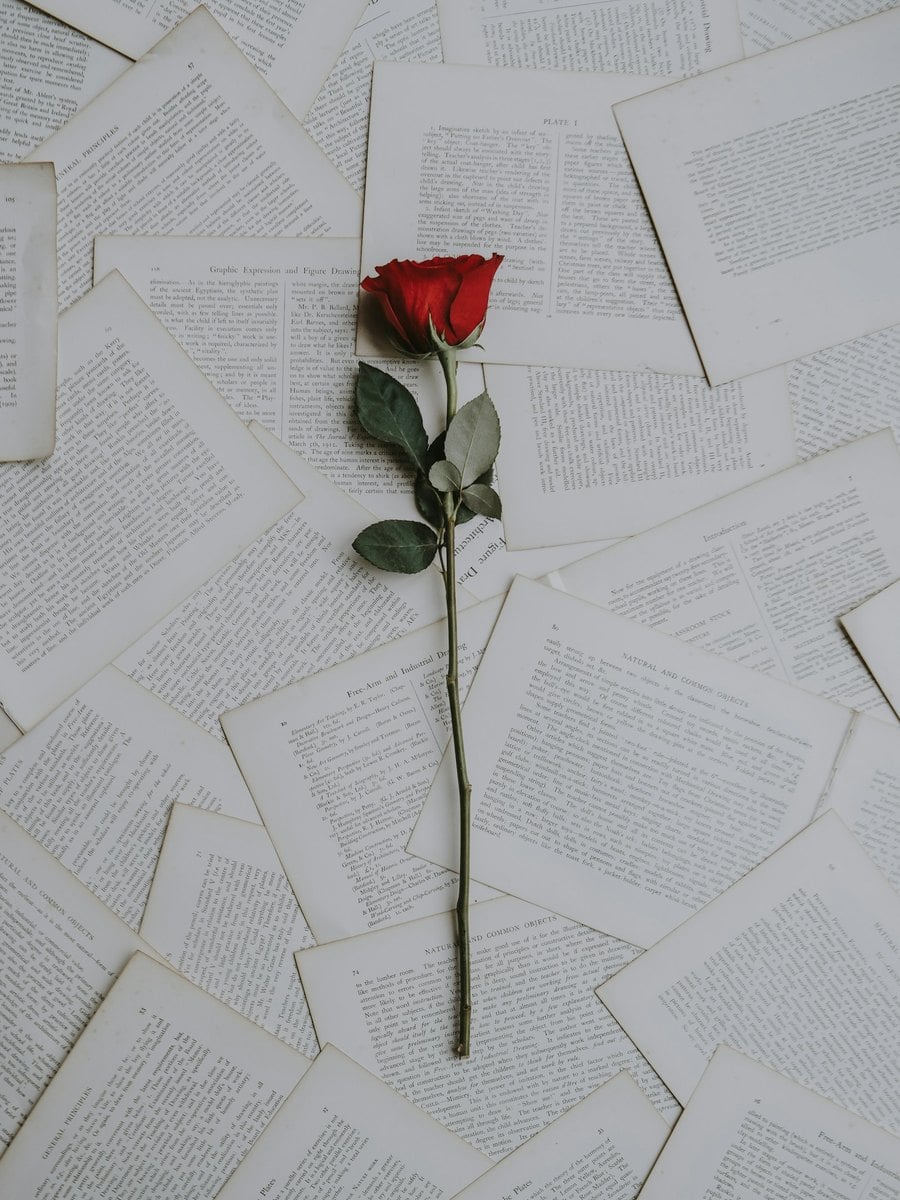
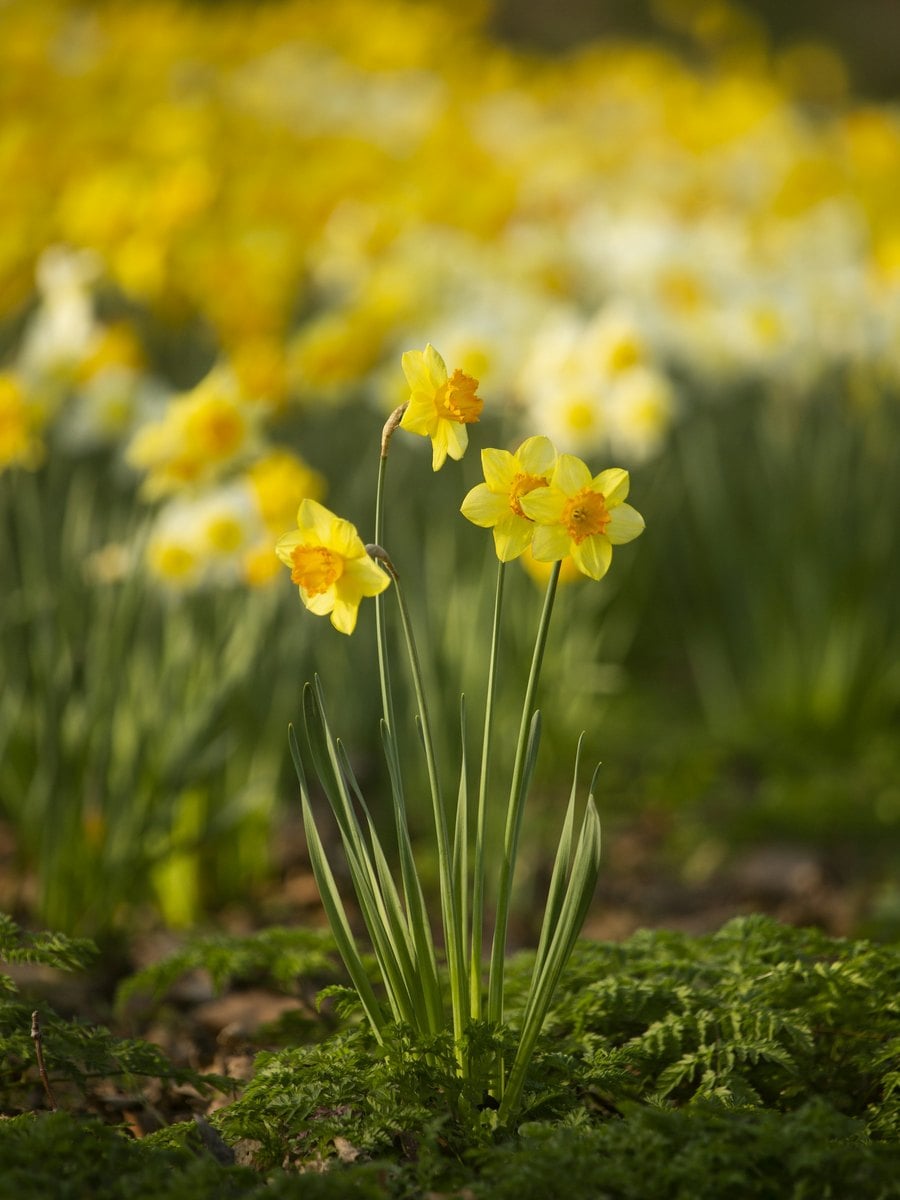
The daffodil poem. Wordsworth and his sister Dorothy came across the flowers on a walk along Ullswater on 15 April 1802; Dorothy wrote them into her journal that evening, and William published the poem in 1807, adding the second stanza in 1815. This is the 1815 text, with his capitals and his spelling of show. The daffodils were wild Narcissus pseudonarcissus, smaller than anything in your bucket; the cut trade sells Tazetta types such as Narcissus Grand Soleil d'Or and Narcissus Paperwhite next to the trumpet kinds. What the daffodil has meant since owes a great deal to these 24 lines.
I wandered lonely as a Cloud
That floats on high o'er Vales and Hills,
When all at once I saw a crowd,
A host of golden Daffodils;
Beside the Lake, beneath the trees,
Fluttering and dancing in the breeze.Continuous as the stars that shine
And twinkle on the milky way,
They stretched in never-ending line
Along the margin of a bay:
Ten thousand saw I at a glance,
Tossing their heads in sprightly dance.The waves beside them danced, but they
Out-did the sparkling waves in glee:—
A Poet could not but be gay
In such a jocund company:
I gazed—and gazed—but little thought
What wealth the shew to me had brought:For oft when on my couch I lie
In vacant or in pensive mood,
They flash upon that inward eye
Which is the bliss of solitude,
And then my heart with pleasure fills,
And dances with the Daffodils.
6. The Rhodora, Ralph Waldo Emerson (1834)
Written in 1834, first printed in 1839, and subtitled On Being Asked, Whence Is the Flower. The rhodora is Rhododendron canadense, a small deciduous shrub of the American Northeast that flowers before its leaves come out. Emerson's answer to why a flower bothers to be beautiful where nobody sees it is the line people quote from this poem without knowing where it comes from: beauty is its own excuse for being. The garden Rhododendron is its bigger, showier cousin.
In May, when sea-winds pierced our solitudes,
I found the fresh Rhodora in the woods,
Spreading its leafless blooms in a damp nook,
To please the desert and the sluggish brook.
The purple petals, fallen in the pool,
Made the black water with their beauty gay;
Here might the red-bird come his plumes to cool,
And court the flower that cheapens his array.
Rhodora! if the sages ask thee why
This charm is wasted on the earth and sky,
Tell them, dear, that if eyes were made for seeing,
Then Beauty is its own excuse for being:
Why thou wert there, O rival of the rose!
I never thought to ask, I never knew;
But, in my simple ignorance, suppose
The self-same Power that brought me there brought you.
7. Nobody Knows This Little Rose, Emily Dickinson (1858)
One of only about ten Dickinson poems printed in her lifetime, and she did not send it in herself: the Springfield Daily Republican ran it anonymously on 2 August 1858 after her sister-in-law passed it to the editor. It was written to go with a rose, which makes it the original bouquet card. Twelve lines.
Nobody knows this little rose;
It might a pilgrim be,
Did I not take it from the ways,
And lift it up to thee!Only a bee will miss it;
Only a butterfly,
Hastening from far journey,
On its breast to lie.Only a bird will wonder;
Only a breeze will sigh;
Ah! little rose, how easy
For such as thou to die!
8. Flower in the Crannied Wall, Alfred Tennyson (1869)
Six lines, the shortest poem here and the easiest to print. Tennyson pulls a small flower out of a wall, root and all, and admits he cannot understand it. Any grower who has tried to explain a crop to a banker knows the feeling.
Flower in the crannied wall,
I pluck you out of the crannies,
I hold you here, root and all, in my hand,
Little flower—but if I could understand
What you are, root and all, and all in all,
I should know what God and man is.
9. In Flanders Fields, John McCrae (1915)
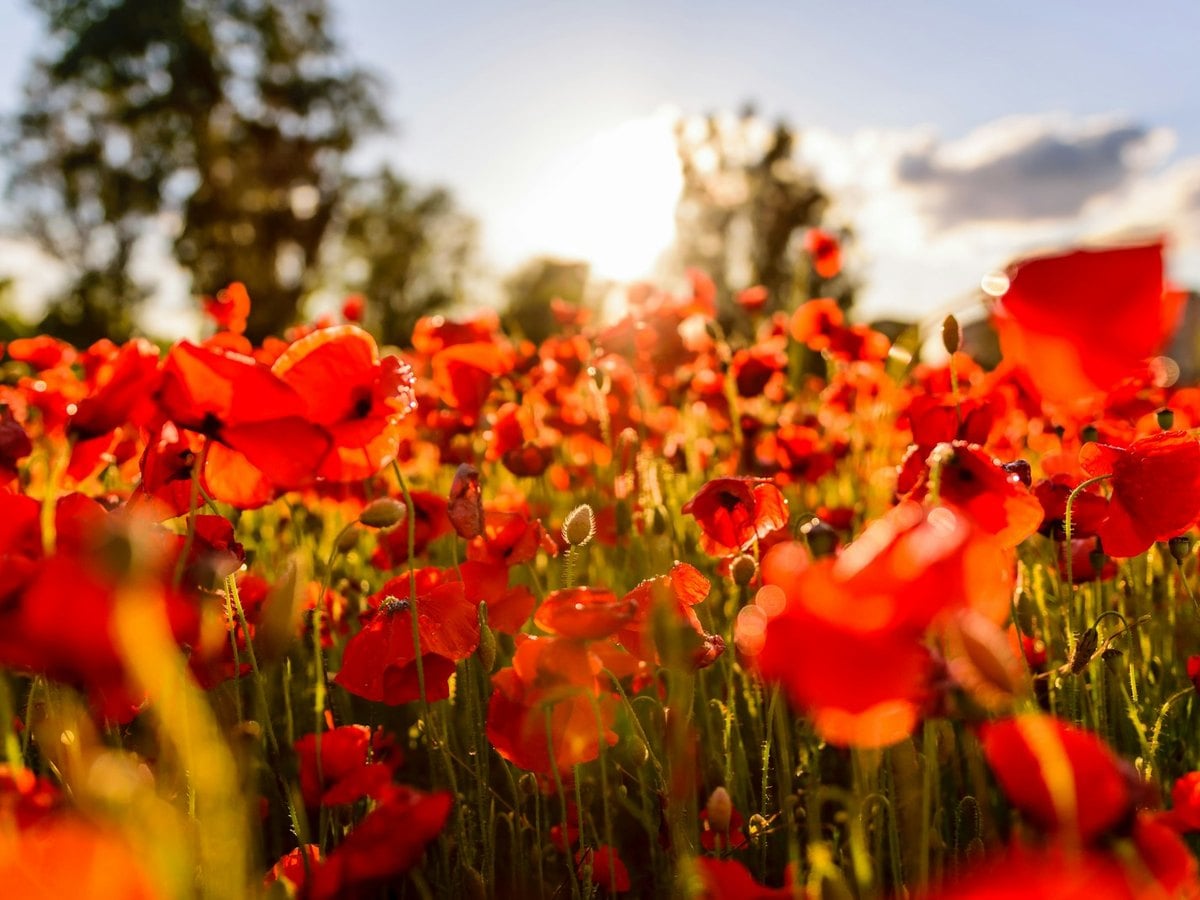
McCrae, a Canadian army doctor, wrote it near Ypres in May 1915 after burying a friend; Punch printed it that December, and McCrae himself died of pneumonia in France in January 1918. It is the reason the corn poppy is worn every November across Britain, Canada and the Commonwealth, and the reason the poppy is the one flower most people wear as a paper replica without a second thought.
In Flanders fields the poppies blow
Between the crosses, row on row,
That mark our place; and in the sky
The larks, still bravely singing, fly
Scarce heard amid the guns below.We are the Dead. Short days ago
We lived, felt dawn, saw sunset glow,
Loved and were loved, and now we lie,
In Flanders fields.Take up our quarrel with the foe:
To you from failing hands we throw
The torch; be yours to hold it high.
If ye break faith with us who die
We shall not sleep, though poppies grow
In Flanders fields.
10. Afternoon on a Hill, Edna St. Vincent Millay (1917)
From Renaissance and Other Poems, Millay's first book, published when she was 25. Twelve lines about touching a hundred flowers and not picking one, an odd poem to hand to a trade that picks them for a living, and a good one for a wildflower bunch. Millay is also the one poet on this list with a Thursd design series to her name: Amsterdam floral designer Katya Hutter built a series of pieces around her poem The End of Summer in 2023: "This poem by Edna St. Vincent Millay inspired me to create these floral pieces," she wrote, and the roses, Lathyrus and Lisianthus did the rest.
I will be the gladdest thing
Under the sun!
I will touch a hundred flowers
And not pick one.I will look at cliffs and clouds
With quiet eyes,
Watch the wind bow down the grass,
And the grass rise.And when lights begin to show
Up from the town,
I will mark which must be mine,
And then start down!
Ten More Flower Poems, by Title Only
Ten more poems about flowers, too long, too recent, or written in a language whose good translations are still under copyright. Buy the book, or quote a line with the poet's name.
11. The Seven Flowers of Autumn, Yamanoue no Okura (8th Century)
Two short poems in the Man'yoshu, Japan's oldest anthology, in which a Nara-era aristocrat counts the flowers of the autumn field on his fingers: bush clover, silver grass, kudzu, wild carnation, golden lace, thoroughwort and bellflower. They started the aki no nanakusa tradition that still runs through Japanese textiles and gardens. The Japanese is thirteen centuries out of copyright; the English translations worth reading are not.
12. When Lilacs Last in the Dooryard Bloom'd, Walt Whitman (1865)
Whitman's elegy for Abraham Lincoln, shot in April 1865 as the lilacs opened, and the reason the lilac has carried mourning in America ever since. Public domain, but more than 200 lines, which is a window display, not a card.
13. Sea Rose, H.D. (1916)
From Sea Garden, Hilda Doolittle's first book: a salt-scarred rose on the shore praised above the fat garden kind. Every florist who has sold a spray rose next to a standard one has had this argument. Published in 1916 and in the public domain in the United States, but H.D. died in 1961, so in Europe it stays under copyright until 2032. Hence not printed.
14. Les Roses, Rainer Maria Rilke (1927)
Two dozen short poems written in French in 1924, published in Bussum, in the Netherlands, in 1927, with a preface by Paul Valéry. Rilke circles the rose from every side, petal by petal. The French is out of copyright; the translations you will actually want are not. Thursd's rose quotes give a taste in English.
15. Bavarian Gentians, D. H. Lawrence (1932)
Written in 1929 as Lawrence was dying, published in Last Poems. The deep blue gentian becomes a torch to light the way down into the underworld. The great poem about a blue flower. Published in 1932, it falls outside the 1931 line, so it appears here by title only.
16. Tulips, Sylvia Plath (1961)
Written in March 1961 in hospital after surgery, published in Ariel in 1965. A get-well bunch of red tulips that the patient does not want: too loud, too alive for the room. Still the best argument in literature for asking before you send red flowers to a hospital bed.
17. The Wild Iris, Louise Glück (1992)
Title poem of the collection that won the Pulitzer Prize in 1993; Glück took the Nobel Prize in 2020. Across the book, the flowers speak in the first person, and the iris opens it, coming back up through the earth after a winter it did not expect to survive.
18. Peonies, Mary Oliver (1992)
From New and Selected Poems, Volume One. Oliver goes out at dawn to watch the peonies open, ants climbing over the buds, and every peony grower reading it will nod at the ants. Widely quoted, for good reason.
19. Flowers, Wendy Cope (1992)
From Serious Concerns. A man who nearly bought flowers and then did not, and the woman who has kept the thought of them for years. Funny, sad, three short stanzas, and the poem florists should read once and then put away.
20. Daffodils, Ted Hughes (1998)
From Birthday Letters, Hughes's late poems to Sylvia Plath. He remembers the two of them picking daffodils in their Devon garden in the early 1960s and selling the bunches to a local shop for a few pence: the economics of a grower-florist, in verse. It answers Wordsworth across two centuries, and it is the only poem here in which somebody sells the flowers.
How to Use Poems About Flowers in a Shop
Card, window, newsletter, social post: the ten poems in the first half can go on any of them, in full, with the poet's name, and nobody can send you an invoice. The rule of thumb is simple. In the United States, anything published before 1931 is public domain, and that line moves forward a year every January. In the European Union and the UK, a work is protected until 70 years after the poet's death. Everything printed above clears both bars. For the second ten, a title and a short quotation with attribution is normal practice; printing the whole poem, or selling it on a card, needs the publisher's permission. Not legal advice, but a good place to start.
Then the practical bit. Match the poem to the stem: Herrick or Hughes for daffodils, Burns or Dickinson for roses, McCrae for poppies in November, Millay for a wildflower bunch, Blake for the customer who wants something that is not sweet. Six to twelve lines fit a gift card; Herrick's twenty need the inside of a folded one. Print the poet's name and the year under it. It costs nothing, and it is the difference between a card and a quotation. If you want lines rather than whole poems about flowers, Thursd's flower quotes do that job.
Sources: full texts from Wikisource, checked on 18 September 2026: Herrick (Hesperides, Pollard edition), Blake, Ah! Sun-flower and The Sick Rose, Burns, Wordsworth (1815), Emerson (1847), Dickinson (1858), Tennyson, McCrae (1919 edition), Millay (1917). Dates for the second ten from the poets' collections named in each entry.
Featured and header image by Yoksel Zok on Unsplash. Body images by Yoksel Zok, Annie Spratt, Diana Parkhouse, and Léonard Cotte on Unsplash.