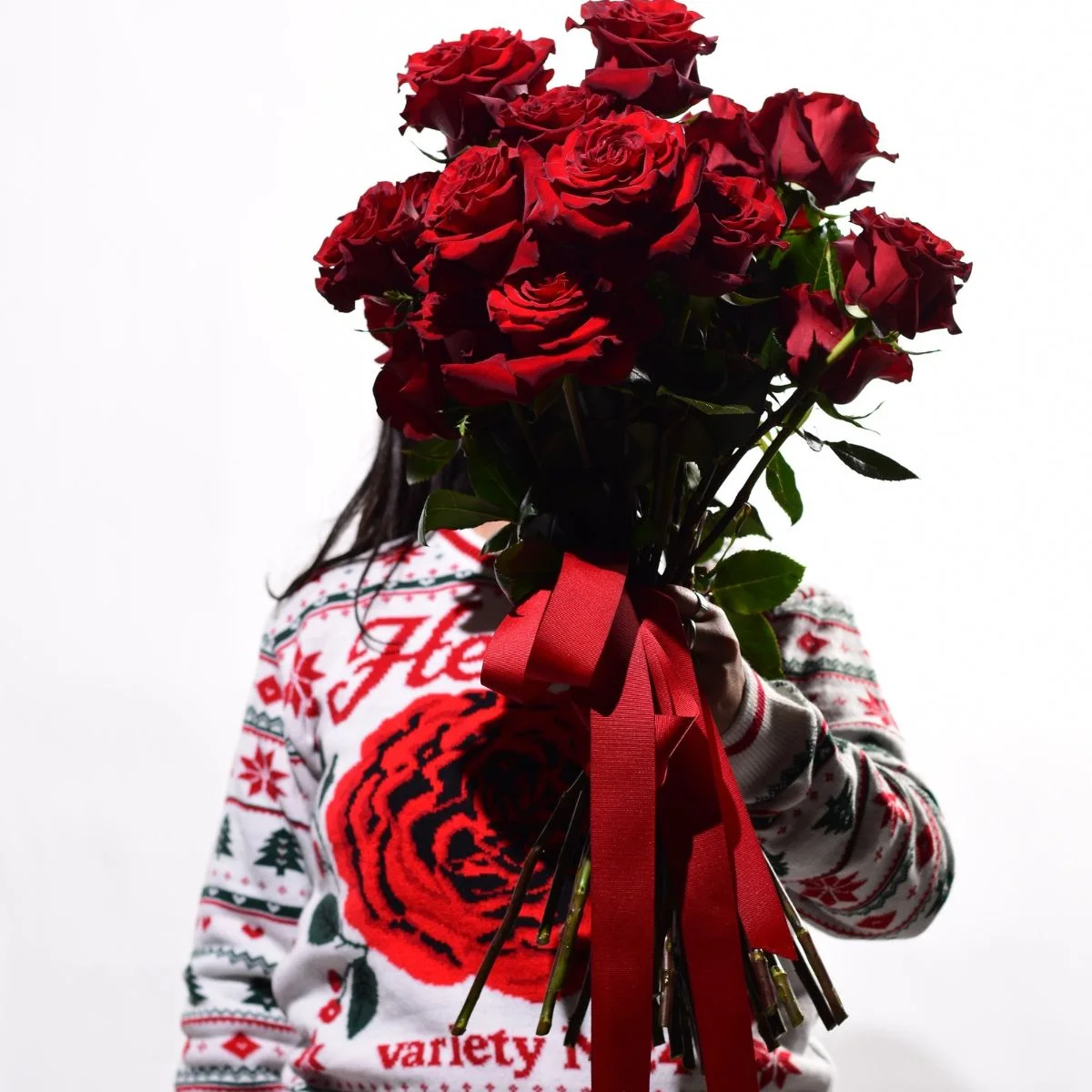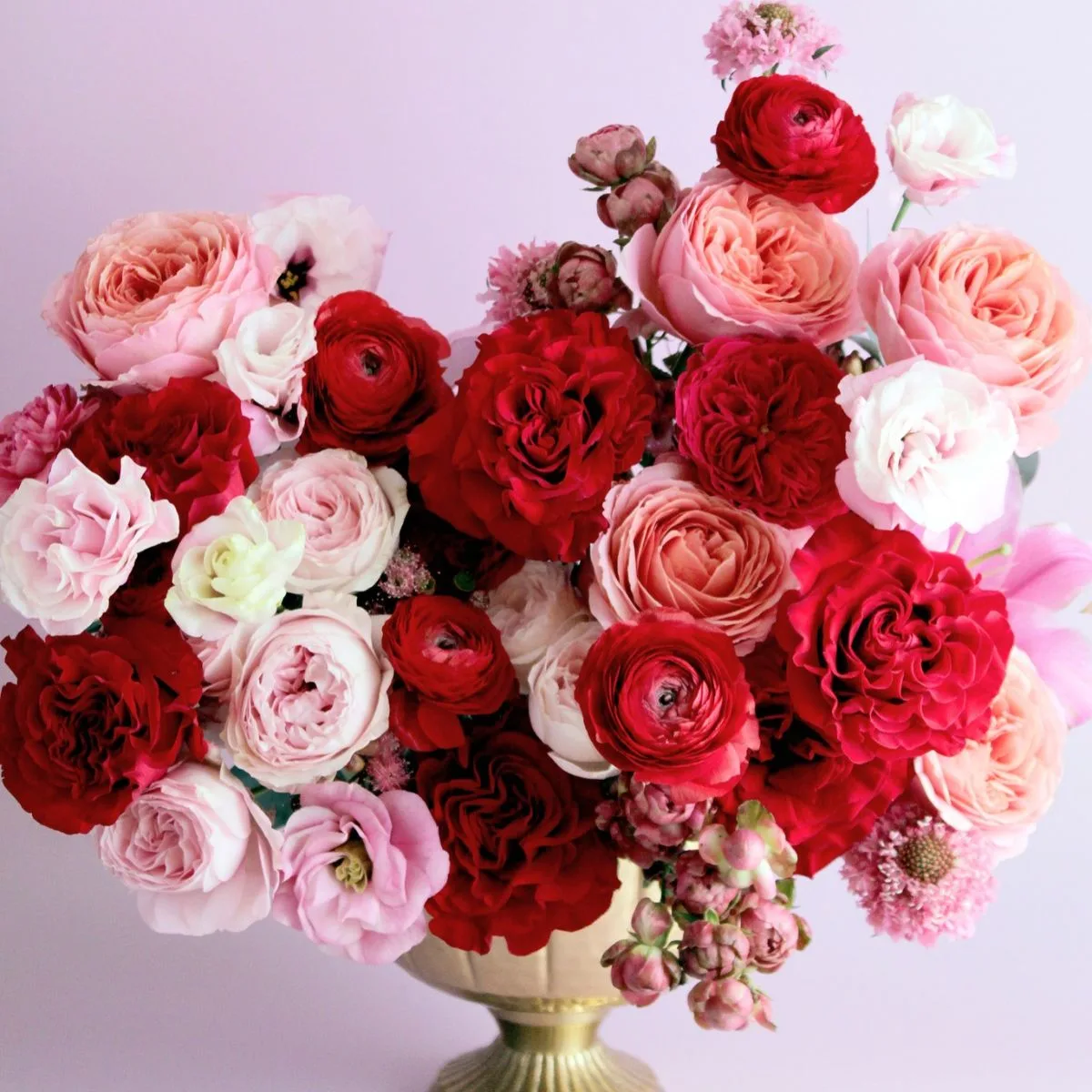
Quicksand, Koko Loko, Playa Blanca, Toffee. Four names that come across the counter more often than the colors they stand for. Nobody asks for a champagne rose anymore. The request is Rose Quicksand. A designer building a caramel palette does not say brown. The word is Toffee. This guide takes the four muted roses florists ask for by name and puts the facts next to each other: who bred them, what they look like when they open, how long they last, and which growers list them on Thursd.
One thing up front, because the names travel faster than the facts: these four are not one kind of rose. Two are greenhouse hybrid teas from Ecuador and Colombia, one is a garden rose a florist gets for a few weeks a year, and one is a white hybrid tea from Kenya and Ecuador that belongs in the same breath because it holds the palette together. Knowing which is which saves a phone call to the wholesaler.
Why Florists Ask for These Roses by Name
The demand is measurable. In the United States alone, "quicksand rose" is searched about 3,400 times a month, "playa blanca rose" 2,400, "koko loko rose" 1,200, and "toffee rose" 1,000, according to Ahrefs in September 2026. Nobody types "beige rose" 3,400 times a month. People type the name they saw on Instagram or heard from a florist, and they want to know what it is and where to get it.

The palette behind the names has a history on Thursd. In November 2020, Scorched Earth was named the floral trend color for 2021, and florist Timo Bolte set that spice-brown apart from the neutrals of the moment: "Designers have recently enjoyed using either rainbow bright colors, or exclusively muted neutrals. Beige, anyone? Scorched Earth is different: it's bold, but also muddy." Five years on, the beige of that joke has its own vocabulary, and the muddy end of it is where Toffee lives.
The roses came first, though. Rose Café Latte, introduced by De Ruiter in 2005, spent years as a hard-to-find item before Kenyan production made it a wedding favorite; the Café Latte feature tells that story. Rose Cappuccino, bred by Rosen Tantau, got its own Thursd feature in 2021 as that season's florist favorite. And in late 2018, a brown rose from Ecuador did what nobody expected: it sold. Toffee turned brown from a defect into a color, as covered in Why Toffee Roses Are the Most Popular Brown Rose.
Reginah Mwangi put the shift in one line in an August 2026 piece on what rose colors really mean: "muted caramel, terracotta, toffee, and antique tones palettes that would once have been dismissed as dull or unfinished are now the ones read as elegant and luxurious." That is the whole reason a florist now asks for a variety rather than a color. The color is a category. The name tells you how the flower opens and how long it holds.
The Four Roses, One by One
Rose Quicksand, the Blending Rose
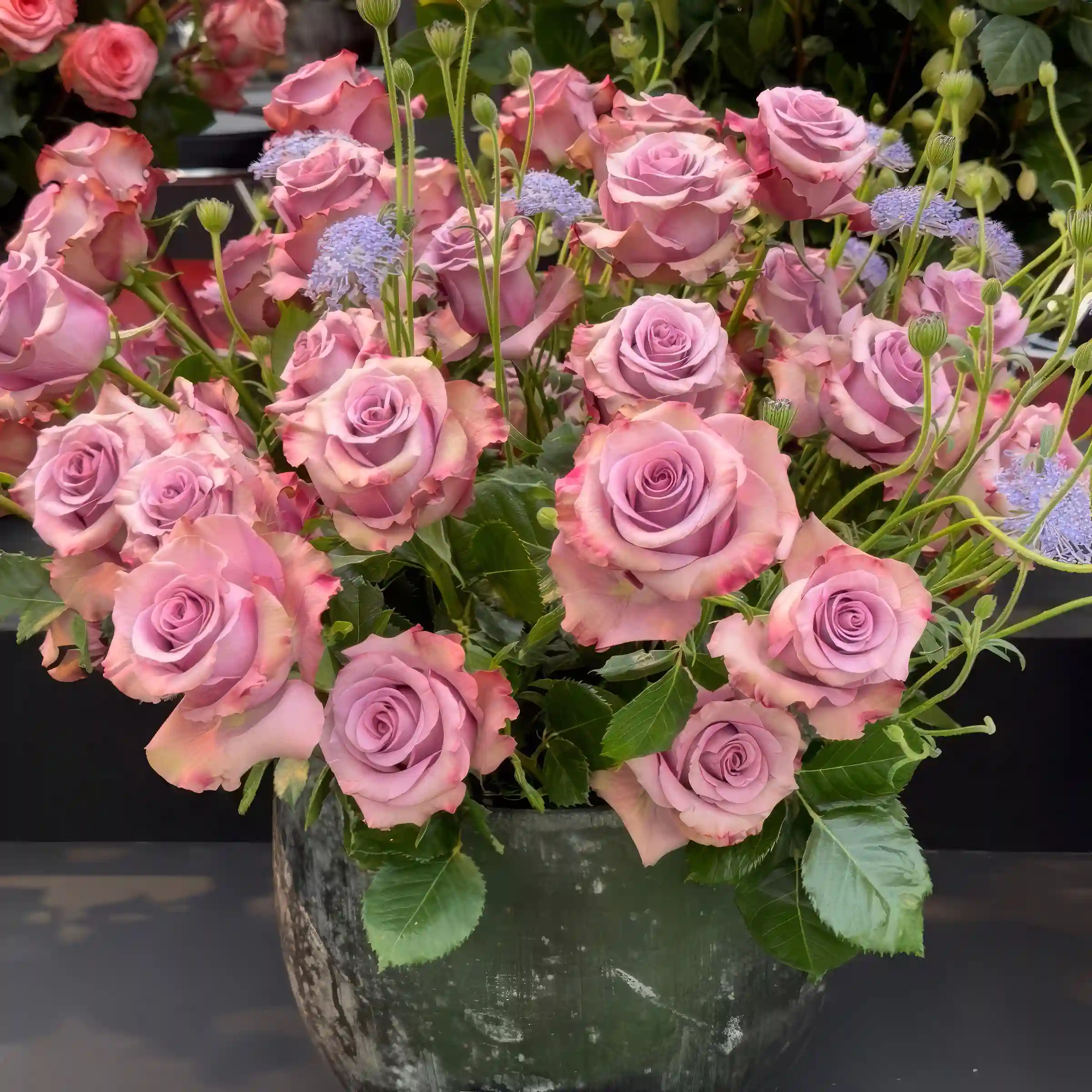
Rose Quicksand is the one on the most wish lists. Thursd's product page describes it as a soft champagne hybrid tea with an almost pearl-like effect, a classic shape "with a touch of attitude," and a real fragrance, and it lists Interplant in the Netherlands as the breeder. Interplant's catalog carries Quicksand as a cream hybrid tea with stems of 60 to 80 centimeters and a vase life of 12 to 14 days. Ecuadorian propagators such as Plantec credit the cross to the breeder Fazari under the denomination Fazjade, with 35 to 40 petals, a detail for the buyers who like to know where a rose comes from.
Florists describe it by what it does in a bouquet rather than by its color. Milena and Asia of Twins Flowers in Poland told Thursd in a 2022 interview why it is in almost every design they make: "Rose Quicksand: it's this beautiful beige color, but it also has tints of pink and purple inside. It looks fragile, but it's strong, opening completely, and long-lasting." Amsterdam designer Katya Hutter used it in an ultra-luxury wedding at Parc Broekhuizen, in a rose cascade for a Guerlain beauty bar: "For this exquisite cascading arrangement, we used luxurious French White O'Hara roses, premium Dutch Café Latte roses, and Quicksand roses." Alexandra Farms, which grows it in Colombia, files it in its sandy-toned collection as the blending rose of the group, and that is the right word: the pink clay wash in the cream sits next to almost anything.
On Thursd, twelve growers list Quicksand among the varieties they have access to: Agrivaldani, EQR, Hoja Verde, Josarflor, Naranjo Roses, Rosaprima, Star Roses, Sunrite Farms, and Tessa in Ecuador, Alexandra Farms in Colombia, and Farm Direct and VIP Roses by Sassen in the Netherlands. That is the widest spread of the four on Thursd, and it shows in how often the name comes up.

Rose Koko Loko, the Garden Rose That Changes Color
Rose Koko Loko is the odd one out, and knowing that is most of the battle. It is a floribunda garden rose, bred by Christian Bédard for Weeks Roses in the United States and introduced in 2012: 30 to 35 petals, a moderate fragrance, and a plant that stays around 90 centimeters (3 feet). The reason people ask for it by name is the color change. The bud opens milky chocolate and finishes a soft lavender, so one stem can show two colors on the same day. Thursd's product page puts it plainly: "Don't expect strong stems or a compact, filled center. It's a bit crazy and nice and wild." It also gives the honest vase life: about five days.
That makes Koko Loko a seasonal item rather than a year-round import. The Thursd product page lists two growers with access: Grace Rose Farm in the United States and VIP Roses by Sassen in the Netherlands. Grace Rose Farm's own site offers Koko Loko as a rose bush, potted or bare root, and says its bouquets are grown in its greenhouses in Colombia, so for cut stems, check with the grower first. The dusty rose feature filed Koko Loko under that color family for a reason: at the lavender end, it is the closest a rose gets to dusty rose without dye. If a customer brings a Koko Loko photo in January, this is the rose you talk about substitutions for.
In the United States, garden roses also come through Florabundance, a wholesaler in Carpinteria, California, that supplies florists across the country, and through Garden Roses Direct, the Florabundance company that ships garden roses wholesale, direct from the farm. Neither site lists Koko Loko at the moment, but Florabundance lists Quicksand, Toffee, and Playa Blanca, the last under the name White Beach.

Rose Playa Blanca, the White That Holds the Palette
Strictly, Rose Playa Blanca is not muted at all. It is a bright white hybrid tea with a soft ivory heart, and it belongs in this guide because it is the white florists put next to Quicksand and Toffee: a clean base that lets caramel and champagne read as color instead of as dirt. It was bred by Genviv in Ecuador, a breeding house that Esmeralda Farms acquired in February 2022, and in Kenya, it is represented by De Ruiter East Africa. Thursd has no product page for it yet.
The Kenyan story is the best documented. Porini Flowers, the sister farm of Isinya Roses, grows it at 2,865 meters, which its Thursd page calls the only rose farm in Kenya at that altitude, and above the 2,400 meters De Ruiter recommends for the variety. The result is heads of 5 to 6 centimeters on stems of 50 to 80 centimeters. Rosemary Kimunya visited the farm for Thursd in late 2024, took stems home, and found them hardy and long-lasting in the vase, with the petals curling into a soft ivory as the flower opens fully, the quality florists mention first. In Ecuador, Rosaprima and Mystic Flowers have shown it in designs on Thursd; Matina Flowers in Colombia lists it among its varieties, and Fontana brought it from Kenya to IFTF 2025. Esmeralda's own listing gives it 10 to 14 days in the vase.

Rose Toffee, the Brown Rose That Sells
Rose Toffee is the newest of the four and the one with the clearest origin. It was bred by Brown Breeding in Puembo, Ecuador, from a cross made in 2010 and reached the market in late 2018. EcoRoses in Machachi still lists it among its exclusive varieties. The breeder gives a head of about 5.5 centimeters (2.2 inches), 32 petals, and a vase life of 14 days, and EcoRoses cuts it at 50 to 70 centimeters (20 to 28 inches).
The color runs from caramel to burnt orange and gets browner as the flower opens, and it opens wide. On the Thursd product page, four growers list it: BellaRosa, Greenrose in Cayambe at 3,000 meters, and Hoja Verde in Ecuador, plus Farm Direct in the Netherlands. The 2024 piece on why Toffee became the most popular brown rose counted more than 10,000 Instagram hashtags at the time. Since then, it has turned up on Thursd in Thanksgiving tables, in the most coveted wedding flowers, and in the Crimson Nocturne pairings, each time as the caramel note a modern palette takes without a fight.

Side by Side: Breeder, Color, and Vase Life
| Variety | Color and shape | Size and vase life |
|---|---|---|
| Quicksand Interplant catalog; cross-credited to Fazari |
Champagne cream with a pink clay wash, hybrid tea, spiral center, fragrant | 60 to 80 cm, 35 to 40 petals, 12 to 14 days |
| Koko Loko Weeks Roses, Christian Bédard, 2012 |
Milky chocolate bud opening to lavender, floribunda garden rose, open center | Garden stems, 30 to 35 petals, about 5 days, seasonal |
| Playa Blanca Genviv, Ecuador (Esmeralda since 2022); De Ruiter East Africa in Kenya |
Bright white with an ivory heart, hybrid tea, opens fully in the vase | 5 to 6 cm heads, 50 to 80 cm, 10 to 14 days |
| Toffee Brown Breeding, Ecuador, 2018 |
Caramel to burnt orange, browner as it opens, hybrid tea, opens wide | 5.5 cm heads, 32 petals, 50 to 70 cm, 14 days |
What This Means at the Counter
Three practical things. First, ask by name and check the origin. A Quicksand from Ecuador and a Quicksand from Colombia are the same variety at different altitudes, and head size follows altitude, as the Porini story with Playa Blanca shows. Second, use the Thursd product pages the way they are built: each one lists the growers and traders with access to that variety, so a name on a wish list becomes a supplier in two clicks. Third, treat Koko Loko as a season, not a stock item, and sell it that way: a few weeks of garden roses with a color that shifts on the table is a story, and a story is easier to price than a substitute.
Pairing is where the names earn their keep. Milena and Asia built an entire wedding on Quicksand and Gypsophila. Katya Hutter put Quicksand between White O'Hara and Café Latte. Toffee sits with white orchids in bridal work and with Chrysanthemums and eucalyptus on an autumn table. And when the whole thing goes brown on you, Playa Blanca is the white that brings it back.
Care is the same across the four and is on every product page: a clean vase, flower food, a fresh cut at an angle, no leaves under the waterline, and no fruit bowl next to the vase, because ethylene finishes a rose faster than any of them deserve.
The four names will not stay four. Every season, a wholesaler's list gains a new variety that florists start asking for the way they now ask for Quicksand. When that happens, the test is the same: who bred it, how does it open, how long does it hold, and who grows it. Thursd's product pages exist to answer exactly that, one rose at a time.
Sources outside Thursd: Interplant catalog, Quicksand; Plantec, Quicksand (breeder Fazari, denomination Fazjade); Weeks Roses, Koko Loko; Grace Rose Farm, Koko Loko rose bush; Florabundance listings for Quicksand, Toffee, and White Beach (Playa Blanca); Flower.Style on Esmeralda Farms acquiring Genviv, March 2022; Esmeralda Farms, Playa Blanca; Brown Breeding, Toffee-BB variety sheet (archived copy); EcoRoses, Toffee; Ahrefs US search volumes, September 2026.
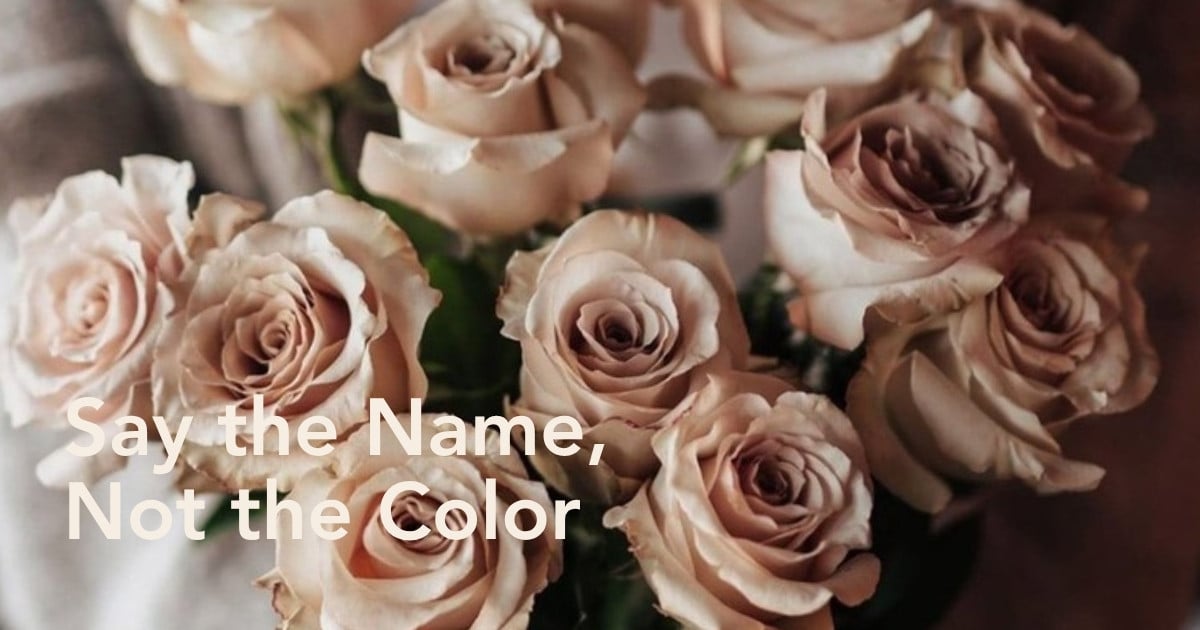
Feature image: Rose Quicksand, Thursd product page media. Header image: the same Rose Quicksand bunch on the Thursd header template.