In February, a clump of hellebores can be the only thing in flower in a shady corner of the garden. The stems push up through the mulch, sometimes through snow, and the nodding flowers are still going when the daffodils open. This guide explains the types of hellebores, starting with the Lenten rose. It covers hellebore care in the garden and in pots, and it ends with the one habit that keeps cut stems from wilting.
Part of the reason they last so long is hidden in the flower. What look like petals are sepals, and a hellebore keeps them for weeks after the flower is pollinated, which is why a Lenten rose stays in color for two months or more and slowly turns green. The same ripening is what florists count on: a stem cut once the seed pod starts to swell outlasts a freshly opened one.
Two questions come up before anyone plants one: are hellebores poisonous, and are hellebores deer resistant? Both get a straight answer below. The care advice comes from university extension services, the RHS, and the ASPCA, all listed at the end.

What Is a Hellebore?
Hellebores belong to Helleborus, a small genus of about 20 species native to Europe and Asia, in the buttercup family, the Ranunculaceae, according to Wisconsin Horticulture. Despite the common names, they are not roses at all. Many are evergreen perennials with leathery, deeply divided leaves, and they flower in winter or early spring, when little else in the garden does.
Look closely at a flower, and you can see why it lasts. The five colored parts that look like petals are sepals. The true petals have turned into a ring of small, tubular nectaries around the stamens, Wisconsin Horticulture explains, and after pollination, the petals and stamens drop while the sepals stay on for one to two months or more. Clemson Cooperative Extension gives them two to three months. Many flowers turn greener as they age, and dark purple ones often fade to a pastel pink.

When Do Hellebores Bloom?
That depends on the type and on your winter. The Lenten rose, the hellebore most gardens grow, flowers from late winter into spring. Its buds form the summer before, and the flower stems push up in late winter. In Wisconsin, they open in early spring with the daffodils and tulips, while Clemson sees them flower in winter and early spring in South Carolina, which puts them among the first flowers of spring. The Christmas rose comes earlier, around Christmas in warmer regions and in early spring in cooler ones, according to NC State Extension. The stinking and Corsican hellebores flower from February to April. Once a Lenten rose is open, Clemson counts eight to ten weeks of flowering and fruiting.
Types of Hellebores
Gardeners and growers mostly deal with a handful of groups. The RHS sorts them into hellebores that are easy to grow and hellebores that need more care, and it puts the Christmas rose in the second group. Here is how to tell them apart.
The Lenten Rose (Helleborus × hybridus)
The RHS calls these hybrids the most popular hellebores and the easiest to grow. Lenten roses are hybrids of at least nine species, grouped as Helleborus × hybridus, although the trade often sells them as Helleborus orientalis, which is really a separate species, according to Wisconsin Horticulture. The name comes from the season: Clemson explains that in some parts of the world, they flower during Lent.
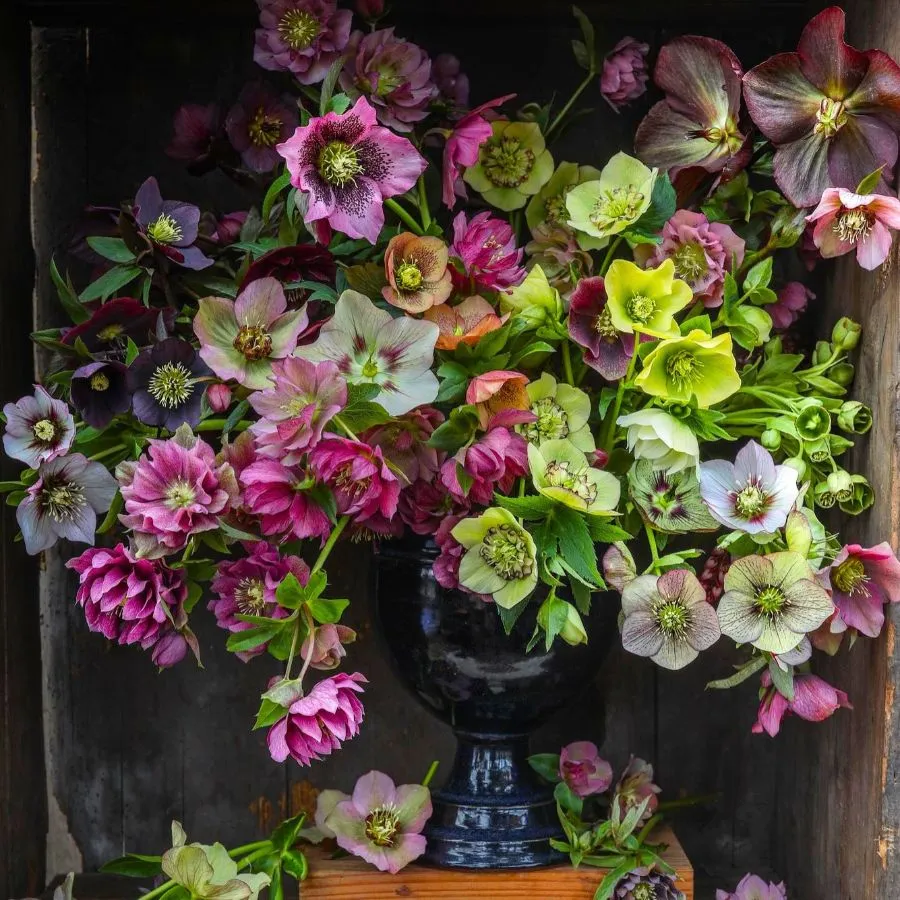
The range is wide. Flowers run from pure white through pink, red, yellow, and green to a plum so dark it looks black, and they can be single, semi-double, double, or anemone-centered, with a ruffled ring in the middle. Many carry spots or dark veins inside, and picotee types have a thin edge in a darker color. Most face down, so plant them where you can look up into them, such as on a slope above a path, as Wisconsin Horticulture suggests.
Breeders sell them in named series, and many nurseries hand-pollinate in greenhouses so insects cannot cross their plants, Clemson notes. In the Netherlands, Nachtvlinder in Ter Aar, the breeder behind the Double Ellen hellebores, selects continuously and pollinates by hand, and Montis in Moerkapelle grows Helleborus, Helleborus orientalis among them. French breeder Morel, known for its Cyclamen, has a Lenten rose range as well, with single and double flowers.

The Christmas Rose (Helleborus niger)
The Christmas rose is a species of its own, Helleborus niger, from the mountains and open woods of central and southern Europe. It is shorter than the Lenten rose, at 23 to 30 cm (9 to 12 in), with white flowers that can blush pink, and it flowers earlier, often in December where winters are mild. It is also fussier: the RHS says it needs excellent drainage in winter and suggests growing it in a container. Growers raise it from seed as a pot plant for the holidays, in selections such as Advent Star from Florensis and Christmas Carol from Syngenta Flowers, and Thursd covers the Christmas rose in winter on a page of its own.
Breeders select the Christmas rose for that one moment. French breeder Morel is not after an ever earlier plant, says Héloïse Morel, its product manager: "We select for a flowering window in November and December," so the plant is at its best when people want it. Shape comes next. Morel looks for a branched plant that stays compact but open in the center, a "seeing through" habit that lets light and air reach the heart of the plant, and the target is a plant as tall as its pot. The leaves should be dark green with rounded leaflets, and the flowers pure white, well open, and held slightly upright rather than drooping, so they face the person looking at them.
A Christmas rose bought in flower is not a houseplant. "It's a hardy garden perennial that has simply been brought indoors for the festive season," Héloïse Morel says, and the sooner it goes back outside, the better its chances of flowering again. While it flowers, keep it in the coolest bright spot in the house, away from radiators, and water when the surface of the potting mix feels dry, without letting the pot stand in water. In January, once flowering is over or in a mild spell, give it a week or so in a sheltered, unheated place, such as a porch, so it can get used to the cold. Then plant it in the garden or in a larger, deep pot, at the same depth as before, in rich soil that drains well, ideally under a deciduous shrub for winter light and summer shade. It may need a season to settle in, but a well-placed Christmas rose gets better year after year.

Stem-Bearing Hellebores: Stinking and Corsican
A few hellebores carry their flowers in clusters on top of leafy stems. The stinking hellebore, Helleborus foetidus, grows wild from western Europe to Italy and northern Morocco and is native to the UK. It has pale green, bell-shaped flowers, often rimmed in purple, and the RHS points out that it only smells when you crush the leaves. The Corsican hellebore, Helleborus argutifolius, comes from Corsica and Sardinia and has sharply toothed leaves and clusters of 15 to 30 pale green flowers, according to NC State Extension. Helleborus × sternii has pale green flowers tinted with pink.
These like more sun than most hellebores, except the stinking hellebore, which takes deeper shade, and they tend to be short-lived: NC State gives the stinking and Corsican hellebores four to five years. They seed themselves around freely, though, the RHS notes. For florists, An Theunynck writes on Thursd that their fresh green flowers are easy to use in green and white arrangements, and she has one rule for cutting them: "do not cut the trusses when they are just starting to bloom, cut them when the plants have finished flowering."

Crosses Between Species and the Newer Series
Breeders also cross the species. Helleborus × ericsmithii combines Helleborus × sternii with the Christmas rose, and Helleborus × nigercors pairs the Christmas rose with the Corsican hellebore, the RHS explains. Helleborus × ballardiae is a Christmas rose crossed with Helleborus lividus, according to Wisconsin Horticulture. Some newer lines have marbled leaves, and NC State lists Frostkiss Anna's Red, with rosy red to burgundy flowers. Helleborus Anna's Red, on the market since 2016, was bred to work as a cut flower as well, its Thursd product page notes.
Writing about the Belgian nursery Het Wilgenbroek, An Theunynck notes that crosses such as Candy Love, Snow Love, and Emma keep longer in flower arrangements, and that Candy Love and Emma can take bright sun. Dutch breeder HilverdaFlorist sells its hellebores in series, among them Awesome and Glamour, and Morel adds a large-flowered hybrid range, Blooma.

Hellebores Grown for the Vase
Most hellebores are sold as plants, but cut hellebores are a crop of their own. One of the cut varieties is Magnificent Bells, a HilverdaFlorist variety with greenish-white flowers. Marginpar grows hellebores for the vase in Kenya and Ethiopia, and Westendorp in Klijndijk grows them next to its Delphiniums. Darker cut varieties exist too, such as Helleborus Kissi Royal Maroon, on long, sturdy stems.

Hellebore Care in the Garden and in Pots
Where to Plant Hellebores
Hellebores come from woodland edges, the RHS explains, so think dappled shade. Clemson Cooperative Extension recommends planting Lenten roses under deciduous trees, where they get sun in winter, when they grow, and shade in summer, when they rest, with no more than morning or dappled sun in summer. The farther south you garden, the more shade they need: Wisconsin Horticulture says they grow well in sun in the Midwest but need some shade farther south. NC State Extension adds that bright winter sun, high temperatures, and cold winter winds do them no good.
Soil comes next. Hellebores want rich, well-drained soil with plenty of organic matter, ideally neutral to alkaline, though Clemson says they also grow well in slightly acidic soil. What they cannot stand is wet ground: Clemson writes that they will not tolerate wet soils, and Wisconsin calls them very sensitive to soggy soil.
In a shade border, they pair well with ferns and Hostas, Clemson suggests, and Wisconsin adds Epimedium, Hepatica, and the wood anemone (Anemone nemorosa) for early spring. For more ideas, see the shade garden ideas. The creeping Oregon grape, winter aconite, and snowdrops flower around the same time.
Planting and Watering
Plant from fall to spring, the RHS advises, at the same depth the plant sat in its pot, because hellebores do not like being planted too deep, and space them 35 to 45 cm (14 to 18 in) apart. Mulch with organic matter, leaving a gap around the base of the plant. Water new plants through their first growing season. After that, established clumps are fairly drought tolerant but grow best with steady moisture, according to Wisconsin Horticulture, and Clemson advises watering in a drought, when the leaves droop. Feeding is simple: Clemson calls their needs low, and the RHS says plants in borders seldom need extra food.
Cut Back the Old Leaves in Late Winter
This is the main job of the year. When the new flower stems appear in late winter, cut last year's leaves off at the base, as close to the center of the plant as you can, Clemson advises, and not in fall. The flowers show better, and the old leaves are where hellebore leaf spot, a fungal disease, carries over to the next season, the RHS explains. With Lenten roses, whose flowers grow on separate stems from the leaves, removing all the old foliage in winter or early spring does not weaken the plant.
Keep an eye out for black streaks that follow the veins, stunted new growth, and twisted leaves. That points to hellebore black death, a disease the RHS links to Helleborus net necrosis virus, which aphids probably spread. There is no cure, so dig up the plant and destroy it. Slugs, snails, and leaf miners do only minor damage, according to Clemson.
Seedlings and Dividing
Lenten roses seed themselves around, and the seedlings will not come true to the parent. Clemson says they take at least two years to reach flowering size, and Wisconsin says four or five years from seed. If you would rather not have them, cut off the flower stems before the seed pods open. Established clumps can stay put for 20 years or more and recover slowly from division, according to Wisconsin. If you do divide, the RHS suggests early fall or right after flowering.
How to Care for Hellebores in Pots
Most hellebores are happy in a pot for one winter. The RHS treats them as a temporary winter display: plant them in a container only slightly larger than the nursery pot, in free-draining compost, and move them into the border after they flower in spring. The ones that dislike cold, wet soil, the Christmas rose among them, can stay in a container for good, so you can move them to a sheltered spot in winter.
Pots dry out quickly, so water them regularly and keep them out of summer sun. A plant in a pot has less to draw on than one in the ground, so the RHS suggests feeding it with a balanced liquid fertilizer, or a potassium-rich one such as tomato feed to encourage flowering.
A hellebore bought in flower for the house is a garden plant that has come indoors for a while. Horticulture magazine advises keeping it in as cool and bright a spot as you can, watering sparingly without letting it wilt, keeping water off the leaves, and moving it outside step by step before you plant it in part shade.

Are Hellebores Poisonous?
Yes. All parts of the plant are toxic if eaten, and the name says as much: NC State Extension traces Helleborus to the Greek helein, to injure, and bora, food. The ASPCA lists the Christmas rose, which it also knows as hellebore and Lenten rose, as toxic to dogs, cats, and horses, with drooling, abdominal pain, diarrhea, colic, and depression among the signs. In people, NC State lists a burning mouth and throat, vomiting, and diarrhea, and it notes that the sap can irritate the skin.
So wear gloves when you cut, divide, or tidy the plants, as Wisconsin Horticulture advises, and keep pots out of reach of pets. If a pet has chewed on one, call your vet or an animal poison control center. For homes with animals, Thursd has a list of low-maintenance plants that are safe for dogs and cats, and one of houseplants that are poisonous for dogs.
Are Hellebores Deer Resistant?
As far as any plant is, yes. Rutgers University's list of landscape plants rated by deer resistance puts the Lenten or Christmas rose, Helleborus, in its top category: rarely damaged. Clemson explains why: all parts of the plant are toxic, so deer and rabbits usually leave it alone, and Wisconsin points to the same compounds in the leaves. Rutgers adds that no plant is deer proof and that results depend on local deer numbers and the weather. Slugs are another story, Wisconsin notes, because they eat the flowers.
Cut Hellebores: How to Keep Them From Wilting
Cut hellebores have a reputation. Put a freshly opened flower in a vase, and it can hang its head by the next morning. The fix starts before you cut.
Cut Them Once the Seed Pod Forms
The stage of the flower matters most. The flower farm Floret tells growers to wait for flowers that have dropped their stamens and started to form seed pods, because the more developed the pod, the longer the flower holds. Picked too early, Floret writes, they rarely last more than a day. The same idea runs through Thursd's guide to cutting stages by the growers.
Amy Balsters, the floral educator behind The Floral Coach, says the same on Thursd: "As they go through phases of blooming, reproduction, and seeding, they become more hardy, so cutting them after they have been on the plant for some time tends to bear tougher blooms." She looks for firm, fully hydrated flowers without brown or fungal spots, and when she has to buy stems that still carry pollen, she orders 5 to 10 percent extra.
Variety matters too. Balsters calls the white Winter Bell "a very reliable workhorse" that rarely wilts, while doubles are riskier: "They can be fussy, wilty, and floppy."

Condition the Stems Right Away
When she cuts from the garden, Balsters waters the plants 48 hours ahead or cuts after rain, and she harvests in the cool of the morning. Then the stems go straight into water. Her method: a clean bucket with flower food and a shallow layer of hot, not boiling, water, 2.5 cm (1 in) cut off the stems with clean shears, and the flower heads draped over the rim so the steam does not reach them. Once the water has cooled, the bucket goes into the cooler. If a stem still will not drink, she submerges it completely to revive it.
Growers have their own tricks. Some farmer-florists slit two sides of the stem lengthwise, Floret notes.
Sugar helps as well, as Thursd found when it looked at whether sugar helps flowers last longer. At Ondokuz Mayis University in Turkey, researchers stood Helleborus orientalis stems in a 20% sucrose solution overnight, and the flowers lasted more than two weeks in the vase. For a full florist routine, from storage temperature to ethylene, see Chrysal's care routine for Helleborus.
In arrangements, let the nodding heads hang. An Theunynck warns that Lenten rose hybrids "do not keep well on floral foam" and recommends water tubes instead, which keep them for at least a week. A few heads floating in a shallow bowl work too, and NC State suggests exactly that for the Christmas rose. For more ideas, see Laura Draghici's hellebore heart or Helleborus stems in water tubes on an advent wreath.

Most hellebore care comes down to timing. The old leaves come off as the new flowers rise, and cut stems wait for their seed pods.
For more winter plants, see the guides to Cyclamen care, amaryllis care, Poinsettia care, the Christmas cactus and the Thanksgiving cactus, and the Norfolk Island pine, plus a roundup of Christmas plants and flowers to grow or gift and a guide to the flowers that bloom in winter. Florists who want to know what is really in season can read Winter Flowers That Are Actually in Season, and for near-black hellebores in a dark planting, see Kat Von D's black garden and the 15 best black flowers.
Sources opened for this guide, September 2026: Wisconsin Horticulture, University of Wisconsin-Madison Division of Extension, Lenten Rose, Helleborus × hybridus (Susan Mahr, updated 2025). Clemson Cooperative Extension Home and Garden Information Center, Lenten Rose, HGIC 1185 (Joey Williamson and Ginger Elizabeth Long, revised August 2024). NC State Extension Gardener Plant Toolbox, Helleborus, Helleborus × hybridus, Helleborus orientalis, Helleborus niger, Helleborus foetidus, and Helleborus argutifolius. RHS, growing guide for hellebores, hellebore leaf spot, and hellebore black death. Rutgers NJAES, Landscape Plants Rated by Deer Resistance. ASPCA Animal Poison Control, Christmas Rose. Horticulture magazine, Hellebores As Houseplants? Tips for Their Care Indoors (Meghan Shinn, 2016). Floret, Say Hello to Hellebores. M.F. Abdulla and F.G. Çelikel, Postharvest quality and extending vase life of Helleborus orientalis flowers by sucrose pulsing, Acta Horticulturae 1263, 2019. Grower and breeder information from Nachtvlinder (double-ellen.nl), Montis (montisplant.nl), Morel (Helleborus collection), and Marginpar (Helleborus Bella Belles).
Featured image: pink and deep red Lenten roses in a heart design by Laura Draghici of Chic Fleuriste, photo by Marius Petre Photography. Header image: an anemone-centered hellebore, photo via An Theunynck's blog on Het Wilgenbroek.